In 2018, 21 049 confirmed giardiasis cases were reported in the EU/EEA. The EU/EEA notification rate was 5.6 cases per 100 000 population. The highest notification rates were reported in Belgium, Bulgaria and Sweden. The highest notification rate per 100 000 population was observed in the age group 0–4 years (17.2 for males and 14.4 for females). While the EU/EEA notification rate was stable from 2014 to 2018, the annual number of cases has increased steadily.
FAO & WHO. 2023. Measures for the control of non-typhoidal Salmonella spp. in poultry meat – Meeting report. Microbiological Risk Assessment Series, No. 45. Rome. https://doi.org/10.4060/cc9026e
Executive summary
Scope and objectives
In response to a request from the 52nd Session of the Codex Committee on Food
Hygiene (CCFH), the FAO/WHO Joint Expert Meetings on Microbiological
Risk Assessment (JEMRA) convened a meeting in Geneva, Switzerland from 12 to 16
September 2022, to collate and assess the most recent scientific information
relating to the control of non-typhoidal (NT)-Salmonella spp. in chicken meat,
including a review of the Codex Guidelines for the Control of Campylobacter
and Salmonella in Chicken Meat (CXG 78-2011). 1 The group of subject matter
experts reviewed the available data on NT Salmonella spp. control in the broiler
production chain, including scientific literature published since 2008 and
data submitted in response to a call for data for this meeting. The experts: 1)
determined the extent to which various control measures, good hygiene practices
(GHPs) or hazard-based control measures (targeted to reduce NT-Salmonella
spp.), provided adequate evidence for assessing their efficacy; 2) evaluated the
impact or efficacy of control measures relevant to NT-Salmonella spp. in the
broiler production chain, noting the variability of the impact reviewed and
recommended revisions to the Guidelines for the Control of Campylobacter and
Salmonella in Chicken Meat (CXG 78-2011), Paragraphs 1 to 114, based on the
evidence currently available (Annex 3).
Based on evaluation criteria such as the number, quality, applicability and
representativeness of reports and research on a particular intervention available
for screening, many control measures lacked sufficient evidence to allow the
experts to assess their effectivness.
The poultry industry in the United States is one of the largest in the world. Poultry consumption has significantly increase since the COVID-19 pandemic and is predicted to increase over 16% between 2021 and 2030. Two of the most significant causes of hospitalizations and death in the United States are highly related to poultry consumption. The FSIS regulates poultry processing, enforcing microbial performance standards based on Salmonella and Campylobacter prevalence in poultry processing establishments. This prevalence approach by itself is not a good indicator of food safety. More studies have shown that it is important to evaluate quantification along with prevalence, but there is not much information about poultry mapping using quantification and prevalence. In this study, enumeration and prevalence of Salmonella and Campylobacter were evaluated throughout the process at three different plants in the United States. Important locations were selected in this study to evaluate the effect of differences interventions. Even though there were high differences between the prevalences in the processes, some of the counts were not significantly different, and they were effective in maintaining pathogens at safe levels. Some of the results showed that the intervention and/or process were not well controlled, and they were not effective in controlling pathogens. This study shows that every plant environment is different, and every plant should be encouraged to implement a bio-mapping study. Quantification of pathogens leads to appropriate risk assessment, where physical and chemical interventions can be aimed at specific processing points with higher pathogen concentrations using different concentrations of overall process improvement.
Multinational food-borne outbreak investigations require cross-sectoral collaboration not only at the local, regional and national level, but also across countries. This typically involves a number of organisations such as health authorities, regulatory food and veterinary authorities, central and regional laboratories as well as clinicians. Successful outbreak investigation is built on a coordinated approach at all regulatory and administrative levels. This paper presents an example of how a coordinated effort with cross-national collaboration was beneficial in solving a multinational outbreak of Salmonella Braenderup in Europe in the spring of 2021.
S. Braenderup is a serovar of Salmonella enterica subsp. enterica, which causes symptoms of gastrointestinal illness including abdominal cramps, diarrhoea, nausea and fever [1]. S. Braendrup ranked 19th among Salmonella serovars reported to the European Surveillance System (TESSy) between 2015 and 2019 and around 300 cases of S. Braenderup in the EU/EEA are reported each year.
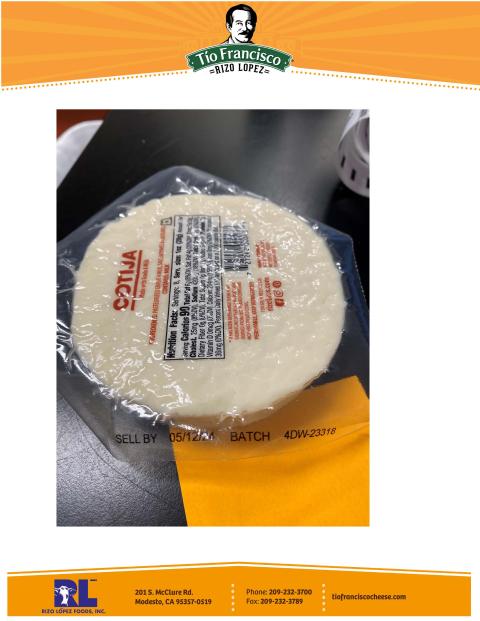
Rizo Lopez Foods, Inc. of Modesto, CA is recalling a total of 344 cases of Aged Cotija Mexican Grating Cheese (8oz), UPC 72724200043 batch number 4DW-23318 because it has the potential to be contaminated with Listeria monocytogenes, an organism which can cause serious and sometimes fatal infections in young children, frail or elderly people, and others with weakened immune systems. Although healthy individuals may suffer only short-term symptoms such as high fever, severe headache, stiffness, nausea, abdominal pain and diarrhea, Listeria infection can cause miscarriage and stillbirths among pregnant women.
Aged Cotija Mexican Grating Cheese (8oz) was distributed nationwide through distributors.
The product comes in a small 8oz. “puck” shape wrapped in clear plastic marked with red and black lettering on the botom noted as “Cotija, made with Grade A Milk” along with an ingredient description. Nutritional facts are noted in black below the ingredient description. The top shows “Cotija Aged Mexican Grating Cheese” with orange background. Batch number is identified on the outer edge of the clear plastic with “SELL BY 05/12/24 BATCH 4DW-23318” in black lettering.
To date, no confirmed illnesses related to this product have been reported.
The recall was a result of a routine sampling program by the Hawaii State Department of Health’s Food and Drug Branch on Wednesday, January 3rd which revealed that the finished product contained the bacteria. Rizo Lopez Foods, Inc. has ceased the producon and distribution of the product as the FDA and Rizo Lopez Foods continue their investigation as to what caused the issue.
Consumers who have purchased Aged Cotija Mexican Grating Cheese (8oz). are urged to quarantine the product and destroy it. Consumers with questions may contact the company at 1-800-626-5587, Monday through Friday, 8:00am-5:00pm Pacific Standard Time.
Product category
Food
Product subcategory
Milk and dairy products
Product brand name
FRUIT COUNT
Model names or references
FRUIT COUNT
Product identification
GTIN Batch Date
36122022 36122022 Use-by date 01/17/2024
Products List
Scan.pdfAttachment
Packaging
cheese by cut 250 -500 grs or kilo
Start/end date of marketing
From 12/27/2023 to 01/03/2024
Storage temperature
Product to keep in the refrigerator
Geographical sales area
Whole France
Distributors
FRUITIERE IN COMTE EURL LA SAINT CHRISTOPHE 1 GRANDE RUE 39130 CLAIRVAUX LES LACS
List of points of sale
DISTRIBUTOR.pdf
CHICAGO, Illinois – January 11, 2024 – The Quaker Oats Company today announced an expansion of the December 15, 2023, recall to include additional cereals, bars and snacks listed below because they have the potential to be contaminated with Salmonella, an organism which can cause serious and sometimes fatal infections in young children, frail or elderly people, and others with weakened immune systems. Healthy persons infected with Salmonella often experience fever, diarrhea (which may be bloody), nausea, vomiting and abdominal pain. In rare circumstances, infection with Salmonella can result in the organism getting into the bloodstream and producing more severe illnesses such as arterial infections (i.e., infected aneurysms), endocarditis and arthritis.
The products listed in the link above are sold throughout the 50 United States, Puerto Rico, Guam and Saipan. Consumers should check their pantries for any of the products listed below and dispose of them. Additionally, consumers with any product noted below can contact Quaker Consumer Relations (9 a.m. – 4:30 p.m. CST, Mon.-Fri.) at 1-800-492-9322 or visit www.QuakerRecallUSA.comExternal Link Disclaimer for additional information or product reimbursement.
This recall applies to the specific products listed below, in addition to the products announced on December 15, 2023. A combined list of recalled products is available on www.QuakerRecallUSA.comExternal Link Disclaimer.
Product category
Food
Product subcategory
Milk and dairy products
Product brand name
WITHOUT
Model names or references
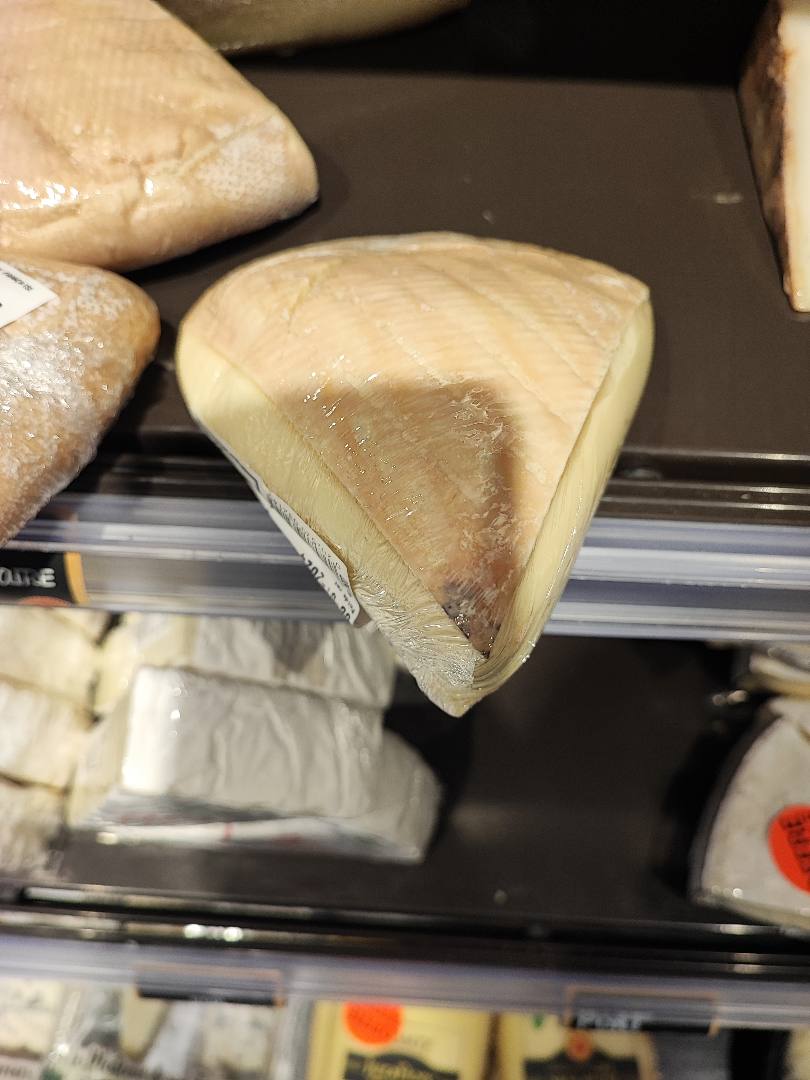
saint nectaire farmer with raw milk aop le buron
Product identification
Batch
01m250423c
Products List
20240111094510371.pdfAttachment
Packaging
sold in the fresh-packaged section
Start/end date of marketing
From 12/12/2023 to 01/05/2024
Storage temperature
Product to keep in the refrigerator
Geographical sales area
21610 FONTAINE-FRANCAISE
Distributors
INTERMARCHE FONTAINE-FRANCAISE




 FoodWorld