France – Recalls down but still more than 2,000 in France for 2023

Food Safety News

More than 2,000 consumer product recalls were issued in France in 2023, according to official figures.

Data from RappelConso shows 2,023 recalls in 2023 compared to 2,441 in 2022.

The category with the most recalls – 601 – was meats, followed by 371 milk and dairy product recalls and 189 fishery product recalls.

Taiwan – Food poisoning cases from Kaohsiung buffet rise to 46

Focus Taiwan

Kaohsiung, April 28 (CNA) The number of people who have sought medical attention for suspected food poisoning symptoms after dining at an upscale buffet restaurant in Kaohsiung on Friday has increased to 46, the city’s health authorities said Sunday.

Since Saturday, when 11 diners were reported to have fallen ill, another 35 people have come down with food poisoning symptoms, the Kaohsiung City Health Department said in press release.

The Department said Saturday it had sent food safety inspectors to the Hi-Lai Harbour (漢來海港) restaurant branch at Kaohsiung Arena, after being notified of the incident by a hospital where one of the diners was being treated.

At the restaurant in Zuoying District, the health inspectors collected 20 samples of food items and from its kitchen, including salads, oysters and sashimi, and they found signs of cross-contamination between raw and cooked foods, the department said.

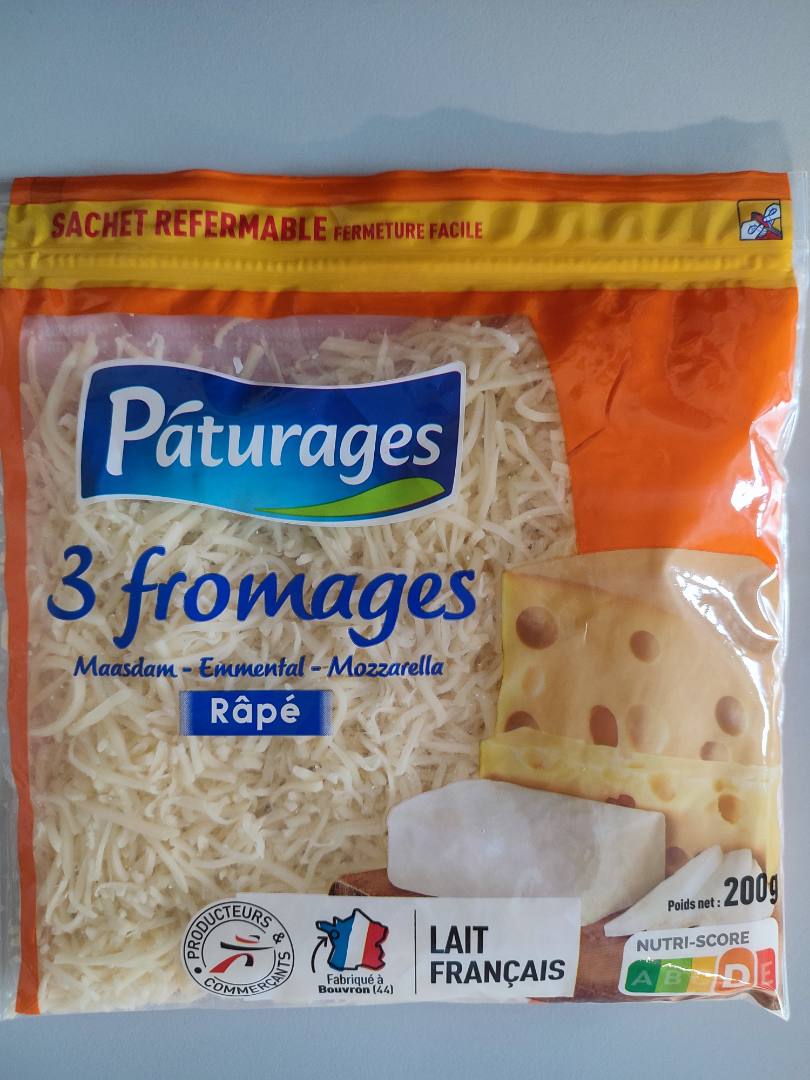
France – 3 cheeses Maasdam, Emmental, Grated Mozzarella 200g PASTURES – Listeria monocytogenes

Gov France

Product category
Food
Product subcategory
Milk and dairy products
Product brand name
PASTURES
Model names or references
3 cheeses Maasdam, Emmental, Grated Mozzarella 200g PASTURES
Product identification
GTIN Batch Date
3250391901746 108C (all times) Minimum durability date 06/28/2024
Packaging
200g
Start/end date of marketing
From 04/17/2024 to 04/24/2024
Storage temperature
Product to keep in the refrigerator
Health mark
FR 44.023.001 CE
Geographical sales area
Departments: AISNE (02), ARDENNES (08), AUBE (10), CALVADOS (14), CHARENTE (16), CHARENTE-MARITIME (17), CORREZE (19), COTE-D’OR (21), DORDOGNE ( 24), ILLE-ET-VILAINE (35), LOIRE-ATLANTIQUE (44), LOIRET (45), MAINE-ET-LOIRE (49), MANCHE (50), MARNE (51), HAUTE-MARNE (52), MAYENNE (53), MEURTHE-ET-MOSELLE (54), MEUSE (55), MOSELLE (57), NORD (59), OISE (60), ORNE (61), PAS-DE-CALAIS (62), BAS- RHIN (67), HAUTE-SAONE (70), SARTHE (72), PARIS (75), SEINE-ET-MARNE (77), DEUX-SEVRES (79), SOMME (80), VENDEE (85), VIENNE ( 86), HAUTE-VIENNE (87), VOSGES (88), YONNE (89), ESSONNE (91), HAUTS-DE-SEINE (92), VAL-DE-MARNE (94), VAL-D’OISE (95 )
Distributors
ITM

Denmark – 40 Danes infected with the same type of Salmonella

SSI

Since mid-March, 40 patients have been registered ill with the same type of salmonella. These are 24 men and 16 women aged 0-83. The first investigations show that the patients have not been travelling, have not eaten at the same restaurants and have not taken part in any joint events. As the patients live throughout the country, it therefore suggests that it is a food that has been sold in supermarkets across the country.

“We are working to find out what is to blame for the outbreak. Preliminary investigations indicate that the source of infection could be minced meat sold in supermarkets,” says epidemiologist Luise Müller, Statens Serum Institut.

Annette Perge from the Danish Food and Drug Administration elaborates:

“Although we do not yet know for sure what has made people sick with salmonella, we would like consumers to pay extra attention to good kitchen hygiene. It is important to cook the minced meat thoroughly, keep the ready-to-eat separate from the raw meat and refrain from tasting the raw meat,” she says.

All patients are infected with the same type of salmonella bacteria.

“Salmonella of the type Typhimurium has previously been found in meat from cattle and pigs as well as in foreign poultry products and has previously given rise to disease outbreaks,” says senior researcher Marianne Sandberg from the DTU Food Institute.

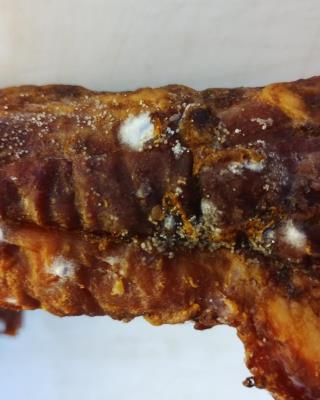
Czech Republic – Smoked ribs – Visible Mold/Mouldi

Potravinynapranyri

Illustrative photo #2

Place of inspection:
Pardubice ( Railway Regiment 2005, 530 02 Pardubice )
ID: 05457891
Invalid parameter:

fungi visible to the eye

There was white and green mold visible to the naked eye on the surface of the food. Food is not considered safe if it shows signs of spoilage.

Packaging: not packed
Quantity of the product in the package: 0.822 kg
Date of sample collection: 3/4/2024
Reference number: 24-000176-SZPI-CZ
The sample was detected by the official control of the State Agricultural and Food Inspection.

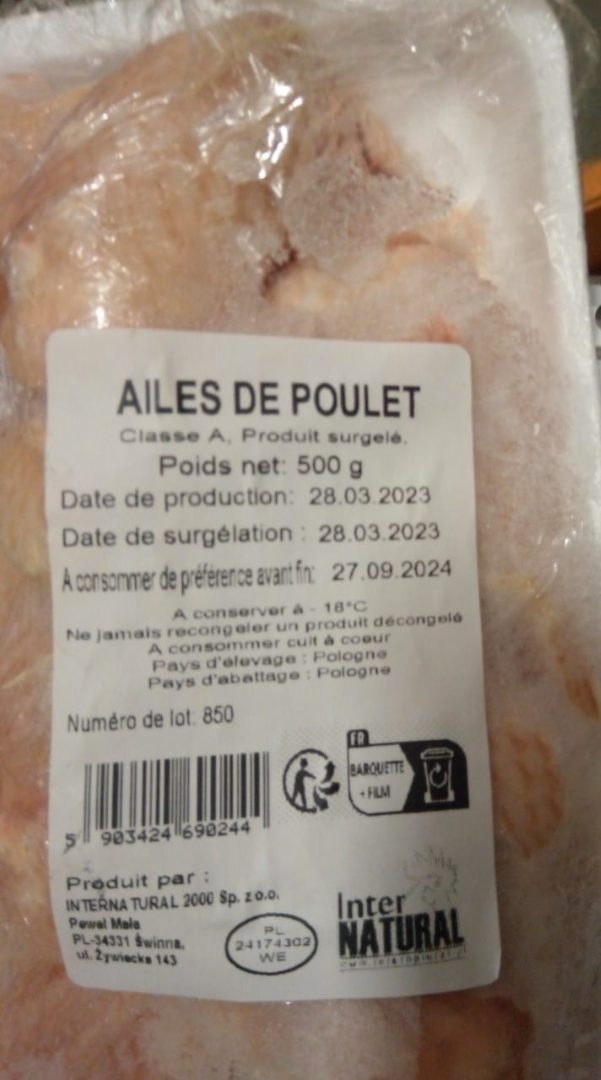
France – FROZEN CHICKEN WINGS – Salmonella

Gov France

Product category
Food
Product subcategory
Others
Product brand name
Inter NATURAL
Model names or references
CHICKEN WINGS – Class A Frozen product
Product identification
GTIN Batch Date
5903424690244 850 Minimum durability date 09/27/2024
Packaging
Filmed tray
Start/end date of marketing
From 05/17/2023 to 10/16/2023
Storage temperature
Product to keep in the freezer
Health mark
PL 24174302 WE
Geographical sales area
Departments: GUADELOUPE (971)
Distributors
Departmental supermarkets and commercial catering

UK – Shiga toxin-producing Escherichia coli (STEC) data: 2020 – Updated 26/04/2024

Gov UK

Main points

A total of 402 confirmed cases of Shiga toxin-producing Escherichia coli (STEC) O157 were reported in England and Wales in 2020.

The lowest incidence of STEC O157 was in the London region (0.29 per 100,000 population) and the highest in the South West region (1.04 per 100,000 population).

Children aged 5 to 9 years had the highest incidence of infection (1.50 per 100,000 population, 95% confidence interval (CI) 1.12 to 1.96).

One-third of confirmed STEC O157 cases in England were hospitalised and 3% were reported to have developed Haemolytic Uraemic Syndrome (HUS).

A further 286 specimens in England and 41 in Wales were positive for Shiga toxins (Stx) genes on polymerase chain reaction (PCR) at the Gastrointestinal Bacteria Reference Unit (GBRU) but an organism was not cultured.

The most commonly isolated non-O157 STEC serogroup was STEC O26 (England: n=103 out of 553, 19%; and Wales: n=26 out of 268, 15%).

Three outbreaks of STEC involving 63 cases in England were investigated in 2020.

Saudi Arabia – Food poisoning cases rise to 35 in Riyadh restaurant incident

Saudi Gazette

Dr. Mohammed Al-Abdali, spokesperson for the Ministry of Health, announced that the number of food poisoning cases linked to a specific restaurant in Riyadh has increased to 35.

Of these, 27 cases are currently receiving intensive care, while 6 individuals have recovered and two have been discharged after necessary medical treatment.

The Ministry has taken measures to prevent further incidents by collaborating with relevant authorities to conduct thorough epidemiological investigations. This proactive approach aims to minimize risks and ensure rapid response to any similar future events.

Riyadh Municipality took immediate action by closing the implicated restaurant as well as its branches and central laboratory for further investigations to ascertain the cause of the outbreak. These closures are part of a comprehensive set of precautions aimed at safeguarding public health.

Canada – 96 lab-confirmed cases linked to E. coli at Calgary day cares, 22 kids in hospital: AHS

Yahoo Movies

There are now 96 lab-confirmed cases linked to the current E. coli outbreak in Calgary daycare centres, the AHS confirmed in a press conference Wednesday.

Dr. Francesco Rizzuti, medical officer of health with AHS Calgary zone said that of the 96 cases there have been 22 hospitalizations thus far.

Sixteen of those patients are currently at the Alberta Children’s Hospital, while six are at the Peter Lougheed Centre. AHS confirmed that all of those hospitalized are children.

The first patients were admitted over the Labour Day weekend, reporting symptoms such as bloody diarrhea.
He added that AHS is still investigating the source of this outbreak and will continue to update families as information becomes available.

USA – SAN DIEGO COUNTY HIT BY NOROVIRUS OUTBREAK LINKED TO SOUTH KOREAN OYSTERS

Hood Line

A shellfish shakedown is sweeping through San Diego County after 33 people fell ill, contracting norovirus likely linked to frozen raw oysters imported from a company in South Korea, health officials said.

The California Department of Public Health (CDPH) is sounding the alarm, telling distributors and retailers to halt sales and service of frozen raw oysters from JBR, Inc., located in Tongyeongsi, Republic of Korea; these shellfish are suspected culprits behind a string of gastroenteritis cases among eaters in late March and April. These specific oysters arrived bearing the label “Amazing Sea Brand.” They have been traced back to being harvested on several dates—November 26, 2023, January 4, and February 15—and San Diego County public health officials, alongside the CDPH’s investigation, pointed to these as the likely source of the virus transmission, according to a statement obtained by the California Department of Public Health.