Category Archives: Vibrio

RASFF Alerts- Vibrio cholerae – Shrimp

RASFF

Vibrio cholerae in frozen shrimps from Ecuador in Bulgaria

RASFF

Vibrio cholerae in shrimps from Ecuador in Spain

RASFF Alerts- Vibrio Cholerae – Shrimps from Ecuador

RASFF

Vibrio cholera in frozen shrimps from Ecuador in Spain

RASFF

Vibrio cholera in frozen shrimps from Ecuador in Spain

RASFF

Detection of Vibrio cholerae in shrimps from Ecuador in Spain

RASFF

Vibrio cholerae in frozen shrimps from Ecuador in Spain

RASFF

Vibrio cholerae in shrimps from Ecuador in Spain

USA – DPH warns residents about severe Vibrio infections caused by consumption of raw shellfish or exposure to salt or brackish water

CT Portal

The Connecticut Department of Public Health (DPH) is warning residents about the potential dangers of consuming raw shellfish and exposure to salt or brackish water along Long Island Sound, due to severe Vibrio vulnificus infections.

 Since July 1, three cases of V. vulnificus infections have been reported to DPH. The three patients are between 60-80 years of age. All three patients were hospitalized and one died.  One patient reported consuming raw oysters from an out-of-state establishment. Two patients reported exposure to salt or brackish water in Long Island Sound. Both patients had pre-existing open cuts or wounds or sustained new wounds during these activities which likely led to the infections. 

 “The identification of these severe cases, including one fatality, due to V. vulnificus is concerning,” said DPH Commissioner Manisha Juthani, MD. “People should consider the potential risk of consuming raw oysters and exposure to salt or brackish water and take appropriate precautions. Particularly during the hottest months of the summer, bacteria are more likely to overgrow and contaminate raw shellfish. Given our current heat wave, this may be a time to exercise particular caution in what you consume.”

RASFF Alerts – Vibrio cholerae – Pacific White Shrimps – Shrimps

RASFF

Vibrio cholerae in Pacific white shrimps from Ecuador in Spain

RASFF

Microbiological contamination (Vibrio cholerae), frozen shrimps, Ecuador in Spain

RASFF

Microbiological contamination (Vibrio cholerae), frozen shrimps, Ecuador in Spain

RASFF Alert- Vibrio cholerae – Shrimps

RASFF

Vibrio cholerae in shrimps from Ecuador in Romania

RASFF

Vibrio cholerae in shrimps from Ecuador in Romania

Research USA – FoodNet 2022 Preliminary Data

CDC

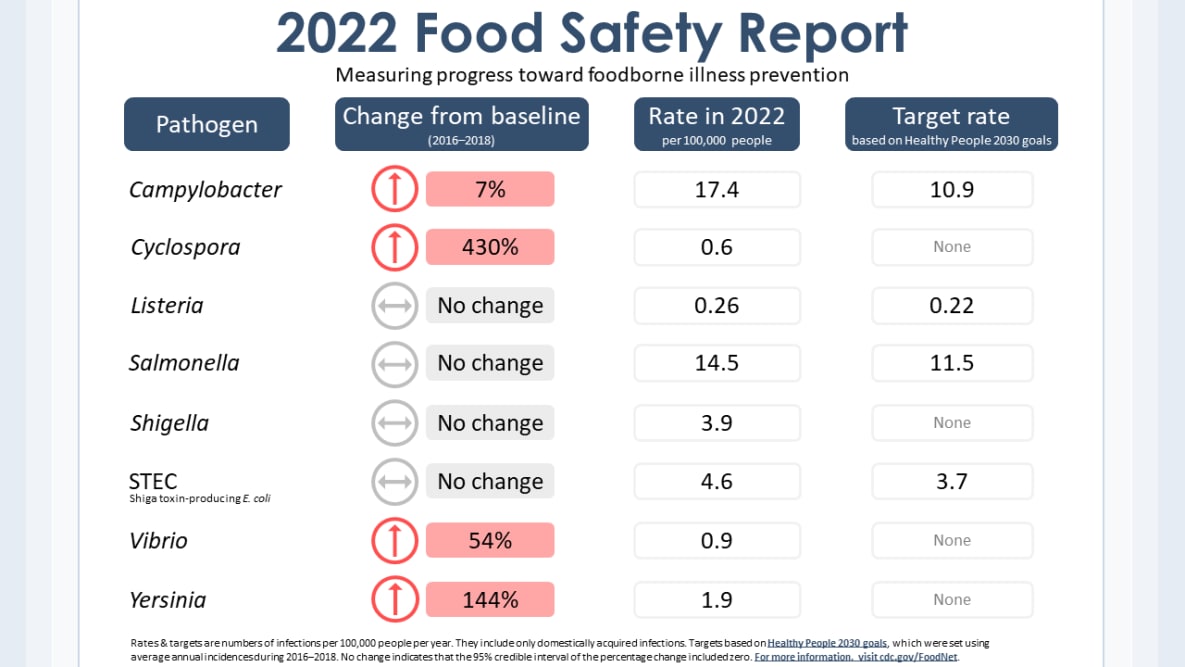
Graphic showing progress in 2022 toward foodborne illness prevention, with changes from the 2016–2018 baseline, rates in 2022, and target rates based on Healthy People 2030 goals. Rates increased for Campylobacter, Cyclospora, Vibrio, and Yersinia and did not change for Listeria, Salmonella, Shigella, and Shiga toxin-producing E. coli. Rates for Campylobacter, Listeria, Salmonella, and Shiga toxin-producing E. coli are all higher than their established target rates.

This year’s report summarizes 2022 preliminary surveillance data. It describes 2022 incidence compared with the average incidence for 2016–2018, the reference period used for the U.S. Department of Health and Human Services (HHS) Healthy People 2030 goals. The report also summarizes cases of hemolytic uremic syndrome (HUS) during 2021.

  • In 2022, enteric (intestinal) infections monitored by FoodNet generally returned to or exceeded levels observed in 2016–2018 (before the COVID-19 pandemic).
    • Incidence of CampylobacterListeriaSalmonella, and Shigella infections did not change in 2022 compared with 2016–2018.
    • Incidence of Cyclospora, STEC, Vibrio, and Yersinia infections increased in 2022 compared with 2016–2018.
  • Campylobacter and Salmonella remain the top causes of enteric infections monitored by FoodNet.
  • Increased use of CIDTs contributed to the increased detection of infections.
  • FoodNet data show lack of progress during 2022 toward Healthy People 2030 goals for reducing foodborne illness. Concerted efforts are needed to implement effective prevention strategies to reduce disease burden.

RASFF Alert- Vibrio vulnificus – Frozen Prawns from Ecuador

RASFF

Presence of vibrio vulnificus in frozen prawns of Ecuador in Italy

USA – Preliminary Incidence and Trends of Infections Caused by Pathogens Transmitted Commonly Through Food — Foodborne Diseases Active Surveillance Network, 10 U.S. Sites, 2022

CDC

The figure is a photo of a worker in a produce section with information about foodborne illnesses.

Summary

What is already known about this topic?

Campylobacter and Salmonella are the leading causes of bacterial enteric infections transmitted commonly by food. Reported incidence of enteric infections was lower during the COVID-19 pandemic (2020–2021) compared with previous years.

What is added by this report?

During 2022, FoodNet identified higher incidences of Shiga toxin-producing Escherichia coliYersiniaVibrio, and Cyclospora infections compared with 2016–2018. Campylobacter, Salmonella, Shigella, and Listeria incidences did not change.

What are the implications for public health practice?

Progress in reducing enteric infection incidence was not observed during 2022, as influences of the COVID-19 pandemic subsided. Collaboration among food growers, processors, retail stores, restaurants, and regulators is needed to reduce pathogen contamination during poultry slaughter and to prevent contamination of leafy greens.

USA – Man dies after contracting flesh-eating bacteria from raw oysters – Vibrio vulnificus

National Post

A Missouri man died after contracting a flesh-eating bacteria from eating raw oysters from a seafood stand, U.S. health officials said.

The 54-year-old man, whom authorities have not publicly identified, became infected after he ate oysters bought from The Fruit Stand & Seafood in Manchester, Mo., the St. Louis County Public Health Department said last week.

He died after being infected with the bacteria Vibrio vulnificus, which is contracted by consuming raw or undercooked oysters and other shellfish.

Research – Antibacterial Activity against Four Fish Pathogenic Bacteria of Twelve Microalgae Species Isolated from Lagoons in Western Greece

MDPI

Abstract

Microalgae may produce a range of high-value bioactive substances, making them a promising resource for various applications. In this study, the antibacterial activity of twelve microalgae species isolated from lagoons in western Greece was examined against four fish pathogenic bacteria (Vibrio anguillarumAeromonas veroniiVibrio alginolyticus, and Vibrio harveyi). Two experimental approaches were used to evaluate the inhibitory effect of microalgae on pathogenic bacteria. The first approach used bacteria-free microalgae cultures, whereas the second approach used filter-sterilized supernatant from centrifuged microalgae cultures. The results demonstrated that all microalgae had inhibitory effects against pathogenic bacteria in the first approach, particularly 4 days after inoculation, where Asteromonas gracilis and Tetraselmis sp. (red var., Pappas) exhibited the highest inhibitory activity, reducing bacterial growth by 1 to 3 log units. In the second approach, Tetraselmis sp. (red var., Pappas) showed significant inhibition against V. alginolyticus between 4 and 25 h after inoculation. Moreover, all tested cyanobacteria exhibited inhibitory activity against V. alginolyticus between 21 and 48 h after inoculation. Statistical analysis was performed using the independent samples t-test. These findings suggested that microalgae produce compounds with antibacterial activity, which could be useful in aquaculture.