Category Archives: Uncategorized

Research – Behavior of 11 Foodborne Bacteria on Whole and Cut Mangoes var. Ataulfo and Kent and Antibacterial Activities of Hibiscus sabdariffa Extracts and Chemical Sanitizers Directly onto Mangoes Contaminated with Foodborne Bacteria

Journal of Food Protection

The behavior of foodborne bacteria on whole and cut mangoes and the antibacterial effect of Hibiscus sabdariffa calyx extracts and chemical sanitizers against foodborne bacteria on contaminated mangoes were investigated. Mangoes var. Ataulfo and Kent were used in the study. Mangoes were inoculated with Listeria monocytogenes, Shigella flexneri, Salmonella Typhimurium, Salmonella Typhi, Salmonella Montevideo, Escherichia coli strains (O157:H7, non-O157:H7 Shiga toxin–producing, enteropathogenic, enterotoxigenic, enteroinvasive, and enteroaggregative). The antibacterial effect of five roselle calyx extracts (water, ethanol, methanol, acetone, and ethyl acetate), sodium hypochlorite, colloidal silver, and acetic acid against foodborne bacteria were evaluated on contaminated mangoes. The dry extracts obtained with ethanol, methanol, acetone, and ethyl acetate were analyzed by nuclear magnetic resonance spectroscopy to determine solvent residues. Separately, contaminated whole mangoes were immersed in five hibiscus extracts and in sanitizers for 5 min. All foodborne bacteria attached to mangoes. After 20 days at 25 ± 2°C, all foodborne bacterial strains on whole Ataulfo mangoes had decreased by approximately 2.5 log, and on Kent mangoes by approximately 2 log; at 3 ± 2°C, they had decreased to approximately 1.9 and 1.5 log, respectively, on Ataulfo and Kent. All foodborne bacterial strains grew on cut mangoes at 25 ± 2°C; however, at 3 ± 2°C, bacterial growth was inhibited. Residual solvents were not detected in any of the dry extracts by nuclear magnetic resonance. Acetonic, ethanolic, and methanolic roselle calyx extracts caused a greater reduction in concentration (2 to 2.6 log CFU/g) of all foodborne bacteria on contaminated whole mangoes than the sodium hypochlorite, colloidal silver, and acetic acid. Dry roselle calyx extracts may be a potentially useful addition to disinfection procedures of mangoes.

Research – Notes from the Field: Investigation of an Outbreak of Salmonella Paratyphi B Variant L(+) tartrate + (Java) Associated with Ball Python Exposure — United States, 2017

CDC  


In July 2017, PulseNet, the national molecular subtyping network for foodborne disease surveillance, identified a cluster of five Salmonella Paratyphi B variant L(+) tartrate + (Java) clinical isolates that were indistinguishable by pulsed-field gel electrophoresis (PFGE). Initial questionnaires administered by state and local health department investigators indicated animal exposure as a possible source of infection, with all five patients reporting snake exposure. An outbreak investigation was initiated to identify the source of infection.

A case was defined as isolation of Salmonella Paratyphi B variant L(+) tartrate + (Java) from June 17, 2017, to July 23, 2017, with a PFGE enzyme pattern indistinguishable from the outbreak strain. A snake-specific questionnaire regarding snake type, snake purchase location, and reptile food, including feeder rodents, was developed and administered to patients by state and local health department investigators. In addition, animal and environmental sampling was conducted at patient residences. Traceback of patients’ snakes was conducted by contacting snake purchase locations to identify common suppliers. Finally, whole genome sequencing (WGS) was performed on clinical, environmental, animal, and pet food isolates to further characterize their genetic relatedness, measured in single nucleotide polymorphism (SNP) differences (1).

Five cases were identified in four states: one each in Arizona, Oklahoma, and Oregon, and two in Indiana from different households with no epidemiologic link. Median patient age was 10 years (range = <1–40 years), and four were female. No patient was hospitalized, and no deaths occurred. Five patients or their proxies completed the snake-specific questionnaire, four of whom reported exposure to a ball python in the residence. Ball python sampling occurred in the Arizona, Oregon, and one of the Indiana patient residences by sampling the python cloaca, environment, water, and bedding. Feeder rodent sampling occurred in the Arizona and Indiana patient residences. No common suppliers of either ball pythons or feeder rodents were identified by traceback.

Research – Microbiological survey of field‐grown and retail lettuce in Beijing

Wiley Online Eurofins Food Testing UK

Abstract

About 108 retail and 101 field‐grown lettuce samples from across Beijing were examined. These samples were analyzed for their aerobic plate counts, coliform counts, fecal flora counts, and presence of pathogenic bacteria. Samples included retail leaf (n = 56), retail head (n = 52), field‐grown leaf (n = 54), and field‐grown head lettuce (n = 47). The number of aerobic colonies of retail leaf lettuce was significantly higher than that of retail head lettuce throughout the year, with the exception of December. The means of retail leaf lettuce aerobic plate counts varied from 4.87 to 7.03 log10 cfu/g. For retail head lettuce, the mean count of aerobic microbiological populations varied from 4.33 to 6.33 log10 cfu/g. The aerobic microbiological populations of field‐grown lettuce were lower than those of retail lettuce in the same month. The mean count of field‐grown head lettuce was 5.53 log10 cfu/g. The mean count of retail head lettuce was 5.92 log10 cfu/g. The mean of the coliform counts ranged from <0.47 to 2.85 log10cfu/g. Leaf and retail lettuce had significantly higher coliform, fecal flora, and Escherichia coli counts than head and field‐grown lettuce. The detection rate of E. coli was directly proportional to that of fecal flora. No E. coli O157:H7 or Salmonella spp. were detected in these lettuce samples.

Practical applications

It is generally agreed that microbial contamination of lettuce will arise if there is improper operation in the process of its storage, transportation, and shelves sale. As lettuce is usually eaten raw, microbes can cause people to suffer from illnesses. Therefore, it is of critical importance to monitor the presence of microbes closely. In this study, the number of aerobic plate count in lettuce from different sources was examined. It was found that freshly picked lettuce had fewer microorganisms than retail lettuce had; lettuce harvested in low‐temperature seasons has fewer microorganisms than that in hot seasons. The suggestion is that cold chain transport is the best way for lettuce transportation, especially in summer and aseptic packaging is helpful to reduce contact pollution.

Research- Occurrence of Toxigenic Fungi and Mycotoxins on Root Herbs from Chinese Markets

Journal of Food Protection Aspergillus

Herbs derived from roots, leaves, flowers, or fruits of plants are unavoidably contaminated with fungi and mycotoxins during growth, harvest, and storage, thereby posing a health threat to humans. Especially, root herbs (RHs) are more easily contaminated with fungi and mycotoxins because the roots are in direct contact with the soil. Here, we investigated the occurrence of fungi, aflatoxins (AFs), and ochratoxin A (OTA) in eight RHs that are used as medicines, beverages, dietary supplements, and functional foods in China and other countries. Morphological observation and MultiGeneBlast (β-tubulin and calmodulin) were used to identify the potentially toxigenic fungi. Of the 48 samples tested, all were contaminated by fungi, and 1,844 isolates belonging to 25 genera were detected. The genera Aspergillus and Penicillium, which contain potentially toxigenic fungal species, represented a frequency of 10 and 25%, respectively. Thirty-three isolates of Aspergillus flavus, Aspergillus parasiticus, Aspergillus niger, and Penicillium polonicum were arbitrarily selected for analysis of their toxigenic potential. Five of 13 isolates of A. flavus and 1 isolate of A. parasiticus produced AFs, whereas OTA production was not detected for any of the isolates of A. niger and P. polonicum. The occurrence of AFs and OTA in the 48 samples of eight RHs was tested by ultraperformance liquid chromatography–tandem mass spectrometry; 37.50% of samples from six RHs were contaminated with AFs and 16.67% of samples from four RHs were contaminated with OTA. Seven (14.58%) and four (8.33%) samples of ginseng, polygala, and liquorice exceeded the permissible limits of aflatoxin B1 and AFs, respectively. Because ginseng, polygala, and liquorice are widely used as herbs, dietary supplements, and functional foods, the high frequency of AF contamination of these herbs indicated by our current study warrant attention to raise public awareness.

Reasearch – Viable-but-Nonculturable Listeria monocytogenes and Salmonella enterica Serovar Thompson Induced by Chlorine Stress Remain Infectious

mbioasm 

ABSTRACT

The microbiological safety of fresh produce is monitored almost exclusively by culture-based detection methods. However, bacterial food-borne pathogens are known to enter a viable-but-nonculturable (VBNC) state in response to environmental stresses such as chlorine, which is commonly used for fresh produce decontamination. Here, complete VBNC induction of green fluorescent protein-tagged Listeria monocytogenes and Salmonella enterica serovar Thompson was achieved by exposure to 12 and 3 ppm chlorine, respectively. The pathogens were subjected to chlorine washing following incubation on spinach leaves. Culture data revealed that total viable L. monocytogenes and Salmonella Thompson populations became VBNC by 50 and 100 ppm chlorine, respectively, while enumeration by direct viable counting found that chlorine caused a <1-log reduction in viability. The pathogenicity of chlorine-induced VBNC L. monocytogenes and Salmonella Thompson was assessed by using Caenorhabditis elegans. Ingestion of VBNC pathogens by C. elegans resulted in a significant life span reduction (P = 0.0064 and P < 0.0001), and no significant difference between the life span reductions caused by the VBNC and culturable L. monocytogenes treatments was observed. L. monocytogenes was visualized beyond the nematode intestinal lumen, indicating resuscitation and cell invasion. These data emphasize the risk that VBNC food-borne pathogens could pose to public health should they continue to go undetected.

IMPORTANCE Many bacteria are known to enter a viable-but-nonculturable (VBNC) state in response to environmental stresses. VBNC cells cannot be detected by standard laboratory culture techniques, presenting a problem for the food industry, which uses these techniques to detect pathogen contaminants. This study found that chlorine, a sanitizer commonly used for fresh produce, induces a VBNC state in the food-borne pathogens Listeria monocytogenes and Salmonella enterica. It was also found that chlorine is ineffective at killing total populations of the pathogens. A life span reduction was observed in Caenorhabditis elegans that ingested these VBNC pathogens, with VBNC L. monocytogenes as infectious as its culturable counterpart. These data show that VBNC food-borne pathogens can both be generated and avoid detection by industrial practices while potentially retaining the ability to cause disease.

Research – Thermal Inactivation of Shiga Toxin–Producing Escherichia coli in Ground Beef with Varying Fat Content

Journal of Food Protection

Decimal reduction time (D-value) was calculated for six non-O157 Shiga toxin–producing Escherichia coli (STEC) in a laboratory medium and ground beef. For the laboratory medium, an overnight culture of each strain of STEC was divided into 10-mL sample bags and heated in a water bath for a specific time on the basis of the temperatures. Survival curves were generated by plotting the surviving bacterial population against time, and a linear-log primary model was used to estimate the D-values from survival curves. The z-values (the temperature raised to reduce the D-value by one-tenth) were calculated by plotting the log D-values against temperature. Similarly, for ground beef, six fat contents, 5, 10, 15, 20, 25, and 30% of ground beef were formulated for this study. Inoculated meat was divided into 5-g pouches and submerged in a water bath set at specific temperatures (55, 60, 65, 68, and 71.1°C). The average D-value for these strains in a laboratory medium was 17.96 min at 55°C, which reduced significantly (P < 0.05) to 1.58 min at 60°C, and then further reduced (P < 0.05) to 0.46 min at 65°C. In ground beef, a negative correlation (P < 0.05) between fat content of ground beef and D-values was observed at 55°C. However, at temperatures greater than 60°C, there was no impact (P > 0.05) of fat content of ground beef on the thermal resistance of non-O157 STECs. Irrespective of the fat content of ground beef, the D-values ranged from 15.93 to 11.69, 1.15 to 1.12, and 0.14 to 0.09 min and 0.05 at 55, 60, 65, and 68°C, respectively. The data generated from this study can be helpful for the meat industry to develop predictive models for thermal inactivation of non-O157 STECs in ground beef with varying fat content.

Research – Inactivation of Escherichia coli by Ultrasound Combined with Nisin

Journal of Food Protection ecoli

The aim of this study was to investigate the inactivation of nonpathogenic Escherichia coli in nutrient broth and milk through the use of either ultrasound (US) alone or US combined with nisin (US + nisin) treatments. The E. coli cells were treated at 0 to 55°C, 242.04 to 968.16 W/cm2 for 0 to 15 min. The results showed that the inactivation of E. coli by US and US + nisin increased when the temperature, US power density, and treatment time were increased. The inactivation kinetics of E. coli in nutrient broth by US and US + nisin both conformed to linear models. The largest reductions of 2.89 and 2.93 log cycles by US and US + nisin, respectively, were achieved at 968.16 W/cm2 and at 25°C for 15 min. The suspension media of the E. coli cells influenced the inactivation effect of US, while the growth phases of E. coli cells did not affect their resistance to US. Under all experiment conditions of this study, the differences between US and US + nisin in their respective inactivation effects on E. coli were not obvious. The results suggested that nisin had either no effect at all or a weak synergistic effect with US and that the E. coli cells were inactivated mainly by US, thus indicating that the inactivation of E. coli by US is an “all or nothing” event.

Research – Response surface modeling for the inactivation of Bacillus cereus on cooked spinach by natural antimicrobials at various temperatures

Wiley Online Library

Abstract

This study was conducted to investigate the growth of Bacillus cereus on cooked spinach with natural antimicrobial substances (0.00–0.02% thymol, 0.60–1.30% acetic acid, and 0.00–0.05% nisin) at various temperatures (15, 25, and 35°C) in order to find the best combination of inhibition. Response surface modeling with the Gompertz model equation was used to describe the growth of B. cereus vegetative cells on cooked spinach with natural antimicrobial substances as a function of temperature. The specific growth rate of B. cereus at the highest concentration of thymol (0.02%) was lower than with the other treatments. In particular, the lag time of B. cereus was the longest for combinations thymol 0.02%, acetic acid 0.68%, and nisin 0.03% at 25°C. The predicted values were shown to be significantly in good agreement with experimental values because the adjusted determination coefficient ( urn:x-wiley:01496085:media:jfs12484:jfs12484-math-0001) was 0.91 and the level of significance was p < .0001. Besides, bias factor (Bf) values of the SGR and LT for B. cereus were 1.07 and 1.10, respectively, indicating that they were mostly at the acceptable level. In sensory evaluation, appearance and color of cooked spinach with antimicrobial substances was similar to the control.
Practical applications

Natural antimicrobials could be used as the preservation method to improve the food safety of cooked foods such as cooked vegetables.

Research – Good practices and microbiological quality of food contact surfaces in public school kitchens

Wiley Online

Abstract

The objective of this work was to analyze the hygienic and sanitary conditions of 52 school kitchens and to investigate the microbiological contamination of surfaces that contact food. A specific checklist was used to classify the units’ health risk. Microbiological samples were collected from utensils, bench, and equipment in 10 units to evaluate the contamination levels of these surfaces. In total, 3.8% of the evaluated units had a very low health risk, and 61.5% had a low sanitary risk, indicating that most of the sites were adequately sanitary. Important failures have been identified in the block of buildings and facilities. Inadequacies related to hand hygiene, the absence of the manual of good practices and environmental hygiene were also highlighted. Microbiological analyses resulted in high counts of aerobic mesophiles and enterobacteria. Intervention with the involvement of all the actors of the National School Feeding Program is suggested for improving the situation.

Practical applications

This study is important, since it carried out the survey of the information regarding the adoption of good practices and sanitary conditions in the food production in the school environment, considering the relevance of the subject and vulnerability of the attended public. In this way, such information may guide corrective and preventive actions in the face of observed situations.

Research – Cryptosporidium, Pseudomonas and Legionella responsible for most outbreaks in swimming venues including hotel swimming pools

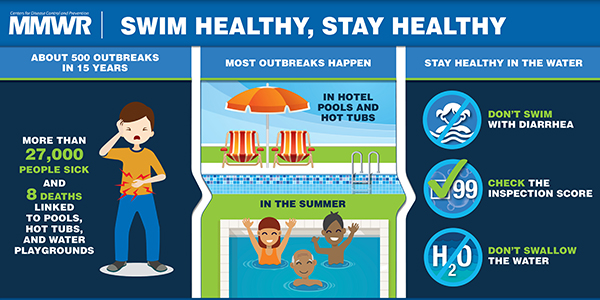
The figure is a visual abstract that details illnesses associated with recreational water and recommends how to stay healthy when swimming.

CDC-Outbreaks Associated with Treated Recreational Water — United States, 2000–2014

Outbreaks associated with exposure to treated recreational water can be caused by pathogens or chemicals in venues such as pools, hot tubs/spas, and interactive water play venues (i.e., water playgrounds). During 2000–2014, public health officials from 46 states and Puerto Rico reported 493 outbreaks associated with treated recreational water. These outbreaks resulted in at least 27,219 cases and eight deaths. Among the 363 outbreaks with a confirmed infectious etiology, 212 (58%) were caused by Cryptosporidium (which causes predominantly gastrointestinal illness), 57 (16%) by Legionella (which causes Legionnaires’ disease, a severe pneumonia, and Pontiac fever, a milder illness with flu-like symptoms), and 47 (13%) by Pseudomonas (which causes folliculitis [“hot tub rash”] and otitis externa [“swimmers’ ear”]). Investigations of the 363 outbreaks identified 24,453 cases; 21,766 (89%) were caused by Cryptosporidium, 920 (4%) by Pseudomonas, and 624 (3%) by Legionella. At least six of the eight reported deaths occurred in persons affected by outbreaks caused by Legionella. Hotels were the leading setting, associated with 157 (32%) of the 493 outbreaks. Overall, the outbreaks had a bimodal temporal distribution: 275 (56%) outbreaks started during June–August and 46 (9%) in March. Assessment of trends in the annual counts of outbreaks caused by Cryptosporidium, Legionella, or Pseudomonas indicate mixed progress in preventing transmission. Pathogens able to evade chlorine inactivation have become leading outbreak etiologies. The consequent outbreak and case counts and mortality underscore the utility of CDC’s Model Aquatic Health Code (https://www.cdc.gov/mahc) to prevent outbreaks associated with treated recreational water.

Hlavsa MC, Cikesh BL, Roberts VA, et al. Outbreaks Associated with Treated Recreational Water — United States, 2000–2014. MMWR Morb Mortal Wkly Rep 2018;67:547–551. DOI: http://dx.doi.org/10.15585/mmwr.mm6719a3