Category Archives: Uncategorized

USA -Central Valley Meat Co., Inc. Recalls Ground Beef Products Due to Possible Salmonella Dublin Contamination

FSIS

EDITOR’S NOTE: FSIS and our public health partners, including the Centers for Disease Control and Prevention (CDC) and state public health officials, are investigating a Salmonella Dublin outbreak. Please note that FSIS is continuing to investigate illnesses associated with this outbreak and their sources and additional product may be recalled.

WASHINGTON, Nov. 15, 2019 – Central Valley Meat Co., Inc., a Hanford, Calif. establishment, is recalling approximately 34,222 pounds of ground beef products that may be contaminated with Salmonella Dublin, the U.S. Department of Agriculture’s Food Safety and Inspection Service (FSIS) announced today.

The ground beef items were produced on July 23, 2019. The following products are subject to recall: [View Labels (PDF only)]

  • 1-lb. chub packages of “STATER BROS. 100% PURE GROUND BEEF 96% LEAN 4% FAT” with lot 2049 on the retail label; lot 19204 on the case label; and Use By 08-14-19.
  • 2-lb. chub packages of “STATER BROS. 100% PURE GROUND BEEF 93% LEAN 7% FAT” with lot 2049 on the retail label; lot 19204 on the case label; and Use By 08-14-19.
  • 20-lb. cases containing “STATER BROS 93/7 Ground Beef 10# Chub 10 Lb. Chubs/ 2 Count” with lot 19204 on the case label and Use By 08-14-19.

The products subject to recall bear establishment number “EST. 6063A” printed on the retail labels next to the lot number and inside the USDA mark of inspection on the case labels. These items were shipped to retail locations in California.
Canada – Food Recall Warning – Farm Boy brand cheese balls recalled due to Listeria monocytogenes

CFIA

Ottawa, November 17, 2019 – Farm Boy is recalling Farm Boy brand cheese balls from the marketplace due to possible Listeria monocytogenes contamination. Consumers should not consume the recalled products described below.

Recalled product

Brand Product Size UPC Codes
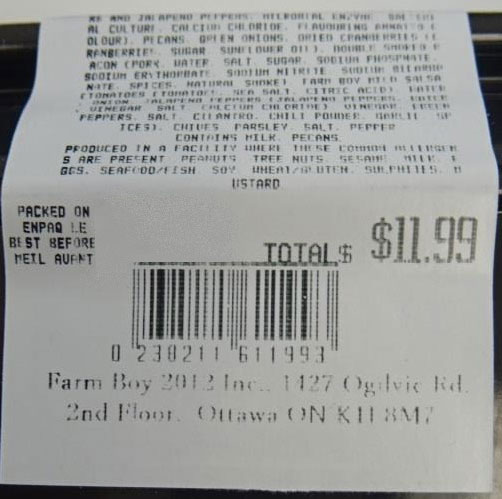
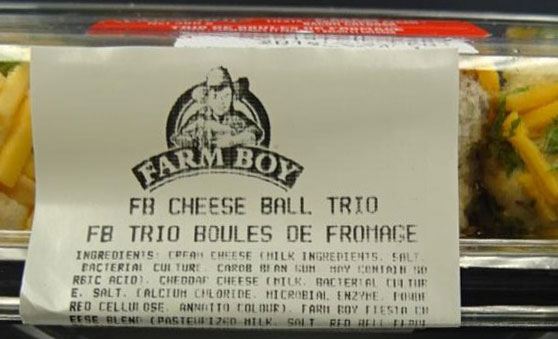
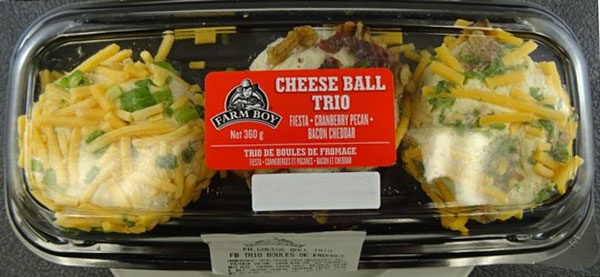
Farm Boy Cheese Ball Trio – Fiesta, Cranberry Pecan, Bacon Cheddar and/or “FB Cheese Ball Trio” 360 g Starting with 0 238211 All units sold up to and including November 17, 2019
Farm Boy “FB Blue Cheese & Walnut Ball” 180 g Starting with 0 238274 All units sold up to and including November 17, 2019
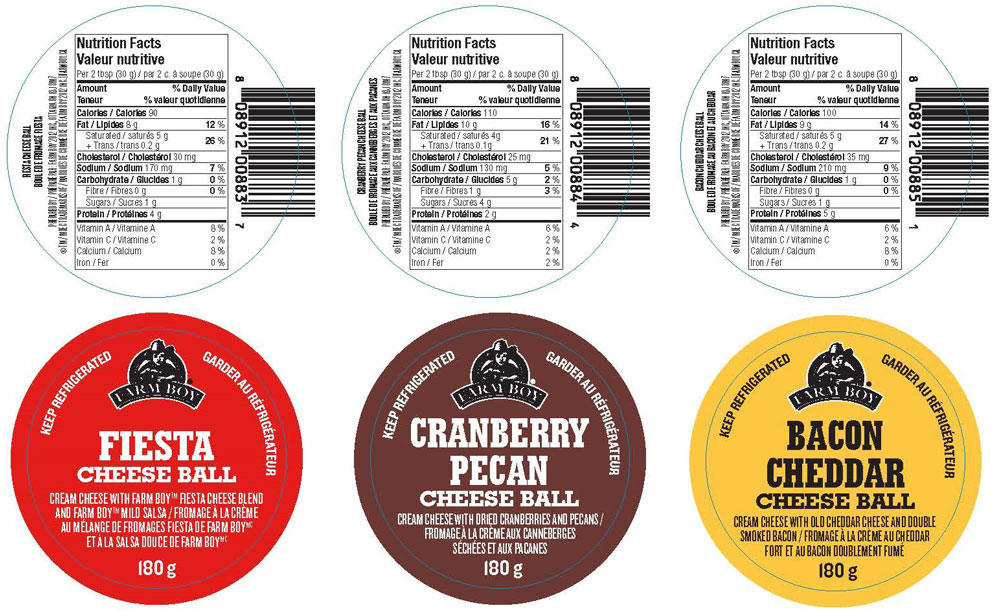
Farm Boy Cranberry Pecan Cheese Ball and/or “FB Cran Pecan Cheese Ball” 180 g 8 08912 00884 4 or Starting with 0 232337 All units sold up to and including November 17, 2019
Farm Boy Fiesta Cheese Ball and/or Farm Boy Fiesta Cheese Ball 180 g 8 08912 00883 7 or Starting with 0 238283 All units sold up to and including November 17, 2019
Farm Boy “FB Wht Choc Pecan Cran Ball” 180 g Starting with 0 238275 All units sold up to and including November 17, 2019
Farm Boy Bacon Cheddar Cheese Ball and/or “FB Bacon Chedd. Cheese Ball” 180 g 8 08912 00885 1 or Starting with 0 238284 All units sold up to and including November 17, 2019

Illnesses

There have been no reported illnesses associated with the consumption of these products.

Product photos

Printer ready version of photos

  • Farm Boy Cheese Ball Trio – 360 grams (side)
  • Farm Boy Cheese Ball Trio – 360 grams (outer label)
  • Farm Boy Cheese Ball Trio – 360 grams (UPC)
  • Farm Boy Cheese Ball – 180 grams (pre-printed labels)
  • Farm Boy Cheese Ball – 180 grams (store-printed labels)

Australia – Udder Delights in Hahndorf recalling cheese after E.coli found

Adelaide Now

Hugely popular Hahndorf cheesemaker Udder Delights has voluntarily recalled nearly a dozen of its cheese brands after E.coli bacteria above permitted levels was found.

Some of its most popular cheeses, including its 200g camembert and brie are being recalled. The SA company said there was no evidence the form of E.coli found was dangerous but it was recalling them as a precaution.

The cheeses are available from Coles and independent retailers in SA, Queensland, Victoria and WA. In NSW they also sell at Woolies and in Tasmania they are sold at independent retailers.

Udder Delights chef executive Sheree Sullivan said the team was “devastated” after small levels of the bacteria were found in some of the company’s white mould 200g cheeses.

Canada- Lobster and Crab Recalled For Possible Botulism in Canada – Clostridium botulinum

Food Poisoning Bulletin

Denis Losier is recalling Lobster and Crab, both packed in brine, that were sold in jars with no labels, because they may be contaminated with Clostridium botulinum bacteria that can produce the deadly botulinum toxin. These products were sold in New Brunswick and Quebec in Canada.

The Lobster in brine and Crab in brine were sold in jars with no labels with no brand name. The recalled products are Lobster in brine sold in 250 ml or 500 ml Mason jars with no UPC number. All units sold up to and including November 13, 2019 are recalled. They were sold at Marché G & D, at 1006 Saint-Laurent Blvd., in Montréal, Quebec and distributed in New Brunswick by Denis Losier, Tracadie in New Brunswick.

USA – ProMed: 3 women hospitalized with E. coli O157, Wisconsin, RFI

Barf Blog

Over the past 5 days, our health care facility in northwest Wisconsin, USA, has seen 3 women hospitalized with E. coli O157 infection. All presented with significant abdominal pain without fever and watery diarrhea which in 2 progressed to bloody diarrhea. None of the 3 have manifested any evidence of hemolytic-uremic syndrome. Both of the women seen by the Infectious Diseases service stated that their diet contains a lot of salads.

Singapore -Eating raw pig liver from local market may raise chances of contracting Hepatitis E virus liver disease

Alvinology

Do you like to eat raw liver? Is liver pâté one of your favorite dishes? You may want to think twice before ingesting such a meal again, as researchers at the Singapore General Hospital have found definite similarities between the virus strains of Hepatitis E virus or (HEV) in pig liver and human liver.


USA – Natural Grocers Issues Recall on Organic Soybeans Due to Mold

FDA

Vitamin Cottage Natural Food Markets, Inc., a Lakewood, Colorado-based natural grocery chain, is recalling Natural Grocers brand 2-pound Organic Soybeans because they have the potential to contain mold. Consumers who may have purchased this product are advised to discontinue use and either throw it away or return it to the store for credit or refund.

The recalled product is packaged in clear plastic bags weighing 2 pounds and bearing the “Natural Grocers” label. Only packages bearing 19-168 and 19-205 as the packed-on dates are subject to recall.  The packed-on date can be found in the bottom left-hand corner of the label.

The potential for contamination was noted after routine testing by the company revealed the presence of mold.

Production of the product has been suspended while the Food and Drug Administration and the company continue their investigation into the source of the problem.

UPC Code Description Packed on Dates
000080663607 Organic Soybeans 2 LB 19-168 & 19-205

Research – Decontamination of Bacillus cereus in cardamom (Elettaria cardamomum) seeds by infrared radiation and modeling of microbial inactivation through experimental models

Wiley Online 

In this work, infrared (IR) irradiation was used for inactivation of Bacillus cereus in cardamom seeds. The effect of IR power (100, 200, and 300 W), sample distance from radiation source (5, 10, and 15 cm) and holding times (0–11 min) was investigated on B. cereus count, as well as cardamom seeds color and temperature profiles. Inactivation of B. cereus on cardamom seeds during IR processing was demonstrated by experimental models. The highest reduction of B. cereus count (5.11 Log CFU/g) was achieved after 8 min IR irradiation at 300 W power and 15 cm distance. Measurement of temperature profiles revealed that there was a significant difference (p < .05) between surface and center temperatures of the cardamom seeds. The green color (a* value) of cardamom seeds was slightly affected and the highest color change was observed at 200 W IR, 10 cm distance and 10 min irradiation that resulted in an increase of a* from −3.05 ± 0.96 to −0.05 ± 0.44. In conclusion, IR irradiation could be successful for decontamination of cardamom seeds without severe alteration of its quality. Among the experimental models for microbial inactivation during IR processing, the Double Weibull model had the highest coefficient value of determination (R2 = 0.9966).

Research -Occurrence of Campylobacter spp., Salmonella spp. and shiga toxin‐producing Escherichia coli in inline milk filters from Swedish dairy farms

Wiley Online

Abstract

This study investigated the occurrence of shiga toxin‐producing Escherichia coli (STEC), thermotolerant Campylobacter spp. and Salmonella spp. in Swedish dairy milk. A total of 302 inline milk filters were analyzed. Salmonella was not isolated from any filters. Polymerase chain reaction screening detected thermotolerant Campylobacter in 30.5% of the milk filters analyzed and it was isolated from 12.6% of filters. The stx genes (stx 1, stx 2, or both) were screened from 71% of the filters and STEC was isolated from 14% of these. Of the STEC isolates, 21 contained the stx 1 gene, 19 the stx 2 gene, and five a combination of both stx 1 and stx 2 genes. Whole genome sequence typing on 34 of the 45 STEC showed that they belonged to 21 different serotypes, of which STEC O145:H28 was the most common (2%). STEC O157:H7 was only found from one (0.3%) of the filters. A combination of stx 2 and eae genes was found from 0.7% of the total number of inline milk filters analyzed, while stx 2a was found in 24% of the whole genome‐sequenced isolates. There was a significant positive correlations between number of animals per farm and presence of pathogens on milk filters.

Research -Radiofrequency pasteurization process for inactivation of Salmonella spp. and Enterococcus faecium NRRL B-2354 on ground black pepper

Science Direct

Abstract

Salmonella persistence in ground black pepper has caused several foodborne outbreaks and created public concern about the safety of low water activity (aw) foods. In this study, radiofrequency (RF) processing was evaluated for pasteurization of ground black pepper. Stability and homogeneity tests were done for both Salmonella spp. and E. faecium during moisture equilibration before RF heating to evaluate the inoculation method. Moisture content of samples were conditioned such that the final moisture content after RF heating reached the optimal storage moisture. RF heating was shown to provide more than 5.98 log CFU/g reduction for Salmonella spp. and the reduction of 3.89 log CFU/g for E. faecium with a 130 s of treatment time. The higher thermal resistance of E. faecium indicated its suitability as surrogate for Salmonella spp. during RF heating of ground black pepper. Piperine, total phenolics, volatile compounds, and antioxidant activity were assessed as quality parameters for ground black pepper. The results demonstrated that the RF processing provided effective inactivation of Salmonella spp. with insignificant (p > 0.05) quality deterioration.