Category Archives: Salmonella

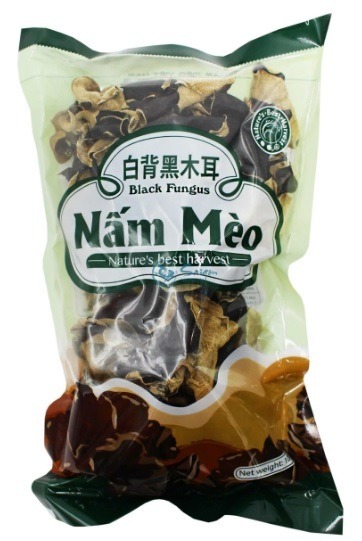
France – Nam Meo -Salmonella

Gov france

Identification information of the recalled product

  • Product category Feed
  • Product subcategory Fruits and vegetables
  • Product brand name Nature’s Best Harvest
  • Model names or references Batch No. BBD 10-10-2023
  • Identification of products
    Batch Date
    Batch No. BBD 10-10-2023 Best before date 10/10/2023
  • Packaging bag 100g
  • Marketing start/end date From 03/18/2022 to 05/31/2022
  • Storage temperature Product to be stored at room temperature
  • Health mark100g
  • Further information Importer: Herman Kuijper located Noorddaammerweg 91 B, 1187 ZS Amstelveen in the Netherlands
  • Geographic area of ​​saleGrenoble
  • Distributors king long store

Practical information regarding the recall

  • Reason for recall Contamination of Salmonella enterica serovar Stanley

USA – Comercializadora PepsiCo S. de R.L. de C.V. Issues Voluntary Recall of Gamesa® Arcoiris Marshmallow Cookies Due to Possible Health Risk – Salmonella

FDA

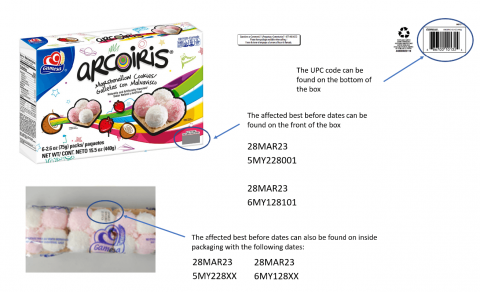
Product Labeling Arcoiris Marshmallow Cookies

Company Announcement

Comercializadora PepsiCo S. de R.L. de C.V. today issued a voluntary recall for 15.5 oz, 6 count box of Gamesa Arcoiris Marshmallow Cookies due to the potential presence of Salmonella.

The recall was initiated as the result of a routine sampling program by the company, which revealed the finished product may contain SalmonellaSalmonella is an organism that can cause serious and sometimes fatal infections in young children, frail or elderly people, and others with weakened immune systems. Healthy persons infected with Salmonella often experience fever, diarrhea, nausea, vomiting and abdominal pain. In rare circumstances, infection with Salmonella can result in the organism getting into the bloodstream and producing more severe illnesses such as arterial infections, endocarditis and arthritis.

The company initiated the voluntary recall on the product below out of a commitment to and concern for consumers. The product covered by this recall was distributed to warehouses in California and Texas and may have reached consumers through select retail stores.

Product Description Size UPC Best Before
Gamesa Arcoiris Marshmallow Cookies, Naturally and Artificially Flavored 15.5 Oz, 6 Count 6 86700 10132 4 28MAR23
5MY228001
28MAR23
6MY128101

The company is working closely with the Food and Drug Administration (FDA) to further investigate this issue and ensure the recalled product is removed from store shelves and is no longer distributed. No illnesses related to Salmonella have been confirmed to date.

Consumers who have purchased the above product are advised not to consume it and urged to dispose of it immediately. Consumers may also contact Gamesa Consumer Relations for product questions and further details at 1-877-842-6372 (9 a.m. – 4:30 p.m. CST, Monday-Friday) or visit https://contact.pepsico.com/gamesaExternal Link Disclaimer


Company Contact Information

Consumers:
Gamesa Consumer Relations
 1-877-842-6372
Media:
Gamesa Media Relations
 pepsicomediarelations@pepsico.com

Research – Influence of commercial laying hen housing systems on the incidence and identification of Salmonella and Campylobacter

Science Direct

Foodborne Pathogen

Abstract

The housing of laying hens is important for social, industrial, and regulatory aspects. Many studies have compared hen housing systems on the research farm, but few have fully examined commercial housing systems and management strategies. The current study compared hens housed in commercial cage-free aviary, conventional cage, and enriched colony cage systems. Environmental and eggshell pool samples were collected from selected cages/segments of the housing systems throughout the production cycle and monitored for Salmonella and Campylobacter prevalence. At 77 wk of age, 120 hens per housing system were examined for Salmonella and Campylobacter colonization in the: adrenal glands, spleen, ceca, follicles, and upper reproductive tract. All isolates detected from environmental swabs, eggshell pools, and tissues were identified for serotype. Two predominant Salmonella were detected in all samples: S. Braenderup and S. Kentucky. Campylobacter coli and C. jejuni were the only Campylobacter detected in the flocks. Across all housing systems, approximately 7% of hens were colonized with Salmonella, whereas > 90% were colonized with CampylobacterSalmonella Braenderup was the isolate most frequently detected in environmental swabs (P < 0.0001) and housing system impacted Salmonella spp. shedding (P < 0.0001). Campylobacter jejuni was the isolate most frequently found in environmental swabs (P < 0.01), while housing system impacted the prevalence of C. coli and jejuni in ceca (P < 0.0001). The results of this study provide a greater understanding of the impact of hen housing systems on hen health and product safety. Additionally, producers and academia can utilize the findings to make informed decisions on hen housing and management strategies to enhance hen health and food safety.

Research – Propionate and Butyrate Inhibit Biofilm Formation of Salmonella Typhimurium Grown in Laboratory Media and Food Models

MDPI

Salmonella is among the most frequently isolated foodborne pathogens, and biofilm formed by Salmonella poses a potential threat to food safety. Short-chain fatty acids (SCFAs), especially propionate and butyrate, have been demonstrated to exhibit a beneficial effect on promoting intestinal health and regulating the host immune system, but their anti-biofilm property has not been well studied. This study aims to investigate the effects of propionate or butyrate on the biofilm formation and certain virulence traits of Salmonella. We investigated the effect of propionate or butyrate on the biofilm formation of Salmonella enterica serovar Typhimurium (S. Typhimurium) SL1344 grown in LB broth or food models (milk or chicken juice) by crystal violet staining methods. Biofilm formation was significantly reduced in LB broth and food models and the reduction was visualized using a scanning electron microscope (SEM). Biofilm metabolic activity was attenuated in the presence of propionate or butyrate. Meanwhile, both SCFAs decreased AI-2 quorum sensing based on reporter strain assay. Butyrate, not propionate, could effectively reduce bacterial motility. Bacterial adhesion to and invasion of Caco-2 cells were also significantly inhibited in the presence of both SCFAs. Finally, two SCFAs downregulated virulence genes related to biofilm formation and invasion through real-time polymerase chain reaction (RT-PCR). These findings demonstrate the potential application of SCFAs in the mitigation of Salmonella biofilm in food systems, but future research mimicking food environments encountered during the food chain is necessitated. View Full-Text

CDC – Annual Reports on Foodborne Illness Source Attribution Estimates – 2020

CDC

Executive Summary

Each year in the United States, an estimated 9 million people get sick, 56,000 are hospitalized, and 1,300 die of foodborne disease caused by known pathogens. These estimates help us understand the scope of this public health problem. However, to develop effective prevention measures, we need to understand the types of foods contributing to the problem. The Interagency Food Safety Analytics Collaboration (IFSAC) is a tri-agency group created by the Centers for Disease Control and Prevention (CDC), the U.S. Food and Drug Administration (FDA), and the U.S. Department of Agriculture’s Food Safety and Inspection Service (USDA-FSIS). IFSAC developed a method to estimate the percentages of foodborne illness attributed to certain sources using outbreak data from 1998 through the most recent year for IFSAC’s priority pathogens: Salmonella, Escherichia coli O157, Listeria monocytogenes, and Campylobacter. IFSAC described this method and the estimates for 2012 in a report, in a peer-reviewed journal article, and at a public meeting. Unlike in prior IFSAC Annual Reports, attribution estimates for Campylobacter are not presented in this year’s report. Evidence suggests the sources of Campylobacter outbreaks likely differ considerably from the sources of non-outbreak-associated illnesses caused by this pathogen. IFSAC is exploring alternative approaches for estimating the sources ofCampylobacter illnesses.IFSAC derived the estimates for 2020 using the same method used for the previous estimates, with some modifications. The data came from 1,287 foodborne disease outbreaks that occurred from 1998 through 2020 and for which each confirmed or suspected implicated food was assigned to a single food category. The method relies most heavily on the most recent five years of outbreak data (2016 – 2020).

Foods are categorized using a scheme IFSAC created to classify foods into 17 categories that closely align with the U.S. food regulatory agencies’ classification needs.

Salmonella illnesses came from a wide variety of foods. More than 75% of Salmonella illnesses were attributed to seven food categories: Chicken, Fruits, Pork, Seeded Vegetables (such as tomatoes), Other Produce (such as fungi, herbs, nuts, and root vegetables), Beef, and Turkey.

E. coli O157illnesseswere most often linked to Vegetable Row Crops (such as leafy greens) and Beef. More than 80% of illnesses were linked to these two categories.

Listeria monocytogenes illnesses were most often linked to Dairy products, Fruits, and Vegetable Row Crops. More than 75% of illnesses were attributed to these three categories, but the rarity of Listeria monocytogenes outbreaks makes these estimates less reliable than those for other pathogens.

Click to access P19-2020-report-TriAgency-508.pdf

USA- Kalera Voluntarily Recalls Fresh Lettuce Products Because of Possible Health Risk – Salmonella

FDA

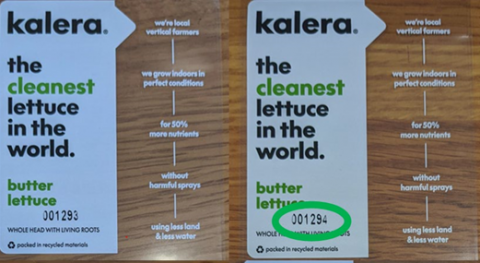
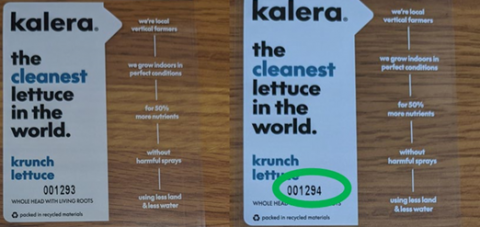
Label Image – kalera, butter lettuce, with coding

Label Image – kalera, krunch lettuce, with coding

ORLANDO, Fla., November 3, 2022 (FOR DISTRIBUTION) – Kalera Public Limited Company (“Kalera” or the “Company”) (Nasdaq: KAL), is voluntarily recalling 633 cases of Krunch, Butter and Romaine whole head variety lettuce with lot codes 001293 and 001294 on the label and sold under the Kalera brand because it has the potential to be contaminated with Salmonella, an organism which can cause serious and sometimes fatal infections in young children, frail or elderly people, and others with weakened immune systems. Healthy persons infected with Salmonella often experience fever, diarrhea (which may be bloody), nausea, vomiting and abdominal pain. In rare circumstances, infection with Salmonella can result in the organism getting into the bloodstream and producing more severe illnesses such as arterial infections (i.e., infected aneurysms), endocarditis and arthritis.

Distribution was limited to a small number of retail and foodservice customers in Florida. The Company has notified these customers and is working with them to ensure consumers do not receive any of the products affected by the recall.

Kalera’s food safety testing procedures indicated the potential presence of Salmonella in some of its whole head lettuce SKUs.  The Company promptly reported this issue to the FDA, and, to the Company’s knowledge, no illnesses have occurred or been reported to date.

Only those products that are named in this announcement, produced in the Orlando farm and sold in the state of Florida are being recalled. No other Kalera products are affected by the recall.

In the event consumers have the recalled products in their refrigerators, they should be discarded and not consumed. To obtain a refund or for more information, consumers may contact the company at (407) 574-8204 M-F from 9 a.m. to 5 p.m. Eastern Time. Media representatives should contact Aric Nissen, company spokesperson, aric.nissen@kalera.com.


Company Contact Information

Consumers:
 (407) 574-8204
Media:
Aric Nissen
 aric.nissen@kalera.com

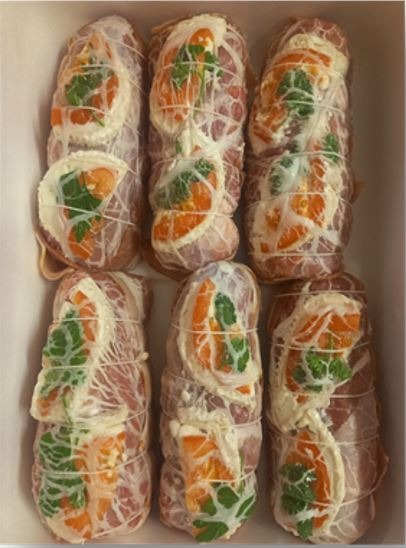
France – Filet mignon of pork with goat cheese – Salmonella

Gov france

Identification information of the recalled product

  • Product category Feed
  • Product subcategory Meats
  • Product brand name Novoris
  • Model names or references Filet mignon of pork with goat cheese
  • Identification of products
    GTIN Batch Date
    3383886900310 4329922 Use-by date 05/11/2022
  • Marketing start/end date From 27/10/2022 to 31/10/2022
  • Storage temperature Product to be stored in the refrigerator
  • Health mark28-177-002
  • Geographic area of ​​sale Regions: Ile-de-France
  • Distributors Novoris
  • List of points of salelist_of_stores_products.pdf

Practical information regarding the recall

  • Reason for recallSalmonella alert
  • Risks incurred by the consumer Salmonella spp (causative agent of salmonellosis)

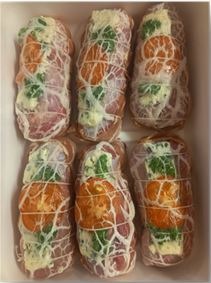
France – Roquefort Pork Tenderloin -Salmonella

Gov france

Identification information of the recalled product

  • Product category Feed
  • Product subcategory Meats
  • Product brand name Novoris
  • Model names or references Roquefort Pork Tenderloin
  • Identification of products
    GTIN Batch Date
    3383886900327 4329922 Use-by date 05/11/2022
  • Marketing start/end date From 27/10/2022 to 31/10/2022
  • Storage temperature Product to be stored in the refrigerator
  • Health mark 28-177-002
  • Geographic area of ​​sale Regions: Ile-de-France
  • Distributors Novoris
  • List of points of salelist_of_stores_products.pdf

Practical information regarding the recall

  • Reason for recall Salmonella alert
  • Risks incurred by the consumer Salmonella spp (causative agent of salmonellosis)

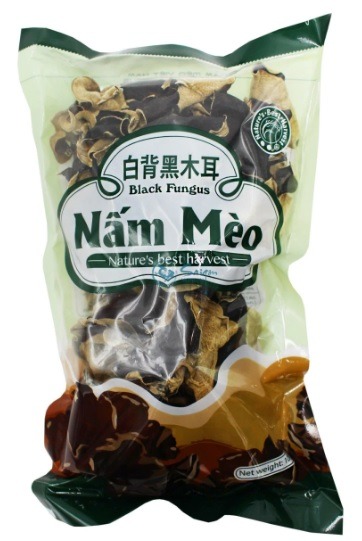
France – Dried Black Mushrooms – Salmonella

Gov france

Identification information of the recalled product

  • Product category Feed
  • Product subcategory Fruits and vegetables
  • Product brand name Nam Meo
  • Model names or references Dried Black Mushrooms – Black Fungus 100g
  • Identification of products
    GTIN Batch Date
    8717624001321 BBD 10-10-2023 Date of minimum durability 10/10/2023
  • Packaging100g plastic bag
  • Marketing start/end date From 01/09/2022 to 28/10/2022
  • Storage temperature Product to be stored at room temperature
  • Further information Importer: Herman Kuijper located Noorddaammerweg 91 B, 1187 ZS Amstelveen in the Netherlands
  • Geographic area of ​​saleSaint-Maur-des-Fosses
  • DistributorsUncle Wang Store

Practical information regarding the recall

  • Reason for recall Contamination of Salmonella enterica serovar Stanley
  • Risks incurred by the consumer Salmonella spp (causative agent of salmonellosis)

RASFF Alerts – Salmonella – Polish Chicken Products – Polish Goose – Polish Goose – Sesame Seeds -Wild Boar – Thyme – Halva

RASFF

Salmonella in chilled wild boar meat from Belgium in Luxembourg

RASFF

Whole chicken ready to cook – Salmonella Enteritidis from France in Germany and Denmark

RASFF

Salmonella CO in thyme from Egypt in Poland

RASFF

Salmonella Kottbus in goose breast fillet from Poland in Germany

RASFF

Salmonella Enteritidis in fresh poultry meat from Poland in the Czech Republic

RASFF

Salmonella Infantis detected in poultry carcasses used for production of chicken kebab from Poland in Slovakia

RASFF

Salmonella Newport in fresh duck meat (legs) from Poland in Italy

RASFF

Salmonella spp. in halva from Turkey in Germany

RASFF

Presence of salmonella in sesame seed from Nigeria in Spain