Category Archives: outbreak

USA – Ruby Princess: More than 200 sickened on the Princess Cruises voyage

Outbreak News Today

Federal health officials are reporting that some 219 passengers and crew suffered with symptoms of  vomiting and diarrhea during a recent Princess Cruises’ Ruby Princess voyage (RU305P  from February 26–March 5, 2023).

To date, the etiology of the illness has not been discovered.

In response to the outbreak, Princess Cruises and the crew aboard the ship reported the following actions:

  • Increased cleaning and disinfection procedures according to the ship’s outbreak prevention and response plan.
  • Collected stool specimens from gastrointestinal illness cases to send to the CDC lab for pathogenic identification.

Vessel Sanitation Program (VSP) epidemiologists and environmental health officers will board the ship in Galveston, Texas, on March 5 to conduct a formal outbreak investigation.

Ireland – Outbreak of Salmonella Typhimurium on the island of Ireland declared over

NDSC

An outbreak investigation was launched by HPSC on 22/12/2022 after seven Salmonella Typhimurium isolates were identified as forming a cluster by routine Whole Genome Sequencing (WGS) carried out by the National SalmonellaShigella and Listeria Reference Laboratory (NSSLRL). The isolates, which were of a less commonly occurring subtype of Salmonella Typhimurium, MLST type ST36, were related to two previous Salmonella Typhimurium isolates (sequenced in the NSSLRL in October 2020 and December 2021) and isolates identified in other European countries since 2020. The source of salmonellosis was not identified for these previous cases. An additional thirteen isolates were added to this cluster following further WGS by the NSSLRL in January 2023, while WGS performed by the Gastrointestinal Bacteria Reference Unit (GBRU) of the UK’s Health Security Agency’s (UKHSA) identified an additional seven cases resident in Northern Ireland and England that fell within the same cluster. In total 27 cases, identified between December 2022 and January 2023, who were resident on or who visited the island of Ireland were investigated as part of this outbreak.

Epidemiological data on outbreak cases were collected in each jurisdiction via national computerised surveillance systems, enhanced surveillance forms and trawling questionnaires. Symptom onset dates for cases ranged between the 30th of November 2022 and the 13th of January 2023, peaking on December 7th. Cases were geographically distributed across multiple areas on the island of Ireland. Fourteen cases were male and thirteen were female. Most cases were adults, ranging in age from 25 to 91 years, and two cases were children (aged <18 years). The median age of cases was 57 years. Forty-one percent (41%) of cases (n=11) were reported to have been hospitalised.[1]

A multi-disciplinary Outbreak Control Team (OCT), chaired by HPSC, was convened in January 2023. This group comprised representatives from HPSC, National Health Protection Service, NSSLRL, Departments of Public Health, the HSE Environmental Health Service, The Food Safety Authority of Ireland (FSAI) and the HSC Public Health Agency of Northern Ireland (PHA) and Food Standards Agency in Northern Ireland (FSA-NI). The OCT met four times during January and February 2023. Enhanced surveillance forms and trawling questionnaires were used to determine food and environmental exposure histories for all cases but no common exposures were identified. Additionally, food business supplier lists were examined and no commonalities were identified. The outbreak was declared over on February 16th 2023 as more than two incubation periods had elapsed without the reporting of new cases associated with this cluster but the source of this outbreak remains unknown.

In January 2023, FSAI instigated a food recall of batches of chicken products due to the detection of Salmonella Typhimurium and the Department of Agriculture, Food and the Marine launched an investigation into the incidence of Salmonella Typhimurium in a number of broiler flocks. There is no microbiological evidence of a link between the cases of salmonellosis investigated as part of this outbreak with the poultry product recall and positive poultry flocks.

Finland – Around 150 cases of food poisoning caused by oysters in Helsinki – Norovirus

Helsinki Times

Food Borne Illness - Norovirus -CDC Photo

Between February 8th and 26th, 2023, around 150 people have reported falling ill after eating oysters in restaurants across Helsinki. The illnesses are related to oysters imported from France and the Netherlands.

Reports of illnesses have been recorded from several different restaurants, prompting inspections and sample collections from affected venues. Importers of the oysters in question have also withdrawn their products from the market.

The examination of food samples is still ongoing, but some patient samples have already been completed. So far, seven individuals have tested positive for norovirus related to this outbreak.

Those who have eaten oysters are being encouraged to contact environmental services to provide information for the ongoing investigation.

USA – New Hepatitis A outbreak discovered; other outbreak investigations continue

Food Safety News

Federal officials have identified a new outbreak of hepatitis A infections suspected to be from a food source.

The Food and Drug Administration reports that it has begun product traceback efforts, but the agency has not named the product or products being traced.

As of March 1 there have been nine patients identified. The FDA has not reported where the patients live or their ages.

Hepatitis A can be transmitted when food handlers have contaminated hands. This contamination usually comes from microscopic amounts of feces. Thorough hand washing is one of the best ways to prevent transmission of the disease. Food surfaces can become contaminated as well as foods and beverages.

USA – FDA Advises Restaurants, Retailers and Consumers to Avoid Recalled Wild Harvest Oysters from Harvest Area FL-3012, Cedar Key, Florida Potentially Contaminated with Salmonella

FDA

Audience

  • Restaurants and food retailers that have received shipments of wild harvest oysters from harvest area FL-3012, Cedar Key, Florida, harvested between December 16, 2022, and February 24, 2023.
  • Consumers who have recently purchased oysters from area FL-3012 sold in Alabama, Florida, and Georgia.

Product

  • Wild harvest oysters from FL-3012, Cedar Key, Florida, harvested between December 16, 2022, and February 24, 2023. The oysters were distributed to restaurants and retailers in Alabama, Florida, and Georgia It is possible that additional states received these oysters through further distribution.
  • Packaged oysters include harvest area information on the packaging.

Purpose

The FDA is advising consumers not to eat, and restaurants and food retailers not to sell, and to dispose of recalled wild harvest oysters from FL-3012, Cedar Key, Florida, harvested between December 16, 2022, and February 24, 2023, due to possible Salmonella contamination. These oysters were sold in Alabama, Florida, and Georgia. Consumers who purchased oysters after December 16, 2022, should check the packaging to see if they were wild harvest oysters from FL-3012, Cedar Key, Florida. Contaminated oysters can cause illness if eaten raw, particularly in people with compromised immune systems. Food contaminated with Salmonella may look, smell, and taste normal. Consumers of these products who are experiencing symptoms of salmonellosis should contact their healthcare provider, who should report their symptoms to their local Health Department.

Summary of Problem and Scope

The Florida Department of Health and the state health departments of Georgia and Alabama have detected a Salmonella outbreak associated with the consumption of raw oysters harvested from shellfish harvesting area FL-3012 in Cedar Key, Florida. To date, there have been 8 cases linked to this outbreak within Florida, Georgia, and Alabama. On February 24, 2023, the Florida Department of Agriculture and Consumer Services issued an emergency closure order for wild harvest oysters from harvest area FL-3012 and initiated a recallExternal Link Disclaimer of wild harvest oysters from harvest area FL-3012 in Cedar Key that were harvested from December 16, 2022, to February 24, 2023. On February 24, the State of Florida also notified the Interstate Shellfish Sanitation Conference of the closure and recall. Florida Department of Health posted an advisory bulletin on February 28. 2023.

FDA Actions

The FDA is issuing this alert advising consumers not to eat, and restaurants and food retailers not to sell, recalled wild harvest oysters from FL-3012, Cedar Key, Florida, harvested between December 16, and February 24, 2023, due to possible Salmonella contamination. The FDA will assist with and coordinate interstate notification efforts as necessary pending receipt of shellfish distribution information.

Symptoms of Salmonellosis

Most people infected with Salmonella will begin to develop symptoms 12 to 72 hours after infection. The illness, salmonellosis, usually lasts four to seven days and most people recover without treatment.

Most people with salmonellosis develop diarrhea, fever, and abdominal cramps. More severe cases of salmonellosis may include a high fever, aches, headaches, lethargy, a rash, blood in the urine or stool, and in some cases may become fatal. The U.S. Centers for Disease Control and Prevention estimated that approximately 450 persons in the United States die each year from acute salmonellosis.

Due to the range in severity of illness, people should consult their healthcare provider if they suspect that they have developed symptoms that resemble a Salmonella infection.

Recommendations for Restaurants and Retailers

Restaurants and retailers should not sell the potentially contaminated oysters. Restaurants and retailers should dispose of any potentially contaminated products by throwing them in the garbage or returning to their distributor for destruction.

Restaurants and retailers should also be aware that oysters and other filter-feeding bivalve molluscan shellfish may be a source of pathogens and should control the potential for cross-contamination of food processing equipment and the food processing environment. They should follow the steps below:

  • Wash hands with warm water and soap following the cleaning and sanitation process.
  • Retailers, restaurants, and other food service operators who have processed and packaged any potentially contaminated products need to be concerned about cross-contamination of cutting surfaces and utensils through contact with the potentially contaminated products.
  • Retailers that have sold bulk product should clean and sanitize the containers used to hold the product.
  • Regular frequent cleaning and sanitizing of food contact surfaces and utensils used in food preparation may help to minimize the likelihood of cross-contamination.

USA – FDA Core Outbreak Table – Update

FDA

What’s New

  • A new outbreak of hepatitis A virus infections (ref # 1143) linked to a not yet identified product has been added to the table. FDA has initiated traceback.
  • For the outbreak of Listeria monocytogenes (ref # 1123), FDA has initiated an onsite inspection, sample collection, and analysis. This investigation is ongoing and additional information will be provided as it become available.
  • The outbreak of Salmonella Typhimurium (ref # 1137) linked to alfalfa sprouts has ended and the FDA investigation is closed.

USA – Salmonella Outbreak Linked to Alfalfa Sprouts – Outbreak is Over

CDC

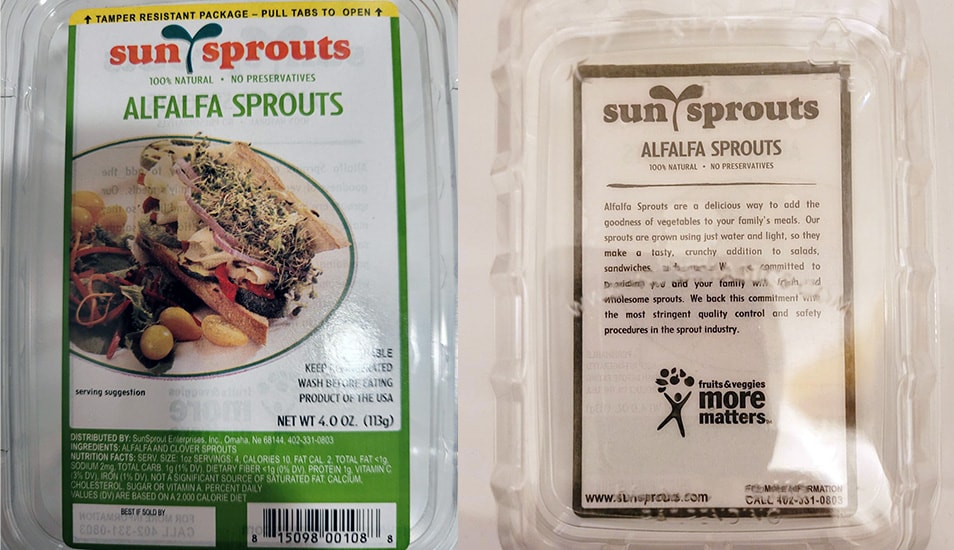
Front and back packaging of alfalfa sprouts in this outbreak

Fast Facts
  • Illnesses: 63
  • Hospitalizations: 10
  • Deaths: 0
  • States: 8
  • Recall: Yes
  • Investigation status: Closed
Outbreak Investigation Summary

Data showed that alfalfa sprouts made people in this outbreak sick.

  • Of the 50 people interviewed, 35 (70%) reported eating alfalfa sprouts.
  • Eight of the people who got sick in this outbreak confirmed they had purchased Sun Sprouts brand alfalfa sprouts from their local grocery store.

On December 29, 2022, SunSprout Enterprises recalled four lots of raw alfalfa sprouts.

USA – Florida – Salmonella Outbreak linked to Oysters

Food Poison Journal

The Florida Department of Health (DOH) and the state health departments of Georgia and Alabama have detected a Salmonella outbreak associated with the consumption of raw oysters harvested from shellfish harvesting area FL-3012 in Cedar Key, Florida. To date, there have been 8 cases linked to this outbreak within Florida, Georgia, and Alabama.

On February 24, 2023, the Florida Department of Agriculture and Consumer Services closed shellfish harvesting area FL-3012 for the harvest of wild oysters and initiated a recall of these wild oysters harvested from December 16, 2022, to February 24, 2023.

Finland – People sick in Finland after eating oysters – Norovirus?

Food Safety News

Health officials in a city in Finland are investigating several cases of illness caused by contaminated oysters.

Food poisoning in Helsinki is suspected to be related to eating in different restaurants and at an event since the beginning of February. This past week, officials reported at least 20 people were affected but updates in local media suggest there are around 100 illnesses.

Investigators have tested food from restaurants and taken patient samples and have found norovirus. Some of those sick reported eating oysters.

A few restaurants have already been inspected after suspected epidemics and oyster importers have started to issue withdrawals and recall.

Food safety officials in Helsinki asked people who had eaten oysters and then fallen sick to contact them.

Norovirus is the most commonly identified cause of foodborne outbreaks in Finland. Between 2017 and 2021, oysters caused 11 norovirus outbreaks in which more than 110 people fell ill, according to the Finnish Institute for Health and Welfare (THL).

In October 2022, five people fell sick in the country after eating oysters from France contaminated with norovirus.

Wales – Multi agency outbreak team investigating Abergavenny food poisoning incident

Abergavenny Chronicle

A food poisoning outbreak has plagued Abergavenny in recent weeks, with Public Health Wales confirming that there are 13 known cases of shigella infection within the area and a number suspected cases still being investigated.

The illness identified as shigella infection (shigellosis) is an intestinal infection caused by a family of bacteria known as shigella. The main symptom of shigella infection is diarrhoea. It is not life threatening, although in some cases it may result in hospitalisation, but symptoms usually clear up within four to five days.

A Public Health Wales spokesperson said: “Following an increase in reports of gastrointestinal illness in the Abergavenny area, Public Health Wales stood up a multiagency Outbreak Control Team with representation from Aneurin Bevan University Health Board, Monmouthshire County Council, and Powys County Council.

“We are investigating cases of shigella infection (shigellosis) associated with a single fast-food premises in the town. To date, we have identified 13 confirmed cases and a number of suspected cases are still being investigated. Appropriate public health measures have been undertaken including tracing contacts of those affected and offering testing for contacts with relevant symptoms.

Public Health Wales recommended that anyone who may be concerned about any symptoms they’re experiencing should contact 111 over the weekend and evening or contact their GP in-hours service during weekdays.