Category Archives: Microbiology

USA – USDA Launches New Effort to Reduce Salmonella Illnesses Linked to Poultry

USDA

he U.S. Department of Agriculture’s Food Safety and Inspection Service (FSIS) today announced that it is mobilizing a stronger, and more comprehensive effort to reduce Salmonella illnesses associated with poultry products. The agency is initiating several key activities to gather the data and information necessary to support future action and move closer to the national target of a 25% reduction in Salmonella illnesses.

“Far too many consumers become ill every year from poultry contaminated by Salmonella,” said Agriculture Secretary Tom Vilsack. “We need to be constantly evolving in our efforts to prevent foodborne illness to stay one step ahead of the bad bugs. Today we’re taking action to help prevent Salmonella contamination throughout the poultry supply chain and production system to protect public health.”

Despite consistent reductions in the occurrence of Salmonella in poultry products, more than 1 million consumer illnesses due to Salmonella occur annually, and it is estimated (PDF, 1.4 MB) that over 23% of those illnesses are due to consumption of chicken and turkey.

“Reducing Salmonella infections attributable to poultry is one of the Department’s top priorities,” said USDA Deputy Under Secretary Sandra Eskin, who is leading the initiative. “Time has shown that our current policies are not moving us closer to our public health goal. It’s time to rethink our approach.”

USDA intends to seek stakeholder feedback on specific Salmonella control and measurement strategies, including pilot projects, in poultry slaughter and processing establishments. A key component of this approach is encouraging preharvest controls to reduce Salmonella contamination coming into the slaughterhouse. The data generated from these pilots will be used to determine if a different approach could result in a reduction of Salmonella illness in consumers.

The effort will leverage USDA’s strong research capabilities and strengthen FSIS’ partnership with the Research, Education and Economics (REE) mission area to address data gaps and develop new laboratory methods to guide future Salmonella policy. Meanwhile, the National Advisory Committee for Microbiological Criteria in Foods, an independent federal advisory committee, will be asked to advise on how FSIS can build on the latest science to improve its approach to Salmonella control. Since it is not just the presence or absence of Salmonella, but the quantity of bacteria that can impact the likelihood of illness, FSIS will examine how quantification can be incorporated into this approach. Moreover, with emerging science suggesting that not all Salmonella are equally likely to cause human illness, FSIS will focus on the Salmonella serotypes and the virulence factors that pose the greatest public health risk.

Moving forward, this initiative will require collaboration and ongoing dialogue with stakeholders — industry, consumer groups, and researchers alike. USDA looks forward to working closely with stakeholders on informing and implementing key activities of this framework in the very near future.

USDA touches the lives of all Americans each day in so many positive ways. In the Biden-Harris Administration, USDA is transforming America’s food system with a greater focus on more resilient local and regional food production, fairer markets for all producers, ensuring access to safe, healthy and nutritious food in all communities, building new markets and streams of income for farmers and producers using climate smart food and forestry practices, making historic investments in infrastructure and clean energy capabilities in rural America, and committing to equity across the Department by removing systemic barriers and building a workforce more representative of America. To learn more, visit www.usda.gov.

Australia – Banks and Burbidge Alcohol Free Gin 700ml – Microbial Contamination

FSANZ

Product informationWaterloo Bay Distilling Company is conducting a recall of Banks and Burbidge Alcohol Free Gin 700ml. The product has been available for sale at Dan Murphy’s selected stores and stores online in NSW, ACT, QLD, VIC, TAS, SA, NT, WA.

Date markings

Best Before 11 May 2023

Problem

The recall is due to a potential for microbial contamination.

Food safety hazard

Food products with potential microbial contamination may cause illness if consumed.​

Country of origin

Australia

What to do​

Any consumers concerned about their health should seek medical advice. Consumers should not drink this product, and should dispose of it safely. Consumers seeking a full refund should contact the place of purchase for instructions.​​
For further information please contact:​​​

Waterloo Bay Distilling Company

0429 773 743

contact@waterloobaydistilling.com

www.banksandburbidge.com

​​Related links:

Research – Nisin-based antimircobial combination with cold plasma treatment inactivate Listeria monocytogenes on Granny Smith apples

Science Direct

Abstract

A nisin-based antimicrobial and cold plasma combination treatments in reducing Listeria monocytogenes inoculated on apple surfaces purchased from a New Jersey farm and a supermarket in Philadelphia area was investigated. All apples were spot inoculated or by submersion in 107 CFU/ml L. monocytogenes inoculum. Populations of L. monocytogenes recovered on farm and supermarket apples after spot inoculation averaged 5.8 ± 0.24 log CFU/g and 4.6 ± 0.12 log CFU/g, respectively and 4.1 ± 0.22 log CFU/g and 3.6 ± 0.12 log CFU/g, respectively on submerged apples. All apples were treated with antimicrobial solution for 30 s, 40 s, 3 min (180s) and 1 h (3600 s), cold plasma treatments for 30 and 40s, and a combination of antimicrobial and cold plasma treatments and the surface structure of apples were examined using scanning electron microscopy (SEM). Cold plasma treatment at 40s, followed immediately with antimicrobial treatments at 180s and 3600 s led to 2.5 and 4.6 log CFU/g inactivation of L. monocytogenes, respectively. SEM observation showed changes on apple surface structures but not on bacterial cell structure. This result suggests that this combination treatments is effective in killing L. monocytogenes on apple surfaces.

Research – Heatwave-associated Vibrio infections in Germany, 2018 and 2019

Eurosurveillance

Food Illness

The genus , which belongs to the family  and the class , includes many species that are potential human pathogens [1].  is a highly diverse species that consists of more than 200 serogroups [2]. Strains within the serogroups O1 and O139 produce cholera toxin and are the causative agents of endemic and epidemic cholera, which represent an important cause of morbidity and mortality in countries with inadequate access to clean water and sanitation facilities [3].  strains not included in these serogroups as well as other  spp. are referred to as non-cholera  spp. and are ubiquitous aquatic bacteria with a worldwide distribution, especially in warm estuarine and marine ecosystems [2]. These halophilic bacteria prefer low to moderate salinity (less than 25 parts per thousand (ppt) NaCl) [4]. The abundance of  spp. in marine and estuarine waters closely corresponds with the sea surface temperatures (SSTs) since they proliferate in warm water [5]. Thus, regional variations in environmental conditions are paramount importance in understanding the ecology of  spp.

Human infections with non-cholera  spp. can manifest as wound infections, ear infections, gastroenteritis, and primary septicaemia and have been predominantly reported in tropical and subtropical regions [6]. In Europe, cases are rare, and infections associated with the Mediterranean Sea [79], the Atlantic Ocean [1012], or the Baltic Sea [13,14] have only been sporadically reported. However, a rapidly warming marine environment accompanied by an increase in extreme weather events such as heatwaves has resulted in unprecedented peak SSTs favouring the spread of  spp. worldwide. Recently, larger  spp. outbreaks have been reported in temperate regions such as Spain [15], Sweden, and Finland [16]. In Germany,  spp. other than toxigenic  strains were not classified as reportable pathogenic agents before March 2020; to date, only a few cases have been reported and few case series of autochthonous infections have been published [1720]. Over the last decades, resistance to various antibiotics, including to ampicillins, tetracyclines, and carbapenems, has emerged among  spp [21,22]. As a result of resistant isolates, the monitoring of antibiotic profiles of clinical and environmental  spp. has become of increasing importance. However, information on the number of human cases and the abundance of  spp. in coastal waters is scarce in most other European countries.

When we became aware of a high number of human infections with virulent  strains contracted in the Baltic Sea during the summer months of 2018 and 2019 (data not shown), we decided to conduct an observational retrospective multi-centre cohort study of domestically-acquired  infections. This study describes the epidemiology and the clinical impact of those infections and assesses antibiotic resistance patterns and phylogenetic relationships among clinical isolates. To determine the association between  infections and SST anomalies, we analysed the degree of warming in the south-western Baltic Sea, where the majority of the infections occurred.

Research – Use of Acetic Acid to Partially Replace Lactic Acid for Decontamination against Escherichia coli O157:H7 in Fresh Produce and Mechanism of Action

MDPI

Escherichia coli O157:H7 is frequently detected in ready-to-eat produce and causes serious food-borne diseases. The decontamination efficacy of lactic acid (LA) is clearly established. In this study, LA was mixed with acetic acid (AA) to reduce costs while achieving consistent or better inhibitory effects. Time-kill curves and inoculation experiments using fresh-cut spinach and arugula indicated that 0.8%LA+0.2%AA shows similar antibacterial effects to those of 1%LA. To determine whether 1%LA and 0.8%LA+0.2%AA exert antibacterial effects by similar mechanisms, proteomics analysis was used. The proteins related to macromolecule localization, cellular localization, and protein unfolding were uniquely altered after the treatment with 1%LA, and the proteins related to taxis, response to stress, catabolic process, and the regulation of molecular function were uniquely altered after the treatment with 0.8%LA+0.2%AA. Based on these findings, combined with the results of a network clustering analysis, we speculate that cell membrane damage is greater in response to LA than to 0.8%LA+0.2%AA. This prediction was supported by cell membrane permeability experiments (analyses of protein, nucleotide, ATP, and alkaline phosphatase leakage), which showed that LA causes greater membrane damage than 0.8%LA+0.2%AA. These results provide a theoretical basis for the application of an acid mixture to replace LA for produce decontamination. View Full-Text

Research – Application of Whole Genome Sequencing to Understand Diversity and Presence of Genes Associated with Sanitizer Tolerance in Listeria monocytogenes from Produce Handling Sources

MDPI

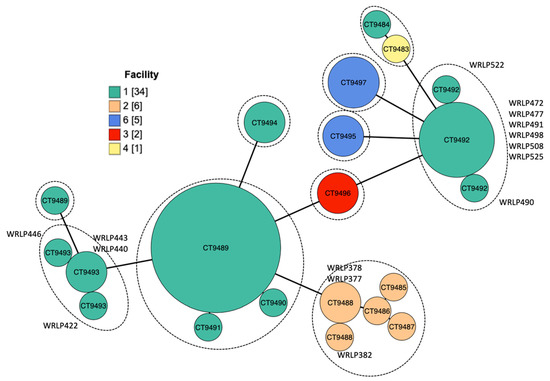
Recent listeriosis outbreaks linked to fresh produce suggest the need to better understand and mitigate L. monocytogenes contamination in packing and processing environments. Using whole genome sequencing (WGS) and phenotype screening assays for sanitizer tolerance, we characterized 48 L. monocytogenes isolates previously recovered from environmental samples in five produce handling facilities. Within the studied population there were 10 sequence types (STs) and 16 cgMLST types (CTs). Pairwise single nucleotide polymorphisms (SNPs) ranged from 0 to 3047 SNPs within a CT, revealing closely and distantly related isolates indicative of both sporadic and continuous contamination events within the facility. Within Facility 1, we identified a closely related cluster (0–2 SNPs) of isolates belonging to clonal complex 37 (CC37; CT9492), with isolates recovered during sampling events 1-year apart and in various locations inside and outside the facility. The accessory genome of these CC37 isolates varied from 94 to 210 genes. Notable genetic elements and mutations amongst the isolates included the bcrABC cassette (2/48), associated with QAC tolerance; mutations in the actA gene on the Listeria pathogenicity island (LIPI) 1 (20/48); presence of LIPI-3 (21/48) and LIPI-4 (23/48). This work highlights the potential use of WGS in tracing the pathogen within a facility and understanding properties of L. monocytogenes in produce settings. View Full-Text

RASFF Alert- High Microbial Count- Food Supplement

RASFF

High microbial count in food supplement from Italy in San Marino

RASFF Alerts – Animal Feed – Salmonella – Rapeseed Expeller

RASFF

Salmonella spp. in organic rapeseed expeller from Italy in Germany

RASFF

Salmonella Havana in rapeseed expeller from Germany in Denmark

EU – EU helps strengthen food safety controls in Bosnia and Herzegovina

Food Safety News

The European Union is providing more than 30 vehicles for use by authorities in Bosnia and Herzegovina for phytosanitary inspections as well as food controls and monitoring.

The 33 new off-road vehicles worth €467,000 ($540,000) will be used by authorities in the country to support alignment with EU standards. Bosnia and Herzegovina is not yet an EU member country.

Food and feed chain monitoring will be faster, the delay from taking a sample during border inspections until the final analysis will be shortened, and the time spent on issuing phytosanitary certificates will be reduced.

Research – O148 Shiga toxin-producing Escherichia coli outbreak: microbiological investigation as a useful complement to epidemiological investigation

Core

An outbreak of Shiga toxin-producingEscherichia coli(STEC) O148 infection occurred among weddingattendees in France in June 2002. A retrospective cohort study was performed and ten cases wereidentified, including two adults with haemolytic uraemic syndrome (HUS). The analytical studyrevealed that > 80%of affected individuals had eaten lightly roasted mutton and poultry paˆte ́, but onlythe consumption of paˆte ́tended to be associated with illness (relative risk 3.4; 95%CI 0.8–14.4). Left-overs (cooked mutton and raw offal) and processed foods (paˆte ́) from the same batches as served at theparty were sampled. Human, food and environmental samples were examined for the Shiga toxin (stx)gene and virulence traits by PCR.Stx-positive samples were cultured for STEC. HUS cases were testedfor serum antibodies against 26 major STEC serogroups. An STEC O26 strain (stx1,eae,ehxA) wasisolated from one case with diarrhoea, and an STEC O148 strain (stx2c) from one case of HUS. Serumantibodies against O26 were not detected in either of these patients; antibodies against O148 were nottested. Three STEC strains were isolated from the mutton and the offal (stx2c, O148), and two from thepaˆte ́(stx2c, O-X and O-Y). The isolates from the mutton were indistinguishable from the humanstx2cisolate, whereas the paˆte ́isolates differed. Although four different STEC strains were identified inpatients and foods, the results of molecular subtyping, in conjunction with analysis of food consumptionpatterns, strongly suggested that this outbreak was caused by mutton contaminated with STEC O148.