Category Archives: microbial contamination

Reusable Food Containers and Food Safety

Food Safety Council

The Food Safety Information Council today issued advice about safely using reusable food containers, especially as they are gaining acceptance with food retailers.

Cathy Moir, Council Chair, said whether it is your coffee keep cup, refillable water bottle, or if you are taking your own container to the deli, take away or cafe we need to follow some safety tips to make sure we aren’t increasing cases of food poisoning.

‘We support the reduction of singe use plastics but not at the expense of increasing the number of cases of food poisoning. For example, we support the use of thin plastic bags to stop the contamination of ready to eat salad vegetables at the checkout or loose in supermarket trolleys.’ Ms Moir said.

‘But you need to follow these 6 simple tips to keep your food safe:

  1. Make sure the container is easy to keep clean and that you clean it thoroughly with hot water and detergent (or in the dishwasher) between uses. Some types of containers, such as plastic takeaway food containers are only meant for single use or are very difficult to clean so are not suitable to reuse as a food container.
  2. Your container must have a sealable lid that won’t leak and have removable seals for easy cleaning. This is especially important for raw meat that could drip onto other food.
  3. Stick to the rules of the retailer, for example, some retailers won’t accept glass or ceramic containers in case they are dropped and shatter.
  4. Where your retailer doesn’t offer plastic ‘barrier’ bags for fruit and vegetables, that won’t be cooked before eating, take your own washable bag and, as always, thoroughly rinse the fruit and veggies under running water before use. If you do use a plastic produce bag remember that soft plastics can be recycled at RED facilities in many major supermarkets.
  5. If you are purchasing hot food or taking a ‘doggy bag’ of leftovers home from a restaurant transport the food in an insulated bag and use or refrigerate within 2 hours. Make sure the container you use is suitable for reheating in the microwave or oven. Leftovers will last 2 to 3 days in the fridge and should be reheated to 75°C or using the microwave reheat auto function.
  6. Discard your plastic container once it shows signs of wear and tear as cracks, breaks, scores in the plastic can allow contaminants to enter or make the container difficult to clean. This may allow chemicals to migrate into the food or contaminate it with shards of plastic.

‘Finally, don’t forget to empty and wash your reusable water bottles daily after use to prevent bacteria, and even fungi, growing inside the bottle from it touching your mouth or even leaving a half-finished bottle lying about at room temperature. Use hot water and a bottle brush then allow the bottle to air dry thoroughly before refilling or put it in the dishwasher if the bottle is dishwasher safe. If you use a water bladder when jogging or cycling you can clean it with hot water and two tablespoons of baking soda or bleach, hold the bladder up and pinch the bite valve so the solutions runs into the tube, then leave for 30 minutes. Then rinse with clean water. Some brands also sell cleaning tablets to use,’ Ms Moir concluded.

Media contact: Lydia Buchtmann, Food Safety Information Council, 0407 626 688 or info@foodsafety.asn.au

Research – WHO wants help to estimate foodborne disease burden

Food Safety News

The World Health Organization (WHO) has called for help as part of work to estimate the burden of foodborne disease.

WHO is seeking support from independent consultants or groups of experts with relevant experience to undertake systematic reviews and other studies on foodborne illness. The process is part of collecting and assessing available evidence.

One call is for the review and evidence synthesis of diarrheal diseases and deaths caused by 14 pathogens commonly transmitted by food. The other covers global expert elicitation for attribution of burden of disease to foodborne transmission and to specific foods.

The WHO Foodborne Disease Burden Epidemiology Reference Group (FERG) was reconvened in May 2021 to update global estimates published in 2015. This group has already met three times in July and October 2021, and April 2022. A new report is expected in 2025.

Research – Campylobacter Retailer Survey

Lex blog

Campylobacter kswfoodworld

Lidl has reported Campylobacter in chicken levels above the FSA’s target for the second quarter of 2022.

The supermarket chain recorded 8 percent of birds in the highest category which is up from 2 percent in the previous quarter and 6 percent in the period before that.

The Food Standards Agency (FSA) maximum level is 7 percent of birds with more than 1,000 colony forming units per gram (CFU/g) of Campylobacter.

Data from all nine retailers covers April to June 2022 on high findings of Campylobacter in fresh, shop-bought, UK-produced chickens.

Results at Lidl and Asda went up while Sainsbury’s, Marks and Spencer, Morrisons, Waitrose and Aldi recorded lower levels of contamination compared to the previous quarter. Figures for Tesco and Co-op stayed the same.

Research – Legionnaires’ disease – Annual Epidemiological Report for 2020 Research –

ECDC

CDC legionella

Executive summary

  • Legionnaires’ disease remains an uncommon and mainly sporadic respiratory infection with an overall notification rate of 1.9 cases per 100 000 population for the EU/EEA in 2020.
  • A small decrease in the annual notification rate was observed, down from the 2.2 cases per 100 000 population reported in 2019.
  • Notification rates remained heterogenous across the EU/EEA, varying from fewer than 0.5 cases per 100 000 population to 5.7 cases per 100 000 population, with the highest rate reported by Slovenia.
  • Four countries (France, Germany, Italy and Spain) accounted for 72% of all notified cases.
  • Males aged 65 years and older were most affected (7.1 cases per 100 000 population).
  • The number of reported cases to the travel-associated surveillance scheme decreased by 67% in 2020 compared with 2019.
  • Only 10% of cases were culture confirmed (10%), likely leading to underestimation of disease caused by Legionella species other than Legionella pneumophila.

Luxembourg – RECALL: 0% SUGAR SWEET CHILI SAUCE – Lactic Acid Bacteria

SAP

RECALL: 0% SUGAR SWEET CHILI SAUCE

Potential presence of lactic acid bacteria causing the packaging to swell

Action is recalling the following product:

Last name 0% Sugar Sweet Chilli Sauce
Unity 250ml
bar code 8718836395338
Use-by date (DLC) 01/01/2024; 02/01/2024; 03/01/2024

Danger  : Abnormal development of lactic acid bacteria that can cause the packaging to swell

The development of lactic acid bacteria can cause the packaging to swell. The product itself does not generally pose a risk to public health if consumed.

The Food Safety Division advises, however, not to consume this product and to return it to the distributor. 

India – 20 students fall ill due to suspected food poisoning

The Hindu

As many as 20 students of Social Welfare Residential school located at Dubbak in Siddipet district fell ill on Friday, due to suspected food poisoning.

The students complained about stomach pain and symptoms of fever, according to sources.

District Medical and Health Officer (DM&HO) Kashinath along with medical teams rushed to the hostel and was treating the students.

The students told the treating doctors that they have developed these health issues after consuming Payasam the day before yesterday, the DM&HO said that there might be some other reasons, including water contamination, but they could not confirm it till medical tests were completed.

There are some 400 students studying in the school and according to locals some of the students have been suffering with seasonal fevers. Some students have complained that they have been not receiving proper food despite repeated appeals.

Research – Virulence Characteristics and Distribution of the Pathogen Listeria ivanovii in the Environment and in Food

MDPI

Listeria ivanovii and L. monocytogenes, are the only pathogenic species of the genus Listeria and share many virulence factors and mechanisms of pathogenicity. L. ivanovii shows host tropism towards small ruminants and rodents and much lower virulence for humans compared to L. monocytogenes. However, severe infections caused by L. ivanovii, resulting in bacteremia, abortion and stillbirth, occasionally occurred in immunocompromised persons and in pregnant women, while in immunocompetent hosts L. ivanovii can cause gastroenteritis. In this review, the updated knowledge on virulence aspects and distribution of L. ivanovii in the environment and in food is summarized. Recent research on its virulence characters at genome level gave indications on how pathogenicity evolved in this bacterial species. As for L. monocytogenesL. ivanovii infections occurred after the ingestion of contaminated food, so an overview of reports regarding its distribution in food products was carried out to obtain indications on the categories of foods exposed to contamination by L. ivanovii. It was found that a wide variety of food products can be a source of this microorganism and that, like L. monocytogenesL. ivanovii is able to persist in the food production environment. Studies on its ability to grow in enrichment and isolation media suggested that its occurrence in nature might be underestimated. Moreover, virulence varies among strains for differences in virulence character regulation, presence/absence of genetic regions and the possible instability of a Listeria pathogenicity genomic island, LIPI-2, which is unique to L. ivanovii. We can conclude that L. ivanovii, as a possible pathogen for animals and humans, requires more focused investigations regarding its occurrence in the environment and in food and on intra-species variability of pathogenic potential. View Full-Text

Research – Eco-Friendly Edible Packaging Systems Based on Live-Lactobacillus kefiri MM5 for the Control of Listeria monocytogenes in Fresh Vegetables

MDPI

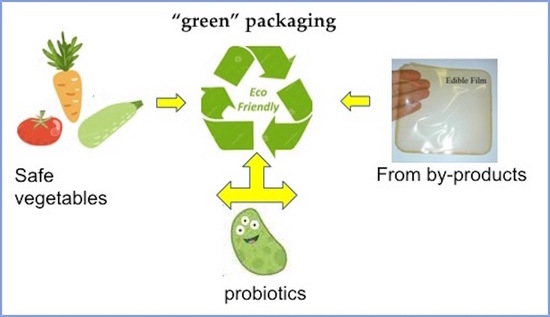
To meet consumer requirements for high quality food free of chemical additives, according to the principles of sustainability and respect for the environment, new “green” packaging solutions have been explored. The antibacterial activity of edible bioactive films and coatings, based on biomolecules from processing by-products and biomasses, added with the bacteriocin producer Lactobacillus kefiri MM5, has been determined in vegetables against L. monocytogenes NCTC 10888 (i) “in vitro” by a modified agar diffusion assay and (ii) “on food” during storage of artificially contaminated raw vegetable samples, after application of active films and coatings. Both polysaccharides-based and proteins-based films and coatings showed excellent antilisterial activity, especially at 10 and 20 days. Protein-based films displayed a strong activity against L. monocytogenes in carrots and zucchini samples (p < 0.0001). After 10 days, both polysaccharide-based and protein-based films demonstrated more enhanced activity than coatings towards the pathogen. These edible active packagings containing live probiotics can be used both to preserve the safety of fresh vegetables and to deliver a beneficial probiotic bacterial strain. The edible ingredients used for the formulation of both films and coatings are easily available, at low cost and environmental impact.

Research – Whole-Genome Analysis of Staphylococcus aureus Isolates from Ready-to-Eat Food in Russia

MDPI

This study provides a thorough investigation of a diverse set of antimicrobial resistant (AMR) Staphylococcus aureus isolates collected from a broad range of ready-to-eat (RTE) food in various geographic regions of Russia ranging from Pskov to Kamchatka. Thirty-five isolates were characterized using the whole genome sequencing (WGS) analysis in terms of clonal structure, the presence of resistance and virulence determinants, as well as plasmid replicon sequences and CRISPR/Cas systems. To the best of our knowledge, this is the first WGS-based surveillance of Russian RTE food-associated S. aureus isolates. The isolates belonged to fifteen different multilocus sequence typing (MLST)-based types with a predominant being the ones of clonal complex (CC) 22. The isolates studied can pose a threat to public health since about 40% of the isolates carried at least one enterotoxin gene, and 70% of methicillin-resistant (MRSA) isolates carried a tsst1 gene encoding a toxin that may cause severe acute disease. In addition, plasmid analysis revealed some important characteristics, e.g., Rep5 and Rep20 plasmid replicons were a “signature” of MRSA CC22. By analyzing the isolates belonging to the same/single strain based on cgMLST analysis, we were able to identify the differences in their accessory genomes marking their dynamics and plasticity. This data is very important since S. aureus isolates studied and RTE food, in general, represent an important route of transmission and dissemination of multiple pathogenic determinants. We believe that the results obtained will facilitate performing epidemiological surveillance and developing protection measures against this important pathogen in community settings. View Full-Text

Research – Insights into the Bacterial Diversity and Detection of Opportunistic Pathogens in Mexican Chili Powder

MDPI

Chili powder is the most frequently consumed spice in Mexican diets. Thus, the dissemination of microorganisms associated with chili powder derived from Capsicum annuum L. is significant during microbial quality analysis, with special attention on detection of potential pathogens. The results presented here describe the initial characterization of bacterial community structure in commercial chili powder samples. Our results demonstrate that, within the domain Bacteria, the most abundant family was Bacillaceae, with a relative abundance of 99% in 71.4% of chili powder samples, while 28.6% of samples showed an average relative abundance of 60% for the Enterobacteriaceae family. Bacterial load for aerobic mesophilic bacteria (AMB) ranged from 104 to 106 cfu/g, while for sporulated mesophilic bacteria (SMB), the count ranged from 102 to 105 cfu/g. Bacillus cereus sensu lato (s.l.) was observed at ca. ˂600 cfu/g, while the count for Enterobacteriaceae ranged from 103 to 106 cfu/g, Escherichia coli and Salmonella were not detected. Fungal and yeast counts ranged from 102 to 105 cfu/g. Further analysis of the opportunistic pathogens isolated, such as B. cereus s.l. and Kosakonia cowanii, using antibiotic-resistance profiles and toxinogenic characteristics, revealed the presence of extended-spectrum β-lactamases (ESBLs) and Metallo-β-lactamases (MBLs) in these organisms. These results extend our knowledge of bacterial diversity and the presence of opportunistic pathogens associated with Mexican chili powder and highlight the potential health risks posed by its use through the spread of antibiotic-resistance and the production of various toxins. Our findings may be useful in developing procedures for microbial control during chili powder production. View Full-Text