Category Archives: foodbourne outbreak

USA – Food Poisoning Outbreak in McHenry County, IL at D. C. Cobb’s

Food Poisoning Bulletin

A food poisoning outbreak in McHenry County, Illinois at D. C. Cobb’s restaurant has sickened at least 13 people, according to the McHenry County Health Department. That restaurant is located at 1204 North Green Street in McHenry.

Food Poisoning Outbreak in McHenry County, IL at D. C. Cobb’s

A food poisoning outbreak in McHenry County, Illinois at D. C. Cobb’s restaurant has sickened at least 13 people, according to the McHenry County Health Department. That restaurant is located at 1204 North Green Street in McHenry.

The outbreak was identified when public health officials reviewed complaints of people who got sick after eating at that establishment. An investigation into the pathogen that caused these illnesses, and the possible source of the pathogen has been launched.

Syria – Cholera outbreak

Jpost

Food Illness

cholera outbreak in several regions of Syria presents “a serious threat to people in Syria and the region”, the United Nations representative in the country said, calling for an urgent response to contain its spread.

The outbreak is believed to be linked to irrigation of crops using contaminated water and people drinking unsafe water from the Euphrates river which bisects Syria from the north to the east, UN Resident and Humanitarian Coordinator Imran Riza said in a statement.

Canada – Non-travel related Cyclospora infections under investigation – September 9, 2022

Public Health Notice

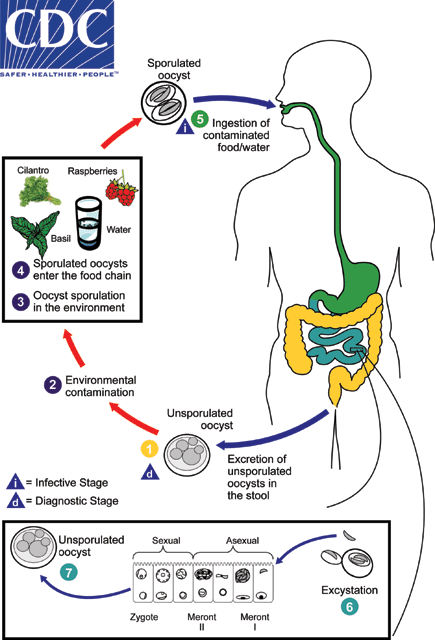
Each spring and summer, Canada sees an increase in non-travel related Cyclospora illnesses reported to the Public Health Agency of Canada (PHAC). PHAC is working with its public health and food safety partners to identify possible ways infections are occurring in Canada. Previous Cyclospora illnesses have been linked to various types of imported fresh produce, including pre-packaged salad mix, basil, cilantro, berries, lettuce, and snow and snap peas.

Learn more about the causessymptoms and risks of infection, as well as how to prevent and treat an illness.

At a glance
Investigation status Ongoing
Case count 310
Provinces/Territories
  • Alberta (1)
  • British Columbia (3)
  • Newfoundland and Labrador (3)
  • Ontario (252)
  • Quebec (51)
Hospitalizations 13
Deaths 0
Gender
  • 150 Males
  • 159 Females
  • Gender is unknown for 1 case
Age Range in Years 1-90
Recall No
Public Health Notice No

USA – E. coli at San Diego State University

Food Poison Journal

On Sept. 6, Student Health Services notified the SDSU community of two cases of Shiga Toxin-Producing E. coli (STEC) in the student community in one residential and one non-residential student.  These students began experiencing symptoms on Aug. 27 and 29, respectively.

At this time, a specific food source has not been identified for either of these cases. SDSU’s Environmental Health and Safety team is working closely with the County of San Diego Health & Human Services Agency to investigate these cases and to identify and confirm the potential source. Additional information will be shared with the community as it becomes available.

USA – Illinois county reports outbreak of infections from Campylobacter

Food Safety News

Campylobacter kswfoodworld

The McHenry County Department of Health in Illinois is reporting a significant increase in infections from Campylobacter.

Health officials have identified eight cases of campylobacteriosis with illness onsets between Aug. 17 and Aug. 30. That is four times more cases compared to the previous two weeks and 3.33 times more cases in August compared to July.

“No common source of infection has been identified at this time,” according to the health department.

Campylobacter bacteria is the most common cause of bacterial diarrhea in the United States, according to the county health officials. People can become ill with campylobacteriosis by eating contaminated food, drinking contaminated water or having contact with infected animals.

UK – Reading Festival: Investigation into food poisoning outbreak

BBC

An outbreak of food poisoning, after a number of festival-goers fell ill at Reading Festival, is being scrutinized.

Reading Borough Council said it was investigating following reports “relating to suspected food poisoning” at the festival.

Posting on the Reading Festival Community Facebook group, several festival-goers said they were suddenly struck down over the weekend with symptoms including diarrhoea, vomiting, stomach aches and a fever.

Some said they were forced to leave the festival as they were so unwell.

Research – Incidence of Food Poisoning Outbreaks in Pahang, Malaysia, for Six-Year, from 2013 to 2018

Pertanika

The Food Safety and Quality Division (FSQD) in Malaysia is the competent authority tasked with ensuring food safety throughout the food supply chain within the country. Despite implementing various regulations toward improving food hygiene standards in Malaysia, outbreaks of food poisoning cases continued to occur in Malaysia. This cross-sectional study was designed to explore the occurrence of food poisoning incidents in Malaysia, within the Pahang state, from 2013 to 2018 via both reported passive case detection (PCD) and active case detection (ACD) food poisoning incidents. Upon detecting all the food poisoning cases using both PCD and ACD, the people identified to have suffered from food poisoning underwent a structured interview for investigators to elicit all relevant information about the food poisoning incident. Results showed that in Pahang, the number of reported episodes fluctuated from 2013 until 2018, with an average of 21 food poisoning episodes occurring yearly, reaching a maximum in August and a minimum in May. Furthermore, Kuantan, being the state capital, had reported an exceptionally high total number of reported incidents of food poisoning with a total of 48 episodes over six years from 2013 to 2018, while Kuala Lipis had only one incident reported during the same period (which was reported in 2016). Finally, this study concluded that adequate measures must always be taken to minimise the occurrence of food poisoning, especially when preparing foods in large quantities.

Research – USA – Summary of Possible Multistate Enteric (Intestinal) Disease Outbreaks in 2017–2020

CDC

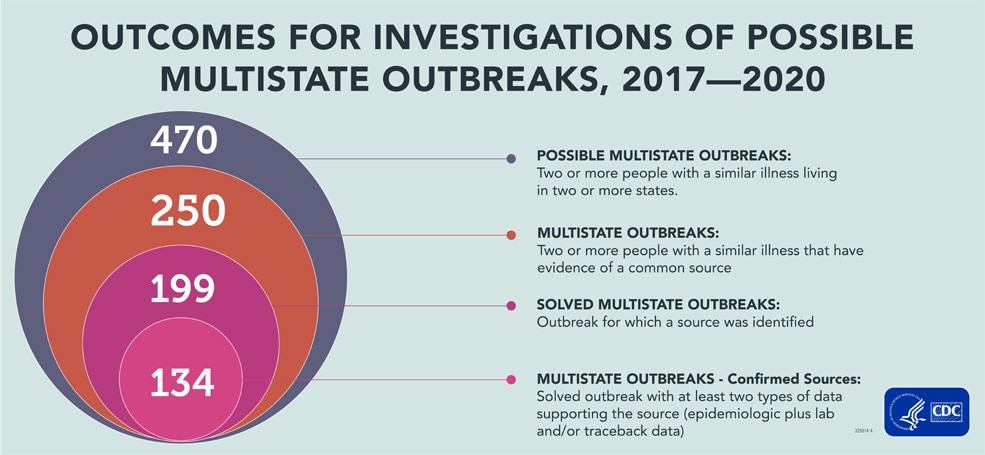
This analysis includes 470 possible multistate outbreak investigations during 2017–2020.

Research – Notes from the Field: Outbreak of Salmonella Enteritidis at a Correctional Facility Using Mechanically Separated Chicken — Nebraska, 2022

CDC

On January 14, 2022, the Lincoln-Lancaster County (Nebraska) Health Department (LLCHD) notified the Nebraska Department of Health and Human Services (NDHHS) of two cases of laboratory-confirmed Salmonella in inmates at a correctional facility (facility A). LLCHD initiated an investigation in collaboration with NDHHS to identify the source of the outbreak and develop recommendations. The investigation linked consumption of mechanically separated chicken to illness. Mechanically separated chicken, which is produced at chicken processing facilities by separating edible chicken from bone and cartilage under pressure, is frequently purchased for use in institutions, such as prisons, jails, and correctional facilities because of its affordability (1,2).

Staff members at facility A reported approximately 100 inmates experienced gastrointestinal symptoms during a period of a few days; no staff member reported illness. LLCHD conducted open-ended interviews with ill inmates. Because the facility was experiencing a concurrent outbreak of COVID-19, and access to inmates for interviews was limited, it is likely that additional cases existed among noninterviewed and untested inmates beyond the total cases identified in the investigation. Inmates who were designated food handlers were prioritized for interviews because of transmission risk to others; untested inmates were able to seek care through facility A medical staff. A probable case was defined as the onset of diarrhea, stomach cramps, or vomiting during January 9–11, 2022, but without a positive stool culture, in an inmate at facility A; a confirmed case was defined as isolation of Salmonella serotype Enteritidis highly related to the outbreak strain (within three alleles) by core genome multilocus sequence typing in a clinical specimen. LLCHD conducted an environmental assessment on January 15, 2022. A list of food handlers, food menus for January, and temperature logs were requested. During the environmental assessment, a sample of raw, unopened mechanically separated chicken from a 50-lb intact box from the same shipment used to prepare a meal on January 8, 2022, was collected for testing.

A total of 15 cases of S. Enteritidis infection were identifie

Ireland – Irish officials warn about rise in E. coli infections

Food Safety News

Health officials in the Republic of Ireland have issued a warning after an increase in E. coli cases and outbreaks in recent weeks.

The Department of Public Health Mid-West reported that in a four week period there have been more than 20 E. coli cases reported in the region, including several hospitalizations.

Public health teams have managed and investigated outbreaks and cases in households and rural settings, particularly on or near farms, and sites with access to a private well supply. Sources of infection are under investigation.

Officials also confirmed a “small number” of hemolytic uremic syndrome (HUS) cases. HUS is a type of kidney failure associated with E. coli infection.

The Mid-West region, which includes Clare, Limerick and North Tipperary, has one of the top rates of E. coli in the country, and Ireland has one of the highest rates in Europe.

In the past decade, there have been 1,250 cases of E. coli in the Mid-West region, with the highest number being 164 infections in 2021.

Infection can be acquired through contact with farm animals or their environment, from eating unwashed or undercooked contaminated food, drinking water from contaminated sources, and from contact with infected people such as in household or childcare settings where there are nappy changing or shared toilet facilities.

Meanwhile, an E. coli outbreak in Scotland has affected at least 50 people. Two nurseries in East Lothian have now reopened. Some patients were hospitalized but most people had mild symptoms and did not require hospital treatment.

Public Health Wales also recently reported an increase in cases of diarrhea and vomiting, specifically those caused by E. coli, in the Wrexham and Flintshire areas.