Category Archives: foodbourne outbreak

Research – Researchers identify seasonal peaks for foodborne infections

Eureka Alert

Each year, thousands of pounds of food are wasted and billions of dollars in food sales lost because of recalls tied to foodborne infections. Using a newly developed approach, researchers identified seasonal peaks for foodborne infections that could be used to optimize the timing and location of food inspections.

“We rely upon food producers, distributors and retailers to keep food safe in fields, grocery stores and restaurants,” said Ryan B. Simpson, doctoral candidate at Tufts University Friedman School of Nutrition Science and Policy. “A lapse in food safety practices during any step in the food delivery and supply chain can jeopardize human health, waste food resources and threaten the national food economy.”

Foodborne infections can be caused by a variety of pathogens, such as Listeria, Salmonella and E. Coli. A single pathogen can lead to outbreaks that peak in different states at different times. Knowing the patterns for each pathogen and state could be used to design an optimized schedule for food safety inspections.

To characterize the timing and intensity of infection peaks, Simpson and colleagues developed an analysis method that robustly determines which specific pathogens are likely to cause an outbreak at a given time.

Simpson will present the new analysis method as part of NUTRITION 2020 LIVE ONLINE, a virtual conference hosted by the American Society for Nutrition (ASN). The research was performed under the supervision of Elena N. Naumova, Chair of the Department of Nutritional Epidemiology and Data Sciences at Tufts University Friedman School of Nutrition Science and Policy.

Using their new analysis method, the researchers found that although foodborne outbreaks typically peak in July, food recalls are delayed by 1 to 2 months, peaking from mid-August through mid-September. These findings were consistent across examined states and pathogens.

Next, the researchers aim to refine their analysis method by exploring specific foods and food groups linked to foodborne outbreaks. They also plan to examine relationships between outbreaks for particular pathogens with food preparation practices and other factors.

“Our future research will provide valuable information that could help refine existing food safety policies while also aiding food producers, distributors and retailers in preventing or mitigating foodborne outbreaks,” said Simpson.

###
Ukraine – Salmonella outbreak reported in Zaporizhia

Outbreak News Today

Health officials in Ukraine report investigating a Salmonella outbreak in the southeastern Ukraine city of Zaporizhia. Twelve cases have been hospitalized with salmonellosis and sources of infection are being investigated  to include food, drinking and wastewater.

A few days before hospitalization, all the victims ate in the same cafeteria.

Contact persons are also interviewed and surveyed. Final disinfection was organized in the hearth at the place of residence of sick people. Anti-epidemic measures continue.

Canada -Raw Beef and Veal Recall For E. coli O157:H7 in Canada Updated

Food Poisoning Bulletin

The food recall warning for raw beef and veal for E. coli O157:H7 in Canada that was issued on October 17, 2020 and many other dates has been updated with more information. This information was discovered during the Canadian Food InspectionAgency’s food safety investigation. The investigation has been closed.

You can see the long list of recalled products at the CFIA web site. The products include beef bone-in hind shank, beef back ribs, fresh beef, choice grain-fed veal scallopine (frozen), ground beef, boneless veal shank, flat iron, rump roast, beef liver, beef top sirloin, and boneless beef brisket, among others.

USA – Blue Bell Directors Reach $15 Million Listeria-Outbreak Deal

Bloomberg

Blue Bell Creameries Inc. directors agreed to a $15 million settlement resolving claims that their alleged mismanagement led to a 2015 listeria outbreak that forced the ice-cream maker to recall all products.

The deal means a Blue Bell shareholder won’t get a chance at an April 27 trial to determine whether Blue Bell’s board did enough to oversee the cleanliness of the company’s plants. Delaware Chancery Court Judge Joseph Slights III must approve the deal.

Blue Bell officials agreed to settle to cut down the “expense, inconvenience and distraction” the listeria allegations caused, according to a filing Friday in Chancery Court. The $15 million in cash will be returned to the company under the terms of the deal.


RASFF Alert – Salmonella – Foodborne Outbreak – Frrance – VP Cooked Sliced Pork Shoulder

RASFF-Logo

RASFF – foodborne outbreak suspected to be caused by and Salmonella (presence /25g) in chilled vacuum-packed cooked sliced pork shoulder from Spain in France

USA – Chipotle hit with $25 Million Food Safety Fine for Norovirus, Clostridium Perfringens Outbreaks

Food Poison Journal

“Although there is no intentional criminal behavior like there was in the Peanut Corporation of America case that sickened several hundred, killing nine, this hefty food safety fine for negligence, should clearly send a message to the restaurant industry,” said Marler Clark attorney, William Marler.

According to a US Attorney press release today, Chipotle Mexican Grill Inc. will pay $25 million to resolve criminal charges related to the company’s involvement in foodborne illness outbreaks that sickened more than 1,100 people between 2015 and 2018.

The $25 million criminal fine, the largest ever in a food safety case.

Chipotle was implicated in at least five foodborne illness outbreaks between 2015 and 2018 connected to restaurants in the Los Angeles area, Boston, Virginia, and Ohio.  These incidents primarily stemmed from store-level employees’ failure to follow company food safety protocols at company-owned restaurants, including a Chipotle policy requiring the exclusion of employees who were sick or recently had been sick.

USA – At least 5 people in NJ hospitalized amid romaine lettuce E. coli outbreak

Grunt Stuff

At least 5 people in New Jersey have been hospitalized after consuming romaine lettuce contaminated with E. coli micro organism, because the nationwide outbreak has now jumped to greater than 100 instances, the state well being division confirmed Thursday.

A complete of seven people from Atlantic, Burlington, Camden, Cumberland and Ocean counties have been contaminated with the possibly lethal pressure, which brought on 75,233 kilos of bagged salad merchandise in 22 states to be recalled in final month.

France – New report documents rise in foodborne illness outbreaks in France

Food Safety News

More than 1,600 foodborne outbreaks were declared in France in 2018 affecting 14,700 people with two deaths, according to statistics published by the national public health agency.

A total of 1,630 illness outbreaks were reported involving 14,742 people, and 777 of them needed hospital treatment.

Santé Publique France said the number has gone up from 2017 when 1,310 outbreaks were recorded affecting 13,010 people.

The two people that died were more than 85 years old. The first death was because of microbiologically confirmed poisoning from Bacillus cereus. The second followed intoxication where Bacillus cereus and Clostridium perfringens were suspected.

USA – Outbreak Investigation of Listeria monocytogenes: Enoki Mushrooms (March 2020)

FDA

Recommendation

Consumers should not eat and should check their refrigerators and throw away any recalled enoki mushrooms from Sun Hong Foods, Inc., Guan’s Mushroom Co., and H&C Food, Inc. because they may be contaminated with Listeria monocytogenes.

Restaurants and retailers should not sell or serve recalled enoki mushrooms distributed by Sun Hong Foods, Inc., Guan’s Mushroom Co., and H&C Food, Inc.

FDA recommends that anyone who received recalled products use extra vigilance in cleaning and sanitizing any surfaces and containers that may have come in contact with these products to reduce the risk of cross-contamination. Listeria can survive in refrigerated temperatures and can easily spread to other foods and surfaces.

At this time, high risk groups, including the elderly, people with weakened immune systems or chronic diseases, pregnant women and their newborn babies, should not eat enoki mushrooms from Korea (Republic of Korea), even if they were not part of the recalls.

Consumers, restaurants, retailers, and high risk groups should discard and not eat, sell, or serve enoki mushrooms if they cannot tell where they came from.

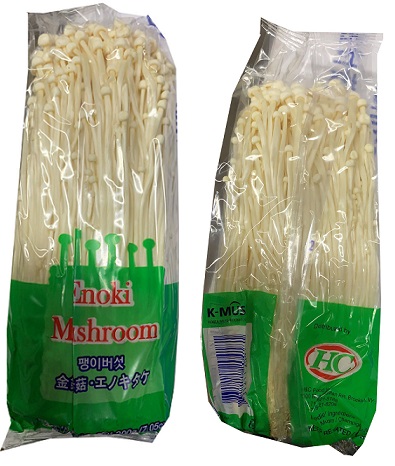
H&C Food Inc Enoki Mushrooms


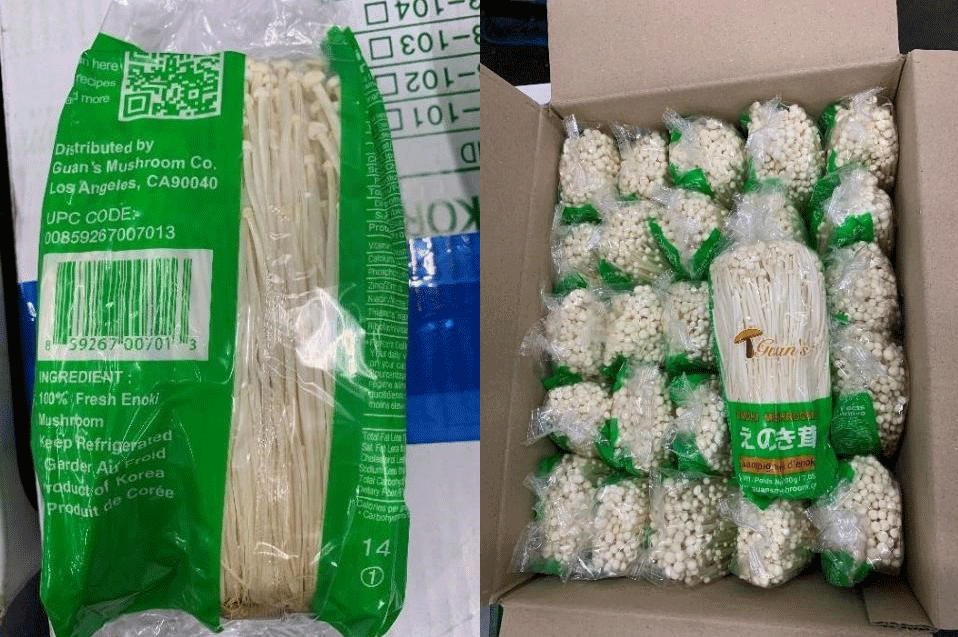
Guan’s Mushroom Co.
Guan’s Mushroom Co.
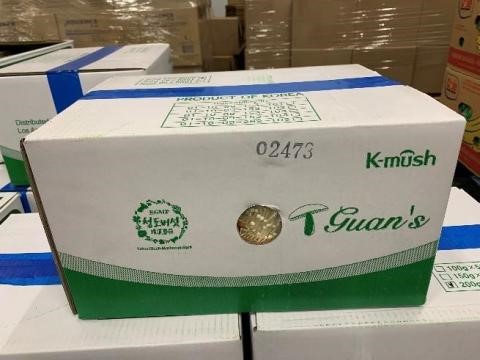
Picture of enoki mushroom case
Sample Enoki Mushrooms Imported from Korea
Company Size UPC Code Retailers* Distribution*
Sun Hong Foods, Inc. 200 g/ 7.05 oz. 7 426852 625810 J&L Supermarket, Jusgo Supermarket, ZTao Market, New Sang Supermarket, Galleria Market, Distributors CA, FL, IL, OR, TX, WA
Guan’s Mushroom Co. 200 g/ 7.05 oz. 859267007013 Sold to Distributors and Wholesalers CA, NY, PA
H&C Food Inc. 200 g/ 7.05 oz. 831211204181 Great Wall Supermarket NY, MD, VA

*This includes confirmed distribution information from companies; products could have been further distributed and sent to additional retailers and states.

Update

FDA, CDC, and state and local partners are currently investigating a multistate outbreak of Listeria monocytogenes infections linked to enoki mushrooms. Enoki mushrooms are a long thin white mushroom, usually sold in clusters. They are especially popular in East Asian cuisine and are also known as enokitake, golden needle, futu, or lily mushrooms.

On April 7, 2020, H&C Foods Inc. recalled 200 g/7.05 oz packages of enoki mushrooms imported from Green Co. LTD of the Republic of Korea. FDA import samples of enoki mushrooms from Green Co. LTD tested positive for Listeria monocytogenes and on April 6, 2020, whole genome sequencing analysis determined that the Listeria monocytogenes found in the positive samples matched the outbreak strain. As a result, On April 7, 2020, Green Co. LTD was placed on Import Alert 99-23, which flags imported shipments from this firm for potential detention without physical examination. The FDA is encouraging the international community to consult the Import Alert.

The investigation is ongoing to determine the source of contamination and if additional products are linked to illness. Additional information will be provided as it becomes available.


Case Counts

Total Illnesses: 36
Hospitalizations: 30
Deaths: 4
Illness Onset Date Range: November 23, 2016 – December 13, 2019
States with Cases: AZ (2), CA (9), FL (2), HI (3), IN (1), KY (1), MA (2), MD (2), MI (1), MO (1), NC (1), NJ (1), NV (1), NY (4), RI (1), TN (1), VA (3)
Product Distribution*: CA, FL, IL, NY, MD, OR, PA, TX, VA, WA
*States with confirmed distribution; product could have been distributed further

USA – Outbreak Investigation of Listeria monocytogenes: Enoki Mushrooms (March 2020)

FDA

Case Counts

Total Illnesses: 36
Hospitalizations: 30
Deaths: 4
Illness Onset Date Range: November 23, 2016 – December 13, 2019

Recommendation

Consumers should not eat and should check their refrigerators and throw away any recalled enoki mushrooms from Sun Hong Foods, Inc., Guan’s Mushroom Co., and H&C Food, Inc. because they may be contaminated with Listeria monocytogenes.

Restaurants and retailers should not sell or serve recalled enoki mushrooms distributed by Sun Hong Foods, Inc., Guan’s Mushroom Co., and H&C Food, Inc.

FDA recommends that anyone who received recalled products use extra vigilance in cleaning and sanitizing any surfaces and containers that may have come in contact with these products to reduce the risk of cross-contamination. Listeria can survive in refrigerated temperatures and can easily spread to other foods and surfaces.

At this time, high risk groups, including the elderly, people with weakened immune systems or chronic diseases, pregnant women and their newborn babies, should not eat enoki mushrooms from Korea (Republic of Korea), even if they were not part of the recalls.

Consumers, restaurants, retailers, and high risk groups should discard and not eat, sell, or serve enoki mushrooms if they cannot tell where they came from.

H&C Food Inc Enoki Mushrooms


Guan’s Mushroom Co.
Guan’s Mushroom Co.
Picture of enoki mushroom case
Sample Enoki Mushrooms Imported from Korea
Company Size UPC Code Retailers* Distribution*
Sun Hong Foods, Inc. 200 g/ 7.05 oz. 7 426852 625810 J&L Supermarket, Jusgo Supermarket, ZTao Market, New Sang Supermarket, Galleria Market, Distributors CA, FL, IL, OR, TX, WA
Guan’s Mushroom Co. 200 g/ 7.05 oz. 859267007013 Sold to Distributors and Wholesalers CA, NY, PA
H&C Food Inc. 200 g/ 7.05 oz. 831211204181 Great Wall Supermarket NY, MD, VA

*This includes confirmed distribution information from companies; products could have been further distributed and sent to additional retailers and states.

Update

FDA, CDC, and state and local partners are currently investigating a multistate outbreak of Listeria monocytogenes infections linked to enoki mushrooms. Enoki mushrooms are a long thin white mushroom, usually sold in clusters. They are especially popular in East Asian cuisine and are also known as enokitake, golden needle, futu, or lily mushrooms.

On April 7, 2020, H&C Foods Inc. recalled 200 g/7.05 oz packages of enoki mushrooms imported from Green Co. LTD of the Republic of Korea. FDA import samples of enoki mushrooms from Green Co. LTD tested positive for Listeria monocytogenes and on April 6, 2020, whole genome sequencing analysis determined that the Listeria monocytogenes found in the positive samples matched the outbreak strain. As a result, On April 7, 2020, Green Co. LTD was placed on Import Alert 99-23, which flags imported shipments from this firm for potential detention without physical examination. The FDA is encouraging the international community to consult the Import Alert.

The investigation is ongoing to determine the source of contamination and if additional products are linked to illness. Additional information will be provided as it becomes available.