Category Archives: foodbourne outbreak

EU – Kinder Chocolate Salmonella Typhimurium Outbreak sickens over 200 in Europe – International outbreak of Salmonellosis in young children linked to the consumption of Kinder brand products. Update on April 20, 2022.

Sante Publique

Update on 20/04/22 following the recall of several products from the Kinder range manufactured in a factory in Belgium due to suspected contamination by  Salmonella Typhimurium.

Following the investigations carried out by the Belgian health authorities, together with their English, European and in particular French counterparts, the company Ferrero proceeded on April 5, 2022 to the recall of several Kinder range products manufactured in a factory in Belgium due to suspected contamination by Salmonella Typhimurium . On April 8, 2022, the recall finally affected all Kinder products from this factory, regardless of their expiry date. On April 14, 2022, an update of the recalled products, including the 2021 Christmas Advent Calendars, was released.

Case of salmonellosis in France: update on April 20, 2022

In total, as of 04/19/2022: 42 cases of salmonellosis with a strain belonging to the epidemic have been identified by the National Reference Center (CNR) for salmonella at the Institut Pasteur in France. 

The 42 cases are spread over 11 regions: Ile-De-France (7 cases), Provence-Alpes-Côte d’Azur (7 cases), Grand-Est (6 cases), Hauts-de-France (4 cases), Auvergne-Rhône-Alpes (4 cases), Nouvelle-Aquitaine (3 cases), Bourgogne-Franche-Comté (3 cases), Normandy (3 cases), Brittany (2 cases), Occitanie (2 cases), and Corsica (1 cases), with a median age of 3 years, and involved 22 boys and 20 girls.

Thirty-two cases were able to be questioned by Public Health France. All the cases report, before the onset of their symptoms (which occurred between 20/01 and 23/03/2022), the consumption of chocolates of the brand cited here.

Thirteen people were hospitalized for their salmonellosis, all discharged since. No deaths were reported. Public Health France is continuing its investigations with the families of cases recently reported by the CNR. 

The successive withdrawals and recalls of the Kinder brand products concerned, produced by the Belgian factory with its closure by the Belgian authorities, should limit the occurrence in France of new cases of salmonellosis in the coming days/weeks. 

To find out the list of products concerned by the withdrawal-recall: https://rappel.conso.gouv.fr/

People who have consumed the products mentioned above and who present symptoms (gastrointestinal disorders, fever within 72 hours of consumption), are invited to consult their doctor without delay, notifying him of this consumption.

In order to limit person-to-person transmission (especially in households with young children), it is recommended to wash your hands well with soap and water after using the toilet, after changing your child, and before to cook.

Situation internationale

See the previous points

Germany -Officials admit failures in German Listeria outbreak

Food Safety News

Officials in a German district have apologized for mistakes made as part of an investigation into a Listeria outbreak in which one person died.

Four people were infected between October 2021 and January this year but the person died with, not because of, listeriosis. Contaminated cucumbers from one company have been linked to the illnesses.

Thomas Will, Groß-Gerau district administrator and Walter Astheimer, district health officer, said in the past two and a half years, there have been significant gaps in food controls and this had been a big mistake with hygiene deficiencies overlooked.

“We deeply regret that food contaminated with Listeria could come into circulation and several people fell ill because a company in Gernsheim was not properly checked for two years,” they said.

The company should have been checked more often but inspections were running behind because of the COVID-19 pandemic and a lack of staff resources.

EU – 19 April update: Monophasic Salmonella Typhimurium outbreak

ECDC

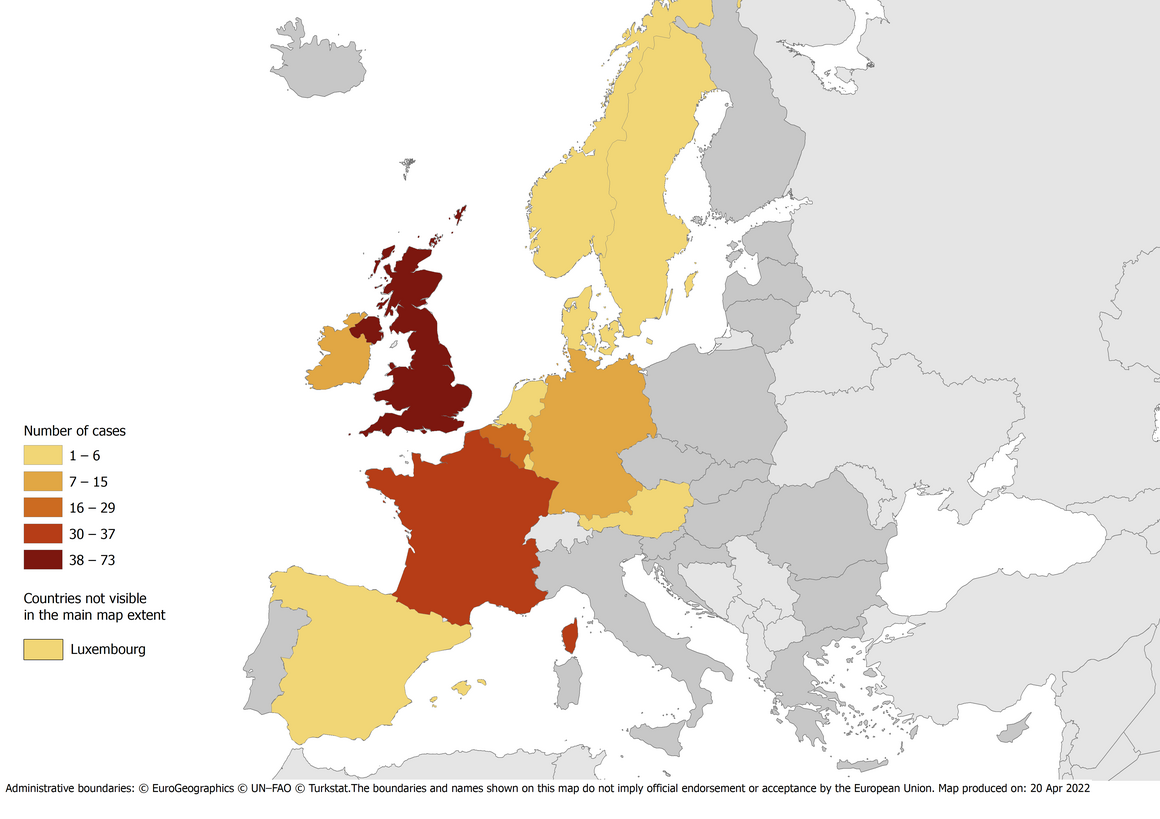
As of 19 April 2022, an outbreak of 187 confirmed and probable cases of monophasic S. Typhimurium (cluster 1) has been identified in the EU/EEA and the United Kingdom.

Number of confirmed and probable cases* with monophasic S. Typhimurium infection by country, EU/EEA and the UK, as of 19 April 2022

The outbreak is characterised by an unusually high proportion of children being hospitalised, some with severe clinical symptoms such as bloody diarrhoea. Based on interviews with patients and initial analytical epidemiological studies, specific chocolate products have been identified as the likely route of infection. Affected cases have been identified through advanced molecular typing techniques. As this method of testing is not routinely performed in all countries, some cases may be undetected.

Product recalls have been launched globally and examples of these can be found on several countries web sites including BelgiumFranceGermanyIrelandLuxembourgNetherlandsNorway, and the UK. The recalls aim to prevent the consumption of products potentially contaminated with Salmonella. Further investigations are being conducted by public health and food safety authorities in countries where cases are reported, to identify the cause and the extent of the contamination, and to ensure contaminated products are not put on the market.

ECDC and EFSA published a rapid outbreak assessment on 12 April 2022. The second strain of monophasic S. Typhimurium in non-human samples (cluster 2), which is mentioned in the published ROA, was found matching with 23 human cases from Belgium (n=5), France (n=5), Germany (n=4), Ireland (n=1), the Netherlands (n=1), and the UK (n=7).

Questions regarding ongoing product recalls should be addressed to national food safety authorities.

Number of confirmed and probable cases* with monophasic S. Typhimurium infection (cluster 1) by country, EU/EEA and the UK, as of 19 April 2022

Country Confirmed cases Probable cases Total cases
Austria 5 1 6
Belgium 7 22 29
Denmark 1 0 1
France 37 0 37
Germany 11 3 14
Ireland 15 0 15
Luxembourg 1 1 2
Netherlands 2 0 2
Norway 1 0 1
Spain 1 2 3
Sweden 4 0 4
Total EU/EEA 85 29 114
United Kingdom 73 0 73
Total 158 29 187

*According to the European outbreak case definition

UK – UKHSA update on Salmonella cases linked to confectionary products

Gov UK

Investigating an ongoing outbreak linked to certain Kinder products made by Ferrero. The majority of the cases are children under 5 years of age.

Latest

The UK Health Security Agency (UKHSA) is continuing to work with the Food Standards Agency, Food Standards Scotland, Public Health Scotland, Public Health Wales, Public Health Agency Northern Ireland – as well as international public health and food safety authorities – to investigate an ongoing outbreak of salmonella linked to certain Kinder products made in one of Ferrero’s factories, in Arlon, Belgium.

As of 20 April, there are 73 cases linked to this outbreak in the UK. The majority of the cases are children under 5 years of age.

We continue to remind people that a range of Kinder Egg products and Schoko-Bon’s should not be eaten.

Full details on the products affected and the recall can be found here.

Further information on case numbers in all affected countries can be found at the European Centre for Disease Prevention and Control (ECDC).

Previous

15 April 2022

As we enter the bank holiday weekend, the Food Standards Agency (FSA), Food Standards Scotland (FSS) and the UK Health Security Agency (UKHSA) are strongly reminding people that a range of Kinder Egg products and Schoko-Bon’s should not be eaten.

The agencies are continuing to work with Public Health Scotland, Public Health Wales, Public Health Agency Northern Ireland – as well as international public health and food safety authorities – to investigate an ongoing outbreak of salmonella linked to certain Kinder Egg product ranges and Schoko-Bons produced at one of the Ferrero company’s factories, in Arlon, Belgium.

Full details on the products affected and the recall can be found here.

As of 15 April, there are 70 cases linked to this outbreak in the UK. The majority of the cases are in children under 5 years of age.

Dame Jenny Harries, Chief Executive of UKHSA, said:

We’re reminding people of the recall this bank holiday weekend as it’s possible these products have been bought and stored as gifts, or for events such as Easter trails.

It’s crucial these products are not eaten and are discarded. Salmonella infection can be severe and many children affected in this outbreak have been very unwell and hospitalised, so anyone giving chocolate products to friends or family should take extra care to ensure their Easter gifts are not amongst those products recalled.

Thank you to parents and guardians  who worked with us and other public health authorities in the UK to tell us what their children had eaten prior to becoming unwell – this allowed us to rapidly pinpoint a potential source of infection and helped food chain investigations both in this country and in Europe. We understand this has been a worrying time for these families, and their responses have helped to prevent more children and vulnerable adults being affected.

Emily Miles, Chief Executive of the Food Standards Agency, said:

As we go into the Easter weekend, we are strongly urging consumers to follow the advice in the latest recall notice and to check any Kinder products they might have already bought against the list detailed in the notice, as they may pose a risk to health. If they do have any products on the list, they should not eat them and should discard them immediately.

We have emphasised to the business and the authorities in Belgium the importance of taking a precautionary approach to their recall and trust that they will continue to put consumers’ needs first in any action they take.

Symptoms of salmonellosis – or infection with salmonella – typically resolve themselves within a few days. However, symptoms can be more severe, especially in young children, those who are pregnant and those with weakened immune systems.

Anybody with concerns that they have symptoms of salmonellosis should contact their GP or call NHS 111. Salmonella can be spread from person to person as well as from food, so anyone affected should adhere to good hygiene practices, such as washing hands thoroughly after using the bathroom and avoiding handling food for others where possible, if you have symptoms.

The following products have been recalled and regardless of best-before date, should not be eaten.
The recall includes:

  • Kinder Surprise 20g and 3x 20g
  • Kinder Surprise 100g
  • Kinder Egg Hunt
  • Kinder Mini Eggs
  • Kinder Schoko-Bons

13 April 2022

The UK Health Security Agency (UKHSA) is continuing to work with the Food Standards Agency, Food Standards Scotland, Public Health Scotland, Public Health Wales, Public Health Agency Northern Ireland – as well as international public health and food safety authorities – to investigate an ongoing outbreak of Salmonella linked to certain Kinder products produced by the Ferrero Group.

Full details on the products affected and the recall can be found here.

As of 13 April, there are 67 cases linked to this outbreak in the UK. The majority of the cases are in children under 5 years of age.

Dr Lesley Larkin, Surveillance Lead, Gastrointestinal Pathogens and Food Safety (One Health) at UKHSA, said:

We would like to thank all the parents who worked with us and other public health authorities in the UK to tell us what their children had eaten prior to becoming unwell – they allowed us to rapidly pinpoint a potential source, which facilitated food chain investigations both in this country and in Europe. We understand this has been a worrying time for these families, and their responses have helped to prevent more children being affected.

Symptoms of salmonellosis typically resolve themselves within a few days. However, symptoms can be more severe, especially in young children, those who are pregnant and those with weakened immune systems.

Anybody with concerns that they have symptoms of salmonellosis should contact their GP or call NHS 111. Salmonella can be spread from person to person as well as from food, so anyone affected should adhere to good hygiene practices, such as washing hands thoroughly after using the bathroom and avoiding handling food for others where possible, if you have symptoms.

Belgium – Product Recall: Several Kinder chocolates – Salmonella

AFSCA

04/22/2022 (Product Recall Update 04/08/2022)
Ferrero
Product Recall: Several Kinder chocolates.
Problem: Possible presence of Salmonella.


FERRERO RECALLS THAT KINDER SCHOKOBONS SHOULD NOT BE CONSUMED. REGARDLESS OF THE EXPIRY DATE , LOT NUMBER OR PACKAGING SIZE Ferrero wishes to draw attention to the possible presence, albeit small and unlikely, of Kinder Schokobons of different sizes than those usually present

on the Belgian market, because they would be imported from foreign markets. These products, also produced in the Arlon factory, should not be consumed.

Kinder Schokobons and Kinder Happy Moments, all formats combined, were withdrawn from the market on April 8th. Since then, Ferrero and the distributors have made every effort to ensure that the products withdrawn from the market no longer circulate and are no longer available for sale, under the control of the FASFC.

However, it seems that certain formats of Schokobons, usually not distributed in Belgium, are present in minute quantities on the market and this, following import practices, not controlled by Ferrero Belgium.

The full product list is below.

Product Weight
Kinder Surprise Maxi 100g
Kinder Surprise 1 x 20g
Kinder Surprise 3 x 20g (60g)
Kinder Surprise 4 x 20g (80g)
Kinder Schokobons WHITE All weights _
Kinder Schokobons All weights _
Kinder Mix Plush 133g
Kinder Mix Advent Calendar 127g
Kinder Mini Eggs Hazelnut 100g
Kinder Mini Eggs Mix 250g
Kinder Happy Moments All weights _

We advise consumers who have purchased the products concerned by the recall, not to consume them and to return them to the store where they purchased them in order to be reimbursed. He can also contact Ferrero’s consumer service for any questions on this subject or to obtain a refund at the following address Consumer.Service.benelux@ferrero.com or on the number 0800 21042 .

We reassure our consumers that all other products in the Kinder range are perfectly safe to eat: Kinder Bueno, Kinder Chocolat, Kinder Maxi, Kinder Country, Kinder Cards, Kinder Joy, Kinder Tranche au Lait, Kinder Pingui, Kinder Choco Fresh and Kinder Délice can be consumed with confidence.

We would like to thank the distributors and the authorities for their collaboration. We take food safety very seriously and all actions we take are guided by our commitment to consumers.

Research – Fall Seasonal Effects Connected to E. coli Outbreaks in Bagged Romaine

USDA

Agricultural Research Service scientists have begun to uncover details underlying a pattern of seasonal E. coli O157:H7 outbreaks linked to bagged romaine lettuce.

That E. coli O157:H7 infection outbreaks connected to romaine are more frequently associated with lettuce commercially grown and harvested at the end of the growing seasons in California and Arizona has been recognized for several years. Although contamination of lettuce products is rare, between 1998 and 2019, 36 outbreaks that traced back to lettuce were recorded by the Centers for Disease Control and Prevention. Most of these outbreaks involved romaine lettuce harvested in the fall on the California Central Coast such as in Salinas, and in late winter in Southern California and Arizona. These two states are the major lettuce growing areas in the United States with farm production valued at nearly $2.7 billion in 2021.

“To begin unravelling the causes of these seasonal outbreaks, our research team looked at various factors to identify conditions that may increase E. coli survival on fresh-cut lettuce that we grew in Salinas, and processed and cold-stored in modified atmosphere packaging as is done commercially,” said ARS microbiologist Maria Brandl, with the Produce Safety and Microbiology Research Unit of the ARS Western Regional Research Center in Albany, California, and leader of the study.

One of the most significant findings of this study is that E. coli survived on average 5.6 times better in cold-stored packaged romaine harvested in the fall than on the same varieties harvested in late spring.

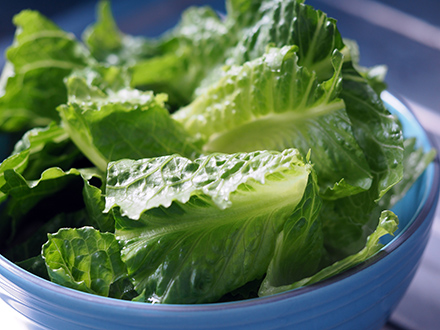
Romaine lettuce

ARS scientists have begun to unravel details that may underly a pattern of fall E. coli O157:H7 outbreaks linked to bagged romaine lettuce. (Photo courtesy of Getty Images)

“We also found that among romaine varieties with longer and shorter shelf life in this study, the deterioration rate of the variety with long shelf life was significantly greater when harvested in the fall than in spring. I have observed this in previous studies as well but the significance to E. coli on lettuce had not been tested. Here we showed that greater deterioration in the fall lettuce was associated with better pathogen survival,” explained study co-author ARS geneticist Ivan Simko, with the Crop Improvement and Protection Research Unit in Salinas, California.

In addition, the research team, which included biologist Susan Leonard and others at the U.S. Food and Drug Administration, demonstrated that the bacterial community present on bagged romaine differed by season, lettuce deterioration state, and whether survival of E. coli on the lettuce was high or low. This suggests a potential for using the microbiome as an indicator of the microbial quality of fresh-cut bagged lettuce.

The researchers were a little surprised to find such differences in E. coli survival in fall harvested-lettuces compared to spring-harvested ones because many current hypotheses about the seasonality of outbreaks linked to lettuce focus on differences in the prevalence of the E. coli pathogen in the environment.

“While prevalence may also be involved, our results strongly indicate that fall-harvested romaine and the microbe communities it harbors have intrinsic characteristics that make them a better place for E. coli to survive in fresh-cut product. These are the next areas we want to work on. For example, is this something we could try to manipulate in the long run through plant physiology and breeding, and microbiome engineering? And would this trend also be observed for E. coli survival in the field? Our observations definitely open an entire new branch of inquiry about outbreak seasonality,” Brandl said.

USA/Canada – Norovirus Outbreak Linked to Raw Oysters from British Columbia

CDC

Fast Facts
Illnesses: 103 illnesses* have been reported as of April 6, 2022

States affected: CA, CO, FL, HI, IL, MA, MN, NJ, NV, NY, OR, TX and WA

Recall: No

Investigation Status: Active

*This number is an estimate based on the information we have at this time. CDC is working with state and local partners to determine a more accurate number of illnesses in this outbreak and will update this number as more information is gathered.

CDC is working with the U.S. Food and Drug Administration (FDA) state, and local officials, and with Canadian public health authorities to investigate a multistate norovirus outbreak linked to raw oysters from British Columbia, Canada.

As of April 6, 2022, at least 103 norovirus illnesses have been reported from 13 states: CDC is working with state and local partners to determine a more accurate number of illnesses in this outbreak and will update this number as more information is gathered. FDA Advises Restaurants and Retailers Not to Serve or Sell Potentially Contaminated Raw Oysters from Canada (April 2022)external icon

Norovirus is the leading cause of foodborne illness in the United States. However, state, local, and territorial health departments are not required to report individual cases of norovirus illness to a national surveillance system. That’s why we may not know about many cases, especially if people do not go to a doctor’s office or hospital. Each year, there are about 2,500 reported norovirus outbreaks in the United States. Norovirus outbreaks occur throughout the year but are most common from November to April.

State and local public health officials are interviewing people about the foods they ate a day to four days before they got sick. In interviews, many of the sick people reported eating raw oysters.

State and local officials have collected information about the source of oysters from restaurants where sick people ate. FDA has confirmed that potentially contaminated raw oysters were harvested in the south and central parts of Baynes Sound, British Columbia, Canada. The FDA and the states are conducting a trace forward investigation to determine where the raw oysters were distributed and to ensure they’re removed from the food supply.

This investigation is ongoing. CDC will update the public as more information is gathered.

Italy – Kinder Products Recalls – Salmonella

Salute

Brand : Ferrero Kinder
Name : Maxi Mix rabbit plush containing Kinder Schoko Bons
Reason for reporting : Recall due to microbiological risk
Publication date : 22 April 2022
Documentation

Documentation

Salute

Brand : FERRERO KINDER
Name : KINDER HAPPY MOMENTS MINIMIX
Reason for reporting : Recall due to microbiological risk
Publication date : 22 April 2022

Documentation

Documentation

Salute

Brand : FERRERO
Name : FERRERO MAXI MIX 133 GR
Reason for reporting : Other reason for revocation
Publication date : 22 April 2022
Documentation

Documentation

Salute

Brand : Ferrero Kinder
Name : Maxi Mix rabbit plush containing Kinder Schoko Bons
Reason for reporting : Recall due to microbiological risk
Publication date : 22 April 2022
Documentation

Documentation

EU – International outbreak of salmonellosis in young children linked to the consumption of Kinder brand products. Update on April 20, 2022.

Sante Publique

Update on 04/20/22 following the recall of several Kinder range products manufactured in a factory in Belgium due to suspected contamination by  Salmonella Typhimurium .

Following the investigations carried out by the Belgian health authorities, together with their English, European and in particular French counterparts, the company Ferrero proceeded on April 5, 2022 to the recall of several Kinder range products manufactured in a factory in Belgium due to suspected contamination by Salmonella Typhimurium . On April 8, 2022, the recall finally affected all Kinder products from this factory, regardless of their expiry date. On April 14, 2022, an update of the recalled products, including the 2021 Christmas Advent Calendars, was released.

Case of salmonellosis in France: update on April 20, 2022

In total, as of 04/19/2022: 42 cases of salmonellosis with a strain belonging to the epidemic have been identified by the National Reference Center (CNR) for salmonella at the Institut Pasteur in France. 

The 42 cases are spread over 11 regions: Ile-De-France (7 cases), Provence-Alpes-Côte d’Azur (7 cases), Grand-Est (6 cases), Hauts-de-France (4 cases), Auvergne-Rhône-Alpes (4 cases), Nouvelle-Aquitaine (3 cases), Bourgogne-Franche-Comté (3 cases), Normandy (3 cases), Brittany (2 cases), Occitanie (2 cases), and Corsica (1 cases), with a median age of 3 years, and concern 22 boys and 20 girls.

Thirty-two cases were able to be questioned by Public Health France. All the cases report, before the onset of their symptoms (which occurred between 20/01 and 23/03/2022), the consumption of chocolates of the brand cited here.

Thirteen people were hospitalized for their salmonellosis, all discharged since. No deaths were reported. Public Health France is continuing its investigations with the families of cases recently reported by the CNR. 

The successive withdrawals and recalls of the Kinder brand products concerned, produced by the Belgian factory with its closure by the Belgian authorities, should limit the occurrence in France of new cases of salmonellosis in the coming days/weeks. 

To find out the list of products concerned by the withdrawal-recall: https://rappel.conso.gouv.fr/

People who have consumed the products mentioned above and who present symptoms (gastrointestinal disorders, fever within 72 hours of consumption), are invited to consult their doctor without delay, notifying him of this consumption.

In order to limit person-to-person transmission (especially in households with young children), it is recommended to wash your hands well with soap and water after using the toilet, after changing your child, and before to cook.

International situation

See the previous points

Italy –  KINDER SCHOKO BONS – Salmonella

Salute

Brand : FERRERO KINDER
Name : KINDER SCHOKO BONS
Reason for reporting : Recall due to microbiological risk
Publication date : 21 April 2022
Documentation

Documentation