Category Archives: foodbourne outbreak

Kinder Chocolate Salmonella Outbreaks hits 151 – mostly children – now 1 ill in United States

Food Poison Journal

On 27 March 2022, WHO was informed by the IHR National Focal Point of the United Kingdom of Great Britain and Northern Ireland (the United Kingdom) of a widely distributed cluster of Salmonella enterica serovar Typhimurium (S. Typhimurium) with an unidentified source. Molecular typing confirmed isolation of the bacteria S. Typhimurium sequence typing (ST) 34 and epidemiological evidence has subsequently linked the outbreak to chocolate products from Belgium, which, as of 25 April 2022, have been found to be distributed to at least 113 countries and territories1 across all WHO Regions

Monophasic S. Typhimurium matching the human outbreak cases were identified in buttermilk tanks at the Ferrero Corporate plant in Arlon, Belgium in December 2021 and January 2022. After implementing hygiene measures and negative Salmonella testing, the implicated products (all Kinder products manufactured at the implicated facility (Arlon) including Kinder Surprise, Kinder Mini Eggs, Kinder Surprise Maxi 100g and Kinder Schoko-Bons) were distributed across Europe and globally.

According to the analyses of the United Kingdom Health Security Agency (UKHSA), the outbreak strain is resistant to six types of antibiotics: penicillins, aminoglycosides (streptomycin, spectinomycin, kanamycin, and gentamycin), phenicols, sulfonamides, trimethoprim, tetracyclines.

As of 25 April 2022, a total of 151 genetically related cases of S. Typhimurium suspected to be linked to the consumption of the implicated chocolate products have been reported from 11 countries (Figure 1): Belgium (26 cases), France (25 cases), Germany (10 cases), Ireland (15 cases), Luxembourg (1 case), the Netherlands (2 cases), Norway (1 case), Spain (1 case), Sweden (4 cases), the United Kingdom (65 cases) and the United States of America (1 case).

Israel – Strauss expands recall as 10-year-old hospitalised with Salmonella

Jpost

Strauss has expanded a recall announced earlier this week to all Elite, Energy, gum and toffee products after traces of salmonella were found on production lines.

An expanding crisis

All Elite chocolates, cakes and wafers, Energy cereal bars and chocolate-covered rice cakes and all Strauss chewing gum and toffees will be removed from store shelves regardless of the expiration date.

Strauss said it would reset the operations at its confectionery factory and restart operations after the issues are fixed. The company found two samples that are suspected of being salmonella from two chocolate products that were returned as part of the recall, out of 270 samples taken.

On Wednesday, a 10-year-old boy was diagnosed with salmonella after being hospitalised with severe dehydration as a result of extensive vomiting and diarrhoea.

New Zealand- Elite brand confectionery products -Salmonella

MPI

Logo of Elite brand

28 April 2022: Benedikt Imports Pty Ltd is recalling all batches, all dates, all packaging, or size and all flavour variations of Elite branded confectionery products, including Elite chocolate, Elite cakes, Elite wafers, Energy grain snacks, Energy chocolate rice cakes, gum and toffee candies due to the possible presence of Salmonella.

Product identification
Product type Confectionery products
Name of product (size) All packaging, or size and all flavour variations of Elite brand confectionery products, manufactured by Elite-Strauss, Israel are affected by this recall, including:

  • Elite brand chocolate
  • Elite brand cakes
  • Elite brand wafers
  • Elite brand Energy grain snacks
  • Elite brand Energy chocolate rice cakes
  • Elite brand gums
  • Elite brand toffee candies
Batch and date marking All batches and all dates
Package size and description The products are sold in various weights in various packaging variations.
Distribution The products are sold at the below ethnic grocery stores and may have been provided to community groups:

  • Chabad New Zealand Hebrew Charitable Trust, 788 Remuera Road, Remuera, Auckland
  • The Greys Ave Deli or The Kosher Deli, 108 Greys Avenue Auckland Central, Auckland and online – The Kosher Deli 
  • Wellington Kosher Co-Operative, 80 Webb Street, Te Aro, Wellington

The products were sold as part of the ‘Home Away From Home Gift Box’ from The Greys Ave Deli or The Kosher Deli in Auckland and online via the company’s website. Only the Elite brand confectionery products in the gift box are affected by this recall and should not be consumed.

The products have not been re-exported.

Notes This recall does not affect any other Elite brand products, or any other products imported by Benedikt Imports Pty Ltd.

If you are a retailer of any of the Elite brand products listed in this recall notice, you need to download a copy of the below Point of Sale notice and display in your store for one month:

Point of sale notice [PDF, 45KB]

Consumer advice

Customers are asked to check the brand of products before consumption.

Affected products should not be consumed. There have been cases of illnesses in Israel reportedly linked to Elite brand confectionery products, manufactured by Elite-Strauss Group, Israel. There have been no confirmed cases of illnesses in New Zealand, however if you have consumed any of these products and have any concerns about your health, seek medical advice.

Customers should return the products to their retailer for a full refund.

Who to contact

If you have questions, contact Benedikt Imports Pty Ltd:

International outbreak of salmonellosis in young children linked to the consumption of Kinder brand products. Update on April 27, 2022.

Sante Publique

Update on 04/27/22 following the recall of several Kinder range products manufactured in a factory in Belgium due to suspected contamination by  Salmonella Typhimurium .

Following the investigations carried out by the Belgian health authorities, together with their English, European and in particular French counterparts, the company Ferrero proceeded on April 5, 2022 to the recall of several Kinder range products manufactured in a factory in Belgium due to suspected contamination by Salmonella Typhimurium . On April 8, 2022, the recall finally affected all Kinder products from this factory, regardless of their expiry date. On April 14, 2022, an update of the recalled products, including the 2021 Christmas Advent Calendars, was released.

Case of salmonellosis in France: update on April 27, 2022

In total, as of 04/27/2022: 59 cases of salmonellosis with a strain belonging to the epidemic have been identified by the National Reference Center (CNR) for salmonella at the Institut Pasteur in France. 

The 59 cases are spread over 11 regions (Ile-de-France (11 cases), Grand-Est (10 cases), Provence-Alpes-Côte d’Azur (9 cases), Auvergne-Rhône-Alpes (7 cases) , Hauts-de-France (6 cases), Bourgogne-Franche-Comté (4 cases), Normandy (4 cases), New Aquitaine (3 cases), Brittany (2 cases), Occitanie (2 cases), and Corsica ( 1 case)), with a median age of 3 years, and involved 29 boys and 30 girls.

Forty-two cases were able to be questioned by Public Health France. All the cases report, before the onset of their symptoms (which occurred between 20/01 and 31/03/2022), the consumption of chocolates of the brand cited here. Seventeen people were hospitalized for their salmonellosis, all since discharged. No deaths were reported.

Public Health France is continuing its investigations with the families of cases recently reported by the CNR. 

The successive withdrawals and recalls of the Kinder brand products concerned, produced by the Belgian factory with its closure by the Belgian authorities, should limit the occurrence in France of new cases of salmonellosis in the coming days/weeks. 

To find out the list of products concerned by the withdrawal-recall: https://rappel.conso.gouv.fr/

People who have consumed the products mentioned above and who present symptoms (gastrointestinal disorders, fever within 72 hours of consumption), are invited to consult their doctor without delay, notifying him of this consumption.

In order to limit person-to-person transmission (especially in households with young children), it is recommended to wash your hands well with soap and water after using the toilet, after changing your child, and before to cook.

International situation

See the previous points

France – Investigation of grouped cases of haemolytic-uremic syndrome (HUS) and shiga-toxin-producing E. coli (STEC) infections linked to the consumption of Buitoni® brand Fraîch’Up pizzas. Update on April 25, 2022.

Sante Publique

Update on April 25, 2022 on the grouped cases of haemolytic-uremic syndrome and E. coli infections producing shiga-toxin and the consumption of frozen pizzas from the Fraîch’Up range of the Buitoni® brand.

Public Health France and the National Reference Center (CNR) E. coli and its associated laboratory (Institut Pasteur, Paris, and Microbiology Laboratory of the Robert Debré Hospital, Paris), in conjunction with the Directorate General for Food, the Directorate General for Competition, Consumer Affairs and Fraud Prevention, and in coordination with the Directorate General for Health, have been investigating since 02/10/2022 an increase in the number of cases of haemolytic uremic syndrome (HUS) pediatric infections and Shiga toxin-producing Escherichia coli (STEC) infections.

The epidemiological, microbiological and traceability investigations carried out since that date have confirmed a link between the occurrence of these grouped cases and the consumption of frozen pizzas from the Buitoni brand Fraîch’Up range contaminated with STEC bacteria. On 03/18/2022, the company proceeded with the withdrawal-recall of all the pizzas in the Fraîch’Up range, marketed since June 2021 and the authorities asked the people who hold these pizzas not to consume them and to destroy them.

The total number of HUS cases linked to the consumption of these pizzas seems to have stabilized since the withdrawal-recall.

Case of SHU in France: update on 04/25/22

As of 04/25/2022, 55 confirmed cases have been identified, of which 53 are linked to STEC O26 strains, and 2 to STEC O103 strains. 

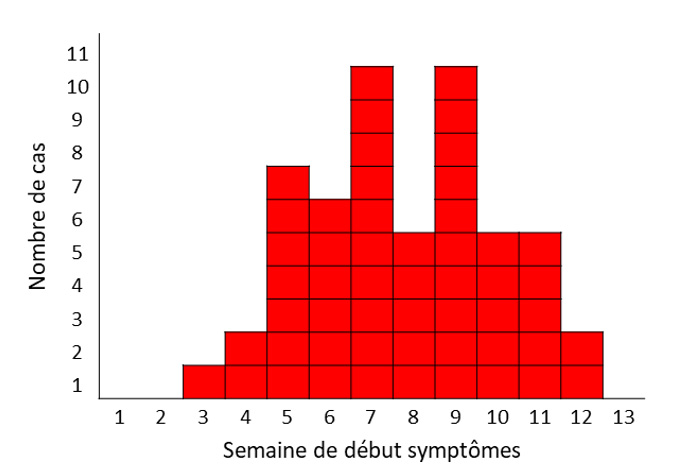
These 55 cases occurred in 54 children and 1 adult, who presented symptoms between 18/01/2022 (week 3) and 25/03/2022 (week 12) (Figure 1). The epidemic peak is in week 7 (14/02 to 20/02) and week 9 (28/02 to 06/03), with 10 cases each of these weeks.
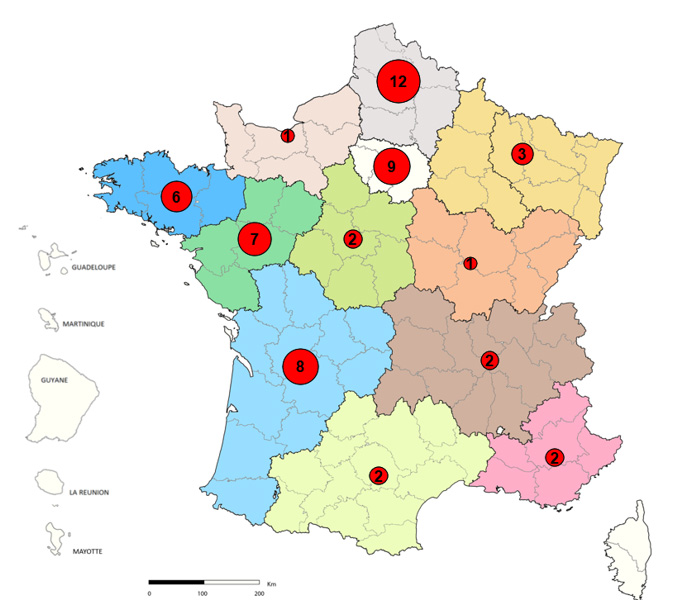
These 55 cases occurred in 12 regions of metropolitan France: Hauts-de-France (12 cases), Ile-de-France (9 cases), New Aquitaine (8 cases), Pays de la Loire (7 cases), Brittany ( 6 cases), Grand Est (3 cases), Auvergne-Rhône-Alpes (2 cases), Occitanie (2 cases), Provence-Alpes-Côte d’Azur (2 cases), Center Val-de-Loire (2 cases) , Bourgogne Franche-Comté (1 case) and Normandy (1 case) (figure 2).

The 54 sick children are aged from 1 to 17 years with a median age of 7 years; 24 (44%) are female; 47 (87%) presented with HUS, 7 (13%) with STEC gastroenteritis. Two children died. The adult did not present with HUS.

Figure 1 – Epidemic curve: number of confirmed cases of HUS and STEC infections, by week of onset of symptoms – Metropolitan France, weeks 3 to 12, 2022 (N=53: week of onset of symptoms not specified for 2 cases )
Figure 1 - Epidemic curve: number of confirmed cases of HUS and STEC infections, by week of onset of symptoms - Metropolitan France, weeks 3 to 12, 2022 (N=53: week of onset of symptoms not specified for 2 cases )
Figure 2 – Geographical distribution of confirmed cases of HUS and STEC infections (N=55) linked to the consumption of Buitoni® brand Fraîch’Up pizzas, by region of residence in metropolitan France, weeks 3 to 12, 2022
Figure 2 - Geographical distribution of confirmed cases of HUS and STEC infections (N=55) linked to the consumption of Buitoni® brand Fraîch'Up pizzas, by region of residence in metropolitan France, weeks 3 to 12, 2022

RASFF Alert – Traceability related to the foodborne outbreak suspected (Salmonella Typhimurium monophasic) to be caused by chocolate products from Belgium

RASFF

 Albania (d) Andorra (d) Argentina (d) Armenia (d) Australia (d) Austria (d)(ffa) Azerbaijan (d) Belarus (d) Belgium (n)(o)(d)(op)(ffa) Bosnia and Herzegovina (d) Bulgaria (d)(ffa) Canada (d) Chile (d) Costa Rica (d) Croatia (d)(ffa) Cyprus (d)(ffa) Czech Republic (d)(ffa) Denmark (d)(ffa) Dominican Republic (d) Egypt (d) El Salvador (d) Estonia (d)(ffa) Ethiopia (d)Faeroe Islands (d) Finland (d)(ffa) France (d)(ffa) French Guiana (d) French Polynesia (d) Georgia (d) Germany (d)(ffa) Greece (d)(ffa) Guadeloupe (d) Guatemala (d) Honduras (d) Hong Kong (d) Hungary (d)(ffa)INFOSAN (ffa) Iceland (d)(ffa) India (d) Iraq (d) Ireland (d)(ffa) Israel (d) Italy (d)(ffa) Jordan (d) Kazakhstan (d)Kosovo (d) Kuwait (d) Kyrgyzstan (d) Latvia (d)(ffa) Lebanon (d) Lithuania (d)(ffa) Luxembourg (d)(ffa) Madagascar (d) Malaysia (d) Malta (d)(ffa) Mauritius (d) Mayotte (d) Mexico (d)Moldova (d) Mongolia (d) Montenegro (d) Morocco (d) Netherlands (d)(ffa) New Caledonia (d) New Zealand (d) Nicaragua (d) Norway (d)(ffa) Oman (d) Panama (d) Paraguay (d) Poland (d)(ffa) Portugal (d)(ffa) Qatar (d)Republic of North Macedonia (d) Romania (d)(ffa)Russia (d) Réunion (d) San Marino (d) Saudi Arabia (d) Serbia (d) Singapore (d) Slovakia (d)(ffa) Slovenia (d)(ffa) Spain (d)(ffa) Sweden (d)(ffa) Switzerland (d)(ffa)Syria (d)Taiwan (d) Tajikistan (d) Tunisia (d) Turkey (d) Turkmenistan (d) Ukraine (d) United Arab Emirates (d) United Kingdom (d) United States (d) Uruguay (d) Uzbekistan (d)Vatican City (d)

(n) Notifying | (o) Origin | (d) Distribution | (op) Operator
(ffup) Flagged for Follow-Up | (ffa) Flagged For Attention

Israel – How did salmonella spread in the Strauss production facility? – analysis

Jpost

How does salmonella spread in a food production facility and can it be prevented?

Because salmonella is a pathogen that is prevalent in the gut of many animals and insects, it can spread by the animal’s feces into the soil, water and food. From there it can easily be introduced into and spread throughout a food production facility by way of raw ingredients, as was the case with the Strauss facility. It can also spread through the facility via contaminated packaging, equipment and workers’ hands and clothing.

Salmonella thrives in moist, warm environments such as drains, floors and processing equipment, making a food production facility the perfect environment for it.

However, there are several ways to ensure that the risk of salmonella contamination in a food facility is lessened, according to international cleaning equipment supplier Vikan’s hygiene and compliance manager Stine Lønnerup Bislev.

The first step to controlling the spread of the bacteria is to ensure that only clean and disinfected equipment, tools and utensils are brought into the processing area, Bislev explains on the company’s website. Then, all incoming ingredients and materials that pose a risk for contamination should be tested for salmonella ahead of production.

Ingredients must be cleaned and disinfected properly, using either a wet or dry cleaning method, depending on the moisture content of the ingredient. High moisture ingredients that require wet cleaning include meat, vegetables and dairy products, Bislev notes.

To avoid the spread of contamination, raw and processed foods must be handled in separate areas, using separate tools and equipment. Cleaning equipment should meet the appropriate hygiene standards to facilitate easy cleaning and prevent microbial growth.

Hygenic design features include smooth surfaces, one-piece construction, easy dismantling and a lack of crevices.

Finally, Bislev states, a program should be developed by the production facility’s management in order to routinely sample the space for salmonella.

“An environmental monitoring program will assess the effectiveness of your overall hygienic practices, monitor the environment for transient pathogens and help mitigate potential harborage and growth niches,” she concludes.

Read more at the link above.

Israel – Two children suspected of Salmonella infection after massive Strauss recall

Times of Israel

At least two children and one adult have sought out medical attention with suspected cases of salmonella poisoning following a massive recall of Strauss products ranging from chocolate to ice cream, pudding, cookies and other snacks over contamination fears.

According to Hebrew media reports, two children who recently sought care at the Assuta Medical Center in Ashdod are suspected of being poisoned by salmonella, pending full lab results. In addition, a man who was treated at an urgent care facility in Bnei Brak with relevant symptoms said that he had consumed some of the infected products recently.

Health Minister Nitzan Horowitz said Tuesday that the incident will be fully investigated and the factory will not be allowed to resume operation before it is fully cleared.

USA – CDC issues Health Alert: Investigation of Illness Complaints After Consuming Lucky Charms Cereal

Food Poison Journal

During April 2022, there has been an increase in complaints of gastrointestinal illness (GI) attributed to eating Lucky Charms cereal reported primarily to a crowdsourcing website. Some complaints of illness have also been reported to the U.S. Food and Drug Administration (FDA), state, and local health departments. There are very little data on the clinical presentation of these complaints, e.g., symptom profiles, incubation periods, and illness durations, as well as a lack of laboratory testing of clinical specimens. The scarcity of data and lack of a consistent clinical presentation are making it difficult to ascertain if any of these illnesses are linked to the suspected cereal.

The Centers for Disease Control and Prevention (CDC) is coordinating with state and federal partners to characterize the clinical presentations and epidemiology of recent illness reports. CDC is also collaborating with state and federal partners to evaluate data collected from ill people to determine if an outbreak of GI illnesses is occurring and its potential link to Lucky Charms cereal.

UK – Girl, 3, left ‘lifeless’ after seemingly ‘contracting salmonella from Kinder Egg’

LBC

A “heartbroken” mum has claimed her three-year-old daughter was left looking “dead behind the eyes” after she seemingly contracted salmonella from a Kinder Surprise egg.

Charlotte Elizabeth Wingfield issued a warning on Facebook to other parents after her daughter Brooklyn-Mai fell ill whilst at nursery, with her temperature soaring to 39C.

It comes after thousands of Kinder Surprise chocolate eggs were recalled from shelves due to fears of a salmonella link, with more than 60 cases detected – mainly in children – in the UK.

Ms Wingfield claims her toddler was left “lifeless” after eating a Kinder Surprise egg last weekend.

“She slept for 21 out of the following 24 hours & then kept falling asleep as she was doing things,” she wrote on Facebook.

“Her temperature spiked to over 39° & I struggled to disturb her. I knew something wasn’t right & spoke to the gp who ran through a list of what it could be alongside a hospital visit.”

Following a hospital visit, Ms Wingfield said her daughter was diagnosed with salmonella and has been unwell ever since.

“Pleaseee check your chocolate dates & throw them if they fit the recall description,” the mother pleaded on Facebook.

Read More at the link above.