Category Archives: Foodborne Illness

Iran – Hundreds Of Food Poisonings In Iran’s Universities Raise Alarm

Iran Intl

Food poisoning affecting hundreds of Iranian university students has alarmed many who claim canteen food was deliberately contaminated to keep them out of protests.

In the past couple of days “a large number of students” at Arak Industrial University and Kharazmi University in Karaj came down with symptoms of food poisoning including diarrhea, body aches, and vomiting, the Telegram channel of a national student union said Thursday.

There were food poisoning breakouts recently at two other universities, Al-Zahra University in Tehran and Isfahan University of Technology both believed to have originated from canteens.

Calling the incidents another case of “serial food poisoning”, the channel said, authorities of Arak University attribute the illness, which has sent many to hospital since Wednesday, to some sort of virus but given a similar incident at Isfahan university of technology last week where many students got seriously ill after eating canteen food makes authorities’ explanation implausible.

Research – Multi-country outbreak of Salmonella Mbandaka ST413, possibly linked to consumption of chicken meat in the EU/EEA, Israel and the UK

EFSA

A cross-border outbreak of Salmonella Mbandaka ST413 has been ongoing in the EU/EEA, Israel, and the UK since September 2021. By 8 November 2022, 196 cases had been reported in Czechia (n=5), Estonia (n=3), Finland (n=89), France (n=10), Germany (n=2), Ireland (n=1), the Netherlands (n=1), the United Kingdom (n=81), and Israel (n=4), according to the European case definition. Nineteen cases were hospitalised and five cases had septicaemia. One case in the UK died.

Based on case interviews from Finland and the UK, ready-to-eat (RTE) chicken products and/or fresh chicken meat are the likely vehicles of infection. Fifteen cases in Finland reported consumption of six RTE products from three brands. All 15 cases had consumed at least one RTE chicken product. Two products were marketed under the same brand name, which is adopted by the Estonian Company A and the Finnish Company B. Based on additional information, such as purchase data, and consultation of the grocery chains selling the products and of the Finnish Company B, the food authority in Finland linked the products to the Estonian Company A. However, this link could not be verified by the identification of the batches nor by microbiological evidence. The Estonian Company A received processed chicken meat from different suppliers, but there is no further information in RASFF. Therefore, the role of the Estonian Company A as a source of infection could not be established.

Epidemiological data and microbiological evidence from whole genome sequencing of human isolates indicate there are several active sources through different food distribution chains, with a likely common source higher up in the chicken supply chain. New cases are likely to occur in the EU/EEA until the source has been identified and controlled.

Further investigations are needed by public health and food safety authorities to identify the source(s)/origin of contamination.

Click to access roa-7707.pdf

Italy hit by new Listeria outbreak with one dead

Food Safety News

Italian authorities are investigating a Listeria outbreak that has sickened 22 people and killed one.

Mortadella sold by Veroni is being looked at as a potential source but an official link has not been confirmed by authorities.

In early November, a number of recalls were published for Veroni mortadella due to potential Listeria contamination.

A product recalled by Veroni in November

The Ministry of Health (Ministero della Salute) issued a warning covering a few batches of the Veroni Supergiant Mortadella packed in small portions due to the presence of Listeria monocytogenes.

Veroni said it immediately and voluntarily alerted the market, recalling all batches of Supergiant Mortadella with and without pistachios in portions that had expiry dates before Dec. 27, 2022.

USA – Outbreak Investigation of E. coli O121:H19 Frozen Falafel (October 2022)

FDA

The FDA, along with CDC and state and local partners, investigated a multistate outbreak of E. coli O121:H19 infections linked to Earth Grown frozen falafel.

As of December 1, 2022, CDC announced that the outbreak is over. There have been a total of 24 illnesses in six states. The last illness onset was October 24, 2022.

On October 7, 2022, the Michigan Department of Agriculture and Rural Development collected Earth Grown frozen falafel for testing from a sick person’s home. Whole Genome Sequencing done at the Michigan Department of Health & Human Services showed that the E. coli strain in the falafel sample was closely related to the strain causing illness in this outbreak.

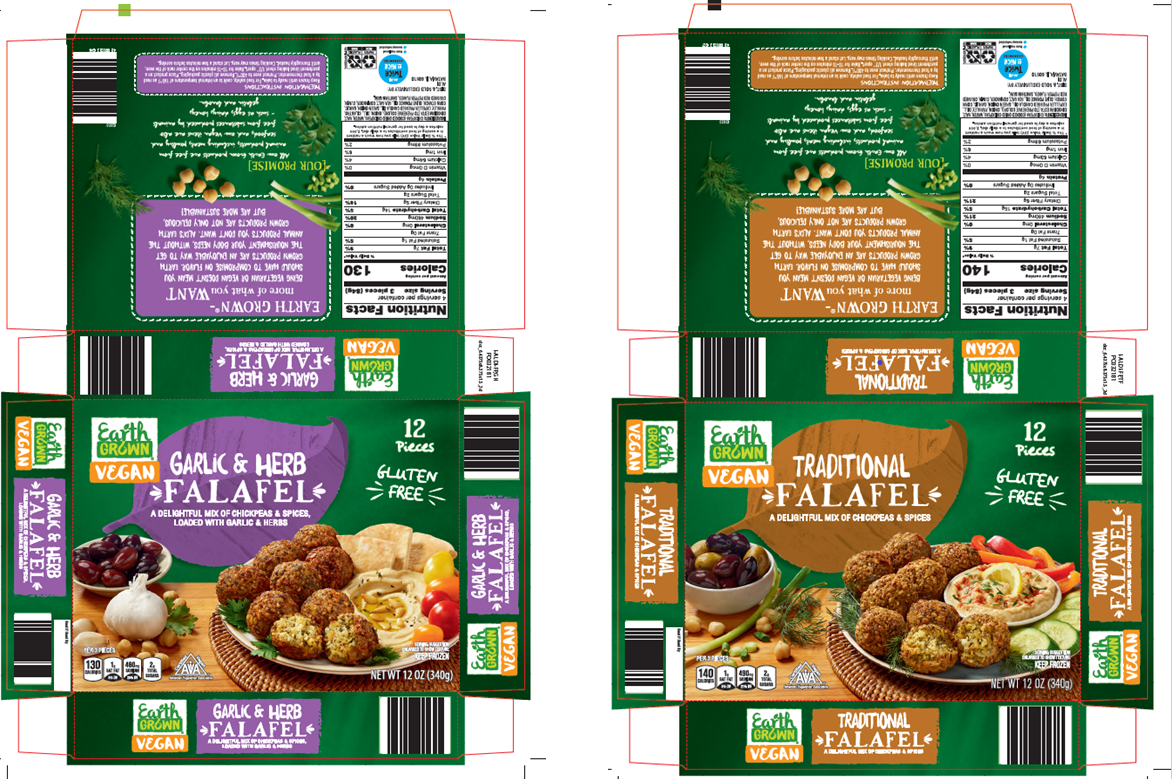
On October 6, 2022, the manufacturer of Earth Grown frozen falafel, Cuisine Innovations, initiated a voluntary recall. Recalled products include Earth Grown vegan traditional falafel and garlic & herb falafel distributed and sold exclusively by ALDI. Additional information on recalled products is available in the firm’s recall notice.

Recommendation

These items are no longer available for sale but were sold frozen and have a long shelf-life of 18 months, so consumers should check their freezers for any recalled Earth Grown vegan traditional falafel and garlic & herb falafel that was sold by ALDI. If you have recalled frozen falafel in your freezer, do not eat or serve them.


Product Images

Outbreak Investigation E.coli Frozen Falafel October 2022 - Sample Product Images

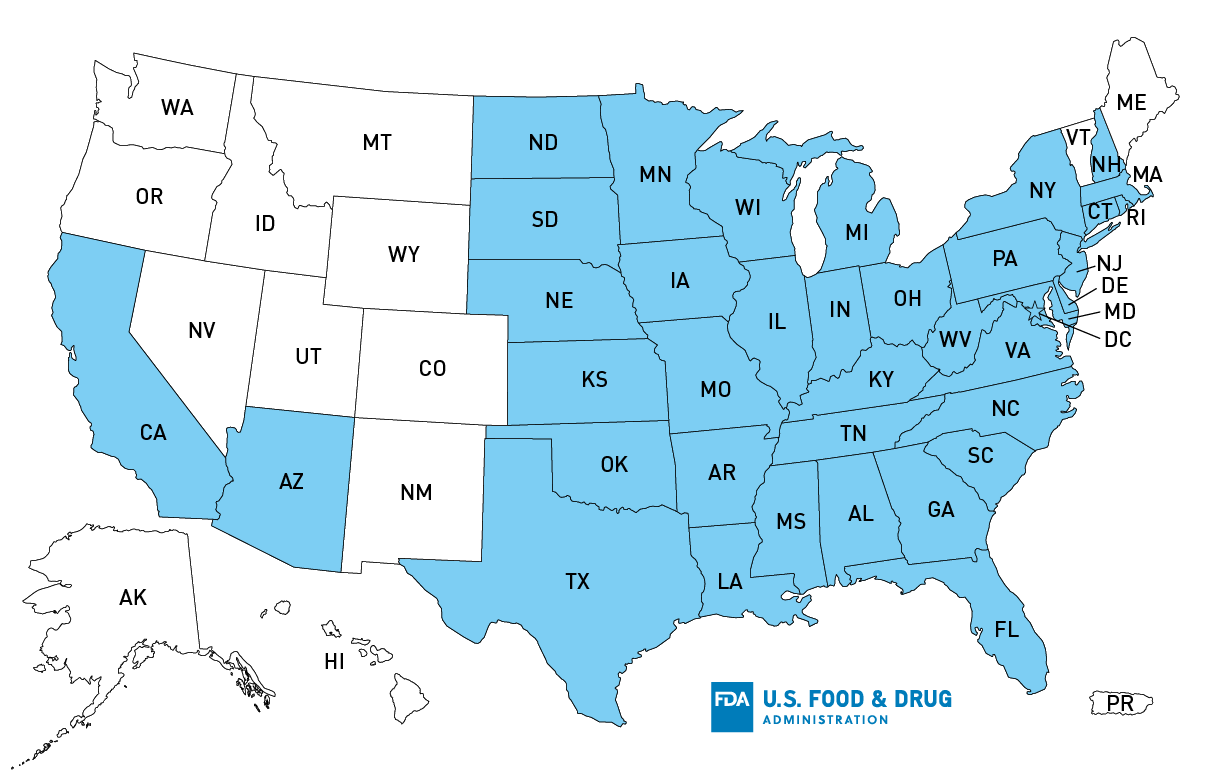
Map of U.S. Distribution

Outbreak Ecoli Falafel Distribution Map

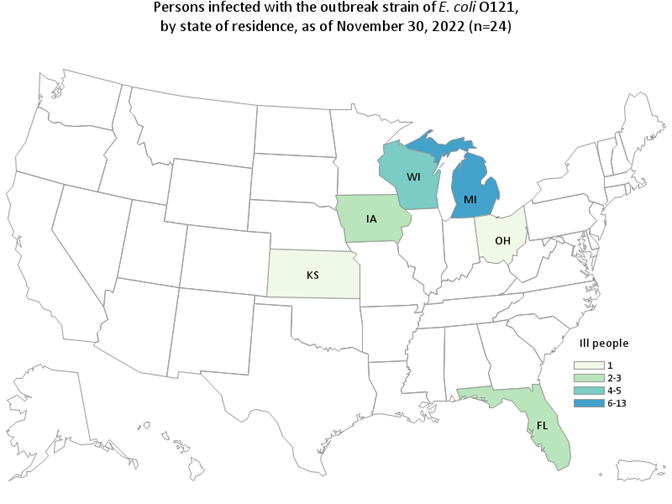
Case Count Map Provided by CDC

Outbreak Investigation of E. coli O121: Frozen Falafel (October 2022) - CDC Case Count Map as of December 1, 2022

Case Counts

Total Illnesses: 24
Hospitalizations: 5
Deaths: 1
Last illness onset: October 24, 2022
States with Cases: FL (2), IA (2), KS (1), MI (13), OH (1), WI (5)
Product Distribution: Nationwide

EU – Outbreak of Salmonella Mbandaka ST413 linked to chicken meat

ECDC

Foodborne Pathogen

As of 8 November 2022, 196 cases have been reported in Czechia, Estonia, Finland, France, Germany, Ireland, the Netherlands, the United Kingdom and Israel. Nineteen cases have been hospitalised and five cases have had septicaemia; there has been one fatal case in the UK. Cases have occurred across all age groups and there is no overall difference when gender is taken into account. 

Based on case interviews from Finland and the UK, ready-to-eat (RTE) chicken products and/or fresh chicken meat, such as those used in sandwiches and wraps, are the likely vehicles of infection. 

Following investigations, the food safety authority in Finland linked the suspected RTE products to an Estonian company, however, this link could not be verified by the identification of batches nor by microbiological evidence. The Estonian company received processed chicken meat from different suppliers, and its role as a source of infection could not be established. 

Epidemiological data and microbiological evidence from whole genome sequencing of human isolates indicate there are several active sources through different food distribution chains, with a likely common source further up the supply chain. New cases are likely to occur in the EU/EEA until the source has been identified and controlled. 

ECDC encourages Member States to sequence S. Mbandaka isolates from human cases and interview cases with S. Mbandaka ST413 infection focusing on the consumption of various poultry meat and related products. Further investigations are recommended in cooperation with food safety authorities. 

Hong Kong – CFS actively follows up on food poisoning clusters involving lava cake

CFS

kswfoodworld.com

The Centre for Food Safety (CFS) of the Food and Environmental Hygiene Department said today (November 29) that it is actively following up on four food poisoning clusters involving lava cake, including inspecting the restaurant concerned. A sample of lava cake collected from the restaurant was found to contain a pathogen, Group D Salmonella. The CFS is following up on the case.

“Upon notification by the Centre for Health Protection of the Department of Health earlier, the CFS immediately sent staff to the restaurant concerned in Tsim Sha Tsui to conduct investigation and take food and environmental samples for testing. The test result showed the presence of Salmonella in 25 grams of the lava cake sample, exceeding the criterion of the Microbiological Guidelines for Food which states that Salmonella should not be detected in 25g of a ready-to-eat food sample,” a CFS spokesman said.

The CFS has informed the restaurant concerned of the irregularity. The restaurant has already stopped selling and discarded the affected product according to the CFS’s advice. The CFS has also provided health education on food safety and hygiene to the person-in-charge and staff of the restaurant, and requested it to review and improve the food production process and carry out thorough cleaning and disinfection. Prosecution will be instituted should there be sufficient evidence.

According to section 54 of the Public Health and Municipal Services Ordinance (Cap.132), all food available for sale in Hong Kong, imported or locally produced, should be fit for human consumption. An offender is subject to a maximum fine of $50,000 and imprisonment for six months upon conviction.

“Salmonella infection may cause fever and gastrointestinal upset such as vomiting, abdominal pain and diarrhoea. The effects on infants, young children, the elderly and persons with a weak immune system could be more severe and may even lead to death,” the spokesman said.

The CFS will continue to follow up on the incident and take appropriate action to safeguard food safety and public health.

USA – Norovirus likely cause of 155 ill at Monical’s Pizza

Food Poison Journal

Norovirus Food Safety kswfoodworld

Monical’s Pizza at 6 Cherry Tree Shopping center in Washington, Illinois is currently closed due to an outbreak of an illness.

According to the Tazewell County Health Department, Monical’s was temporarily closed by the Illinois Department of Public Health (IDPH) due to an outbreak of a currently unknown foodborne illness. IDPH is currently working with the Tazewell County Health Department to identify the source.

155 people have currently reached out to the Tazewell County Health Department and reported symptoms of diarrhea and vomiting lasting 12 to 24 hours.

The health department is encouraging everyone to wash their hands and use hand sanitizer currently.

Anyone who ate at Monical’s since November 21st, and is experiencing symptoms, is encouraged to complete an online form.

Major E. coli, and Salmonella outbreaks highlighted at a conference; investigations ongoing

Food Safety News

Two major foodborne outbreaks have recently been highlighted at a European conference on infectious diseases.

Presentations at the European Scientific Conference on Applied Infectious Disease Epidemiology (ESCAIDE) covered an E. coli outbreak from Nestlé pizzas in France and a multi-country monophasic Salmonella Typhimurium outbreak due to Ferrero chocolate.

In February 2022, Santé Publique France identified more cases of the pediatric hemolytic uremic syndrome (HUS) than usual with eight infections. Cases were positive for Shiga toxin-producing E. coli (STEC) O26:H11 or O103:H2 identified by whole genome sequencing (WGS). Only two people were sick from E. coli O103.

UK – Milk and cheese linked to English E. coli outbreaks

Food Safety News

Three E. coli outbreaks were reported in England earlier this year with two linked to dairy farms.

The Animal and Plant Health Agency (APHA) helped the UK Health Security Agency (UKHSA) investigate Shiga toxin-producing E. coli (STEC) O103, O145, and O26 outbreaks between July and September.

The E. coli O26 outbreak also involved cryptosporidium and began in the previous quarter. There were 11 cases of cryptosporidium and two people also had confirmed E. coli O26.

Cryptosporidium cases visited an open farm attraction during the incubation period of their illness. STEC cases had links to the same premises.

Health officials visited and advised on actions that would improve hygiene for visitors and reduce potential exposure to the pathogens.

APHA collected fresh faeces samples in the O103 and O145 incidents, from the yard where the cows had been prior to milking. In both cases, the outbreak strain was not detected.

The STEC O103 outbreak with 11 cases was associated with soft, raw cheese from a dairy farm in the East of England. An investigation pointed to brie-like unpasteurized soft cheese being contaminated sometime during spring.

The STEC O145 outbreak with 10 patients was linked to the consumption of milk products from a dairy farm in North West England, with illness onset from mid-July. Investigations identified an issue with pasteurization and problems with the cleaning and storage of milk crates which made external contamination of packaging plausible.

USA – Enoki Mushrooms are the Most Recalled Food of 2022

Food Poisoning Bulletin

With one month to go before the end of the year, there have already been 11 Listeria recalls for enoki mushrooms, making them the food most recalled for bacterial contamination in 2022. It wasn’t a close contest. Any commodity vying for the distant second-place finish  -cheese, leafy greens, ground beef, has had fewer than half as many recalls so far this year.

And there’s a decent chance that, before the year’s end, there will be a 12th enoki mushroom recall. That’s because no recall has been issued in connection with an ongoing enoki mushroom Listeria outbreak.