Category Archives: Foodborne Illness Death

USA – Will There Be a Cyclospora Outbreak in the U.S. This Summer?

Food Poisoning Bulletin

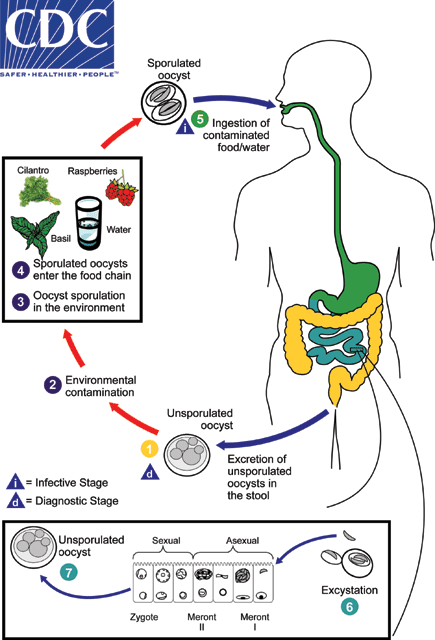
Will there be a cyclospora outbreak in the United States this summer? There have been multiple cyclospora outbreaks in the past nine years, including in 2013, 2014, 2015, 2016, 2017, 2018, 2019, 2020, and 2021. This year may be no exception.

In the past, Cyclospora outbreaks have been linked to fresh produce, including cilantro, raspberries, basil, mesclun, vegetable trays, bagged salad mixes, and snow peas. The cyclospora parasite is transmitted through human feces. The oocyst must mature, or sporulate, outside of the body before it becomes infectious. This infection is not passed person-to-person.

It is very difficult to protect yourself against this parasite, since it can cling to produce, especially produce such as leafy greens and herbs, and is not easily washed or rinsed off. And since most of the foods it contaminates are eaten without being heated, there is no kill step to destroy the parasite.

UK – Three dead in UK fish Listeria outbreak

Food Safety News

Three people have died in an ongoing Listeria outbreak linked to fish in the United Kingdom.

The UK Health Security Agency, Food Standards Agency (FSA), Public Health Scotland and Food Standards Scotland (FSS) are investigating the Listeria monocytogenes outbreak that was first made public in April.

Twelve patients across the UK have been identified, including three in Scotland, with onset dates of illness between October 2020 to March 2022.

Ten sick people are over the age of 65, and one is a pregnant woman. Three of those affected who are older than 65 have died.

Six people have fallen ill since January 2022. The majority of patients reported eating smoked fish.

The FSA and FSS are doing food chain and microbiological investigations including whole genome sequencing (WGS) but the cause is yet to be confirmed.

Canada – Two dead in Listeria outbreak at Ottawa retirement home

Ottawa Citizen

Two residents of a west-end Ottawa retirement home are dead after a Listeria outbreak, the source of which has not been identified.

Catherine Clausi, a spokesperson for the home on Meadowlands Drive, said it has worked with Ottawa Public Health and the regional infection prevention and control team to determine the source of listeria, but has been unable to do so.

“Despite a month of investigating the outbreak with Ottawa Public Health, no known source was identified,” she said.

She added that the home purchases all of its food “through reliable suppliers and requires staff to follow all food storage and handling procedures.

Research – Foodborne Illness Outbreaks Reported to National Surveillance, United States, 2009–2018

CDC

Abstract

Foodborne outbreaks reported to national surveillance systems represent a subset of all outbreaks in the United States; not all outbreaks are detected, investigated, and reported. We described the structural factors and outbreak characteristics of outbreaks reported during 2009–2018. We categorized states (plus DC) as high (highest quintile), middle (middle 3 quintiles), or low (lowest quintile) reporters on the basis of the number of reported outbreaks per 10 million population. Analysis revealed considerable variation across states in the number and types of foodborne outbreaks reported. High-reporting states reported 4 times more outbreaks than low reporters. Low reporters were more likely than high reporters to report larger outbreaks and less likely to implicate a setting or food vehicle; however, we did not observe a significant difference in the types of food vehicles identified. Per capita funding was strongly associated with increased reporting. Investments in public health programming have a measurable effect on outbreak reporting.

Foodborne diseases remain a major public health challenge in the United States, where 31 known pathogens cause an estimated 9 million illnesses, 56,000 hospitalizations, and 1,300 deaths annually (1). Efforts to improve food safety and reduce the burden of foodborne disease rely on data from foodborne disease surveillance and outbreak investigations to help prioritize food safety interventions, policies, and practices. Data from foodborne illness outbreaks reported to the Centers for Disease Control and Prevention (CDC) provide vital information on the foods causing illness and common food–pathogen pairs. Those data are used by the Interagency Food Safety Analytics Collaboration (IFSAC) to inform outbreak-based attribution models that attribute illnesses to specific food categories (2,3).

Foodborne illness outbreaks are investigated by local, state, and territorial health departments, CDC, the US Food and Drug Administration (FDA), and the Food Safety and Inspection Service of the United States Department of Agriculture and are reported to CDC’s Foodborne Disease Outbreak Reporting Surveillance System (FDOSS) through the web-based National Outbreak Reporting System (NORS). Although reported outbreaks are a rich data source, they represent a subset of all outbreaks occurring in the United States; not all outbreaks will be detected, investigated, and reported. Factors influencing which outbreaks are detected, investigated, and reported to CDC include both structural factors associated with the jurisdiction in which the outbreak occurred (e.g., infrastructure and capacity) and characteristics of the outbreak (e.g., size, geographic location, pathogen).

We integrated data from a variety of sources to examine structural factors and describe outbreak characteristics of foodborne outbreaks involving Salmonella, Shiga toxin–producing Escherichia coli (STEC) O157, norovirus, and bacterial toxins that were reported to national surveillance. In addition, we assessed the effects of state variation in outbreak reporting on the types of food vehicles identified.

Norway Research – Outbreaks stable but illnesses down in 2021 

Food Safety News

The number of foodborne outbreaks in Norway has remained steady but fewer people were sick in 2021 compared to the year before.

A total of 25 foodborne outbreaks were announced this past year, which is on a par with 23 in 2020 but down compared to 46 in 2019 and 52 in 2018.

Overall, 327 people fell sick in the 25 outbreaks in 2021 with a range of three to 30 patients per outbreak. The 23 outbreaks in 2020 affected 495 people.

Data comes from a report that gives an overview of outbreaks and related illnesses reported to the Norwegian Institute of Public Health (FHI) in 2021.

France – Foodwatch complaint targets Nestlé and Ferrero

LEX

A consumer watchdog has filed a complaint against Nestlé and Ferrero in relation to recent E. coli and Salmonella outbreaks involving the companies.

In the action, Foodwatch France lists seven offences including placing on the market products harmful to health and failure to implement procedures to withdraw or recall such a product, endangering the lives of others and export to a non-EU country of food potentially harmful to health.

The two complaints include the case of Louna, a 6-year-old, who was hospitalized because of a Salmonella infection after eating Kinder chocolate, said Foodwatch. The multi-country outbreak has sickened hundreds.

The Nestlé E. coli outbreak involves 56 cases and two deaths from Buitoni brand Fraîch’Up pizzas in France. Production at the factory in Caudry was stopped in April. The Paris prosecutor’s office has opened a criminal inquiry into the incident.

The Ferrero monophasic Salmonella typhimurium chocolate outbreak has affected at least 324 people in 16 countries. Belgian authorities halted production at the Arlon facility in April, and an investigation has been launched by the Luxembourg Public Prosecutor’s Office.

The two Foodwatch complaints against Nestlé and Ferrero were filed in Paris this week by the law firm Teissonniere Topaloff Lafforgue Andreu et Associés (TTLA) on behalf of the group and several victims. They are seeking sanctions against the companies and compensation for the victims.

USA – FDA Provides New Updates on Activities to Mitigate Infant Formula Supply Challenges, Abbott Nutrition Agrees to Take Corrective Actions at Facility to Produce Safe Infant Formula

FDA

The U.S. Food and Drug Administration is announcing important updates on its ongoing work to increase the supply and availability of infant formula in the U.S. On Feb. 17, the agency warned consumers not to use certain powdered infant formula products from Abbott Nutrition’s Sturgis, Michigan infant formula production facility, and Abbott voluntarily ceased production at this facility as well as initiated a voluntary recall of certain products.

Today, a proposed consent decree of permanent injunction between the FDA and Abbott Nutrition, as well as three Abbott principals, was filed in the U.S. District Court for the Western District of Michigan. Under the proposed consent decree, which is subject to court approval and entry, Abbott has agreed to take corrective actions following an FDA inspection of its Sturgis, Michigan facility. The proposed consent decree obliges Abbott to take actions that are expected to ultimately result in an increase of infant formula products, while ensuring that the company undertakes certain actions that would ensure safe powdered infant formula is produced at the facility. When the company decides to restart production at this facility, it must conform with the provisions of the proposed consent decree and meet FDA food safety standards. If contamination is identified, the company must notify the FDA, identify the source of the problem and conduct a root-cause investigation before resuming production.

“Today’s action means that Abbott Nutrition has agreed to address certain issues that the agency identified at their infant formula production facility in Michigan. The public should rest assured that the agency will do everything possible to continue ensuring that infant and other specialty formulas produced by the company meet the FDA’s safety and quality standards, which American consumers have come to expect and deserve,” said FDA Commissioner Robert M. Califf, M.D. “We recognize the hardships that parents and caregivers have faced in obtaining infant formula and the FDA is focused on boosting the availability of the country’s supply of these products, including new steps regarding importation. We are also taking a look at the supply of infant formulas developed by manufacturers across the country and around the world to determine if a reallocation of their distribution can be made to help get the right product to the right place, at the right time.” 

In the complaint, filed by the U.S. Department of Justice on behalf of the FDA, the government alleges that powdered infant formula products manufactured at Abbott Nutrition’s Sturgis facility were adulterated because they were made under insanitary conditions and in violation of current good manufacturing practice requirements. On Jan. 31, the FDA commenced a for-cause inspection and identified Cronobacter sakazakii, a bacterium that can potentially cause severe foodborne illness primarily in infants, in the facility and observed significant operational deficiencies. While the agency’s inspection was ongoing, Abbott Nutrition voluntarily recalled certain powdered infant formula products and voluntarily shut down its facility to implement corrective actions that address issues raised by the FDA.

Under the proposed consent decree, Abbott Nutrition will be required to retain an independent expert to review the Sturgis facility’s operations to ensure compliance with the law. It also includes requirements for testing products, as well as ceasing production, and promptly notifying the FDA should contamination be detected. The proposed consent decree also requires the implementation of a sanitation plan, environmental monitoring plan and employee training programs.

In the meantime, the FDA is also continuing to implement several important steps to improve the supply of infant and specialty formula products in the U.S. The agency has been in ongoing discussions with all infant formula manufacturers who are reporting that they are all producing at an expanded capacity. In fact, Gerber has reported that it increased the amount of their infant formula available to consumers by approximately 50% in March and April and Reckitt is supplying more than 30% more product year to date.

This increased production is now evident in increased infant formula sales. According to data from Information Resources Inc. (IRI), national infant formula sales by volume for the month of April were up more than 13% compared to the month prior to the recall and national infant formula sales by unit for the month of April are also up by more than 5% compared to the month prior to the recall.

While some data suppliers have reported lower in-stock rates, the most complete data sets available from IRI are showing nearly 80% in-stock rates at the week ending May 8. This means that if a local supermarket normally carries 50 different infant formula products, an 80% in-stock rate would translate to 40 of those 50 product types being available.

What the sales volume data and in-stock rates tell us is that while there is more product being sold, it may be of less variety than prior to the recall. With increased production by other manufacturers, forthcoming import actions and the potential for Abbott Nutrition’s Sturgis facility to resume production in the near-term, the FDA expects supply to continue to improve over the next couple of months. The FDA recognizes that there is variation in availability throughout the country and is working with federal partners to better understand where shortages of certain formulas exist at a more local level, as well as explore further ways to alleviate more immediate and geographical supply challenges through better distribution of products.

Increased sales are a good indicator of formula available to the general population of infants, but the agency understands that availability of specialty products such as amino acid-based specialty formulas and metabolic products continues to be of concern. The FDA has already taken steps with Abbott Nutrition to make product available to those with life-threatening conditions on a case-by-case basis and will continue its efforts to make these products even more readily available as the agency works with the company to implement provisions of the proposed consent decree. In addition, these products have been an area of focus for discussions with other manufacturers that make comparable products. As a result of the recall and work with the FDA, other manufacturers have increased production of comparable product lines and in some cases expedited the importation of these products where they exist.

The agency is also looking at ways to mitigate future, potential supply issues including building on work to date with its 21 Forward supply chain continuity system. It has made requests for new authorities from Congress to allow the FDA to regularly collect important supply data from the broader infant formula industry and is continuing to implement several important steps to improve supply.

The FDA is committed to transparently communicating updates on this dynamic situation. The agency will continue to dedicate all available resources to help ensure that infant formula products remain safe and available for use in the U.S. and will keep the public informed of progress updates.

Related Information

###

The FDA, an agency within the U.S. Department of Health and Human Services, protects the public health by assuring the safety, effectiveness, and security of human and veterinary drugs, vaccines and other biological products for human use, and medical devices. The agency also is responsible for the safety and security of our nation’s food supply, cosmetics, dietary supplements, products that give off electronic radiation, and for regulating tobacco products.

USA – CDC closes infant formula outbreak investigation; FDA continues work to find source; USDA works to resolve shortages – Cronobacter

Food Safety News

The CDC has declared that an outbreak of cronobacter infections among babies is over, but the Food and Drug Administration is continuing its investigation into the maker of the implicated infant formula.

The FDA received four complaints of cronobacter infections in infants beginning on Sept. 20, 2021, and running through Jan. 11, 2022. Two of the infected babies died. Parents of all four infants reported having fed their children formula produced by Abbott Nutrition before they became ill.

The Centers for Disease Control and Prevention worked with the FDA and state health departments to investigate the outbreak. The FDA began an investigation into Abbott’s Sturgis, MI, production facility and the plant remains closed while the investigation continues. Although five strains of cronobacter have been found in the production plant, none of them is an exact match for the patient samples.

The situation led to the recall of certain Similac products as well as products sold under the Alimentum and EleCare brands.

USA – FDA Investigation of Cronobacter Infections: Powdered Infant Formula (February 2022)

FDA

Content current as of:
05/11/2022

If you want to check if your powdered formula is part of the recall, you can enter the product lot code on the bottom of your package on the company’s websiteExternal Link Disclaimer.

If you have questions or need information about the recall, you can Submit Questions/Get Assistance.

If your infant is experiencing symptoms related to Cronobacter infection, such as poor feeding, irritability, temperature changes, jaundice, grunting breaths, or abnormal body movements; contact your health care provider to report their symptoms and receive immediate care.

To report an illness or adverse event, you can

The U.S. Food and Drug Administration (FDA), along with the Centers for Disease Control and Prevention (CDC) and state and local partners are investigating consumer complaints and/or reports, received from 9/20/2021 to 1/11/2022, of infant illness related to products from Abbott Nutrition’s Sturgis, MI, facility. The four ill patients are reported to have consumed powdered infant formula produced from Abbott Nutrition’s Sturgis, MI, facility.

On May 10, 2022, the U.S. Food and Drug Administration provided an update on its work to increase the availability of infant and specialty formula products. This update was announced with a separate press release.

Following the voluntary recall and hold of certain powdered infant formula products produced at the Abbott Nutrition facility in Sturgis, MI, Abbott has committed to completing enhanced testing of stored product batches prior to making release determinations. While the FDA recognizes that Abbott has conducted standard product testing, there were a limited number of samples tested. Additionally, although finished product testing does not eliminate the risk of contamination, the enhanced testing will provide for a greater chance to detect Cronobacter sakazakii, if present; however, this enhanced level of testing will take additional time.

In the meantime, the FDA has informed Abbott Nutrition that the agency has no objection to the company immediately releasing product to individuals needing urgent, life-sustaining supplies of the specialty and metabolic formulas listed below on a case-by-case basis. The FDA is concerned that the risk of not having certain specialty and metabolic products available could significantly worsen underlying medical conditions and in some cases pose life-threatening risks for infants and individuals who rely on these products. In these circumstances, the benefit of allowing parents, in consultation with their healthcare providers, to access these products may outweigh the potential risk of bacterial infection.

Abbott has confirmed with the FDA that the company will consider release of these products on a case-by-case basis, depending on product availability and the severity of the individual’s need. Patients and caregivers seeking access to these products should contact Abbott directly to request that a product be made available to them by calling 1-800-881-0876.

It is important for parents and caregivers to understand that any products released on a case-by-case basis at this time were made at Abbott Nutrition’s Sturgis, MI, facility, and that the processes, procedures, and conditions that the FDA observed during its inspection of the Sturgis MI production facility from January 31 – March 18, 2022, raise concerns that powdered infant formula produced at this facility prior to the FDA’s inspection carry a risk of contamination. Therefore, those seeking access should consult with their healthcare provider in considering whether the benefit of consuming such product outweighs the potential risk of bacterial infection in the user’s particular circumstances. Parents and caregivers should continue to work with their medical provider to consider whether comparable alternative products may be appropriate.

Parents and caregivers who obtain these products should carefully follow Abbott’s preparation instructions as indicated on the product container. Should product released on a case-by-case basis be used, parents and caregiver should pay close attention to the user’s health status and alert a healthcare provider immediately of any change in health status. In the meantime, the FDA is continuing to work diligently to ensure the safe resumption of production of infant formula at Abbott Nutrition’s Sturgis, Michigan facility.

Specialty and Metabolic Formulas that may be Released on a Case-By-Case Basis:

  • Glutarex-1
  • Glutarex-2
  • Cyclinex-1
  • Cyclinex-2
  • Hominex-1
  • Hominex-2
  • I-Valex-1
  • I-Valex-2
  • Ketonex-1
  • Ketonex-2
  • Phenex-1
  • Phenex-2
  • Phenex-2 Vanilla
  • Pro-Phree
  • Propimex-1
  • Propimex-2
  • ProViMin
  • Calcilo XD
  • Tyrex-1
  • Tyrex-2
  • Similac PM 60/40

Recommendation

The FDA is advising consumers not to use recalled Similac, Alimentum, or EleCare powdered infant formulas. Recalled products can be identified by the 7 to 9 digit code and expiration date on the bottom of the package (see image below). Products are included in the recall if they have all three items below:

  • the first two digits of the code are 22 through 37 and
  • the code on the container contains K8, SH, or Z2, and
  • the expiration date is 4-1-2022 (APR 2022) or later.

In addition to products described above, Abbott Nutrition has recalled Similac PM 60/40 with a lot code 27032K80 (can) / 27032K800 (case). At this time, Similac PM 60/40 with lot code 27032K80 (can) / 27032K800 (case) is the only type and lot of this specialty formula being recalled. Additional recall information for the initial recall is available on the FDA website. Parents can also enter their product lot code on the company’s websiteExternal Link Disclaimer to check if it is part of the recall.

Additional information for parents and caregivers of infants receiving medical specialty infant formulas and individuals using certain medical foods is available below.

Additional Information for Parents and Caregivers:

The recalls do not include liquid formula products.

Parents and caregivers should never dilute infant formula and should not make or feed homemade infant formula to infants. Consumers should also avoid purchasing imported formula through online sales, as it has the potential to be counterfeit.

If your regular formula is not available, contact your child’s healthcare provider for recommendations on changing feeding practices.

If you get infant formula through WIC, do not throw the formula out. Instead, you should take it to the store for a refund and exchange or call the company at 1-800-986-8540 to help you. WIC recipients should be able to obtain a different brand of similar formula. Call your local WIC clinic for more guidance. Also see:

More information on Cronobacter and infant formula is available on CDC’s website.

Recalled powdered infant formulas have the potential to be contaminated with Cronobacter, a bacterium that can cause severe foodborne illness primarily in infants. Cronobacter infections are rare but are especially high risk for newborn infants (see symptoms below).

Cronobacter bacteria can cause severe, life-threatening infections (sepsis) or meningitis (an inflammation of the membranes that protect the brain and spine). Symptoms of sepsis and meningitis may include poor feeding, irritability, temperature changes, jaundice (yellow skin and whites of the eyes), grunting breaths, and abnormal body movements. Cronobacter infection may also cause bowel damage and may spread through the blood to other parts of the body.

If your child is experiencing any of these symptoms, you should notify your child’s healthcare provider and seek medical care for your child immediately. Healthcare providers and health departments are encouraged to report any confirmed cases of Cronobacter sakazakii to CDC.

India – 200 hotels shut in crackdown on stale food after food poisoning death in Kerala

Hindustan Times

A week after a 16-year-old girl died in north Kerala after consuming stale shawarma, the government launched a crackdown on the eateries during which over 200 hotels were shut and large quantity of stale meat and fish was seized in a week-long operation across the state.

“During the drive, over 500 kg stale meat and 6,000 kg fish laced with chemicals was seized in the state,”said a food safety official said, adding, “the checking drive will be intensified.” Last week, the high court had registered a case suo motu and asked the government and food safety officials to conduct regular examinations instead of acting only after a tragedy.