Category Archives: foodborne disease

USA -Investigation of E. coli O157:H7 Outbreak Linked to Romaine from Salinas, California, November 2019

FDA

December 12, 2019

Case Counts

Total Illnesses: 102
Hospitalizations: 58
Deaths: 0
Last illness onset: November 18, 2019
States with Cases:  AZ (3), CA (4), CO (6), FL (1), IA (1), ID (3), IL (1), MD (4), MI (1), MN (3), MT (1), NE (1), NJ (7), NC (1), NM (2), OH (12), OR (1), PA (8), SD (1), TX (4), VA (4), WA (2), WI (31)

Recommendation

FDA, CDC, and state health authorities are investigating an outbreak of illnesses caused by E. coli O157:H7 in the United States. Epidemiologic, laboratory, and traceback evidence indicates that romaine lettuce from the Salinas, California growing region is a likely source of this outbreak. According to CDC, there have been 102 cases reported in 23 states.  The latest date that one of these patients reports becoming ill was on November 18, 2019.

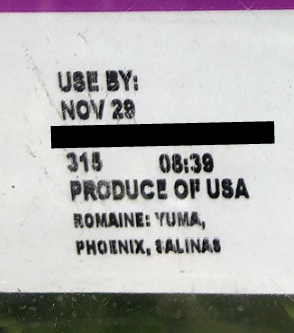
Romaine from Salinas, California Label Enjoy By December 2, 2019


Romaine from Salinas, California Label Use By November 29, 2019

Consumers: Consumers should not eat romaine lettuce harvested from Salinas, California. Additionally, consumers should not eat products identified in the recall announced by the USDA on November 21, 2019.

Romaine lettuce may be voluntarily labeled with a harvest region. If this voluntary label indicates that the romaine lettuce was grown in “Salinas” (whether alone or with the name of another location) do not eat it. Throw it away or return it to the place of purchase.  If romaine lettuce does not have information about harvest region or does not indicate that it has been grown indoors (i.e., hydroponically- and greenhouse-grown), throw it away or return it to the place of purchase. Consumers ordering salad containing romaine at a restaurant or at a salad bar should ask the staff whether the romaine came from Salinas.  If it did, or they do not know, do not eat it.

At this time, romaine lettuce that was harvested outside of the Salinas region has not been implicated in this outbreak investigation. Hydroponically- and greenhouse-grown romaine, which is voluntarily labeled as “indoor grown,” from any region does not appear to be related to the current outbreak. There is no recommendation for consumers to avoid using romaine harvested from these other sources.

Restaurants and Retailers: Restaurants and retailers should not serve or sell romaine harvested from Salinas, California.  If you do not know the source of your romaine lettuce, and if you cannot obtain that information from your supplier, you should not serve, nor sell it.

Suppliers and Distributors: Suppliers, distributors and others in the supply chain should not ship or sell romaine harvested in Salinas, California. If the source of the romaine lettuce is unknown, you should not ship, nor sell the product.

For Restaurants, Retailers, Suppliers and Distributors: Currently, the FDA does not have enough traceback information to identify the specific source of the contamination that would allow us to request a targeted recall from specific growers.

FDA requested that industry voluntarily withdraw romaine grown in Salinas from the market and is requesting that industry withhold distribution of Salinas romaine for the remainder of the growing season in Salinas. Without more specific traceback information, this was the most efficient way to ensure that contaminated romaine was off the market.

At this time, romaine lettuce that was harvested outside of the Salinas region has not been implicated in this outbreak investigation. Hydroponically- and greenhouse-grown romaine, which is voluntarily labeled as “indoor grown,” from any region does not appear to be related to the current outbreak. There is no recommendation for consumers or retailers to avoid using romaine harvested from these other sources.

Update

Based on the information indicating that ill people in Maryland were exposed to romaine lettuce harvested in Salinas, California, FDA, with the assistance of staff from the California Department of Public Health and the California Department of Food and Agriculture, immediately deployed investigators to three farms in the Salinas area that were identified based on the traceback investigation.

FDA continues to actively investigate the cause of this outbreak. Additionally, FDA is investigating two other E. coli outbreaks, each caused by strains that are different from each other and different from the larger outbreak. One of the additional outbreaks, in Washington state, is linked to romaine lettuce, and the other outbreak, with cases in the U.S. and Canada, is linked to Fresh Express Sunflower Crisp Chopped Salad Kits. As part of these investigations, FDA and state partners are conducting traceback investigations to trace romaine exposures to the source.

Currently, the tracebacks on all three outbreaks have identified a common grower in Salinas. FDA, CDC, and California partners are deploying a team to conduct new investigations at several ranches used by this grower as we try to identify the source of the contamination.

Europe – Salmonella the most common cause of foodborne outbreaks in the European Union

ECDC

Nearly one in three foodborne outbreaks in the EU in 2018 were caused by Salmonella. This is one of the main findings of the annual report on trends and sources of zoonoses published today by the European Food Safety Authority (EFSA) and the European Centre for Disease Prevention and Control (ECDC).

In 2018, EU Member States reported 5 146 foodborne outbreaks affecting 48 365 people. A foodborne disease outbreak is an incident during which at least two people contract the same illness from the same contaminated food or drink.

Slovakia, Spain and Poland accounted for 67% of the 1 581 Salmonella outbreaks. These outbreaks were mainly linked to eggs.

 “Findings from our latest Eurobarometer show that less than one third of European citizens rank food poisoning from bacteria among their top five concerns when it comes to food safety. The number of reported outbreaks suggests that there’s room for raising awareness among consumers as many foodborne illnesses are preventable by improving hygiene measures when handling and preparing food” said EFSA’s chief scientist Marta Hugas.

Salmonellosis was the second most commonly reported gastrointestinal infection in humans in the EU (91 857 cases reported), after campylobacteriosis (246 571).

Shiga toxin-producing E. coli (STEC) has become the third most common cause of foodborne zoonotic disease with 8 161 reported cases – replacing yersiniosis with a 37% increase compared to 2017. This may be partly explained by the growing use of new laboratory technologies, making the detection of sporadic cases easier.

Of the zoonotic diseases covered by the report, listeriosis accounts for the highest proportion of hospitalised cases (97%) and highest number of deaths (229), making it one of the most serious foodborne diseases.

The number of people affected by listeriosis in 2018 is similar to 2017 (2 549 in 2018 against 2 480 the previous year). However, the trend has been upward over the past ten years.

The report also includes data on Mycobacterium bovisBrucellaYersiniaTrichinellaEchinococcusToxoplasma, rabies, Coxiella burnetii (Q fever), and tularaemia.

Read the report

Publication

The European Union One Health 2018 Zoonoses Report

Surveillance report  

This report of the European Food Safety Authority and the European Centre for Disease Prevention and Control presents the results of zoonoses monitoring activities carried out in 2018 in 36 European countries (28 Member States (MS) and 8 non-MS).

e.

Netherlands – Belgium – Outbreak of Listeria monocytogenes infections in Europe linked to meat products

HPS

03 December 2019

Article: 53/4804

A new rapid risk assessment from the European Centre for Disease Prevention and Control (ECDC) shows that twenty-one cases of Listeria monocytogenes IVb sequence type ST 6 infections have been reported in the Netherlands (19 cases) and Belgium (two cases). This outbreak was identified using whole genome sequencing (WGS) analysis.

The patients involved had onset of illness between 2017 and August 2019. Three patients died and one suffered a miscarriage due to the infection. The close genetic relatedness of the strains, and the temporal distribution of the cases suggests a prolonged, intermittent, common source food-borne outbreak which occurred in at least two EU member states.

Nine isolates from six sliced ready-to-eat (RTE) meat products, produced between 2017 and 2019 by the Dutch manufacturing company A, were found to be contaminated with L. monocytogenes strains matching the outbreak strain.

Although the exact points of contamination have not yet been identified, the results of the investigation suggest that the contamination may have happened at the Dutch company, which was the only common manufacturing point of the contaminated products. The company distributed products to several EU countries as well as to countries outside the EU.

Company A stopped production in October 2019, and finalised the withdrawals and recalls of all RTE meat products. This measure lowered the risk of new cases occurring, which may be associated with this company’s products.

Pregnant women, the elderly and immunocompromised people are at higher risk of invasive listeriosis, which is associated with severe clinical course and potential death.

Specific attention should be paid to the administration of RTE meat products to people in hospitals, nursing homes and those belonging to vulnerable population groups.

Source: ECDC, 26 November 2019

Sweden – Salmonella outbreak, dozens affected

Outbreak News Today

Swedish Public Health officials (Folkhalsomyndigheten) are reporting (computer translated) an outbreak of Salmonella Typhimurium since the beginning of the month.

To date, 36 cases from 10 counties have been linked with whole-genome sequencing. Most cases have been reported from Västra Götaland, Jönköping, Halland and Dalarna. Ill persons are found in all age groups, both among children and the elderly, and slightly more women (22) than men (14) have become sick.

The Swedish National Food Agency and the Public Health Authority together are investigating the outbreak to identify the source of the infection that is suspected to be a food that has been widely distributed in Sweden.

Spain – Listeria meat firm knew its products were infected, months before outbreak

Euro Weekly News

THE Seville-based company Magrudis knew that its products were contaminated months before it caused the largest outbreak ever recorded in the country.

According to sources from Seville City Council and the Ministry of Health, the Laboratorios Microal sounded the alarm on February 18 after samples of the shredded meat product were sent to them for evaluation.

A statement released by the manager of the quality control and research at Microal, Mariano Barroso, of the two samples that were submitted, one came back as positive.

The listeria outbreak that swept Spain is the worst in recorded history, taking hold on August 15 and claiming the lives of three elderly victims and leaving over 200

USA – Philadelphia E. coli Outbreak Sickens At Least 14

Food Poisoning Bulletin

A Philadelphia E. coli outbreak has sickened at least 14 people, according to a Health Alert issued by the Philadelphia Department of Public Health. Public health officials “have identified a few shared restaurant exposures,” in their ongoing case investigation, but no one restaurant or food has been named so far.

Norway – Norway norovirus outbreaks linked to seaweed salad from China

Food Safety News

More than 100 people have fallen ill in Norway from norovirus likely in a frozen seaweed salad from China.

The first outbreak of norovirus suspected to be linked to the seaweed salad occurred in mid-June and the most recent was at the beginning of August. The implicated product was also shipped to Denmark.

“It is suspected that seaweed from China was the cause of more than 100 cases of gastroenteritis from at least 11 eateries in different areas of Norway. Most of the outbreaks were in June and July this year. Investigations are still ongoing. Norovirus was detected in patients from at least two of these eateries,” Guri Aanderud, senior adviser in the seafood section at the Norwegian Food Safety Authority (Mattilsynet) told Food Safety News.

USA – “Cyclosporapocalypse” sickens 1,696 in 33 States in 2019

Food Poison Journal Cyclospora_LifeCycle201

The number of reported cases of domestically acquired cyclosporiasis has increased from the previous month and remains elevated in the United States since May 1, 2019.

As of August 28, 2019, 1,696 laboratory-confirmed cases of cyclosporiasis were reported to CDC by 33 states, District of Columbia and New York City in people who became ill since May 1, 2019 and who had no history of international travel during the 14-day period before illness onset.

RASFF Alert – Foodborne Outbreak suspected (Salmonella)

RASFF-Logo

RASFF –   to be caused by and Salmonella (present /25g) in eggs from Spain in the Netherlands

Contagion Live – Outbreak Monitor – Listeria monocytogenes

Contagion Live111111