Category Archives: foodborne disease

New Zealand – Annual report concerning Foodborne Diseases in New Zealand 2019

MPI

Annual report concerning Foodborne Diseases in New Zealand 2019

ESR Report FW20013

Human health surveillance and its relationship to foodborne illness is essential for informing the strategic direction that New Zealand Food Safety (NZFS) takes and regulatory measures it puts in place to minimise foodborne illness in New Zealand and overseas consumers.

The annual ESR foodborne disease reports are critical, allowing NZFS to monitor trends in foodborne illness in New Zealand by describing in a consistent manner evidence from notifications, case enquiries, outbreak investigations and other epidemiological studies of human enteric diseases.

This report forms part of a series providing a consistent source of data annually to monitor trends on foodborne illness in New Zealand. The series can be found here. The reduction of human cases of foodborne campylobacteriosis is a top priority for NZFS. The current performance target is a reduction of rates of foodborne campylobacteriosis by 10% from 88.4in 2015to 79.6 by the end 2020.

Progress toward this target is reported in the section entitled Reporting against targets. The surveillance data indicates that during the last ten years the rates of foodborne campylobacteriosis are consistently, albeit slowly, decreasing. NZFS underscores that both total numbers of campylobacteriosis cases and rates per 100,000 population notified in 2019 are the lowest since 1992.Since 2015, NZ diagnostic laboratories have started to replace traditional culture-based methods for enteric pathogens by culture-independent diagnostic tests(CIDT)using molecular polymerase chain reaction.

In 2019, about 78% of human faecal samples were tested using CIDT. However, different laboratories are using different CIDT and six DHBs continue to use culture-based testing methods for enteric pathogens. The implication of improved sensitivity and changes in number of tests is well described in the introduction to the 2019 report. Shiga toxigenic Escherichia coli (STEC) remains a focus for NZFS. A continuing sharp increase in notification of STEC infections is evident, despite the absence of evidence that foodborne sources are increasing. The cause of this is likely to be related to implementation of CIDT and an increase in the number of faecal samples tested for STEC as all community faecal specimens are now screened for STEC.

The selection of diseases covered in the report is based on the potential of the disease to be caused by foodborne transmission and availability of national sources of information related to the disease. The enhanced analysis of risk factors and presentation of the information has resulted in an improved description of foodborne outbreaks in the 2019 report.

Although, some outbreaks reported as foodborne with unidentified food source might be attributed to other routes of transmission, such as water, animal contact or person to person. NZFS and ESR will further continue to improve the analysis and presentation of foodborne human illness surveillance and investigation data in future reports.

Food Safety Website – Stop Foodborne Illness

Stop Foodborne Illness

Incorporated as a not-for-profit in California in 1994, STOP began as a grassroots effort. The U.S. government and non-governmental organizations were not addressing this public safety issue and STOP stepped in to fill the void. The founders knew that increasing awareness about foodborne pathogens had to be a guiding principle.

Initially, STOP learned that there is not a singular government agency – there are many – that oversee food safety in the U.S. We also identified the lack of effective communication at all levels of governmental hierarchy – federal, state and local. It was clear that we weren’t the only organization seeking answers. As STOP became more knowledgeable of how food becomes contaminated, the weaknesses of the system and the complexity of the challenge of preventing foodborne illness became very apparent.

Learning that the United States government — our government — had known about emerging foodborne pathogens but lacked a comprehensive plan to combat them was disheartening. It was identified that as early as 1982, scientists and pathologists had been quietly warning the United States Department of Agriculture (USDA), Congress, and the media that a failure to inspect meat and poultry for bacteria would lead to a food safety disaster.

Time was of the essence and although there was significant resistance at every turn, STOP knew it held the truth.

STOP added its strong voice to the Safe Food Coalition, a group of consumer, public health and labor organizations which has advocated for improvements to the food safety system, particularly with respect to meat and poultry, since 1986. Industry held power, influence, and money. Victims’ families and survivors held onto lives that had been irreparably altered by foodborne illness. Families continued to tell their stories through the advocacy of STOP and its coalition partners.

STOP’s voices became a clarion call for change and eventually STOP was invited to participate in policy making. After countless hours spent educating the USDA and the meat industry about the devastation caused by E. coli, STOP became a key element in facilitating the first meat and poultry reforms since 1906. In 1996, STOP founders Roni and Nancy, were invited to witness this historic overhaul being signed into law by President Clinton.

Research – Monitoring online posts by consumers could help improve food safety

Phys Org

An estimated 48 million cases of foodborne illness are contracted in the United States every year, causing about 128,000 hospitalizations and 3,000 deaths, according to the Centers for Disease Control (CDC). In some instances, the source is well known, such as a batch of tainted ground beef that infected 209 people with E. Coli in 2019. But 80 percent of food poisoning cases are of unknown origin, making it impossible to inform consumers of hazardous food items.

David Goldberg, assistant professor of management information systems at San Diego State University, wants to improve the traceability and communication of risky  products. In a new study published by the journal Risk Analysis, his research team proposes a new Food Safety Monitoring System (FSMS) that utilizes consumer comments posted on websites to identify products associated with food-related illnesses.

The researchers utilized an AI technology called text mining to analyze comments and reviews from two websites: Amazon.com, the world’s largest e-commerce retailer, and IWasPoisoned.com, a site where consumers alert others to cases of food poisoning. The database consisted of 11,190 randomly selected Amazon reviews of “grocery and canned food” items purchased between 2000 and 2018, along with 8,596 reviews of food products posted on IWasPoisoned.com. These two datasets allowed the researchers to test the text mining tools before analyzing 4.4 million more Amazon reviews.

Research – Evaluation of foodborne pathogen die-off in back-sweetened wine and apple cider models

Journal of Food Protection

Wine and alcoholic apple cider are commonly back-sweetened with unpasteurized juice to produce fresh, natural, and palatable sweetened alcoholic beverages. Foodborne pathogens may be introduced from unpasteurized juice into alcoholic beverages through this back-sweetening process. Although pathogens generally do not survive under low pH conditions or high alcohol environment, the die-off of these pathogens has not been established to ensure the safety of the products. To determine the safety of these back-sweetened beverages, we evaluated the survival of three common foodborne pathogens, E. coli O157:H7, Salmonella enterica , and Listeria monocytogenes in modified white grape juice and apple juice models. White grape juice and apple juice were modified with hydrochloric acid/sodium hydroxide and ethanol to achieve conditions that are similar to the back-sweetened white wine and alcoholic apple cider. Pathogen cocktails were inoculated separately into modified juice models and their survival in the juice models were recorded over a 96-hour period. Our results show that a combination of low pH and high ethanol content resulted in a faster pathogen die-off compared to higher pH and lower ethanol conditions. The holding times required for different combinations of pH and ethanol concentration for each juice model to achieve 5-log reduction were reported. This research provides data to validate pathogen die-off to comply with Juice HACCP 5-log pathogen inactivation requirements for back-sweetened wine and alcoholic apple cider.

USA – Hearings set on motions to vacate convictions and sentences of Parnell brothers in deadly Salmonella outbreak

Food Safety News

Brothers Stewart Parnell, 66, and Michael Parnell, 62, have, respectively, another 18 and 11 years to serve in federal prisons for their 2014 jury convictions involving Peanut Corporation of America (PCA).

But with so-called “2255” evidentiary hearings now scheduled, on April 20  for Michal and on May 25 for Stewart, the early release of both men is a possible outcome. Their trial was in relation to a deadly Salmonella outbreak traced to their peanut products.

By getting evidentiary hearings on their motions to “Vacate, Set Aside, or Correct” their sentences, the Parnells have secured something many others do not get.

United States Magistrate Judge Thomas Q. Langstaff has agreed to hear the motions in the same Albany, GA, courthouse where the Parnells were convicted and sentenced.

Research – Updated food safety guidance gives pregnant women more certainty and choice on a wider range of foods

MPI

New research from New Zealand Food Safety provides pregnant women with more options and certainty about what they can safely eat with updated tips to avoid foodborne illness.

“We’ve looked at new foods that were not previously considered because we want pregnant women to have the most up-to-date food safety information so they can enjoy a diverse diet and stay healthy,” says Dr Claire McDonald, Manager Operational Research at New Zealand Food Safety.

“The guidance reflects the increased diversity in the New Zealand diet. The update not only provides more options, but also ensures all risky foods are captured and provides simple ways to reduce the chance of illness from food,” she said.

“It’s important pregnant women know what’s safe to they can avoid dangerous infections, such as listeriosis and toxoplasmosis, which can affect them more severely than non-pregnant women.”

Dr McDonald said the key information for women include:

  • thoroughly cooking seed sprouts (such as alfalfa or mung bean) before eating.
  • thoroughly cooking dried herbs before eating.
  • avoiding unpasteurised fruit juices and non-alcoholic cider.
  • avoiding low-acid, soft, pasteurised cheeses like Brie, Camembert, blue cheeses, ricotta, mozzarella, and feta unless they’re cooked.
  • updating guidance on some pasteurised dairy products (i.e. following manufacturer’s labelling advice and “best before” dates, etc.).
  • freshly cooked fish, mussels, oysters, crayfish, scallops, etc., should be cooked thoroughly until piping hot and eaten while hot.
  • whole melons should be washed and dried before cutting.
  • frozen berries should be cooked thoroughly before eating.
  • no restrictions on number of servings per week for gemfish, oreo dories, orange roughy, ling and smooth oreo fish species (previous advice limited the number of servings per week to minimise mercury intake).

“We know more about food safety now than we did just a few a years ago and it’s important people educate themselves and take simple steps such as washing produce and cooking certain foods properly,” Dr McDonald said.

More information on food and pregnancy

New Zealand Food Safety’s updated food safety guidance for pregnant women – YouTube

France – Product recall: Saint Alby brand Rosette de Lyon -Salmonella

Oulah

Product recall: Saint Alby brand Rosette de Lyon

ENCOUNTERED PROBLEM

Presence of salmonella

PROPOSED SOLUTION

Those in possession of this product are asked not to consume it and to return it to the point of sale where it was purchased for reimbursement.

Foodborne illness caused by salmonella results in gastrointestinal disturbances, diarrhea, vomiting and abdominal pain, often accompanied by fever; these symptoms may be more severe in young children, immunocompromised individuals and the elderly. The incubation period can range from 6 to 72 hours.
People who have consumed the products mentioned below and who have these symptoms are invited to consult their doctor, notifying him of this consumption.

FURTHER INFORMATION

▸ Barcode
20021139

▸ Lot
• 111001
• 111928

▸ DLC
• 01/22/2021
• 01/29/2021

▸ Health
stamp FR 69.238.010 CE

▸ Marketing date
From 10/15/2020 to 11/17/2020

▸ Consumer service contact
The LIDL consumer service is at your disposal at the following telephone number 0 800 900 343.

▸ Source
https://www.lidl.fr/fr

USA – Outbreak Investigation of Salmonella Enteritidis: Peaches (August 2020)

FDA

The FDA, along with CDC, Canadian, state and local partners, has been investigating a multistate outbreak of Salmonella Enteritidis infections linked to peaches packed or supplied by Prima Wawona or Wawona Packing Company.

The multistate outbreak of Salmonella Enteritidis infections linked to peaches from Prima Wawona that were sold in several regions of the United States and Canada, investigated by the FDA, along with CDC and Canadian, state, and local partners, is over. As of October 15, 2020, CDC reported a total of 101 cases across 17 states. This outbreak resulted in recalls of bagged and bulk, or loose, peaches packed or distributed by Prima Wawona. FDA also worked to publicly disclose international distribution of recalled product from Prima Wawona in an effort to facilitate the swift removal of all potentially affected product from the international market. More information about international distribution of the recalled product can be found in the previously published table below. FDA’s traceback investigation, which included 18 cases across eight states, identified multiple distributors, packing facilities, and orchards that supplied peaches during the time period of interest. Investigators from FDA, the California Department of Public Health (CDPH) and the California Department of Food and Agriculture (CDFA) visited Wawona packing facilities and/or orchards that likely supplied peaches to Prima Wawona during the timeframe of interest. FDA’s traceback investigation is ongoing; however, the cause and source of the outbreak has not yet been determined.

Thus far, in an effort to investigate several possible pathways of contamination, FDA has completed over 570 product and environmental sample analyses from multiple facility locations and/or peach orchards, including environmental swabs, peaches and peach tree leaf samples. At this time, sample collection and analysis is underway related to additional peach orchards. A genetic match to the outbreak strain has yet to be identified in any of the samples collected, although a different serotype of Salmonella was detected in one sample collected and analyzed during the investigation. No peaches linked to the positive sample ever reached the marketplace. Although the outbreak is being declared over, FDA will continue its investigation and will communicate any findings that could assist future prevention efforts.

Available recall information is included below.

Recommendation

On August 22, 2020, Prima Wawona recalled bagged and bulk, or loose, peaches that they supplied to retailers nationwide.

The recalled products are now well beyond expiration and likely no longer on the market or in consumers’ homes. However, consumers who may have frozen the recalled bagged peaches packed or supplied by Prima Wawona from June 1, 2020 to August 19, 2020 or the recalled loose/bulk peaches packed or supplied by Prima Wawona from June 1, 2020 to August 3, 2020 should throw them away.

Research – Record number of outbreak alerts on EU platform

Record number of outbreak alerts on EU platform

A European system used by countries to report outbreaks saw a record number of alerts in 2019.

The European Centre for Disease Prevention and Control (ECDC) hosts the Epidemic Intelligence Information System for food- and waterborne diseases (EPIS-FWD) platform. The network is a restricted web-based platform for experts to help with early detection and coordination of response to multi-country outbreaks through sharing information.

It consists of Urgent Inquiries and associated forums, which are the outbreak alert and investigation tools. The forums allow information to be shared about the outbreak investigation among a restricted number of experts. Nominated people outside the EPIS-FWD network, such as food safety and environmental experts or veterinarians from network countries or any expert or organization outside the network can also be invited to join.

USA/Canada – 1,139 Sickened by Cyclospora in the United States and Canada

1,139 Sickened by Cyclospora in the United States and Canada

727 tied to Fresh Express bagged salads – 412 sick from unknown product.

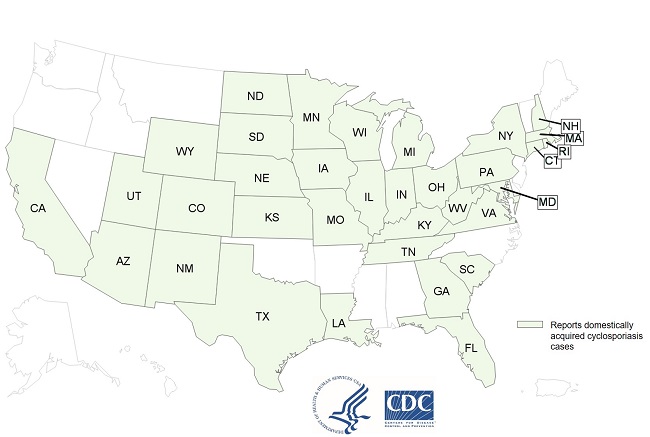
As of August 26, 2020, 1,102 laboratory-confirmed cases of cyclosporiasis in people who had no history of international travel during the 14-day period before illness onset have been reported to CDC by 35 jurisdictions, including 34 states and New York City, since May 1, 2020.

The median illness onset date is June 11, 2020 (range: May 1–August 15, 2020). At least 78 people have been hospitalized; no deaths have been reported.

In Canada, as of July 8, 2020, there are 37 confirmed cases of Cyclospora illness linked to this outbreak in three provinces: Ontario (26), Quebec (10) and Newfoundland and Labrador (1). Individuals became sick between mid-May and mid-June 2020. One individual has been hospitalized. No deaths have been reported. Individuals who became ill are between 21 and 70 years of age. The majority of cases (76%) are female.