Category Archives: food safety training

USA – Annual Reports on Foodborne Illness Source Attribution Estimates

CDC

Foodborne Illness Source Attribution Estimates for SalmonellaEscherichia coli O157, Listeria monocytogenes, and Campylobacter Using Multi-Year Outbreak Surveillance Data, United States.

Latest Report for 2019

IFSAC analyzed data from 1,532 foodborne disease outbreaks that occurred from 1998 through 2019 to assess which categories of foods were most responsible for SalmonellaE. coli O157, Listeria monocytogenes, and Campylobacter infections. These pathogens were chosen because of the frequency or severity of the illnesses they cause, and because targeted interventions can have a major impact in reducing them. The implicated foods were divided into 17 categories for the analysis, and the method gives the greatest weight to the most recent five years of outbreak data (2015–2019).
Read the 2019 report pdf icon[PDF – 14 pages]

Canada – Certain Tiger Nuts recalled due to possible Salmonella contamination from rodent infestation

Gov france

Summary

Product
Tiger Nuts
Issue
Food » Microbial Contamination » Salmonella
What to do

Do not consume, use, sell, serve, or distribute the recalled product.

Issue

African Foodways Market is recalling certain re-packaged Tiger Nuts from the marketplace due to possible Salmonella contamination from rodent infestation.

The recalled product has been sold in Manitoba.

What you should do

  • If you think you became sick from consuming a recalled product, call your doctor
  • Check to see if you have the recalled product in your home
  • Do not consume the recalled product
  • Do not serve, use, sell, or distribute the recalled product
  • Recalled products should be thrown out or returned to the location where they were purchased

Food contaminated with Salmonella may not look or smell spoiled but can still make you sick. Young children, pregnant women, the elderly and people with weakened immune systems may contract serious and sometimes deadly infections. Healthy people may experience short-term symptoms such as fever, headache, vomiting, nausea, abdominal cramps and diarrhea. Long-term complications may include severe arthritis.

USA – Standardization of Retail Food Safety Inspection Personnel

FDA

The main goal of a national food safety program is the reduction and prevention of foodborne illness. To that end, FDA provides several pathways, one of which is the Standardization of retail food inspection personnel. This process provides regulatory personnel the opportunity to subject their knowledge and skills related to the Code’s provisions to a uniform system of measurement. The process and criteria for demonstrating proficiency in the required performance areas are described in the FDA Procedures for Standardization of Retail Food Safety Inspection Officers.

The procedures are based on the FDA Food Code and are updated to reflect current Food Code provisions and to include a more refined focus on foodborne illness Risk Factors, Food Code Interventions, and application of the Principals of Hazard Analysis Critical Control Point (HACCP).

It is critical that food safety personnel become Standardized through this process to ensure that retail foods are safe, unadulterated, and honestly presented at retail throughout the United States. A certificate of standardization as an FDA standardized food safety inspection officer is issued to all Candidates who successfully complete the standardization process.

Resources

Research – Main Groups of Microorganisms of Relevance for Food Safety and Stability

NCBI

Microbiology is important to food safety, production, processing, preservation, and storage. Microbes such as bacteria, molds, and yeasts are employed for the foods production and food ingredients such as production of wine, beer, bakery, and dairy products. On the other hand, the growth and contamination of spoilage and pathogenic microorganisms is considered as one of the main causes to loss of foodstuff nowadays. Although technology, hygienic strategies, and traceability are important factors to prevent and delay microbial growth and contamination, food remains susceptible to spoilage and activity of pathogen microorganisms. Food loss by either spoilage or contaminated food affects food industry and consumers leading to economic losses and increased hospitalization costs. This chapter focuses on general aspects, characteristics, and importance of main microorganisms (bacteria, yeasts, molds, virus, and parasites) involved in food spoilage or contamination: known and recently discovered species; defects and alterations in foodstuff; most common food associated with each foodborne disease; resistance to thermal processing; occurrence in different countries; outbreaks; and associated symptoms.

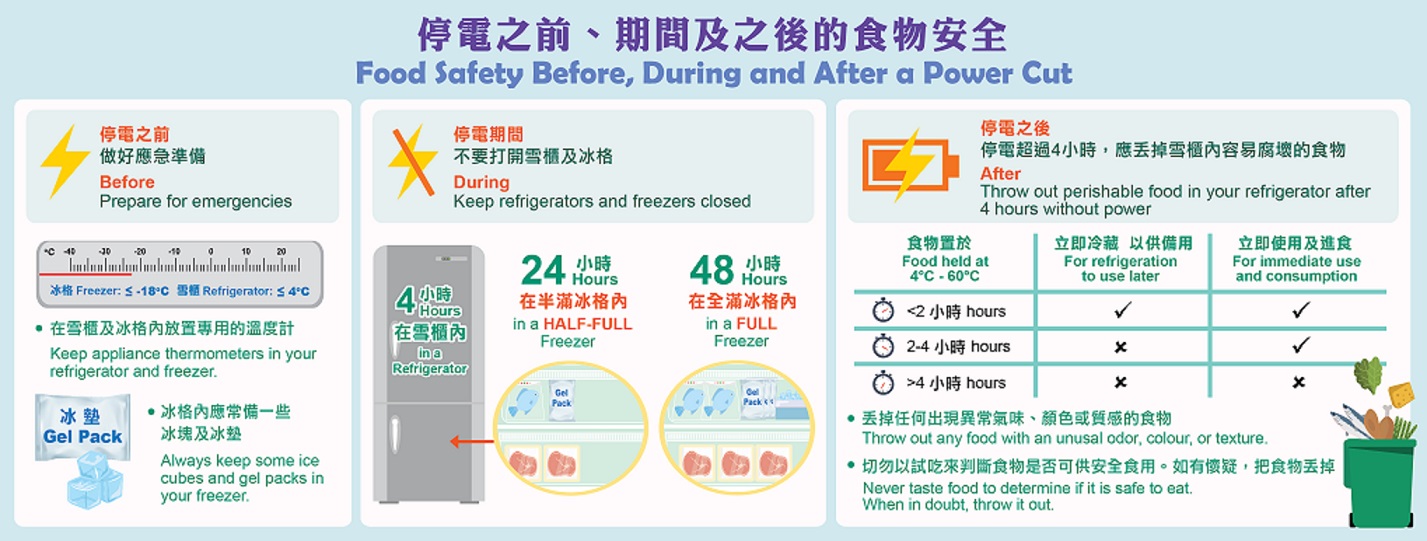
Hong Kong- How to Keep Food Safe in Case of a Power Cut at Home?

CFS

Prolonged power cut is uncommon in Hong Kong nowadays. However, sudden interruption of electricity supply may still occur due to unforeseeable factors such as adverse weather and equipment failure. Power disruptions can last for minutes to hours, during which food will spoil rapidly without refrigeration. Power cut can be troublesome, especially when you have a lot of perishable food items in your refrigerator and freezer compartment. Nonetheless, there is no need to panic. The following tips can help you keep food safe while waiting for resumption of power supply.

Hong Kong – Roving Exhibitions on Food Safety in 2022

CFS

Roving Exhibitions on Food Safety in 2022

The Centre for Food Safety (CFS) holds a series of exhibitions in major shopping centres of public and private housing estates across the territory every year.  Panels covering different topics such as food safety and nutrition, and educational videos are shown to enhance public knowledge on how to make safe and suitable food choices.

TWO roving exhibitions will be held in the following venues in January 2022. Details are as follows:

Date Time Venue Theme
5/1 10am – 4pm Yeung Uk Road Market Enhance Food Traceability, Strengthen Food Safety; Pesticide Residues; Trans Fats
27/1 10am – 4pm Yee On Street Market Nutrition Labelling; Enhance Food Traceability, Strengthen Food Safety; Ciguatoxins

New arrangements of the exhibitions will be announced regularly and members of the public are welcome to visit the CFS website.  For any enquiries, please contact our Communication Resource Unit at 2381 6096.