Category Archives: Food Safety Alert

USA – Factors Potentially Contributing to the Contamination of Leafy Greens Implicated in the Fall 2020 Outbreak of E. coli O157:H7

FDA

Executive Summary

Between August and December 2020, the U.S. Food and Drug Administration (FDA) and multiple state and federal partners were involved in an outbreak investigation related to E. coli O157:H7 illnesses and the consumption of leafy greens. The outbreak, which caused 40 reported domestic illnesses, was linked via whole genome sequencing (WGS) and geography to outbreaks traced back to the California growing region associated with the consumption of leafy greens in 2019 and 2018. FDA, alongside state and federal partners, investigated the outbreak to identify potential contributing factors that may have led to leafy green contamination with E. coli O157:H7. The E. coli O157:H7 outbreak strain was identified in a cattle faeces composite sample taken alongside a road approximately 1.3 miles upslope from a produce farm with multiple fields tied to the outbreaks by the traceback investigations. In addition, several potential contributing factors to the 2020 leafy greens outbreak were identified.

Isolates within this cluster of illnesses are part of a reoccurring strain of concern and are associated with outbreaks that have occurred in leafy greens each fall since 2017. The two most recent outbreaks associated with this strain were an outbreak in 2018 (linked to romaine lettuce from the Santa Maria growing region of California) and an outbreak in 2019 (linked to romaine lettuce from the Salinas growing region of California). Clinical isolates from cases in this 2020 outbreak appear more closely related to those from the 2019 outbreak than the 2018 outbreak. In addition, several specific food and environmental isolates that appear to be highly related to this 2020 outbreak include a faecal-soil composite sample collected by FDA in February 2020 from the Salinas growing region and two leafy green samples collected in 2019 by state partners as a part of the 2019 investigation that traced back to the Salinas growing region.

As part of this investigation, tracebacks of leafy greens consumed by ten ill individuals from eleven points of service were conducted. Although that traceback investigation was based on a relatively small number of the total cases, it was based on those cases which presented the strongest evidence via purchase card information, invoices, bills of lading, and electronic data. The traceback investigation identified the Salinas growing region of California as a geographical region of interest.

In light of this most recent finding, combined with previous outbreak investigation findings in the region, FDA has identified key trends regarding the issues of a reoccurring strain, a reoccurring region, and reoccurring issues around adjacent and nearby land use of primary importance in understanding the contamination of leafy greens by E. coli O157:H7 that occurred in 2020 and previous years.

FDA also recognizes the interconnection between people, animals, plants, and their shared environment when it comes to public health outcomes. As such, we strongly encourage collaboration among various groups in the broader agricultural community (i.e. livestock owners; leafy greens growers, state and federal government agencies, and academia) to address this issue. With this collaboration, the agricultural community, alongside academic and government partners, can work to identify and implement measures to prevent contamination of leafy greens. FDA recommends that these parties participate in efforts to understand and address the challenge of successful coexistence of various types of agricultural industries to ensure food safety and protect consumers against foodborne illnesses.

Download the Full Report (PDF 563KB)
Canada – Public warning – Notice not to consume smoked coho salmon sold by Boucherie O’Max

Quebec

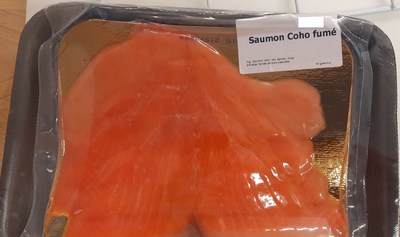
Smoked Coho Salmon (CNW Group / Ministry of Agriculture, Fisheries and Food)

QUEBEC, April 29, 2021 / CNW Telbec / – The Ministry of Agriculture, Fisheries and Food (MAPAQ), in collaboration with the company Boucherie O’Max, located at 85, rue Saint-Joseph , in Gracefield , is advising the public not to consume the product indicated in the table below if it has not been kept in the freezer at all times since the time of purchase. This is because the product packaging does not include the required “Keep frozen until use” statement.

Product name

Format

Targeted lot

“Smoked Coho Salmon”

65 g

Units sold until April 28, 2021

The product that is the subject of this warning was offered for sale until April 28, 2021 inclusive, and only at the establishment designated above. It was vacuum packed and sold frozen. The product label includes, in addition to its own name, the list of ingredients and the price of the product.

The operator is voluntarily recalling the product in question. He agreed with MAPAQ to disseminate this warning as a precautionary measure. People who have this product in their possession and have not kept it in the freezer at all times since the time of purchase are advised not to consume it. They must either return it to the establishment where they bought it or throw it away. Even if the affected product does not show any signs of spoilage or a suspicious odor, consuming it may represent a health risk. It should be noted that no case of illness associated with the consumption of this food has been reported to MAPAQ so far.

Additional information

The Ministry publishes various information documents concerning food safety. Those interested can consult them in the “Food consumption” section of the MAPAQ website: www.mapaq.gouv.qc.ca/consommation . They also have the option of registering online, by visiting www.mapaq.gouv.qc.ca/rappelsaliments , to receive, by email, the food recall releases published by the Department. Finally, it is possible to follow “MAPAQaliments” on Twitter at the following address: www.twitter.com/MAPAQaliments .

France – Product recall: Fromagerie des Frisonnes brand Marguerite’s Delight – E.coli

Oulah

Product recall: Fromagerie des Frisonnes brand Marguerite's Delight

ENCOUNTERED PROBLEM

Presence of Escherichia Coli

PROPOSED SOLUTION

People who hold the product in question are asked not to consume them – and more particularly young children, pregnant women, immunocompromised people and the elderly – and to return them to the point of sale where they were purchased.

People who have consumed it and who present symptoms such as diarrhea, abdominal pain or vomiting should consult their doctor as soon as possible, mentioning this consumption and the possible link with the bacterium Escherichia coli.

In the absence of symptoms within 10 days after consuming the affected products, there is no need to worry and consult a doctor.

The bacterium E. coli is naturally present among the digestive microflora of humans and warm-blooded animals. Some strains of E. coli are pathogenic, and can be responsible in humans for various disorders ranging from mild diarrhea to more serious forms such as hemorrhagic diarrhea or severe kidney damage such as HUS, mainly in young children.

FURTHER INFORMATION

▸ Lot
100221

▸ DDM
04/25/2021

▸ Packaging individually
wrapped in paper

▸ Start date / End of marketing
From 03/15/2021 to 04/16/2021

▸ Health mark
FR 86 042 001 CE

▸ Geographical sales area
• INDRE-ET-LOIRE (37)
• VIENNE (86)

▸ Distributors
• Retailers on 86 and 37,
• Amap at 37,
• Tours Beaujardin market
• farm gate sale

▸ Consumer service contact
0247920402

▸ Source
EARL DES FRISONNES EARL des Frisonnes

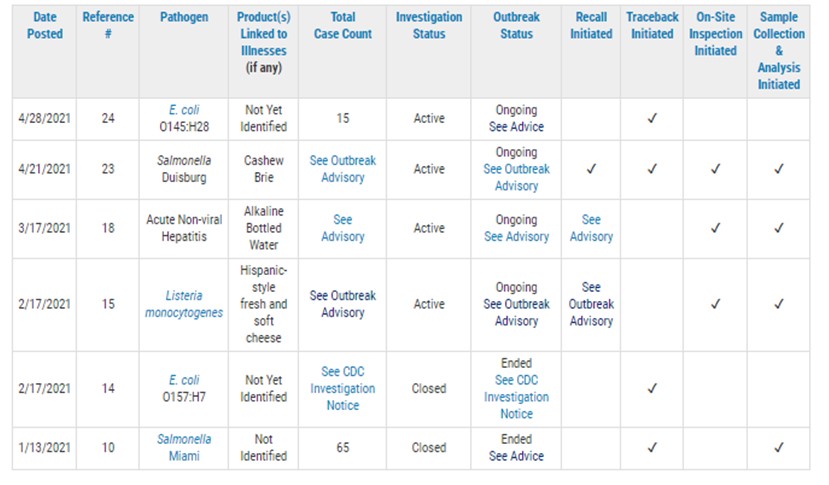
USA – New E. coli O145:H28 Outbreak Sickens 15; Little Information Provided

Food Poisoning Bulletin

A new E. coli O145:H28 outbreak has been posted on the FDA’s CORE Investigation outbreak table. This new outbreak has sickened at least 15 people. There is no more information provided, which is typical for a posting on that table. The FDA only gives out more information about these outbreaks when they believe there are actionable steps that consumers can take to protect themselves, such as a recall.

USA – FDA Core Investigation Table Update

FDA

Ireland – Withdrawal of a Batch of Iceland Luxury 4 Hoisin Duck Quarter Pounder Burgers due to the Presence of Salmonella

FSAI

Wednesday, 28 April 2021

Summary
Category 1: For Action
Alert Notification: 2021.36
Product: Luxury 4 Hoisin Duck Quarter Pounders; pack size: 454g
Batch Code: Best before: 20/09/2022
Country Of Origin: United Kingdom

Message:

The above batch of frozen Iceland Luxury 4 Hoisin Duck Quarter Pounder burgers is being withdrawn due to the presence of Salmonella.  Point-of-sale product withdrawal notices will be displayed in Iceland stores.

Nature Of Danger:

People infected with Salmonella typically develop symptoms between 12 and 36 hours after infection, but this can range between 6 and 72 hours.  The most common symptom is diarrhoea, which can sometimes be bloody.  Other symptoms may include fever, headache and abdominal cramps.  The illness usually lasts 4 to 7 days. Diarrhoea can occasionally be severe enough to require hospital admission. The elderly, infants, and those with impaired immune systems are more likely to have a severe illness.

Action Required:

Manufacturers, wholesalers, distributors, caterers & retailers:

Retailers are requested to remove the implicated batch from sale and to display a point-of-sale product withdrawal notice in stores where the affected batch was sold.

Consumers:

Consumers are advised not to eat the implicated batch.

Iceland duck burgers

France – Product recall: ORGANIC rope Mussels raised in France from the L’ATELIER POISSONNERIE brand – E.coli

Oulah

Product recall: ORGANIC rope molds raised in France from the L'ATELIER POISSONNERIE brand

ENCOUNTERED PROBLEM

Presence of Escherichia coli

PROPOSED SOLUTION

People who hold the product in question are asked not to consume them – and more particularly young children, pregnant women, immunocompromised people and the elderly – and to return them to the point of sale where they were purchased.

People who have consumed it and who present symptoms such as diarrhea, abdominal pain or vomiting should consult their doctor as soon as possible, mentioning this consumption and the possible link with the bacterium Escherichia coli.

In the absence of symptoms within 10 days after consuming the affected products, there is no need to worry and consult a doctor.

The bacterium E. coli is naturally present among the digestive microflora of humans and warm-blooded animals. Some strains of E. coli are pathogenic, and can be responsible in humans for various disorders ranging from mild diarrhea to more serious forms such as hemorrhagic diarrhea or severe kidney damage such as HUS, mainly in young children.

FURTHER INFORMATION

▸ Barcode
3664335020170

▸ Lot
20210418

▸ DLC
04/26/2021

▸ Start date / End of marketing
From 04/21/2021 to 04/26/2021

▸ Health mark
FR 44.069.002 CE

▸ Distributors
E. Leclerc Stores

▸ Contact
customer service 0960445769

▸ Source
https://rappel.conso.gouv.fr/

USA – Notes from the Field: Multistate Outbreak of Escherichia coli O26 Infections Linked to Raw Flour — United States, 2019

CDC

On February 20, 2019, PulseNet, the molecular subtyping network for foodborne disease surveillance, identified six Shiga toxin–producing Escherichia coli (STEC) O26:H11 infections with the same pulsed-field gel electrophoresis (PFGE) pattern combination. This PFGE pattern combination matched that of infections from a July 2018 outbreak that was associated with ground beef. In response, CDC initiated an investigation with federal, state, and local partners to identify the outbreak source and implement prevention measures.

CDC defined a case as STEC O26 infection with an isolate matching the outbreak strain by PFGE or related by core genome multilocus sequence typing scheme (cgMLST), with dates of illness onset during December 11, 2018–May 21, 2019. Investigators initially hypothesized that ground beef was the outbreak cause because of the PFGE match to the July 2018 outbreak and because in early interviews, patients commonly reported eating ground beef and leafy greens. Investigators used cgMLST to compare the genetic sequences of isolates from both outbreaks and determined that they fell into separate genetic clades (differing by 6–11 alleles), suggesting that something other than ground beef caused the illness in 2019. CDC noted that one patient consumed raw cookie dough and that most patients were young adult females, similar to demographic distributions of past flour-associated STEC outbreaks (1–3). Investigators developed a supplemental questionnaire focusing on beef, leafy greens, and flour exposures.

Twenty-one cases were reported from nine states (Figure). The median age of patients was 24 years (range = 7–86 years); 71% were female. Three patients were hospitalized, and none died. Among 13 patients asked about flour exposures, six reported eating, licking, or tasting raw homemade dough or batter during the week before illness onset. Three patients reported eating raw dough or batter made with the same grocery store brand of all-purpose flour, including a patient who reported eating raw dough at a bakery in Rhode Island. Overall, of 18 patients with store information, 11 reported shopping at this same grocery store chain.

The Rhode Island Department of Health visited the bakery reported by the patient and collected flour for testing. On May 21, 2019, testing identified STEC O26 from an intact bag of all-purpose flour, which was the same grocery store brand reported by other patients. PulseNet confirmed that the STEC O26 isolated from the flour was highly related to clinical isolates using cgMLST (0–1 alleles). Product distribution records collected by the Food and Drug Administration indicated that the store brand flour purchased by six patients in three states was produced in a single milling facility in Buffalo, New York. Based on results of the investigation, the store chain recalled all lots of product from its retail locations in 11 states. The milling company also recalled all lots of this product and several other lots of flour produced in that facility, resulting in the recall of additional brands and products distributed to multiple states.

Flour is increasingly recognized as a cause of STEC outbreaks (1–5). Raw flour is not a ready-to-eat product, and this outbreak highlights the continuing risk for illness associated with consumption of flour and raw dough or batter. The investigation was aided by considering demographic information early in the investigation because these characteristics were similar to those in past flour-associated outbreaks (1–3). These similarities, coupled with the discriminatory power of cgMLST, helped to guide the consideration of alternative hypotheses regarding the outbreak source and the successful identification of flour as the cause of this outbreak.

UK – Poland promises action to reassure UK on poultry meat safety

Food Safety News

Officials from Poland and the United Kingdom have met virtually to discuss the safety of Polish poultry meat after it was linked to several outbreaks.

Grzegorz Puda, Polish minister of Agriculture and Forestry, spoke remotely this past week with George Eustice, secretary of state for Environment, Food and Rural Affairs.

Puda said he had taken direct charge of the issue of Salmonella in Polish poultry meat.

“Despite the difficult pandemic situation, Poland will take all measures to minimize and eliminate the UK’s concerns about the quality and safety of Polish poultry,” he said.

“Poland is ready to cooperate with the UK on sequencing of the Salmonella genome in poultry products.”

Singapore – NTUSingapore, Singapore Food Agency, and A*STAR launch Future Ready Food Safety Hub(FRESH)to build Singapore’s capabilities in food safety science

Click to access ntu-singapore-singapore-food-agency-and-a-star-launch-future-ready-food-safety-hub-(fresh)-to-build-singapore-s-capabilities-in-food-safety-science.pdf