Nagpur: Fourteen girls taking basic skill development training under the Deendayal Upadhyaya Kaushalya Yojna (DDUGKY) in city ell ill on Saturday with severe symptoms of vomiting and and motions apparently due to food poisoning.

Nagpur: Fourteen girls taking basic skill development training under the Deendayal Upadhyaya Kaushalya Yojna (DDUGKY) in city ell ill on Saturday with severe symptoms of vomiting and and motions apparently due to food poisoning.
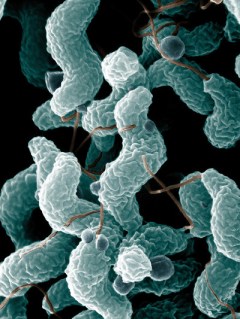
Image CDC
COPENHAGEN, Denmark (AP) — Norwegian authorities said Tuesday they were trying to identify the source of water contamination that has sent dozens of people in southern Norway to the hospital.
Since Thursday, 55 people — including 13 children — from Askoey, an island north of Bergen, have been hospitalized following the contamination. All have been discharged. Norwegian news agency NTB reported that in all, some 2,000 people had fallen sick.
A 1-year-old child on the island died last week of an infection in the digestive tract, but it was not clear whether it was linked to the contamination.
He said tests showed that the bacteria Campylobacter has been found in 36 cases.
Posted in Campylobacter, Contaminated water, food contamination, food death, Food Hygiene, Food Illness, Food Inspections, Food Micro Blog, Food Microbiology, Food Microbiology Blog, Food Pathogen, food recall, Food Safety, Food Safety Alert, Food Testing, Uncategorized, Water, water microbiology, Water Safety
Listeria warnings were not issued to the public until it was confirmed by test results because experts were confident it had been contained and vulnerable patients protected.
Three patients have been killed by hospital sandwiches and 43 NHS trusts placed on alert in one of the worst cases of food poisoning in the health service.
Six people were diagnosed with a serious listeria infection between April 25 and May 15.
Summary
A prolonged multi-country outbreak of 22 listeriosis cases caused by Listeria monocytogenes sequence type (ST) 1247, clonal complex (CC) 8 has been identified through whole genome sequencing (WGS) in five EU countries: Denmark (9 cases), Estonia (6), Finland (2), France (1) and Sweden (4). Five patients have died due to, or with, the disease. The first case had symptom onset in July 2014 in Estonia, and the most recent case occurred in Denmark in February 2019. Eight patients, out of twelve for whom a food consumption history was available, confirmed the consumption of cold-smoked fish products. L. monocytogenes food isolates, matching the human outbreak strain by WGS, were detected at wholesale and retail level in four countries (i.e. France, Denmark, Italy and Sweden) from 13 batches of cold smoked or gravad salmon and from six batches of cold smoked trout products. Traceability information of the contaminated batches pointed to the Estonian processing Company A as the single common manufacturer of these fish products. The raw fish was received from suppliers in Norway and Finland. Environmental investigations and food testing at the Estonian processing plant showed the presence of L. monocytogenes that matched the outbreak strain in two samples on the processing line and in four batches of the final product.
The presence of L. monocytogenes matching the outbreak strain over several years in the fish products suggests the persistence of the microorganism at the Estonian company’s premises. Further investigation is needed to identify points of (cross-)contamination in the food processing plant. Control measures were implemented in Estonia, Denmark, France and Italy following the RASFF (Rapid Alert System for Food and Feed) notifications, but until the source of infection has been identified and controlled, new invasive listeriosis cases associated with this event may still occur.
In general, pregnant women, the elderly and immunocompromised individuals are at increased risk of invasive listeriosis, which is associated with severe clinical course and potentially death.
Posted in food bourne outbreak, food contamination, Food Hygiene, Food Illness, Food Inspections, Food Micro Blog, Food Microbiology, Food Microbiology Blog, Food Pathogen, food recall, Food Safety, Food Safety Alert, Food Testing, foodborne disease, Foodborne Illness, foodborne outbreak, foodbourne outbreak, Listeria, Listeria monocytogenes, Uncategorized
The Winnebago County Illinois Health Department has confirmed three cases of Shiga toxin‐producing E. coli (STEC) in the county.
The patients experienced diarrhea beginning May 31. The cause of the illness has not yet been determined, the department announced Friday evening.
The following are symptoms of E. coli and may be seen with or without a fever: abdominal cramps, watery or bloody diarrhea and vomiting. Residents are urged to contact a health care provider if they experienced symptoms on or after May 21.
Kroger is recalling certain beef products from some of its stores due to potential E. coli contamination. The products included bone-in ribeye steaks, boneless ribeye steaks and in-store produced ground beef. The items will have the following labels:
Customers who purchased these items from April 23 through June 7 should not eat the product. Kroger says the affected stores are in the Cincinnati area, northern Kentucky, Dayton, Ohio, and southeastern Indiana.
Kroger says there have been no confirmed reports of illness due to consumption of the products at this time.
According to data presented at the CDC’s Annual Epidemic Intelligence Service Conference, contaminated asparagus was the likely source of a Shigella outbreak at a Yarnhill County wedding in Oregon in 2018. One hundred twelve people were sickened; 10 people were hospitalized.
A total of 263 people attended the wedding. Seventy-five percent of those people responded to the survey. The patient age range was from 2 to 93 years. Of the 95 people who responded, 97% said they got sick within 12 to 72 hours after the wedding. Fifty-seven patients went to a health care facility.
Investigators found that only asparagus was associated with illness.
Three people have died recently in England from listeriosis with a link to eating pre-made sandwiches and at least three others have been sickened by the deadly bacteria. The patients died at Manchester University NHS Foundation Trust and Aintree University Hospital NHS Foundation Trust in Liverpool.
Cases of Listeria infection have been reported in six hospital patients in England. Sandwiches and salads linked to the sick people have been withdrawn and the supplier, The Good Food Chain, has voluntarily ceased production while the investigation continues.
The FDA is alerting consumers to a hepatitis A virus (HAV) contamination of frozen blackberries under the Kroger grocery store “Private Selection” brand. This contamination was discovered by the FDA as a part of an ongoing frozen berry sampling assignment. The FDA is advising consumers not to eat and to throw away frozen fruit purchased from Kroger and other retail locations packaged under Kroger’s “Private Selection” brand. Here are the recalled products:

These products are available at Kroger and other retail locations and have a two-year shelf life. The FDA is working with the manufacturer on this matter. This posting will be updated with new information as it becomes available. The FDA is continuing to investigate to determine whether there are other implicated products.
At this time, the FDA and the Centers for Disease Control and Prevention (CDC) are not aware of any cases of hepatitis A linked to the consumption of Kroger Private Selection brand frozen blackberries. Hepatitis A virus (HAV) can result in a liver infection that may be inapparent. However, when symptoms occur, they can range in severity from a mild illness lasting a few weeks to a severe illness lasting several months. HAV is found in the stool and blood of people who are infected. HAV is spread when someone ingests the virus, usually through person-to-person contact or from eating contaminated food or drink. Contamination of food with the hepatitis A virus can happen at any point: growing, harvesting, processing, handling, and even after cooking.

Image CDC
The aim of this study was to isolate Listeria monocytogenes from chicken neck skins and lytic bacteriophages from poultry slaughterhouse wastewaters, and following the characterization of the isolates, biocontrol of L. monocytogenes was investigated on chicken drumsticks with the isolated phages. L. monocytogenes prevalence was detected 12.3% in the chicken samples and the dominant serotype was determined as 1/2a (92.5%). Expression levels of major virulence genes were revealed by real‐time RT‐PCR. Ten different DNA profiles were detected by ERIC‐PCR fingerprinting. According to the MIC results, LM‐P75 was defined as MDR by showing resistance to antibiotics in six different groups. Besides, five lytic listeriophages were isolated from wastewaters and treated with Cla1 and Sac1. Taking EoP, TEM, in vitro, and in vivo analyses results into consideration, three bacteriophages were used for the biocontrol assay. The application of the bacteriophages on drumsticks achieved a reduction up to 3.3 log CFU/ml in L. monocytogenes count in 3 hr of incubation at 4°C.
Our results showed that in spite of the developments in hygiene practices during slaughtering, chicken meat is still a potential source for L. monocytogenes. On the other hand, the phage cocktail that used in this study can be an effective tool to reduce L. monocytogenes in chicken carcasses at final wash or at cooling step in poultry slaughtering process, as well as in decontamination of chicken meat parts.