Category Archives: Food Microbiology Blog

France- Pork tongue in jelly – Listeria monocytogenes

Gov france

Identification information of the recalled product

  • Product category Food
  • Product subcategory Others
  • Product brand name The workshop
  • Model names or references Pork tongue cooked in jelly
  • Identification of products
    GTIN Batch Date
    2228084000000 1232022 Use-by date 05/18/2022
    1312022 Use-by date 05/26/2022
  • Marketing start/end date From 03/05/2022 to 17/05/2022
  • Storage temperature Product to be stored in the refrigerator
  • Geographic area of ​​sale Whole France
  • Distributors LECLERC TEMPLEUVE and LECLERC FIVES

Practical information regarding the recall

  • Reason for recall Presence of listeria
  • Risks incurred by the consumer Listeria monocytogenes (causative agent of listeriosis)

Research – Microbial Consortium Associated with Crustacean Shells Composting

MDPI

Soil microbes play an essential role in the biodegradation of crustacean shells, which is the process of sustainable bioconversion to chitin derivatives ultimately resulting in the promotion of plant growth properties. While a number of microorganisms with chitinolytic properties have been characterized, little is known about the microbial taxa that participate in this process either by active chitin degradation or by facilitation of this activity through nutritional cooperation and composting with the chitinolytic microorganisms. In this study, we evaluated the transformation of the soil microbiome triggered by close approximation to the green crab shell surface. Our data indicate that the microbial community associated with green crab shell matter undergoes significant specialized changes, which was reflected in a decreased fungal and bacterial Shannon diversity and evenness and in a dramatic alteration in the community composition. The relative abundance of several bacterial and fungal genera including bacteria Flavobacterium, Clostridium, Pseudomonas, and Sanguibacter and fungi Mortierella, Mycochlamys, and Talaromyces were increased with approximation to the shell surface. Association with the shell triggered significant changes in microbial cooperation that incorporate microorganisms that were previously reported to be involved in chitin degradation as well as ones with no reported chitinolytic activity. Our study indicates that the biodegradation of crab shells in soil incorporates a consortium of microorganisms that might provide a more efficient way for bioconversion. View Full-Text

Research – Microbial Safety and Sensory Analyses of Cold-Smoked Salmon Produced with Sodium-Reduced Mineral Salts and Organic Acid Salts

MDPI

Cold-smoked (CS) salmon contains high levels of sodium salts, and excess dietary sodium intake is associated with an array of health complications. CS salmon may also represent a food safety risk due to possible presence and growth of the foodborne pathogen Listeria monocytogenes which may cause fatal human infections. Here we determine how reformulated CS salmon using commercial sodium-reduced salt replacers containing KCl (e.g., Nutek, Smart Salt, SOLO-LITE) and acetate-based preservative salts (Provian K, proviant NDV) affect sensory properties, quality, and microbial safety. Initial sensory screening of sodium-reduced CS salmon was followed by L. monocytogenes growth analyses in selected variants of reformulated CS salmon, and finally by analyses of CS salmon variants produced in an industrial smokehouse. Projective mapping indicated overall minor sensory changes in sodium-replaced samples compared with a conventional product with NaCl. Growth of L. monocytogenes was temperature-dependent (4 °C vs. 8 °C storage) with similar growth in sodium-reduced and conventional CS salmon. The addition of 0.9% of the preservative salts Provian K or Provian NDV gave up to 4 log lower L. monocytogenes counts in both sodium-reduced and conventional cold-smoked salmon after 29 days of chilled storage. No changes in pH (range 6.20–6.33), aw levels (range 0.960–0.973), or weight yield (96.8 ± 0.2%) were evident in CS salmon with salt replacers or Provian preservative salts. Analyses of CS salmon produced with selected mineral salt and preservative salt combinations in an industrial salmon smokery indicated marginal differences in sensory properties. Samples with the preservative salt Provian NDV provided L. monocytogenes growth inhibition and low-level total viable counts (<2.8 log/g) dominated by Photobacterium and Carnobacterium during storage. Production of sodium-reduced CS salmon with inhibiting salts provides a simple method to achieve a healthier food product with increased food safety.

Research – Removal of Ochratoxin A from Grape Juice by Clarification: A Response Surface Methodology Study

MDPI

This study achieved maximum removal of ochratoxin A (OTA) during the grape juice clarification process with minimal reduction in antioxidant compounds (phenolic acid, flavonoids, and antioxidant capacity by FRAP) by the RSM method. Independent variables included three types of clarifiers—gelatin, bentonite, and diatomite (diatomaceous earth)—at a concentration level of 0.25–0.75% and clarification time of 1–3 h. OTA was measured by high-performance liquid chromatography with fluorescence detection. Clarifying agent concentration and clarification time affected the reduction amount of OTA and antioxidant compounds in grape juice. There was a direct linear correlation between the reduction amounts of OTA and antioxidant compounds and capacity with the concentration of bentonite, gelatin, and diatomite, and the clarification time. The reduction amount of OTA and antioxidant capacity followed the linear mode. However, the decreased phenolic acid and flavonoid values followed the quadratic model. The study results showed that if the concentrations of bentonite, gelatin, and diatomite and clarification time were 0.45, 0.62, 0.25%, and 1 h, respectively, the maximum amount of OTA reduction (41.67%) occurred. Furthermore, the phenolic acid, flavonoid, and antioxidant activity decrease amounts were at their lowest levels, i.e., 23.86, 7.20, and 17.27%, respectively. View Full-Text

Research – Influence of Metal Concentration and Plumbing Materials on Legionella Contamination

MDPI

Legionella colonization of water supply pipes is a significant public health problem. The objective of this work was to evaluate Legionella colonization in hotel hot water systems and to investigate the relationship between metal concentrations, piping materials (galvanized iron pipes and plastic pipes), and Legionella proliferation. Concentrations of calcium and magnesium ions and the presence of Legionella pneumophila were determined in a total of 108 water samples from the hot water systems of four hotels in Split-Dalmatia County over a 12-month period, and additional data on piping materials were collected. L. pneumophila was isolated in 23.1% of all samples—in 28.8% (15/52) of water samples from galvanized iron pipes and in 17.8% (10/56) of samples from plastic pipes. L. pneumophila serogroups 2–14 were isolated from all samples. This study found higher prevalence of L. pneumophila at higher concentrations of Ca and Mg ions (except for Mg and plastic pipes). The metal parts of the water supply may be important factors in Legionella contamination due to the possibility of lime scale or roughness of the pipes. Higher Ca and Mg ion concentrations increased the risk of Legionella colonization. View Full-Text

Ireland – Sixteen Salmonella cases in Ireland linked to Kinder products

Irish Times

The number of people who became ill due to a salmonella outbreak linked to Kinder chocolate products has increased to 369 across Europe and North America, including 16 in Ireland.

One additional Irish case involving a second strain has been identified in addition to the initial 15, according to the European Centre for Disease Prevention and Control (ECDC). Five of the people affected required hospital treatment.

Across Europe and north America, 274 cases from first cluster or strain and 37 from a second have been confirmed in 16 countries, along with 58 suspected cases. Most cases involved children aged under 10.

The two strains are multi-drug resistant and some samples were also resistant to disinfection using ammonium or hydrogen peroxide. The outbreak has been linked to specific products made in Italian confectionery company Ferrero’s factory in Belgium.

Two salmonella strains were identified in buttermilk used at the Belgian plant, which had come from Italy.

France – Fluid buckwheat flour 1kg METRO CHEF – Salmonella

Gov france

Identification information of the recalled product

  • Product category Food
  • Product subcategory Cereals and baked goods
  • Product brand name METRO CHEF
  • Model names or references Fluid buckwheat flour 1kg METRO CHEF
  • Identification of products
    GTIN Batch Date
    3439495101751 503118CS11 Date of minimum durability 28/10/2022
    3439495101751 503118CS11 Date of minimum durability 29/10/2022
  • Packaging1kg bag
  • Marketing start/end date From 03/05/2022 to 17/05/2022
  • Storage temperature Product to be stored at room temperature
  • Geographic area of ​​sale Whole France
  • Distributors METRO

Practical information regarding the recall

  • Reason for recall Suspicion of the presence of Salmonella
  • Risks incurred by the consumer Salmonella spp (causative agent of salmonellosis)

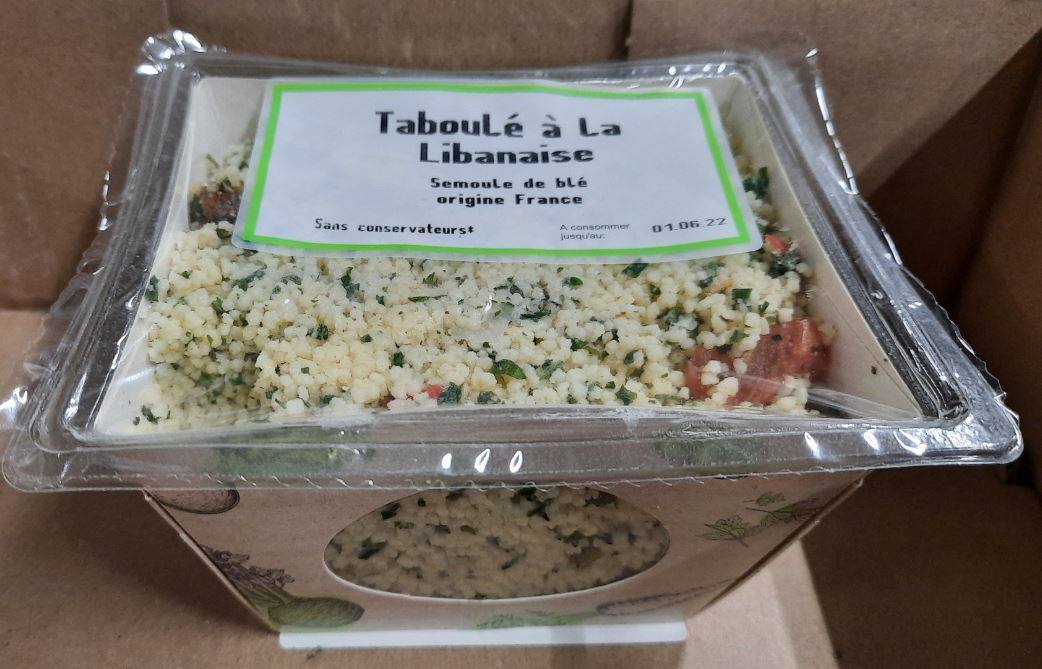
France – Lebanese Tabbouleh 230g – Listeria monocytogenes

Gov france

Identification information of the recalled product

  • Product category Food
  • Product subcategory Others
  • Product brand name SOLEANE
  • Model names or references Lebanese Tabbouleh 230g UPC
  • Identification of products
    Batch Date
    126 Use-by date 05/22/2022
  • Packaging230 g cup-shaped tray
  • Marketing start/end date From 05/11/2022 to 05/18/2022
  • Storage temperature Product to be stored in the refrigerator
  • Geographic area of ​​sale Whole France
  • Distributors Fresh stores and Savoyard Market (St Alban) and Mon Marché
  • List of points of saleliste_mag_rappel_230g_tabouleh_230g.pdf

Practical information regarding the recall

  • Reason for recall Detection of Listeria monocytogenes
  • Risks incurred by the consumer Listeria monocytogenes (causative agent of listeriosis)

France – Lebanese tabbouleh 350g – Listeria monocytogenes

Gov france

Identification information of the recalled product

  • Product category Food
  • Product subcategory Others
  • Product brand name SOLEANE
  • Model names or references Lebanese tabbouleh 350g
  • Identification of products
    Batch Date
    129 Use-by date 05/25/2022
  • Packaging350g tray
  • Marketing start/end date From 05/11/2022 to 05/18/2022
  • Storage temperature Product to be stored in the refrigerator
  • Geographic area of ​​sale Whole France
  • Distributors Fresh stores: St Brevin / Bayeux / Chateaubernard / Houtaud / Ambérieu en Bugey / Soultz / Portau / Azergues / Leman / Bourg en Bresse / Houdemont / Nemours / Etoile sur Rhône / Chaponnay / Belley / Pontcharra / Bonneville

Practical information regarding the recall

  • Reason for recall Detection of Listeria monocytogenes
  • Risks incurred by the consumer Listeria monocytogenes (causative agent of listeriosis)

France – Piedmontese 400g – Listeria monocytogenes

Gov france

Identification information of the recalled product

  • Product category Food
  • Product subcategory Others
  • Product brand name SOLEANE
  • Model names or references Piedmontese 400g
  • Identification of products
    Batch Date
    129 Use-by date 05/25/2022
  • Packaging400g tray
  • Marketing start/end date From 05/11/2022 to 05/18/2022
  • Storage temperature Product to be stored in the refrigerator
  • Geographic area of ​​sale Whole France
  • Distributors Fresh stores and Savoyard Market (St Alban)
  • List of points of salelist_mag_reminder_piedmontaise.pdf

Practical information regarding the recall

  • Reason for recallDetection of Listeria monocytogenes
  • Risks incurred by the consumerListeria monocytogenes (causative agent of listeriosis)