Category Archives: food bourne outbreak

USA – New E. coli outbreak hits children; investigation ongoing with no source yet

Food Safety News

ecoli

At least seven children are sick with E. Coli infections in a new outbreak involving an unknown source. All of the sick children are younger than 14, with three of them younger than five years old, according to an outbreak announcement by King County, WA, health officials.

“Our investigation is ongoing, and we have not identified any foods, restaurants, or other sources in common among all cases. It is not yet known whether these cases share the same source or not,” officials reported in the announcement.

The children became ill between April 22 and May 1. Six of the seven children have been so sick they had to be admitted to hospitals. One of the sick children is confirmed as having developed a life-threatening kidney complication called hemolytic uremic syndrome (HUS) and is recovering. A second child is suspected to have HUS.

hus

USA – Factors Potentially Contributing to the Contamination of Leafy Greens Implicated in the Fall 2020 Outbreak of E. coli O157:H7

FDA

Executive Summary

Between August and December 2020, the U.S. Food and Drug Administration (FDA) and multiple state and federal partners were involved in an outbreak investigation related to E. coli O157:H7 illnesses and the consumption of leafy greens. The outbreak, which caused 40 reported domestic illnesses, was linked via whole genome sequencing (WGS) and geography to outbreaks traced back to the California growing region associated with the consumption of leafy greens in 2019 and 2018. FDA, alongside state and federal partners, investigated the outbreak to identify potential contributing factors that may have led to leafy green contamination with E. coli O157:H7. The E. coli O157:H7 outbreak strain was identified in a cattle faeces composite sample taken alongside a road approximately 1.3 miles upslope from a produce farm with multiple fields tied to the outbreaks by the traceback investigations. In addition, several potential contributing factors to the 2020 leafy greens outbreak were identified.

Isolates within this cluster of illnesses are part of a reoccurring strain of concern and are associated with outbreaks that have occurred in leafy greens each fall since 2017. The two most recent outbreaks associated with this strain were an outbreak in 2018 (linked to romaine lettuce from the Santa Maria growing region of California) and an outbreak in 2019 (linked to romaine lettuce from the Salinas growing region of California). Clinical isolates from cases in this 2020 outbreak appear more closely related to those from the 2019 outbreak than the 2018 outbreak. In addition, several specific food and environmental isolates that appear to be highly related to this 2020 outbreak include a faecal-soil composite sample collected by FDA in February 2020 from the Salinas growing region and two leafy green samples collected in 2019 by state partners as a part of the 2019 investigation that traced back to the Salinas growing region.

As part of this investigation, tracebacks of leafy greens consumed by ten ill individuals from eleven points of service were conducted. Although that traceback investigation was based on a relatively small number of the total cases, it was based on those cases which presented the strongest evidence via purchase card information, invoices, bills of lading, and electronic data. The traceback investigation identified the Salinas growing region of California as a geographical region of interest.

In light of this most recent finding, combined with previous outbreak investigation findings in the region, FDA has identified key trends regarding the issues of a reoccurring strain, a reoccurring region, and reoccurring issues around adjacent and nearby land use of primary importance in understanding the contamination of leafy greens by E. coli O157:H7 that occurred in 2020 and previous years.

FDA also recognizes the interconnection between people, animals, plants, and their shared environment when it comes to public health outcomes. As such, we strongly encourage collaboration among various groups in the broader agricultural community (i.e. livestock owners; leafy greens growers, state and federal government agencies, and academia) to address this issue. With this collaboration, the agricultural community, alongside academic and government partners, can work to identify and implement measures to prevent contamination of leafy greens. FDA recommends that these parties participate in efforts to understand and address the challenge of successful coexistence of various types of agricultural industries to ensure food safety and protect consumers against foodborne illnesses.

Download the Full Report (PDF 563KB)

USA – New E. coli O145:H28 Outbreak Sickens 15; Little Information Provided

Food Poisoning Bulletin

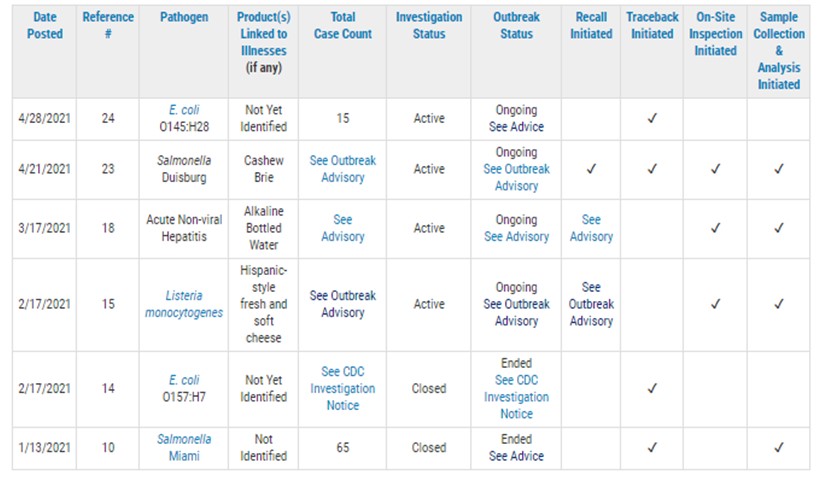
new E. coli O145:H28 outbreak has been posted on the FDA’s CORE Investigation outbreak table. This new outbreak has sickened at least 15 people. There is no more information provided, which is typical for a posting on that table. The FDA only gives out more information about these outbreaks when they believe there are actionable steps that consumers can take to protect themselves, such as a recall.

USA – FDA Core Investigation Table Update

FDA

USA – Notes from the Field: Multistate Outbreak of Escherichia coli O26 Infections Linked to Raw Flour — United States, 2019

CDC

On February 20, 2019, PulseNet, the molecular subtyping network for foodborne disease surveillance, identified six Shiga toxin–producing Escherichia coli (STEC) O26:H11 infections with the same pulsed-field gel electrophoresis (PFGE) pattern combination. This PFGE pattern combination matched that of infections from a July 2018 outbreak that was associated with ground beef. In response, CDC initiated an investigation with federal, state, and local partners to identify the outbreak source and implement prevention measures.

CDC defined a case as STEC O26 infection with an isolate matching the outbreak strain by PFGE or related by core genome multilocus sequence typing scheme (cgMLST), with dates of illness onset during December 11, 2018–May 21, 2019. Investigators initially hypothesized that ground beef was the outbreak cause because of the PFGE match to the July 2018 outbreak and because in early interviews, patients commonly reported eating ground beef and leafy greens. Investigators used cgMLST to compare the genetic sequences of isolates from both outbreaks and determined that they fell into separate genetic clades (differing by 6–11 alleles), suggesting that something other than ground beef caused the illness in 2019. CDC noted that one patient consumed raw cookie dough and that most patients were young adult females, similar to demographic distributions of past flour-associated STEC outbreaks (13). Investigators developed a supplemental questionnaire focusing on beef, leafy greens, and flour exposures.

Twenty-one cases were reported from nine states (Figure). The median age of patients was 24 years (range = 7–86 years); 71% were female. Three patients were hospitalized, and none died. Among 13 patients asked about flour exposures, six reported eating, licking, or tasting raw homemade dough or batter during the week before illness onset. Three patients reported eating raw dough or batter made with the same grocery store brand of all-purpose flour, including a patient who reported eating raw dough at a bakery in Rhode Island. Overall, of 18 patients with store information, 11 reported shopping at this same grocery store chain.

The Rhode Island Department of Health visited the bakery reported by the patient and collected flour for testing. On May 21, 2019, testing identified STEC O26 from an intact bag of all-purpose flour, which was the same grocery store brand reported by other patients. PulseNet confirmed that the STEC O26 isolated from the flour was highly related to clinical isolates using cgMLST (0–1 alleles). Product distribution records collected by the Food and Drug Administration indicated that the store brand flour purchased by six patients in three states was produced in a single milling facility in Buffalo, New York. Based on results of the investigation, the store chain recalled all lots of product from its retail locations in 11 states. The milling company also recalled all lots of this product and several other lots of flour produced in that facility, resulting in the recall of additional brands and products distributed to multiple states.

Flour is increasingly recognized as a cause of STEC outbreaks (15). Raw flour is not a ready-to-eat product, and this outbreak highlights the continuing risk for illness associated with consumption of flour and raw dough or batter. The investigation was aided by considering demographic information early in the investigation because these characteristics were similar to those in past flour-associated outbreaks (13). These similarities, coupled with the discriminatory power of cgMLST, helped to guide the consideration of alternative hypotheses regarding the outbreak source and the successful identification of flour as the cause of this outbreak.

UK – Poland promises action to reassure UK on poultry meat safety

Food Safety News

Officials from Poland and the United Kingdom have met virtually to discuss the safety of Polish poultry meat after it was linked to several outbreaks.

Grzegorz Puda, Polish minister of Agriculture and Forestry, spoke remotely this past week with George Eustice, secretary of state for Environment, Food and Rural Affairs.

Puda said he had taken direct charge of the issue of Salmonella in Polish poultry meat.

“Despite the difficult pandemic situation, Poland will take all measures to minimize and eliminate the UK’s concerns about the quality and safety of Polish poultry,” he said.

“Poland is ready to cooperate with the UK on sequencing of the Salmonella genome in poultry products.”

USA – Jule’s Foods Issues Voluntary Recall of Jule’s Foods Products Because of Possible Health Risk – Salmonella

FDA

Jule’s Foods of Carlsbad, CA is voluntarily recalling all Jule’s Foods products, because the product was potentially contaminated with Salmonella.

Products include:

Jule’s Cashew Brie (Classic)

UPC: 860388001507 – all expiration dates

Jule’s Truffle Cashew Brie

UPC: 860388001514 – all expiration dates

Jule’s Black Garlic Cashew Brie

UPC: 860388001552 – all expiration dates

Jule’s Artichoke Spinach Dip

UPC: 860388001569 – all expiration dates

Jule’s Vegan Ranch Dressing

UPC: 860388001521 – all expiration dates

To date, FDA has preliminary confirmation of Salmonella in brie products containing cashews.We are working with the FDA to isolate the source of the pathogen in samples which were collected by the California Department of Public Health. Jule’s Foods is issuing this recall in connection with a Salmonella outbreak under investigation by the FDA and CDC.

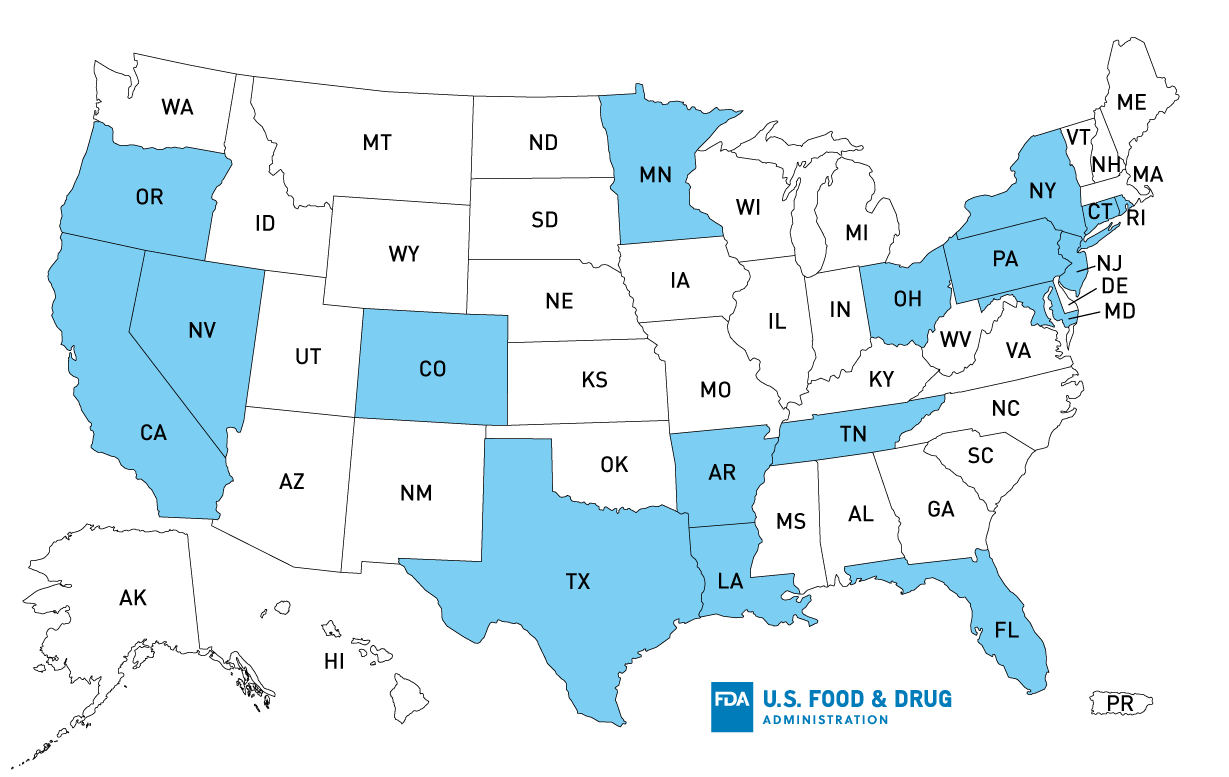
Products were distributed to primarily independently owned grocery stores in Arkansas, California, Colorado, Connecticut, Florida, Louisiana, Maryland, Minnesota, Nevada New York, New Jersey, Ohio, Oregon, Pennsylvania, Rhode Island, Tennessee, Texas as well as direct to consumer. Jule’s Foods Brie products are 6 ounces and wrapped in white cheese paper. A full list of stores is available at www.JulesFoods.netExternal Link Disclaimer.

Consumption of food contaminated with Salmonella can cause salmonellosis. The most common symptoms of salmonellosis are diarrhea, abdominal cramps, and fever within 12 to 72 hours after eating a contaminated product. Most people recover without treatment. In rare circumstances, infection can produce more severe illness and require hospitalization. Older adults, infants, and persons with weakened immune systems are more likely to develop a severe illness. Individuals concerned about an illness should contact their health care provider.

Production of these products has been suspended while the FDA and the company continue their investigation as to the source of the problem.

Please do not consume the product and immediately dispose of the product or return to the place of purchase for a full refund.

Consumers with questions may contact the company via email at jules@julesveganfoods.com or telephone at (310) 980-4697 between 9 a.m. – 5 p.m. PDT.

FDA Outbreak Press link


Company Contact Information

Consumers:
 (310) 980-4697
 jules@julesveganfoods.com

USA – Outbreak Investigation of Salmonella Duisburg: Jule’s Cashew Brie (April 2021)

FDA

The FDA, along with CDC and state and local partners are investigating a multistate outbreak of Salmonella Duisburg infections linked to the consumption of Jule’s Cashew Brie, a vegan, or plant-based cheese alternative. The firm, Jule’s Foods of Carlsbad, California, is conducting a voluntary recall of all varieties of Jule’s Foods products.

CDC identified an outbreak of five Salmonella Duisburg illnesses, which is considered a rare Salmonella serotype. All samples taken from ill patients are highly related according to Whole Genome Sequencing (WGS) analysis, or DNA fingerprinting of the pathogen. Of the five people interviewed, three (60%) reported eating Jule’s Truffle Cashew Brie– the only common product identified.

California Department of Public Health and Tennessee Department of Health state investigators collected samples of Jule’s Cashew Brie (including Cashew Brie (Classic), Truffle Cashew Brie, and Black Garlic Cashew Brie) from various retail locations. Preliminary results indicated that the Jule’s Cashew Brie products collected and analyzed in California may have been contaminated with Salmonella. Additional analysis subsequently confirmed the presence of Salmonella and additional analysis is ongoing to determine if the type of Salmonella found in these products matches the outbreak strain.

Based on these preliminary sample results, on April 21, 2021, the firm agreed to voluntarily recall all Jule’s Cashew Brie products. These tested products were sold on the firm’s website and in select retail locations. Additional distribution information is included in the firm’s recall announcement and below. Additionally, as a precaution the firm is also recalling its plant-based dairy alternative Jule’s Spinach Artichoke Dip and Jule’s Vegan Ranch Dressing. These products were sold directly to customers via the internet.

On April 21, 2021, FDA investigators and California Department of Public Health state inspectors arrived at the firm to conduct an inspection and collect additional product and environmental samples. The FDA investigation is ongoing to determine the source of contamination. Additional information will be provided as it becomes available.

Recommendation

Consumers, restaurants, and retailers should not eat, sell, or serve recalled Jule’s Foods products. Consumers should throw away recalled Jule’s Foods products or return to the place of purchase for a refund.

FDA recommends that anyone who received or suspects having received recalled Jule’s brand products use extra vigilance in cleaning and sanitizing any surfaces and containers that may have come in contact with the products to reduce the risk of cross-contamination. This includes cutting boards, slicers, countertops, refrigerators, and storage bins.


Product Images

Outbreak Investigation of Salmonella Duisburg Jule's Brie

Map of U.S. Distribution of Recalled Jule’s Foods Products

Outbreak Investigation of Salmonella Duisburg - Cashew Brie Products - Map of U.S. Distribution (04-23-2021)

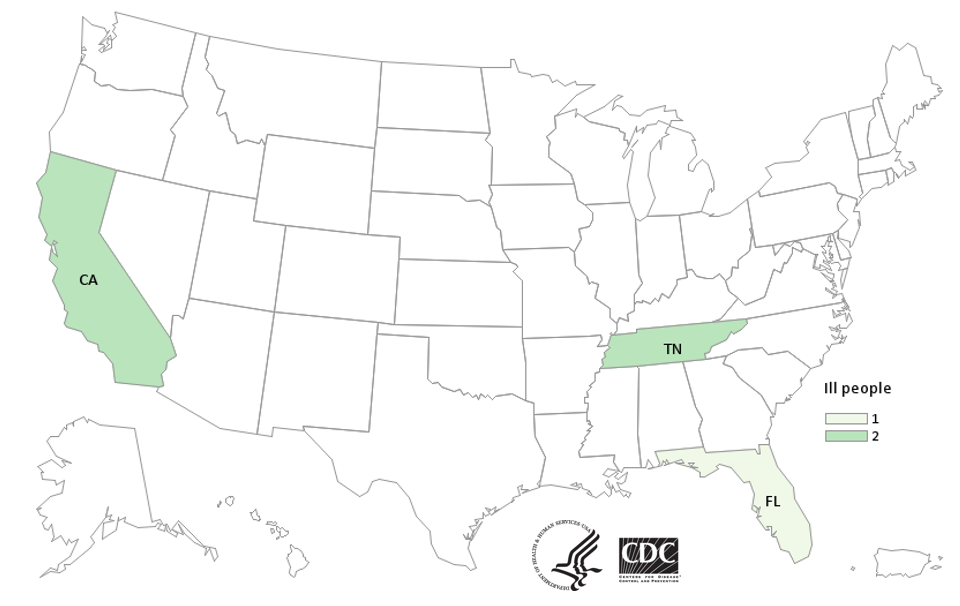
Case Count Map Provided by CDC

Case Count Map Provided by CDC - Salmonella Duisburg  - Cashew Brie Products

Case Counts

Total Illnesses: 5
Hospitalizations: 2
Deaths: 0
Last Illness Onset: February 27, 2021
States with Cases: CA (2), FL (1), TN (2)
Product Distribution*: Arkansas, California, Colorado, Connecticut, Florida, Louisiana, Maryland, Minnesota, Nevada, New York, New Jersey, Ohio, Oregon, Pennsylvania, Rhode Island, Tennessee, Texas
*Distribution has been confirmed for states listed, but product could have been distributed further, reaching additional states

Canada – Public Health Notice: Outbreak of Salmonella infections linked to eggs

Government of Canada

This notice has been updated to reflect that the outbreak appears to be over and the investigation is winding down. Although the outbreak appears to be over, Canadians are advised to always follow safe food-handling tips if you are buying, cleaning, chilling, cooking and storing any type of eggs or egg-based foods.

In total, 70 laboratory-confirmed cases of Salmonella Enteritidis illness were reported in: Newfoundland and Labrador (27), and Nova Scotia (43). Individuals became sick between late October 2020 and mid-March 2021. Nineteen individuals were hospitalized. No deaths were reported. Individuals who became ill were between 2 and 98 years of age. The majority of cases (71%) were female.

Between October and December 2020, CFIA issued food recall warnings for a variety of eggs distributed in Nova Scotia, and Newfoundland and Labrador. Some individuals who became sick in this outbreak reported exposure to recalled eggs; however, there were a number of ill individuals that did not.

USA – A likely Salmonella Outbreak tied to Jule’s Foods Brie products

Food Poison Journal

Jule’s Foods of Carlsbad, CA is voluntarily recalling all Jule’s Foods products, because the product was potentially contaminated with Salmonella.

Products include:

Jule’s Cashew Brie (Classic)

UPC: 860388001507 – all expiration dates

Jule’s Truffle Cashew Brie

UPC: 860388001514 – all expiration dates

Jule’s Black Garlic Cashew Brie

UPC: 860388001552 – all expiration dates

Jule’s Artichoke Spinach Dip

UPC: 860388001569 – all expiration dates

Jule’s Vegan Ranch Dressing

UPC: 860388001521 – all expiration dates

To date, FDA has preliminary confirmation of Salmonella in brie products containing cashews. We are working with the FDA to isolate the source of the pathogen in samples which were collected by the California Department of Public Health. Jule’s Foods is issuing this recall in connection with a Salmonella outbreak under investigation by the FDA and CDC.

Products were distributed to primarily independently owned grocery stores in Arkansas, California, Colorado, Connecticut, Florida, Louisiana, Maryland, Minnesota, Nevada New York, New Jersey, Ohio, Oregon, Pennsylvania, Rhode Island, Tennessee, Texas as well as direct to consumer. Jule’s Foods Brie products are 6 ounces and wrapped in white cheese paper. A full list of stores is available at www.JulesFoods.net