Category Archives: food bourne outbreak

India – 51 Children Among 100 Hospitalised With Food Poisoning In Chhattisgarh

NDTV

About 100 people, including 51 children, from Chhattisgarh’s Ansula village have been hospitalised with suspected food poisoning on Wednesday.

They complained of diarrhoea and vomiting after attending a function at the residence of the headmaster of the state-run primary school in their village, officials told NDTV.

At the health care centres, the patients were administered intravenous drips.

Collector Doman Singh reached the community health centre in Pithora and met the patients who are now said to be out of danger.
USA – FDA Core Investigations – New Listeria outbreak announced

Food Safety News

The outbreak announcement from the Food and Drug Administration reports that 20 people are sick, but does not include what states are involved. 

Investigators have begun traceback efforts of some sort, but specific foods are not included in the outbreak announcement.

There have not been any product recalls associated with this new outbreak.

Norway – searches for source of hepatitis A outbreak – food suspected

Food Safety News

Norwegian public health officials are investigating an outbreak of hepatitis A that has affected 10 people.

The Norwegian Institute of Public Health (FHI) reported an investigation has been started with local health services and the Norwegian Food Safety Authority (Mattilsynet) but the suspected source is unknown.

Infection has been detected in 10 people living in several counties. Another two people are suspected of being part of the outbreak.

Samples were taken from April to September and sequencing shows hepatitis A virus (HAV) with an identical sequence of genotype 1A in all of the patients. This suggests they were infected from the same source.

Sick people are between 25 and 80 years old with a median age of 53. Sixty percent are men.

Widely distributed food suspected
Six patients live in Viken, two in Trøndelag and one each in Oslo, Vestfold og Telemark, Innlandet and Troms og Finnmark.

USA – Outbreak Investigation of Salmonella Typhimurium: Bright Farms Packaged Salad Greens (July 2021) -Outbreak is over

FDA

The FDA, along with CDC and state and local partners, investigated a multistate outbreak of Salmonella Typhimurium infections linked to the consumption of BrightFarms packaged salad greens produced in the firm’s Rochelle, IL facility.

FDA visited the facility and collected samples. Some environmental samples taken inside the facility tested positive for Salmonella Liverpool, but were not a match to the outbreak strain. In addition, a sample collected from an outdoor storm water drainage pond adjacent to the facility was analyzed and reported to be Salmonella Typhimurium and a genetic match to the outbreak strain.

Although no clear route of contamination was readily identified, the FDA is preparing a report to discuss findings and provide information to assist in future prevention efforts.

Recommendation

CDC has declared this outbreak to be over.

Investigation Background

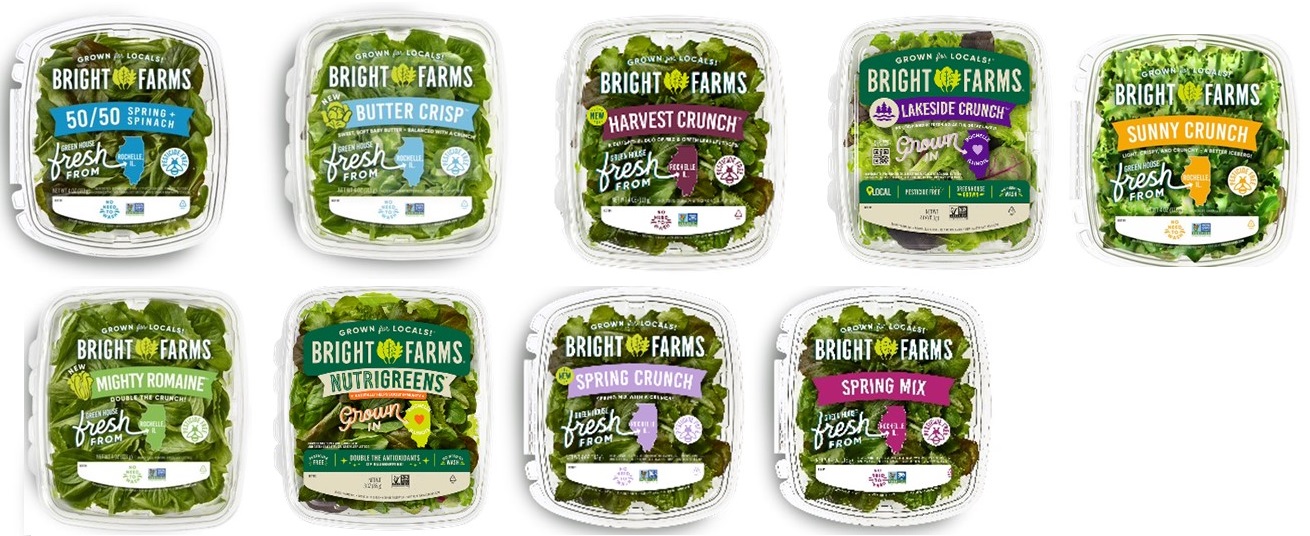
On July 15, 2021, BrightFarms recalled packaged salad greens produced in its Rochelle, Illinois (Ogle County) greenhouse farm sold in Illinois, Indiana, Iowa, and Wisconsin. On July 21, 2021, Michigan was added to the list of states that received recalled products. Interview data and shopper card records show that 15 people ate or bought multiple types of BrightFarms brand salad products before they got sick, including Sunny Crunch, 50/50 Spring & Spinach, Harvest Crunch, and Butter Crisp. FDA conducted a traceback investigation and identified the farm in Rochelle, IL, as the likely source of the BrightFarms brand salad bought by people who became ill. On July 28, 2021, following positive sample results, BrightFarms expanded their recall to include Baby Spinach packaged in clear, plastic clamshells with “Best By” dates through 7/26/2021.


Product Images

Outbreak Investigation of Salmonella Typhimurium in BrightFarms Packaged Salad Greens - Product Images

View Larger Images

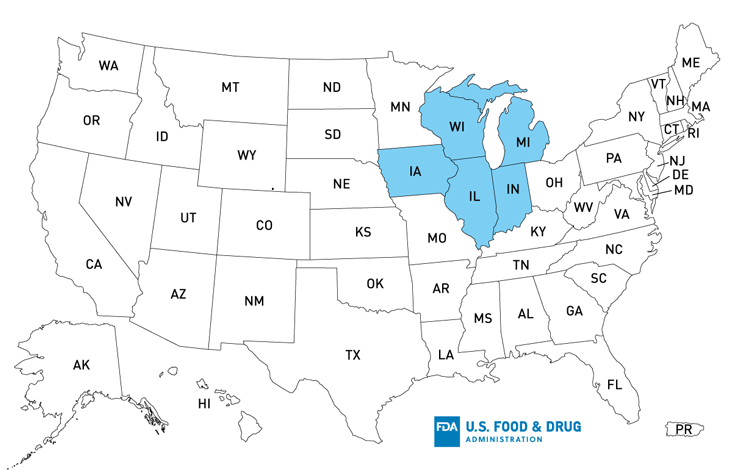
Map of U.S. Distribution of Recalled BrightFarms Products

Outbreak Investigation of Salmonella Typhimurium in BrightFarms Packaged Salad Greens - Map of U.S. Distribution of Recalled Products (October 6, 2021)

Case Count Map Provided by CDC

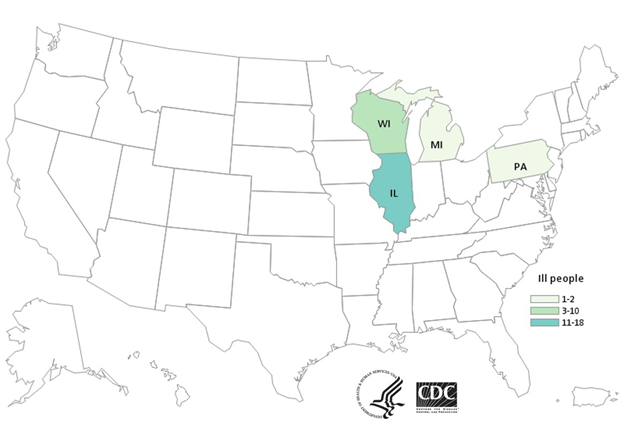
Outbreak Investigation of Salmonella Typhimurium in BrightFarms Packaged Salad Greens - CDC Case Count Map (October 6, 2021)

Case Counts

Total Illnesses: 31
Hospitalizations: 4
Deaths: 0
Last Illness Onset: August 18, 2021
States with Cases: IL (18), MI(1), PA (2), WI (10)
Product Distribution*: IA, IL, IN, MI, WI
*Distribution has been confirmed for states listed, but product could have been distributed further, reaching additional states

USA – Domestically Acquired Cases of Cyclosporiasis — United States, May–August 2021

CDC

cardcyclosporasme

LAST UPDATED SEPTEMBER 30, 2021 4:00 PM EDT

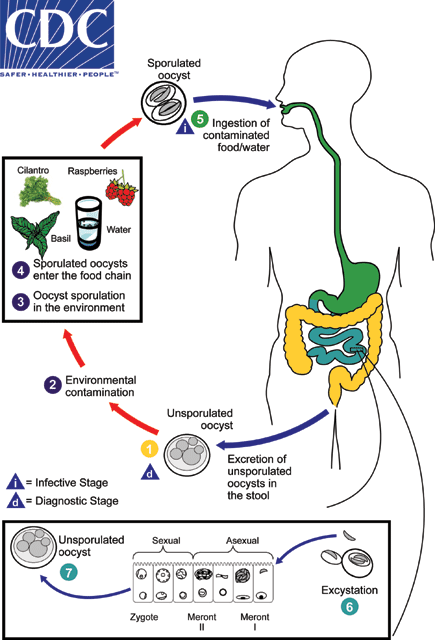
Cyclosporiasis illnesses are reported year-round in the United States. However, during the spring and summer months there is often an increase in cyclosporiasis acquired in the United States (i.e., “domestically acquired”). The exact timing and duration of these seasonal increases in domestically acquired cyclosporiasis can vary, but reports tend to increase starting in May. In previous years the reported number of cases peaked between June and July, although activity can last as late as September. The overall health impact (e.g., number of infections or hospitalizations) and the number of identified clusters of cases (i.e., cases that can be linked to a common exposure) also vary from season to season. Previous U.S. outbreaks of cyclosporiasis have been linked to various types of fresh produce, including basil, cilantro, mesclun lettuce, raspberries, and snow peas.

At a Glance
  • Illnesses: 1020
  • Hospitalizations: 70
  • Deaths: 0
  • States reporting cases: 36

CDC, along with state and federal health and regulatory officials, monitor cases of cyclosporiasis in the United States in the spring and summer months to detect outbreaks linked to a common food source. However, many cases of cyclosporiasis cannot be directly linked to an outbreak, in part because of the lack of validated laboratory “fingerprinting” methods needed to link cases of Cyclospora infection. Officials use questionnaires to interview sick people to determine what they ate in the 14-day period before illness onset. If a commonality is found, CDC and partners work quickly to determine if a contaminated food product is still available in stores or in peoples’ homes and issue advisories.

Final Update

  • In 2021, multiple outbreaks of cyclosporiasis cases associated with different restaurants or events were investigated by state public health authorities, CDC, and FDA.
    • CDC investigated two large multistate outbreaks of cyclosporiasisexternal icon, one including 40 illnesses and one with 130 illnesses, in which ill people reported eating various types of leafy greens. State officials and FDA conducted traceback investigations for these two outbreaks, but a specific type or grower of leafy greens was not identified as the source of either outbreak.
  • As of September 28, 2021, 1,020 laboratory-confirmed cases of cyclosporiasis in people who had no history of international travel during the 14-day period before illness onset have been reported to CDC by 37 jurisdictions, including 36 states and New York City, since May 1, 2021.
    • The median illness onset date is June 25, 2021 (range: May 1–August 31, 2021).
    • At least 70 people have been hospitalized; no deaths have been reported.

September 30, 2021

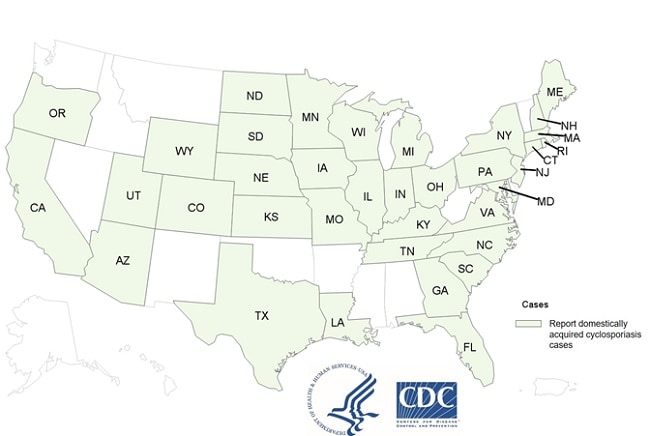
Geographic Distribution of Reported Cases of Domestically Acquired Cyclosporiasis—May 1 to August 31, 2021*

outbreak_map_season_9_30_21

* Data are current as of 09/28/2021 (9:00am EDT). States/jurisdictions highlighted on the map have each reported at least one case. New York State includes case reports from New York City. Data are preliminary and subject to change. For questions related to the number of cases reported in each state, contact that state’s health department.

USA – Rochester Institute of Technology update on Norovirus Outbreak

Food Poison Journal

norovirus-1080x655

The Monroe County Department of Public Health has determined norovirus — a contagious family of viruses — is likely responsible for recent illnesses on RIT’s Henrietta campus.

The vast majority of cases were resolved within 24-36 hours without medical treatment. However, some RIT students did need care in the Student Health Center, and a few received care in a local emergency department. In response to these cases, we have substantially increased our already stringent deep cleaning and sanitization efforts on high-touch surfaces in residence halls, dining areas, restrooms, and other spaces across campus.

Even with the number of cases declining in the past few days, we all must take steps to stay safe. If you are ill, please stay home and do not attend class or go to work. Remember to wash your hands often, stay in your residence when sick, and avoid preparing food for others.

USA – Cyclospora cases top 1000 in the US, 36 states reporting cases

Outbreak News Today

The Centers for Disease Control and Prevention (CDC) reported 156 additional Cyclospora cases in the past month, putting the total cases since May 2021.

The 1,020 laboratory-confirmed cases of cyclosporiasis were reported in people who had no history of international travel during the 14-day period before illness onset. Cases have been reported in 37 jurisdictions, including 36 states and New York City.

Seventy people required hospitalization for their illness.

Russia – Yersinia enterocolitica outbreak reported in Norilsk

Outbreak News Today

Yersinia p

Norilsk is is a city in Krasnoyarsk Krai, Russia, located above the Arctic Circle. Earlier this week, the head of the Rospotrebnadzor department for the Krasnoyarsk Territory Dmitry Goryaev reported an  Yersinia enterocolitica outbreak affecting 44 workers of Velesstroy LLC in Norilsk.

“As part of the sanitary and epidemiological investigation, according to the results of laboratory tests, the pathogen that causes intestinal yersiniosis, Yersinia enterocolitica, was identified in the patients,” he noted.

Earlier, the regional Rospotrebnadzor reported on the identification of violations of the requirements of sanitary legislation in the company canteen.

Research – USA – Novel Outbreak-Associated Food Vehicles, United States

CDC

Novel outbreak-associated food vehicles (i.e., foods not implicated in past outbreaks) can emerge as a result of evolving pathogens and changing consumption trends. To identify these foods, we examined data from the Centers for Disease Control and Prevention Foodborne Disease Outbreak Surveillance System and found 14,216 reported outbreaks with information on implicated foods. We compared foods implicated in outbreaks during 2007–2016 with those implicated in outbreaks during 1973–2006. We identified 28 novel food vehicles, of which the most common types were fish, nuts, fruits, and vegetables; one third were imported. Compared with other outbreaks, those associated with novel food vehicles were more likely to involve illnesses in multiple states and food recalls and were larger in terms of cases, hospitalizations, and deaths. Two thirds of novel foods did not require cooking after purchase. Prevention efforts targeting novel foods cannot rely solely on consumer education but require industry preventive measures.

USA – Core Investigation Table Update

FDA