Category Archives: Decontamination Microbial

Research – Incidence of Food Poisoning Outbreaks in Pahang, Malaysia, for Six-Year, from 2013 to 2018

Pertanika

The Food Safety and Quality Division (FSQD) in Malaysia is the competent authority tasked with ensuring food safety throughout the food supply chain within the country. Despite implementing various regulations toward improving food hygiene standards in Malaysia, outbreaks of food poisoning cases continued to occur in Malaysia. This cross-sectional study was designed to explore the occurrence of food poisoning incidents in Malaysia, within the Pahang state, from 2013 to 2018 via both reported passive case detection (PCD) and active case detection (ACD) food poisoning incidents. Upon detecting all the food poisoning cases using both PCD and ACD, the people identified to have suffered from food poisoning underwent a structured interview for investigators to elicit all relevant information about the food poisoning incident. Results showed that in Pahang, the number of reported episodes fluctuated from 2013 until 2018, with an average of 21 food poisoning episodes occurring yearly, reaching a maximum in August and a minimum in May. Furthermore, Kuantan, being the state capital, had reported an exceptionally high total number of reported incidents of food poisoning with a total of 48 episodes over six years from 2013 to 2018, while Kuala Lipis had only one incident reported during the same period (which was reported in 2016). Finally, this study concluded that adequate measures must always be taken to minimise the occurrence of food poisoning, especially when preparing foods in large quantities.
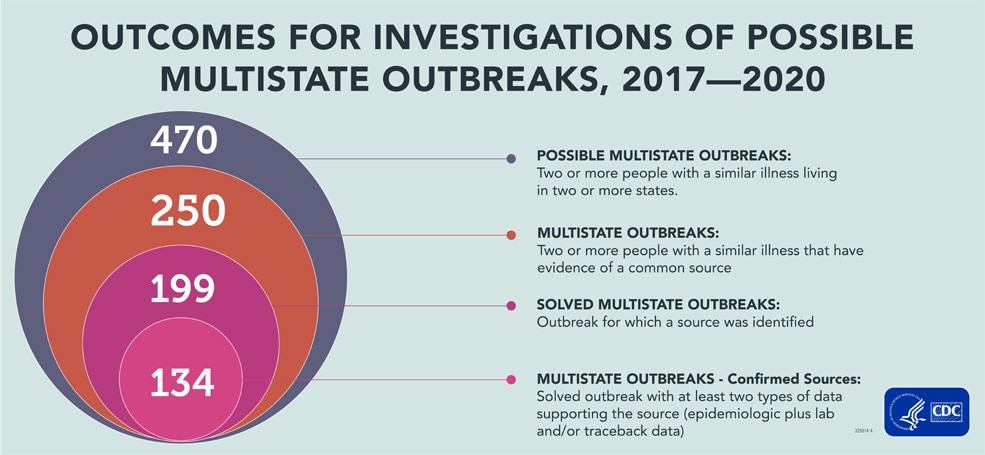

Research – USA – Summary of Possible Multistate Enteric (Intestinal) Disease Outbreaks in 2017–2020

CDC

This analysis includes 470 possible multistate outbreak investigations during 2017–2020.

Research – Examining Patterns of Persistent Listeria Contamination in Packinghouses using Agent-Based Models

Journal of Food Protection

Persistent Listeria monocytogenes contamination may occur in a packinghouse if the pathogen successfully infiltrates the facility and reaches a harborage site, from where it is difficult to remove and may contaminate produce within the facility. There is a need for simulation-based decision support tools that can predict which equipment sites are more likely to undergo persistent contamination and simulate potential corrective actions to prevent persistent contamination. Thus, we adapted for longer term simulation two existing applications of an agent-based model of Listeria spp. hourly contamination dynamics in produce packinghouses. Next, we developed a novel approach to identify and analyze persistent and transient Listeria contamination patterns on simulated agents representing equipment sites and employees. Testing of corrective actions showed that methods that involved targeted, facility-specific, risk-based sanitation were the most effective in both reducing the likelihood and duration of persistent contamination. This emphasizes that generic approaches to controlling Listeria (e.g., more concentrated sanitizers) are unlikely to be successful and suggests that usage of sanitation schedules produced through facility-specific root-cause analysis and hygienic design are key in reducing persistence. Hourly Listeria contamination patterns also suggest that transient contamination may be mistaken for persistent, depending on the frequency of environmental sampling. Likewise, as concentrations of Listeria on most contaminated agents were predicted to be very low, there is also a possibility to mistake persistence for transient contamination of sites, or even miss it outright due to false negative environmental Listeria monitoring results. These findings support that agent-based models may be valuable decision-support tools, aiding in the identification of contamination patterns within packinghouses and assessing the viability of specific corrective actions.

Research – Notes from the Field: Outbreak of Salmonella Enteritidis at a Correctional Facility Using Mechanically Separated Chicken — Nebraska, 2022

CDC

On January 14, 2022, the Lincoln-Lancaster County (Nebraska) Health Department (LLCHD) notified the Nebraska Department of Health and Human Services (NDHHS) of two cases of laboratory-confirmed Salmonella in inmates at a correctional facility (facility A). LLCHD initiated an investigation in collaboration with NDHHS to identify the source of the outbreak and develop recommendations. The investigation linked consumption of mechanically separated chicken to illness. Mechanically separated chicken, which is produced at chicken processing facilities by separating edible chicken from bone and cartilage under pressure, is frequently purchased for use in institutions, such as prisons, jails, and correctional facilities because of its affordability (1,2).

Staff members at facility A reported approximately 100 inmates experienced gastrointestinal symptoms during a period of a few days; no staff member reported illness. LLCHD conducted open-ended interviews with ill inmates. Because the facility was experiencing a concurrent outbreak of COVID-19, and access to inmates for interviews was limited, it is likely that additional cases existed among noninterviewed and untested inmates beyond the total cases identified in the investigation. Inmates who were designated food handlers were prioritized for interviews because of transmission risk to others; untested inmates were able to seek care through facility A medical staff. A probable case was defined as the onset of diarrhea, stomach cramps, or vomiting during January 9–11, 2022, but without a positive stool culture, in an inmate at facility A; a confirmed case was defined as isolation of Salmonella serotype Enteritidis highly related to the outbreak strain (within three alleles) by core genome multilocus sequence typing in a clinical specimen. LLCHD conducted an environmental assessment on January 15, 2022. A list of food handlers, food menus for January, and temperature logs were requested. During the environmental assessment, a sample of raw, unopened mechanically separated chicken from a 50-lb intact box from the same shipment used to prepare a meal on January 8, 2022, was collected for testing.

A total of 15 cases of S. Enteritidis infection were identifie

Research – Outbreak Investigation of E. coli O157:H7: Unknown Food (Fall 2020)

Food Poisoning News

The FDA and CDC, in collaboration with state and local partners, have completed the investigation on two of three multistate outbreak of E. coli O157:H7 infections in the U.S. this fall.

One of these investigations, Outbreak Unknown Source 3, identified 18 reported illnesses in nine states: California, Colorado, Illinois, Michigan, New York, Ohio, Pennsylvania, Virginia, Washington.

FDA completed a traceback investigation of several potential food vehicles identified in patient interviews and although no single farm was identified as a common source of the outbreak, FDA and state partners also conducted on-site investigations on farms of interest. However, information and samples collected in these inspections did not link these farms to the outbreak. The investigation of a farm does not mean that the farm is linked to an outbreak. The results of an investigation into a farm may well lead to that firm being ruled out of the investigation. On 12/18/2020, the CDC announced that this outbreak had ended.

The other completed outbreak investigation, Outbreak Unknown Source 1, identified 32 reported illnesses in 12 states: California, Illinois, Louisiana, Maryland, Michigan, Montana, New Jersey, Ohio, Utah, Virginia, Washington, Wisconsin. This strain of E. coli is genetically similar to a strain linked to a romaine outbreak that occurred in the spring of 2018, though a food was not linked to the current outbreak. FDA completed a traceback investigation and was unable to determine a common source of the outbreak. FDA and state partners also conducted on-site inspections on farms of interest, though information collected in these inspections did not link these farms to the outbreak. On 12/18/2020, the CDC announced that this outbreak had ended.

Investigations of a third E. coli outbreak of Unknown Source 2 continue.

Research – WHO wants help to estimate foodborne disease burden

Food Safety News

The World Health Organization (WHO) has called for help as part of work to estimate the burden of foodborne disease.

WHO is seeking support from independent consultants or groups of experts with relevant experience to undertake systematic reviews and other studies on foodborne illness. The process is part of collecting and assessing available evidence.

One call is for the review and evidence synthesis of diarrheal diseases and deaths caused by 14 pathogens commonly transmitted by food. The other covers global expert elicitation for attribution of burden of disease to foodborne transmission and to specific foods.

The WHO Foodborne Disease Burden Epidemiology Reference Group (FERG) was reconvened in May 2021 to update global estimates published in 2015. This group has already met three times in July and October 2021, and April 2022. A new report is expected in 2025.

Research – Campylobacter Retailer Survey

Lex blog

Campylobacter kswfoodworld

Lidl has reported Campylobacter in chicken levels above the FSA’s target for the second quarter of 2022.

The supermarket chain recorded 8 percent of birds in the highest category which is up from 2 percent in the previous quarter and 6 percent in the period before that.

The Food Standards Agency (FSA) maximum level is 7 percent of birds with more than 1,000 colony forming units per gram (CFU/g) of Campylobacter.

Data from all nine retailers covers April to June 2022 on high findings of Campylobacter in fresh, shop-bought, UK-produced chickens.

Results at Lidl and Asda went up while Sainsbury’s, Marks and Spencer, Morrisons, Waitrose and Aldi recorded lower levels of contamination compared to the previous quarter. Figures for Tesco and Co-op stayed the same.

Research – Legionnaires’ disease – Annual Epidemiological Report for 2020 Research –

ECDC

CDC legionella

Executive summary

  • Legionnaires’ disease remains an uncommon and mainly sporadic respiratory infection with an overall notification rate of 1.9 cases per 100 000 population for the EU/EEA in 2020.
  • A small decrease in the annual notification rate was observed, down from the 2.2 cases per 100 000 population reported in 2019.
  • Notification rates remained heterogenous across the EU/EEA, varying from fewer than 0.5 cases per 100 000 population to 5.7 cases per 100 000 population, with the highest rate reported by Slovenia.
  • Four countries (France, Germany, Italy and Spain) accounted for 72% of all notified cases.
  • Males aged 65 years and older were most affected (7.1 cases per 100 000 population).
  • The number of reported cases to the travel-associated surveillance scheme decreased by 67% in 2020 compared with 2019.
  • Only 10% of cases were culture confirmed (10%), likely leading to underestimation of disease caused by Legionella species other than Legionella pneumophila.

Luxembourg – RECALL: 0% SUGAR SWEET CHILI SAUCE – Lactic Acid Bacteria

SAP

RECALL: 0% SUGAR SWEET CHILI SAUCE

Potential presence of lactic acid bacteria causing the packaging to swell

Action is recalling the following product:

Last name 0% Sugar Sweet Chilli Sauce
Unity 250ml
bar code 8718836395338
Use-by date (DLC) 01/01/2024; 02/01/2024; 03/01/2024

Danger  : Abnormal development of lactic acid bacteria that can cause the packaging to swell

The development of lactic acid bacteria can cause the packaging to swell. The product itself does not generally pose a risk to public health if consumed.

The Food Safety Division advises, however, not to consume this product and to return it to the distributor. 

India – 20 students fall ill due to suspected food poisoning

The Hindu

As many as 20 students of Social Welfare Residential school located at Dubbak in Siddipet district fell ill on Friday, due to suspected food poisoning.

The students complained about stomach pain and symptoms of fever, according to sources.

District Medical and Health Officer (DM&HO) Kashinath along with medical teams rushed to the hostel and was treating the students.

The students told the treating doctors that they have developed these health issues after consuming Payasam the day before yesterday, the DM&HO said that there might be some other reasons, including water contamination, but they could not confirm it till medical tests were completed.

There are some 400 students studying in the school and according to locals some of the students have been suffering with seasonal fevers. Some students have complained that they have been not receiving proper food despite repeated appeals.