Category Archives: Decontamination Microbial

Research – Joint FAO/WHO Expert meeting on microbiological risk assessment of Listeria monocytogenes in foods

FAO

kswfoodworld Listeria monocytogenes

The Joint FAO/WHO Expert meeting on microbiological risk assessment of Listeria monocytogenes in foods was convened in response to a request by the Codex Committee on Food Hygiene (CCFH) at its fifty-second session1to undertake a full farm to table risk assessment on Listeria monocytogenes in food in order to inform a possible future revision of the Guidelines on the Application of General Principles of Food Hygiene to the Control of Listeria monocytogenes in Foods (CXG 61-2007)2.This document summarizes the conclusions and recommendations for the development of microbiological risk assessment of L.monocytogenes in specific foods; namely, leafy greens, frozen vegetables, cantaloupe melon and ready-to-eat (RTE)seafood, in the light of new data and approaches. This document has been prepared to facilitate the deliberations of the upcoming CCFH. The full report will be published as part of the Food and Agriculture Organization (FAO)and World Health Organization(WHO)Microbiological Risk Assessment (MRA) Series.

USA – Patient count growing in Salmonella outbreak from unknown source; other investigations ongoing

Food Safety News

An outbreak of infections from Salmonella Typhimurium is slowly growing according to the FDA, and an investigation into an outbreak of E. coli infections has been closed.

For the Salmonella outbreak, the number of patients has increased from 264 to 269, but the Food and Drug Administration has not reported the patients’ states of residence.

The agency has begun traceback efforts but has not revealed what food or foods are being traced. The FDA has begun sample collection and analysis, but has not revealed what is being collected or sampled.

Israel – After Recall in April Over Salmonella Concerns, Elite Chocolate Brands Return to Shelves in Israel

Haaretz

Israel’s top chocolate manufacturer announced on Tuesday that it is reintroducing several lines of candy to the Israeli market following a nationwide recall earlier this year due to salmonella contamination.

In a statement, the Strauss Group said that products from its Elite chocolate line, including the Parra brand, Pesek Zman and Kif Kef candy bars, would “gradually return to the shelves.” The move follows the reopening of its factory in Nof Hagalil in Israel’s north, where the salmonella was discovered. The company said that it has made “significant investments … to ensure the quality and safety of the products at the highest level.”

Research – Why throwing out food isn’t enough to stop the spread of Listeria

FOX 10

If you have contaminated food in your fridge, throwing it away isn’t enough to stop the spread of listeria and other food-borne illnesses.

That’s the message the Centers for Disease Control and Prevention is reiterating amid recent listeria and other food-borne outbreaks.

Earlier this month, the CDC announced one person died and 13 were hospitalized across six states in a listeria outbreak linked to contaminated deli meat and cheese. Illnesses were reported in Illinois, New York, New Jersey, Massachusetts, California and Maryland, where one person died.

Listeria outbreaks have also been linked to soft cheeses, mushrooms, hard-boiled eggs and a wide range of other foods.

The CDC says foods and surfaces become cross-contaminated. From there, the germs spread to shelves and drawers, then to other foods and the human hands that touch them.

But health experts say there’s a simple solution for stopping the spread of listeria: clean your fridge.

Take out all removable parts and wash them with hot, soapy water. After you clean the inside of the fridge, the CDC recommends adding a tablespoon of bleach to one gallon of water and using that water to wipe down the fridge one more time.

Research – Salmonella not detected on NZ poultry farms since September

RNZ

Efforts to eradicate salmonella enteritidis from the poultry industry are on track with no properties under restricted movement controls.

The bacteria strain was first found in an Auckland hatchery in March last year.

Since then 14 sites tested positive for the strain, about 550 thousand birds have been culled and 130 people became unwell with the bacteria.

Salmonella enteritidis can cause abdominal cramps, diarrhoea, fever, headache and vomiting in people.

New Zealand Food Safety deputy director general Vincent Arbuckle said control efforts were paying off.

Salmonella enteritidis had not been detected on farm since early September and the last case detected in a human was May, he said.

“It’s almost a textbook example of the regulator working with the poultry industry and individual farmers, what was a pretty serious outbreak in 2021. Through careful work with the industry, we believe we’ve got a well contained now.

Viet Nam – Mass food poisoning at Nha Trang school caused by Salmonella bacteria

VN Express

Health officials confirmed over 600 students of Ischool in Nha Trang in the central province of Khanh Hoa were poisoned with the Salmonella bacteria that is sensitive to most antibiotics.

Khanh Hoa Health Department announced the cause four days after the mass food poisoning case on November 17. Among the victims, a 6-year-old boy died on Sunday en route to a HCMC hospital.

Doctor Doan Uyen Vy, an anti-poison expert of Cho Ray Hospital in HCMC, told VnExpress that Salmonella is a common culprit in many food poisoning cases from mild to severe.

Kenya – Kebs seizes 3,000 bags of rice contaminated with aflatoxin

The Star

The Kenya Bureau of Standards has seized 3000 bags of rice in Mombasa which it says is contaminated with aflatoxin.

Kebs said on Monday that the consignment was packaged in 25 kg bags.

“We seized the rice in Shimanzi and found it to be contaminated with a high aflatoxin content,” they said.

The rice, they said, was imported into the country.

Aflatoxin, according to the Center for Disease Control, is a fungal toxin that commonly contaminates maize and other types of crops including legumes such as peanuts.

“The contamination happens during production, harvest, storage or processing,” the centre says.

Exposure to aflatoxin is known to cause both chronic and acute hepatocellular injury.

“In Kenya, acute aflatoxin poisoning results in liver failure and death in up to 40 per cent of cases,” they say.

Research – University Of São Paulo: Study Shows That Spice Bottles Can Be Vectors Of Contamination During Food Preparation

India Education Diary

Did you know that when preparing an everyday meal, the simple act of cutting meat and vegetables and then seasoning them without washing your hands first can expose you to dangerous contamination?

In a study published in the Journal of Food Protection, researchers from the State University of New Jersey, in partnership with the State University of North Carolina, in the United States, indicated that, during the preparation of meals, seasoning containers can be contaminated with microorganisms harmful to health.

According to Daniele Maffei, researcher at the Food Research Center and professor at USP’s Luiz de Queiroz School of Agriculture (Esalq), the intention of the study was to evaluate cross-contamination on surfaces and kitchen utensils used during meal preparation. Cross-contamination happens when bacteria or other microorganisms that are on one surface are transferred to another; food, for example. “Foodborne outbreaks of foodborne illness occur everywhere in the world, including Brazil. And many of these outbreaks may involve cross-contamination,” she says.

In the study, the behavior of 371 people was evaluated during the preparation of a meal consisting of a raw ground turkey burger and a ready-to-eat salad. To simulate the movement of a pathogen in a kitchen, the researchers inoculated a bacteriophage known as MS2 into meat. It works as a kind of safe tracker, as it infects bacteria, but it doesn’t cause any problems for human health.

“The researchers used swabs to analyze the surfaces of kitchen utensils, including seasoning bottles, containers that are not always evaluated in cross-contamination studies”, explains Daniele. From then on, the scientists observed that the presence of the marker was detected on all types of surfaces analyzed. “The frequency with which this happened for most surfaces was less than 20%, however, in the case of spice bottles, scientists detected the material in up to 48% of the samples, that is, almost half of them.”

In view of this, the specialist points out that it is essential that we take some precautions to avoid cross-contamination, including the correct cleaning of food, countertops, sinks, kitchen utensils and, mainly, seasoning containers, before and after each use. All this, using the correct products to do this cleaning.

“Good practices in food handling are essential to prevent contamination and the occurrence of outbreaks, both in relation to the proper cooking of these foods and not forgetting to wash our hands frequently, in addition to the constant hygiene of work surfaces”, he concludes.

Research – Project looks at E. coli risk during romaine post-harvest cooling

CPS

Several researchers have examined the fate of Shiga toxin-producing E. coli O157:H7 bacteria on romaine lettuce in the field and during post-harvest washing at processors. But little is known about potential changes in the microorganism’s physiology during post-harvest cooling and refrigerated transport to processors, which could affect virulence and/or detectability.
Teresa Bergholz, Ph.D., with Michigan State University, hopes to characterize those changes on inoculated romaine lettuce under simulated post-harvest cold storage.
The goal is to develop an easily accessible online tool the industry can use to identify practices to help reduce the risks of E. coli O157:H7 transmission via romaine lettuce.

Key Take-Aways

• Project focuses on period during romaine lettuce post-harvest cooling and refrigerated transport.
• Researchers will gauge pathogen physiological changes on inoculated romaine lettuce under lab-simulated post-harvest cooling.
• Researchers also will examine cooling’s impacts on E. coli O157:H7 persister cells — a form of dormancy.
• Goal is to develop an online tool to help the industry identify practices that reduce risk of E. coli O157:H7.
Compared to the growing season and processing, the time romaine spends in coolers and refrigerated transport after harvest is relatively small.
“But I think it’s a great place where our project can contribute information about what happens during this short period of time,” Bergholz said.
Also involved in the project, titled “Quantifying risk associated with changes in EHEC physiology during post-harvest pre-processing stages of leafy green production,” is co-principal investigator Jade Mitchell, Ph.D., also with MSU. She brings a background in quantitative microbial risk assessment.
“This project really requires both of our expertise,” said Bergholz, a microbiologist. “This couldn’t be possible without both of us.”
They’ve completed the first of the project’s two parts by systematically reviewing published literature on the subject and identifying data gaps. The information gleaned from the review will be used to develop the basis of a risk model.
At the same time, the researchers are conducting laboratory experiments that simulate cooling and transportation of romaine.
To ensure the results accurately reflect real-world scenarios, Bergholz said they sought industry input.
“We’ve benefited so much from our industry partners who shared their anonymized harvest temperature data,” she said. “We could never have collected the 5,000 data points that they shared with us. They’ve been collecting this data for years.”
The real-world data also changed some of the researchers’ initial assumptions.
“This data is invaluable because we need to have conditions in the lab that make sense,” Bergholz said. “When we have a better sense of the conditions that are actually happening in the field, it helps us tremendously.”
The research also involves E. coli O157:H7 strains from 2018, 2019 and 2020 national foodborne outbreaks.
After inoculating multiple lettuce plants with the pathogen, the researchers put them in a growth chamber for a day. They then cut the romaine and placed it in a cooler to simulate harvest and cold storage.
Each day over a five-day period, the researchers pulled samples and assayed them for the pathogen. Of particular interest was its state of dormancy.
When under stress, some microorganisms — such as E. coli O157:H7 — transition to a dormant state known as persister cells. With a slowed metabolism, persisters don’t reproduce but may still cause disease. When the stressor is removed, the cells’ metabolism returns to normal.
Another form of dormancy is viable but nonculturable, or VBNC. As their name implies, these cells cannot be cultured on agar medium, preventing commonly used detection methods.
As part of the project, the researchers plan to examine whether cold storage impacts persister and VBNC transition.
“There’s still so much that we don’t understand about the persister state and how that might be part of the continuum into VBNC,” she said. “We don’t know if being in the persister state impacts detection. We plan to purposely force cells into the persister state and determine whether we can detect them with industry detection methods.”
The research results will be used to help fill in the gaps of the risk-assessment model, which will focus on practices to reduce E. coli O157:H7 risk during the short window between romaine harvest and pre-processing.
“Maybe there’s something you can do to modify the way you’re harvesting and cooling that lets you reduce risk,” Bergholz said. “Can we shift the harvest time and how quickly we get it to the cooling center?”


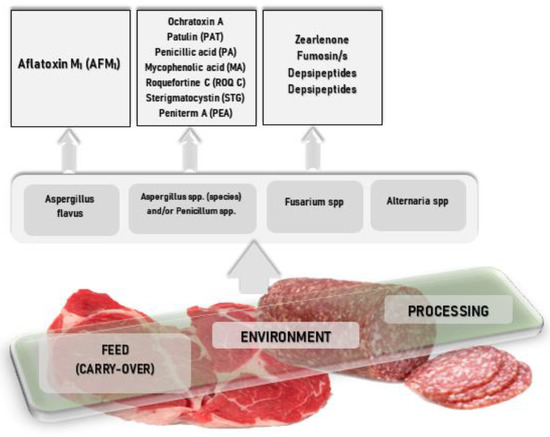
Research – Mycotoxins and Essential Oils—From a Meat Industry Hazard to a Possible Solution: A Brief Review

MDPI

The preservation of food supplies has been humankind’s priority since ancient times, and it is arguably more relevant today than ever before. Food sustainability and safety have been heavily prioritized by consumers, producers, and government entities alike. In this regard, filamentous fungi have always been a health hazard due to their contamination of the food substrate with mycotoxins. Additionally, mycotoxins are proven resilient to technological processing. This study aims to identify the main mycotoxins that may occur in the meat and meat products “Farm to Fork” chain, along with their effect on the consumers’ health, and also to identify effective methods of prevention through the use of essential oils (EO). At the same time, the antifungal and antimycotoxigenic potential of essential oils was considered in order to provide an overview of the subject. Targeting the main ways of meat products’ contamination, the use of essential oils with proven in vitro or in situ efficacy against certain fungal species can be an effective alternative if all the associated challenges are addressed (e.g., application methods, suitability for certain products, toxicity). View Full-Text