Category Archives: Decontamination Microbial

Research – Inhibition of Cronobacter sakazakii by Litsea cubeba Essential Oil and the Antibacterial Mechanism

MDPI

Abstract

Litsea cubeba essential oil (LC-EO) has anti-insecticidal, antioxidant, and anticancer proper-ties; however, its antimicrobial activity toward Cronobacter sakazakii has not yet been researched extensively. The objective of this study was to investigate the antimicrobial and antibiofilm effects of LC-EO toward C. sakazakii, along with the underlying mechanisms. The minimum inhibitory concentrations of LC-EO toward eight different C. sakazakii strains ranged from 1.5 to 4.0 μL/mL, and LC-EO exposure showed a longer lag phase and lower specific growth compared to untreated bacteria. LC-EO increased reactive oxygen species production, decreased the integrity of the cell membrane, caused cell membrane depolarization, and decreased the ATP concentration in the cell, showing that LC-EO caused cellular damage associated with membrane permeability. LC-EO induced morphological changes in the cells. LC-EO inhibited C. sakazakii in reconstituted infant milk formula at 50 °C, and showed effective inactivation of C. sakazakii biofilms on stainless steel surfaces. Confocal laser scanning and attenuated total reflection–Fourier-transform infrared spectrometry indicated that the biofilms were disrupted by LC-EO. These findings suggest a potential for applying LC-EO in the prevention and control of C. sakazakii in the dairy industry as a natural antimicrobial and antibiofilm agent.

Research – Pathogens found on half of the food-safety gloves

Food Safety News

Steve Ardagh, chief executive officer for Eagle Protect, is known as “The Glove Guy.” Food Safety News met him at the International Association for Food Protection’s 2021 trade show. It was then we learned about his multi-year microbial analysis of potential pathogenic glove contamination.

Eagle Protect, which started out in New Zealand before moving to California, is now out with the results of that five-year study revealing the widespread risk of contamination in the disposable glove industry. In collaboration with the B. Michaels Group, the findings were presented at the 2022 International Association for Food Protection (IAFP) annual meeting,

RASFF Alert – Animal Feed -Salmonella

RASFF

Salmonella spp in pet food from Belgium in Italy

ECDC – Hepatitis A – Annual Epidemiological Report for 2018

ECDC

In 2018, 30 European Union/European Economic Area (EU/EEA) countries reported 15 815 cases of hepatitis A, of which 15 677 (99.1%) were confirmed.

Key facts

•In 2018, 30 European Union/European Economic Area (EU/EEA)countries reported 15 815 cases of hepatitis A, of which 15 677 (99.1%) were confirmed.

•Romania and Spain accounted for 43.5% of all confirmed cases

•The EU/EEA notification rate was 3.0 cases per 100 000 population. Ten EU/EEA countries had a notificationrateofless than one confirmed case per 100 000 population. The countries with the highest notification rates were Bulgaria (19.1 cases per 100 000 population) and Romania (23.2 cases per 100000 population).

•In 2018, a considerable reduction in the number of reported cases and notification rates was observed compared with2017. This is because 2017 was characterised by an unprecedented large and prolongedmulti-countryoutbreak disproportionally affecting men who have sex with men, which mainlysubsided during 2018.

•Similar to previous years (excluding 2017), children between the ages of fiveand 14 years accounted for a large proportion of cases (29%) and the highest notification rate (8.2 cases per 100 000 population).

Click to access HEPA_AER_2018_Report.pdf

ECDC – Giardiasis (lambliasis) – Annual Epidemiological Report for 2019

ECDC

Giardia

In 2019, 18 004 confirmed giardiasis cases were reported in the EU/EEA. The EU/EEA notification rate was 5.2 cases per 100 000 population. The highest notification rates were reported in Belgium and Bulgaria. The EU/EEA notification rate was stable in the period 2015–2018, with a drop in 2019, the reasons for which have yet to be determined. The highest notification rate per 100 000 population was observed in the age group 0–4 years (16.5 for males and 15.0 for females).

Giardiasis is a common parasitic infection worldwide, caused by the protozoan Giardia lamblia (syn. G. duodenalis, G. intestinalis). The disease may be asymptomatic and self-limiting, or characterised by fatigue, bloating, acute diarrhoea and other chronic gastrointestinal symptoms. Infection occurs frequently via ingestion of cysts found in contaminated water (water-themed recreational activities, swimming pools or drinking water) or food, but person-to-person transmission may also occur, e.g. through sexual transmission.

Click to access giardiasis-%20annual-epidemiological-report-2019_0.pdf

Research – Increasing prevalence of mycotoxins in silage

Farmers Journal

Mycotoxins are routinely found in grass silage samples and can cause a range of problems within dairy herds, read more at the link above

USA – Food Safety Tips for Healthy Holidays

FDA

Recipe card graphic with text that reads: Food Safety Tips 1. Clean: The first rule of safe food preparation! 2. Separate: Don’t give bacteria a chance to spread! 3. Cook: Kill harmful bacteria! 4. Chill: Refrigerate foods quickly!

Parties, family dinners, and other gatherings where food is served are all part of the holiday cheer. But the merriment can change to misery if food makes you or others ill.

Typical symptoms of foodborne illness are vomiting, diarrhea, and flu-like symptoms, which can start anywhere from hours to days after contaminated food or drinks are consumed.

The symptoms usually are not long-lasting in healthy people — a few hours or a few days — and usually go away without medical treatment. But foodborne illness can be severe and even life-threatening to anyone, especially those most at risk:

  • older adults
  • infants and young children
  • pregnant women
  • people with diabetes, HIV/AIDS, cancer, or any condition that weakens their immune system
  • people who take medicines that suppress the immune system; for example, some medicines for lupus, psoriasis and rheumatoid arthritis

Combating bacteria, viruses, parasites, and other contaminants in our food supply is a high priority for the U.S. Food and Drug Administration. But consumers have a role to play, too, especially when it comes to safe food-handling practices in the home. And the good news is that practicing four basic food safety measures can help prevent foodborne illness.

1. Clean:

The first rule of safe food preparation in the home is to keep everything clean.

  • Wash hands with warm water and soap for 20 seconds before and after handling any food. For children, this means the time it takes to sing ‘Happy Birthday’ twice.
  • Wash food-contact surfaces (cutting boards, dishes, utensils, countertops) with hot, soapy water after preparing each food item and before going on to the next item.
  • Rinse fruits and vegetables thoroughly under cool running water and use a produce brush to remove surface dirt.
  • Do not rinse raw meat and poultry before cooking. Washing these foods makes it more likely for bacteria to spread to areas around the sink and countertops.

2. Separate:

Don’t give bacteria the opportunity to spread from one food to another (cross-contamination).

  • Keep raw eggs, meat, poultry, seafood, and their juices away from foods that won’t be cooked. Take this precaution while shopping in the store, when storing in the refrigerator at home, and while preparing meals.
  • Consider using one cutting board only for foods that will be cooked (such as raw meat, poultry, and seafood) and another one for those that will not (such as raw fruits and vegetables).
  • Keep fruits and vegetables that will be eaten raw separate from other foods such as raw meat, poultry or seafood — and from kitchen utensils used for those products.
  • Do not put cooked meat or other food that is ready to eat on an unwashed plate that has held any raw eggs, meat, poultry, seafood, or their juices.

3. Cook:

Food is safely cooked when it reaches a high enough internal temperature to kill harmful bacteria.

  • Color is not a reliable indicator of doneness. Use a food thermometer to make sure meat, poultry, and fish are cooked to a safe internal temperature. To check a turkey for safety, insert a food thermometer into the innermost part of the thigh and wing and the thickest part of the breast. The turkey is safe when the temperature reaches 165ºF. If the turkey is stuffed, the temperature of the stuffing should be 165ºF. (Please read on for more pointers on stuffing.)
  • Bring sauces, soups, and gravies to a rolling boil when reheating.
  • Cook eggs until the yolk and white are firm. When making your own eggnog or other recipe calling for raw eggs, use pasteurized shell eggs, liquid or frozen pasteurized egg products, or powdered egg whites.
  • Don’t eat uncooked cookie dough, which may contain raw eggs. 

4. Chill:

Refrigerate foods quickly because harmful bacteria grow rapidly at room temperature.

  • Refrigerate leftovers and takeout foods — and any type of food that should be refrigerated — within two hours. That includes pumpkin pie!
  • Set your refrigerator at or below 40ºF and the freezer at 0ºF. Check both periodically with an appliance thermometer.
  • Never defrost food at room temperature. Food can be defrosted safely in the refrigerator, under cold running water, or in the microwave. Food thawed in cold water or in the microwave should be cooked immediately.
  • Allow the correct amount of time to properly thaw food. For example, a 20-pound turkey needs four to five days to thaw completely when thawed in the refrigerator.
  • Don’t taste food that looks or smells questionable. A good rule to follow is, when in doubt, throw it out.
  • Leftovers should be used within three to four days. 

Bonus Tip: Use Care with Stuffing!

  • Whether it is cooked inside or outside the bird, all stuffing and dressing must be cooked to a minimum temperature of 165ºF. For optimum safety, cooking your stuffing in a casserole dish is recommended.
  • Stuffing should be prepared and stuffed into the turkey immediately before it’s placed in the oven.
  • Mix wet and dry ingredients for the stuffing separately and combine just before using.
  • The turkey should be stuffed loosely, about 3/4 cup stuffing per pound of turkey.
  • Any extra stuffing should be baked in a greased casserole dish.

Australia – Investigations into Central Coast Salmonella outbreak continue

NSW GOV AU

NSW Health and the NSW Food Authority are continuing to investigate a significant foodborne outbreak following a conference on the Central Coast last week.

At least 69 people from across NSW, the Northern Territory and Queensland are known to have become unwell with symptoms of food poisoning, of which 27 people have confirmed Salmonella infections to date.

Dr Jeremy McAnulty, NSW Health Executive Director of Public Health, said public health officials from across NSW have been working to speak to all those who have become unwell after attending or working at the conference.

“Close to 230 people attended or worked at the two-day conference, and so far at least 31 of them are known to have attended Emergency Departments,” Dr McAnulty said.

“NSW Health is working closely with the NSW Food Authority to investigate the cause of the outbreak.

“Our public health experts continue to contact people associated with the event, including attendees from the Aboriginal Languages Trust and we thank all of those who have assisted us so far.

Australia – Donuts for weight loss? A norovirus outbreak associated with a bakery in the Australian Capital Territory

Gov Au

Three hundred and one people were surveyed, and 215 individuals (71.4%) reported vomiting and/or diarrhoea following consumption of a donut purchased from the business over a five-day period.
 
All ill respondents reported eating a donut. The medians of incubation period and illness duration were 34 hours (interquartile range, IQR: 29–42 hours) and 48 hours (IQR: 29–72 hours) respectively. Diarrhoea, vomiting and abdominal pain were the most commonly reported symptoms.
 
Eight out of 11 specimens collected from ill individuals were positive for norovirus. For the case-control study, data from 59 attendees were collected, with an attack rate of 46% (27/59). Eating any kind of filled donut was associated with a person becoming ill (odds ratio: 10.4; 95% confidence interval: 1.18–478.13).
 
No single flavour was identified as the likely source of infection.
 
Elevated levels of coliforms were present in two samples of donut filling obtained during the food safety inspection.
 
Conclusion
Donuts are a novel vehicle for norovirus infection. This implicated pathogen, plus evidence collected at the food premises suggestive of faecal contamination, indicates the source of this outbreak was likely an ill food handler. The findings of this outbreak highlight the importance of excluding food


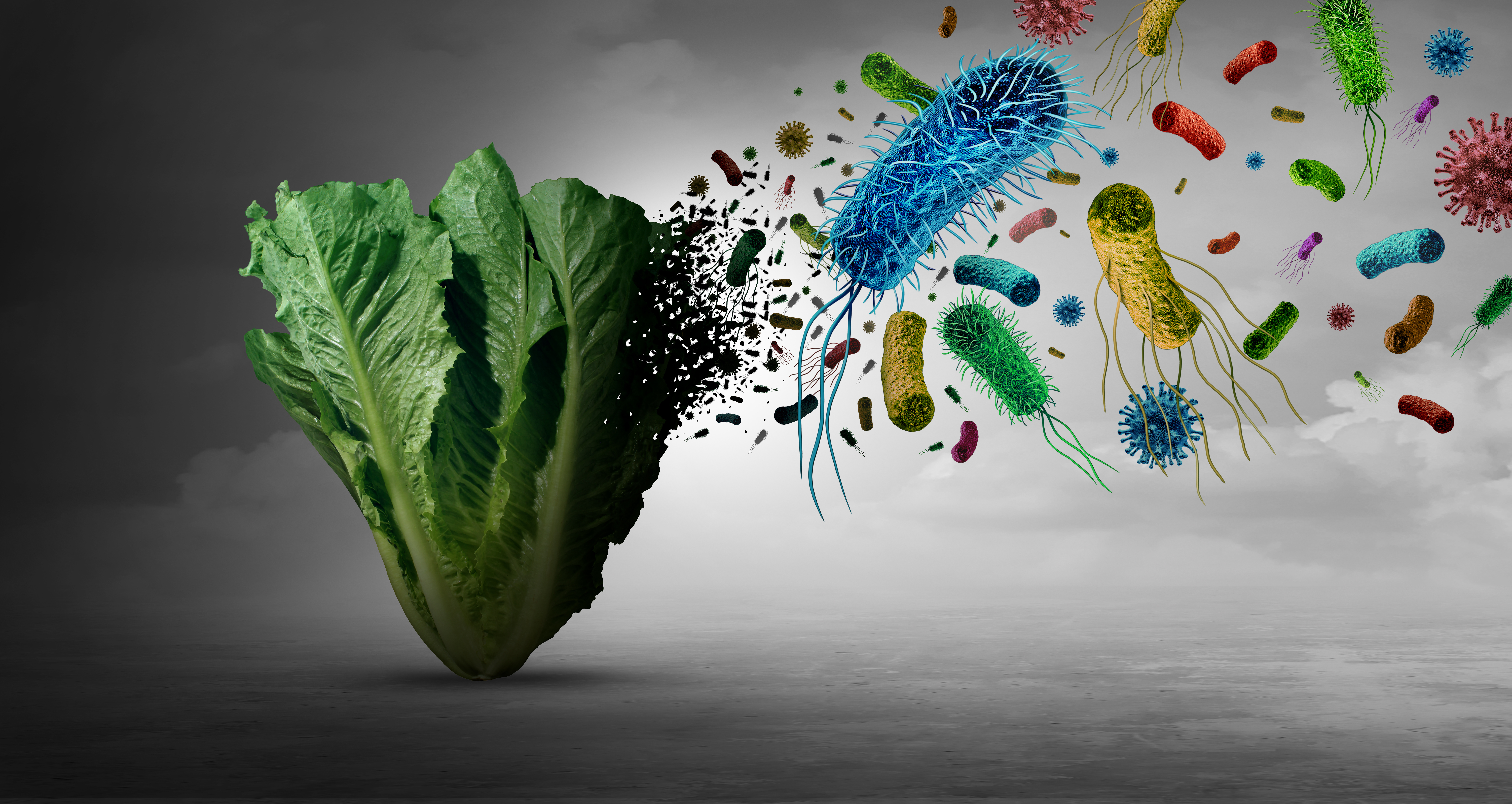
More than 250 ill in UK E. coli outbreak linked to salad

Food Safety News

Vegetable Bacteria Danger

More than 250 people are sick in an E. coli O157 outbreak in the United Kingdom that may have been caused by salad.

There have been 259 confirmed cases in the UK with sample dates ranging from late August to the end of October, although most people fell ill in August and early September.

Shiga toxin-producing E. coli (STEC) O157 has affected people in England, Scotland, Northern Ireland, and Wales. The majority of those sick are adults.

Food Standards Scotland (FSS), the UK Health Security Agency (UKHSA) and Food Standards Agency (FSA) are investigating the outbreak.

It is the largest E. coli outbreak since Whole Genome Sequencing (WGS) started to be used in 2014, according to UKHSA.