Category Archives: Coliforms

USA – DC issues Boil Water Advisory for parts of Northeast after E. coli concerns

FOX5

ecoli

The District has issued a Boil Water Advisory for portions of the Northeast due to the possibility of elevated levels of E. coli/coliform bacteria.

The advisory was issued Thursday and includes the neighborhoods of Edgewood, Brookland, Fort Lincoln, Woodridge, Queens Chapel, Michigan Park and North Michigan Park. Officials say approximately 14,000 residents have been affected.

The impacted region is approximately:

– East of North Capitol Street

– West of Eastern Avenue

– South of New Hampshire Avenue

– North of New York Avenue

RASFF Alert – Coliforms – Bottled Mineral Water

RASFF

Microbial contamination (coliforms) in bottled mineral water from Italy / presenza coliformi in acqua minerale in Malta and Germany

RASFF Alert – Coliforms in Bottled Water

RASFF

Presence of coliforms in bottled still mineral water from Italy in Italy, Austria and Germany

India – Cholera outbreak: 16 of 24 water samples found non-potable in Panchkula

The Tribune

Of the 24 water samples collected from Abheypur and Budhanpur villages, 16 were found to have coliform bacteria, meaning “non-potable”.

The samples were analysed at a government laboratory in Ramgarh. Four other samples collected from Sector 16 (one sample), Rajiv Colony (two) and Indira Colony (one) were found to be fit for drinking. So far, 55 samples have been collected and sent to the Ramgarh laboratory for analysis.

Of the 55 water samples, the report of 28 (16 found non-potable and 12 potable) have been received, while that of 27 is still awaited. Of the 35 stool samples, 23 have been found positive for vibrio cholera. Meanwhile, the number of patients infected with cholera reached 440 today. As many as 72 (30 adults and 42 children) are still under treatment at the Civil Hospital in Sector 6.

Research – Determining bacterial load and water quality of tomato flume tanks in Florida packinghouses

Journal of Food Protection

Monitoring and maintenance of water quality in dump tanks or flume systems is crucial to prevent pathogen cross-contamination during postharvest washing of tomatoes, but there is limited information on how organic matter influences sanitizer efficacy in the water. The main objective of this study was to monitor water quality in flume tanks and evaluate the efficacy of postharvest washing of tomatoes in commercial packinghouses. Flume tank water samples (n=3) were collected on an hourly basis from three packinghouses in Florida and analyzed for pH, total dissolved solids (TDS), free chlorine, chemical oxygen demand (COD), oxidation-reduction potential (ORP), and turbidity. Additionally, three flume water samples were collected and tested for total aerobic plate count (APC), total coliforms (TC), and generic E. coli (EC). Fresh tomatoes (n=3), both before and after washing, were collected and analyzed for the same bacterial counts. Turbidity, COD, and TDS levels in flume water increased over time in all packinghouses. Correlations observed include COD and turbidity (r = 0.631), turbidity and TDS (r = 0.810), and ORP and chlorine (r = 0.660). APC for water samples had an average range of 0.0 to 4.7 log CFU/mL and TC average range of 0.0 to 4.7 log CFU/mL. All water samples were negative for generic E. coli . The average APC for pre-and post-flume tomatoes from the three packinghouses was 6.0 log CFU/tomato and ranged from 2.2 to 7.4 log CFU/tomato. The average TC count was <1.5 and 7.0 log CFU/tomato for pre-and post-wash tomatoes, respectively. There was no significant effect ( P >0.05) of postharvest washing on the microbiological qualities of tomatoes. Water quality in flume tanks deteriorated over time in all packinghouses during a typical operational day of 4-8 h.

Research – In-Plant Validation of Novel On-Site Ozone Generation Technology (Bio-Safe) Compared to Lactic Acid Beef Carcasses and Trim Using Natural Microbiota and Salmonella and E. coli O157:H7 Surrogate Enumeration

MDPI

The purpose of this study was to evaluate the antimicrobial efficacy of an aqueous ozone (Bio-Safe) treatment andtech lactic acid solutions on natural microbiota and E. coli O157:H7 and Salmonella surrogates on beef carcasses and trim in a commercial beef processing plant. For every repetition, 40 carcass and 40 trim swabs (500 cm2) were collected. Samples were taken using EZ-ReachTM swabs, and plated into aerobic plate count (APC), coliform, and E. coli PetrifilmTM for enumeration. In addition, a five-strain cocktail (MP-26) of E. coli surrogates was inoculated onto trim. For every trim surrogate repetition, 30 trim pieces were sampled after attachment and after ozone intervention. Samples were diluted and counts were determined using the TEMPO® system for E. coli enumeration. Ozone and lactic acid interventions significantly reduced (p < 0.003) bacterial counts in carcasses and trim samples. Moreover, lactic acid further reduced APC and coliforms in trim samples compared to ozone intervention (p < 0.009). In the surrogate trials, ozone significantly reduced (p < 0.001) surrogate concentration. Historical data from the plant revealed a reduction (p < 0.001) of presumptive E. coli O157:H7 in trim after a full year of ozone intervention implementation. The novel technology for ozone generation and application as an antimicrobial can become an alternative option that may also act synergistically with existing interventions, minimizing the risk of pathogens such as Salmonella and E. coli O157:H7. View Full-Text

Research – Microbial Growth Study on Pork Loins as Influenced by the Application of Different Antimicrobials

MDPI

The use of antimicrobials in the pork industry is critical in order to ensure food safety and, at the same time, extend shelf life. The objective of the study was to determine the impact of antimicrobials on indicator bacteria on pork loins under long, dark, refrigerated storage conditions. Fresh boneless pork loins (n = 36) were split in five sections and treated with antimicrobials: Water (WAT), Bovibrom 225 ppm (BB225), Bovibrom 500 ppm (BB500), Fit Fresh 3 ppm (FF3), or Washing Solution 750 ppm (WS750). Sections were stored for 1, 14, 28, and 42 days at 2–4 °C. Mesophilic and psychrotrophic aerobic bacteria (APC-M, APC-P), lactic acid bacteria (LAB-M), coliforms, and Escherichia coli were enumerated before intervention, after intervention, and at each storage time. All bacterial enumeration data were converted into log10 for statistical analysis, and the Kruskal–Wallis test was used to find statistical differences (p < 0.05). Initial counts did not differ between treatments, while, after treatment interventions, treatment WS750 did not effectively reduce counts for APC-M, APC-P, and coliforms (p < 0.01). BB500, FF3, and WS750 performed better at inhibiting the growth of indicator bacteria when compared with water until 14 days of dark storage. View Full-Text

Research – Fate of Salmonella spp. in the Fresh Soft Raw Milk Cheese during Storage at Different Temperatures

MDPI

The aim of this study was to determine the survival kinetics of Salmonella spp. in unripened, fresh raw milk cheese during storage at 5, 15 and 25 °C. Microbiological (coliforms and E. coliS. thermophilusLactococcus sp., total microbial count and Enterobacteriaceae) and physicochemical (pH and aw) characteristics were also determined. Two primary models were used to estimate the kinetic parameters of Salmonella spp., namely Weibull and Baranyi and Roberts (no lag) models. Additionally, goodness-of-fit of the primary models was assessed by calculating the R-Square and mean square error. Salmonella spp. growth in the unripened raw milk cheese was inhibited during storage, but nevertheless bacteria survived at 5 °C for 33 days (2.5 log cfu/g) and 15 °C for 18 days (1.8 log cfu/g). A decrease in the number of Salmonella spp. populations from an initial concentration 6.6 log cfu/g to below a detection limit was observed at 25 °C after 7 days of storage of contaminated cheese samples. It was concluded that the storage temperature significantly influenced the inactivation rate of Salmonella spp. in fresh raw milk cheese and proceeded faster at 25 °C compared to remaining storage temperatures.

Research – Microbiological contamination of ready to eat algae and evaluation of Bacillus cereus behavior by microbiological challenge test

Journal of Food Protection

Consumption of seaweeds, often categorized as a superfood, is becoming popular in western countries. Algae can be marketed fresh, but are usually sold dehydrated to ensure longer shelf life. The consumption, often as ready to eat, open up possible risks for public health because of foodborne pathogens that can contaminate the raw material during harvesting or manipulation. In this study, fourteen ready to eat foods based on dehydrated algae, representative of the most consumed species, were considered. The microbial content, with a focus on Listeria monocytogenes and Bacillus cereus, was investigated by plate counts and B. cereus strains were isolated and identified by 16s rRNA gene sequencing. The microbiological quality was heterogeneous among the samples and, in particular, marine bacteria, Listeria spp., B. cereus and coliforms were detected. To contribute to related risk assessment, the ability of B. cereus to grow during refrigerated storage was evaluated, to our knowledge for the first time, by a microbiological challenge test on two ready to eat foods based on Undaria pinnatifida and Palmaria palmata.  Despite this study demonstrating the inability of B. cereus to proliferate in seaweed-based food, its presence in dehydrated foodstuffs cannot rule out the replication after rehydration before consumption, making it necessary to shed light on the possible risks for consumers.

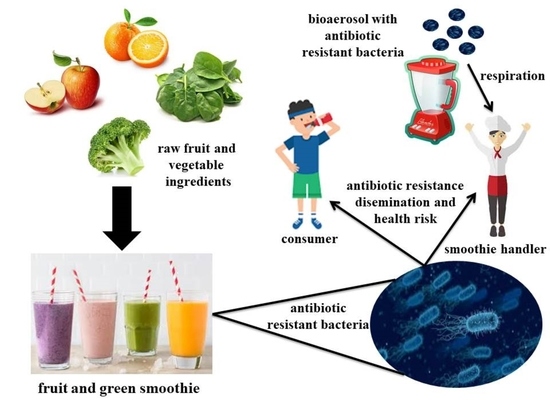
Research – Microbial Safety of Smoothie Drinks from Fresh Bars Collected in Slovakia

MDPI

Among the many consumers in Slovakia, smoothies are nowadays gaining popularity. Smoothie drinks are prepared from raw fruits and vegetables. Therefore, their microbiological safety depends on hygiene standards. The aim of this work was to monitor and quantify selected sensitive and antibiotic-resistant microorganisms present in collected smoothies. Twenty analyzed smoothie samples were collected from six food service establishments (fresh bars) in the capital city of Slovakia, Bratislava. Antibiotic-resistant bacteria were found in at least one of each fresh bar. Antibiotic-resistant coliform bacteria prevailed, especially in green smoothies or juices containing more vegetable ingredients. Resistance to ampicillin, ciprofloxacin, tetracycline, chloramphenicol, and gentamicin was observed in the case of coliform bacteria. More than half of the smoothie drink samples did not contain resistant enterococci. On the other hand, vancomycin-resistant enterococci were detected in 20% of samples. The most frequently isolated antibiotic-resistant strains belonged to the Enterobacter spp. or Klebsiella spp. genus. In the last part of the work, the pretreatment effect of smoothie components on the selected microorganisms’ counts in the final product was investigated. Washing ingredients with an aqueous solution of a biocide agent containing silver and hydrogen peroxide proved to be the most effective way to decrease bacterial counts. View Full-Text