Monthly Archives: January 2020

Research – Combined ohmic heating and krypton‐chlorine excilamp treatment for the inactivation of Listeria monocytogenes, Salmonella Typhimurium, and Escherichia coli O157:H7 in apple juice

Wiley Online

Abstract

The combined effect of the 222‐nm krypton‐chlorine (KrCl) excilamp and ohmic heating for the inactivation of Listeria monocytogenesSalmonella enterica serovar Typhimurium, and Escherichia coli O157:H7 in apple juice was investigated in this study. When ohmic heating and a KrCl excilamp were applied to apple juice simultaneously, the reduction level of E. coli O157:H7 following 70 s (target temperature of 65.9°C) of combination treatment reaching 4.6 log CFU/ml was significantly higher than that of each treatment alone (2.7 log CFU/ml). The same trend, indicating a synergistic bactericidal effect, was observed for L. monocytogenes and S. Typhimurium. Therefore, the combination treatment of the KrCl excilamp and ohmic heating can be used effectively to control bacterial pathogens in apple juice with a reduced processing time.

Practical applications

Demands for energy‐efficient and environmentally friendly bactericidal apparatuses have been increasing. Although the mercury UV lamp has been widely used to inactivate foodborne pathogens in water or juice products individually or combined with heat treatment, the use of this conventional lamp will be limited continuously in accordance with the Minamata Convention treaty, which restricts the use of mercury. Thus, it is of interest to identify the bactericidal effect of an alternative UV‐C lamp and its combination with heat treatment. The synergistic bactericidal effect of the KrCl excilamp and ohmic heating, which are alternative nonthermal and thermal technologies, respectively, was identified in the present study. The results indicated in this study could be utilized by juice processors to achieve a 5‐log reduction in foodborne pathogens.

Research – Effect of Storage Temperature on the Survival of New Zealand Egg-Associated Salmonella Isolates in and on Eggs

Journal of Food Protection


ABSTRACT

The influence of egg storage temperature on Salmonella contamination of eggs is a key consideration in determining storage and shelf life recommendations for eggs. In this study, experiments assessed the survival of Salmonella isolates on and in eggs at storage temperatures (15 and 22°C) currently used in New Zealand. Eggshell surfaces were inoculated with a cocktail of 10 Salmonella isolates comprising five serotypes, at a concentration of ∼106 CFU per egg (for determining shell surface survival) or ∼103 CFU per egg (for determining internalization). Additionally, a subset of eggs was artificially contaminated with sterile chicken feces prior to Salmonella inoculation. Inoculated eggs were incubated at 15 and 22°C. At 0, 21, and 35 days of incubation, eggshells were enumerated for Salmonella, and egg contents were tested for Salmonella presence or absence (yolk) or most probable number (albumen). Higher levels of Salmonella were recovered from eggshells following incubation at 15°C (31% relative humidity [RH]) compared with 22°C (45% RH) after both 21 and 35 days of incubation. Recoverable numbers of Salmonella from visibly clean eggshell surfaces declined over time at both storage temperatures and were at, or below, the limit of detection from eggs stored at 22°C and 45% RH for 35 days. A substantially higher concentration of viable Salmonella was recovered from eggshells that were experimentally contaminated with chicken feces compared with those without, particularly from eggs stored at 15°C and 31% RH for 35 days (2.38 log higher CFU from eggs containing feces). No Salmonella was detected in egg contents (albumen or yolk) at any incubation temperature or time point, regardless of the presence of feces. Findings emphasize the importance of current regulations that require eggs sold at retail to be visibly clean and will inform risk management decisions regarding egg storage times and temperatures with respect to Salmonella control in and on New Zealand eggs at retail.

HIGHLIGHTS
  • Salmonella viability declined over time on eggshell surfaces at both 15 and 22°C.

  • Salmonella survived better on visibly clean eggshells at 15 than at 22°C.

  • Survival on eggshells was enhanced in the presence of fecal contamination.

  • Salmonella was not detected in egg contents at either incubation temperature.


Research – Evaluating the Risk of Salmonellosis from Dry Roasted Sunflower Seeds

Journal of Food Protection

ABSTRACT

Outbreaks and recalls related to nuts and seeds in the United States have increased recently, and 80% of these recalls are due to Salmonella. The U.S. Food and Drug Administration’s Food Safety Modernization Act requires food manufacturers to implement risk-based preventive controls based on scientific and technical evidence. Data are limited on the inactivation of Salmonella during processing of saltwater brined in-shell sunflower seeds. The goal of this research was to validate the adequacy of roasting in controlling Salmonella during the production of sunflower seeds and to assess the resulting risk. Four Salmonella strains were inoculated onto sunflower seeds and processed to simulate commercial manufacturing. Seeds were tumbled and roasted at 225°F (107.2°C) and 275°F (135°C) for roasting times from 5 to 45 min. Regression models for Salmonella inactivation and water activity change were developed. The inactivation model predicted a 5-log reduction in Salmonella when sunflower seeds were roasted at 135°C for 19.2 min, with a corresponding water activity of ∼0.61. Roasted sunflower seeds are typically not saleable at water activities >0.6 due to quality issues. Saleable water activities (0.03 to 0.04) were only achieved when the sunflower seeds were roasted for 45 min at 135°C, which resulted in a >7-log reduction in Salmonella. A quantitative microbial risk assessment based on literature values, expert opinion, and the above-mentioned models was used to predict risk of salmonellosis from sunflower seeds. The quantitative microbial risk assessment model predicted an arithmetic mean probability of illness of 1.45E−07 per 28-g serving based on roasting at 135°C for 20 min and an arithmetic mean probability of illness of 5.46E−10 per serving based on roasting at 135°C for >45 min (i.e., saleable product process parameters). This study demonstrates that sunflower seeds roasted to saleable parameters should not represent a public health risk from potential presence of Salmonella.

Research – Predictive Model of Listeria monocytogenes Growth in Queso Fresco

Journal of Food Protection

ABSTRACT

Listeria monocytogenes is a hardy psychrotrophic pathogen that has been linked to several cheese-related outbreaks in the United States, including a recent outbreak in which a fresh cheese (queso fresco) was implicated. The purpose of this study was to develop primary, secondary, and tertiary predictive models for the growth of L. monocytogenes in queso fresco and to validate these models using nonisothermal time and temperature profiles. A mixture of five strains of L. monocytogenes was used to inoculate pasteurized whole milk to prepare queso fresco. Ten grams of each fresh cheese sample was vacuum packaged and stored at 4, 10, 15, 20, 25, and 30°C. From samples at each storage temperature, subsamples were removed at various times and diluted in 0.1% peptone water, and bacteria were enumerated on Listeria selective agar. Growth data from each temperature were fitted using the Baranyi model as the primary model and the Ratkowsky model as the secondary model. Models were then validated using nonisothermal conditions. The Baranyi model was fitted to the isothermal growth data with acceptable goodness of fit statistics (R2 = 0.928; root mean square error = 0.317). The Ratkowsky square root model was fitted to the specific growth rates at different temperatures (R2 = 0.975). The tertiary model developed from these models was validated using the growth data with two nonisothermal time and temperature profiles (4 to 20°C for 19 days and 15 to 30°C for 11 days). Data for these two profiles were compared with the model prediction using an acceptable prediction zone analysis; >70% of the growth observations were within the acceptable prediction zone (between −1.0 and 0.5 log CFU/g). The model developed in this study will be useful for estimating the growth of L. monocytogenes in queso fresco. These predictions will help in estimation of the risk of listeriosis from queso fresco under extended storage and temperature abuse conditions.

HIGHLIGHTS
  • Growth of L. monocytogenes was examined in queso fresco at constant temperatures.

  • A positive correlation was found between temperature and growth rate.

  • A tertiary model was developed to predict growth under nonisothermal conditions.

  • The acceptable prediction zone analysis suggests that the tertiary model was acceptable.

USA – Limena, LLC Recalls “Salvadorean String Cheese (Quesillo Cheese)” Because of Possible Health Risk

FDA

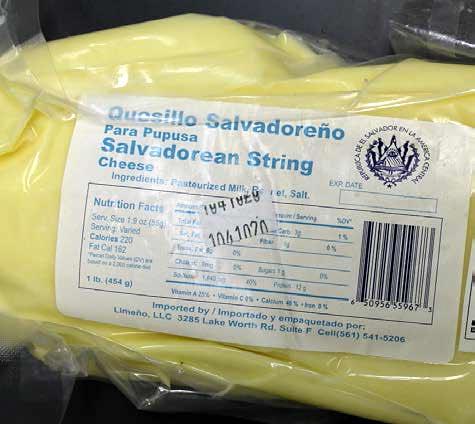
Product image, Salvadorean String Cheese block, Limeno, LLC

Limena, LLC of Palm Springs, FL. is recalling its 1 lb. (16 ounce) blocks of Salvadorean String Cheese (Quesillo Cheese) semi-soft cheese because it has the potential to be contaminated with Listeria monocytogenes, an organism which can cause serious and sometimes fatal infections in young children, frail or elderly people, and others with weakened immune systems.

The recalled “Salvadorean String Cheese (Quesillo Cheese)” was distributed to retail stores and through mail orders.

The product has a blue and white label and comes in a 1 lb. (16 oz.), clear plastic vacuum package marked with lot #1041020 on the top. The Expiration date is blank.

No illnesses have been reported to date in connection with this problem.

The potential for contamination was noted after routine testing by the Florida Department of Agriculture and Consumer Services revealed the presence of Listeria monocytogenes in one sample of 1 lb. (16 ounce) blocks of Salvadorean String Cheese (Quesillo Cheese).

The production of the product has been suspended while FDA and the company continue to investigate the source of the problem.

USA – Outbreak Investigation of Salmonella Javiana Potentially Linked to Tailor Cut Produce Fruit Mix, Winter 2019

FDA

January 2, 2020

Total Illnesses: 96
Hospitalizations: 27
Deaths: 0
Last illness onset: December 10, 2019

Recommendation

FDA, CDC and state and local partners are investigating an outbreak of illnesses caused by Salmonella Javiana. Epidemiologic and traceback evidence indicate that fruit mix with cantaloupe, honeydew, pineapple, and grapes from Tailor Cut Produce of North Brunswick, New Jersey, is a potential source of this outbreak.

The firm recalled the fruit mix, called Fruit Luau, as well as cut honeydew, cut cantaloupe and cut pineapple products on December 7. Food service and institutional food operators should not sell or serve the recalled products.

Tailor Cut Produce reports that their products may be found in restaurants, banquet facilities, hotels, schools, long-term care facilities and institutional food service establishments in Delaware, New Jersey, New York, and Pennsylvania.

Because the recalled products may have been distributed to nursing homes, schools, hospitals and other facilities that cater to vulnerable populations, it is important that these facilities do not sell or serve them. Please consult with your distributor to confirm the source of the fruit mix and cut fruit used in your operation.

Background

As of December 30, 2019, CDC is reporting 96 illnesses confirmed by Whole Genome Sequencing (WGS) in CA, CO, CT, DE, IL, MN, NJ, NY, PA, VA, and WA. Illnesses were reported from states where Tailor Cut Produce distributes, including Pennsylvania, New York City, New Jersey, and Delaware. Ill people from other states reported traveling to these states in the week before their illness started. CDC reports only cases confirmed by WGS, and these numbers may differ from the numbers that states are investigating.

FDA’s inspection at Tailor Cut Produce is ongoing. FDA is currently collecting records to support a traceback investigation and will provide updates as more information becomes available.

Research – Quantifying the Influence of Relative Humidity, Temperature, and Diluent on the Survival and Growth of Enterobacter aerogenes

Journal of Food Protection

ABSTRACT

Survival of bacteria on surfaces plays an important role in the cross-contamination of food. Temperature, relative humidity (RH), surface type, and inoculum diluent can affect bacterial survival. This study was conducted to examine how temperature, RH, and diluent affect the survival of Enterobacter aerogenes on stainless steel, polyvinyl chloride, and ceramic tile. Although surface type had little effect on survival, temperature had a clear effect. E. aerogenes survival was highest at 7°C and 15 and 50% RH on all surfaces. Some diluents allowed growth under high RH conditions. Cell populations in distilled water inoculated onto each surface decreased initially compared with populations in 1% phosphate-buffered saline (PBS) and 0.1% peptone broth. At 15 and 50% RH, cell populations in 1% PBS declined more sharply after 120 h than did those 0.1% peptone, but populations in both diluents had similar declines up to 3 weeks. Cell populations in 0.1% peptone had the greatest growth and reached the highest population density (∼8 log CFU/mL). Cell populations in PBS and distilled water increased by ∼2 log CFU/mL. When cells in 0.1% peptone were inoculated onto stainless steel at 100% RH, populations increased to ∼7 log CFU per coupon, whereas cells in 1% PBS increased to ∼5 log CFU per coupon followed by a decline over 3 weeks. DMFit and GInaFiT software modeled inactivation on surfaces at all conditions other than 100% RH at 21°C. These findings have important implications for experiments in which microorganisms are inoculated onto foods or food contact surfaces because the growth observed may be affected more by the inoculum diluent at high or uncontrolled RH than by the type of inoculated surface.

HIGHLIGHTS
  • Survival of E. aerogenes was quantified at 7°C with 15, 50, and 100% RH and at 21°C with 5 and 50% RH.

  • E. aerogenes survival was higher at 7°C with 15 and 50% RH on all surfaces.

  • Cell populations in 0.1% peptone at 21°C with 100% RH increased to ∼7 log CFU per coupon.

  • Cell populations in 1% PBS at 21°C with 100% RH increased to ∼5 log CFU per coupon.

  • Cell populations in distilled water at 21°C increased by ∼2 log CFU/mL.

USA – Meijer recalls diced eggs used in salad bars – Listeria monocytogenes

Food Safety News

Meijer is recalling frozen hard boiled egg products used on salad bars at two stores because of possible Listeria monocytogenes contamination. The stores with the salad bars are located in Grand Rapid, MI.

The company recall says that it is initiating the recall “in conjunction with Almark Foods.”

The Almark egg facility has been confirmed to be contaminated with the same strain of Listeria monocytogenes that public health officials have found in patients involved in a multi-state outbreak. One person has died.

RASFF Alerts – Aflatoxin – Dried Figs – Groundnuts – Peanut Butter

RASFF-Logo

RASFF – aflatoxins (Tot. = 54.1 / µg/kg – ppb) in dried figs from Turkey in Italy

RASFF – aflatoxins (B1 = 7.6; Tot. = 15.2 µg/kg – ppb) in dried figs from Turkey in France

RASFF – aflatoxins (B1 = 42; Tot. = 61 / B1 = 140; Tot. = 160 µg/kg – ppb) in groundnuts from Egypt in the Netherlands

RASFF – aflatoxins (B1 = 18; Tot. = 21 µg/kg – ppb) in groundnuts from Egypt in the Netherlands

RASFF – aflatoxins (B1 = 24; Tot. = 30 µg/kg – ppb) in groundnuts from Egypt in the Netherlands

RASFF – aflatoxins (Tot. = 13 µg/kg – ppb) in groundnuts from Argentina in the Netherlands

RASFF – aflatoxins (B1 = 9.4; Tot. = 11.3 µg/kg – ppb) in peanut butter from the Netherlands in the Netherlands

RASFF Alert – STEC E.coli – Raw Milk Cheese

RASFF-Logo

RASFF – shigatoxin-producing Escherichia coli (stx2+ eae /25g) in raw milk cheese from France, packaged in Germany in Germany