Category Archives: STEC

USA – Outbreak Investigation of E. coli O157:H7: Unknown Food (Fall 2020)

FDA

The FDA and CDC, in collaboration with state and local partners, is investigating illnesses in a third multistate outbreak of E.coli O157:H7 infections this Fall.

On November 6, 2020, the Michigan Department of Agriculture and Rural Development (MDARD) reported that as a part of routine sampling, they collected a product sample of romaine lettuce for testing. The sample tested positive for E. coli O157:H7 and subsequent whole genome sequencing (WGS) analysis determined that the E. coli O157:H7 present in the samples matches the strain that has caused illnesses in this outbreak.

The strain of E. coli found in the Michigan sample is a third distinct strain not genetically related to the strains causing two distinct multi-state outbreaks of Shiga-toxin producing E. coli O157:H7 (STEC) that FDA and CDC announced on October 28, 2020. At this time, a specific food has not been linked to either of those outbreaks.

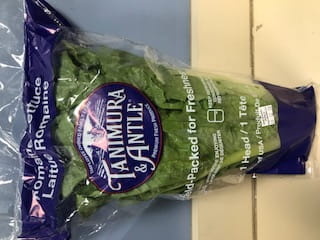
On November 6, 2020, Tanimura & Antle, Inc. recalled packaged single head romaine lettuce with a pack date of 10/15/2020 or 10/16/2020 due to possible contamination with E. coli O157:H7. The firm recalled this product based on test results from a product sample collected and analyzed by MDARD before the WGS analysis showing the match to the outbreak strain was completed.

FDA and state partners are working with the firm to determine if additional romaine should be recalled.

At this time, there is not enough epidemiologic and traceback evidence to determine if ill people in this outbreak were exposed to romaine lettuce from Tanimura & Antle, Inc. Additional information will be provided as it becomes available.

Recommendation

Consumers, restaurants, and retailers, should not eat, sell, or serve Tanimura & Antle, Inc. brand packaged single head romaine lettuce with a pack date of 10/15/2020 or 10/16/2020.
USA – Consumer Advisory: Romaine lettuce grown by Tanimura & Antle tests positive for E. coli

MDARD

Romaine lettuce

LANSING, Mich. – The Michigan Department of Agriculture and Rural Development (MDARD) is advising consumers not to eat Tanimura & Antle brand romaine lettuce packed as single heads due to food safety concerns.

A routine sample of the lettuce collected at a Walmart in Comstock Park, MI, and tested by MDARD’s Laboratory Division confirmed positive for E. coli 0157:H7. Further analysis conducted by the Michigan Department of Health and Human Services laboratory determined that the strain of E. coli recovered from the product sample is highly related genetically to E. coli causing two recent illnesses in Michigan.

The lettuce was sold in a zip-top clear plastic bag with a blue label and white lettering.  It has the UPC number 0-27918-20314-9 and a white sticker indicating it was packed in Salinas, California on October 15, 2020.

Consumers should discard this product or return it to the place of purchase. If you think you or a family member have become ill from consuming any of these products, please seek immediate medical attention.

E. coli can cause serious or life-threatening illness in some individuals. Symptoms of Shiga toxin-producing E. coli (STEC) infection vary for each person, but often include severe stomach cramps, diarrhea (often bloody), and vomiting. Some people may have a fever, which usually is not very high (less than 101˚F/38.5˚C). Most people get better within 5 to 7 days. Some infections are very mild, but others are severe or even life-threatening. People usually get sick from Shiga toxin-producing E. coli (STEC) 2 to 8 days (average of 3 to 4 days) after ingesting the bacteria. Some people with a STEC infection may get a type of kidney failure called hemolytic uremic syndrome (HUS). E. coli infection is usually diagnosed by testing a stool sample.

Scotland – The risk of STEC contamination in wild venison

FSS

Summary

We have published this report to address knowledge gaps and better understand the risk of STEC (Shiga toxin-producing Escherichia coli) contamination of wild venison.

The report is based on three core objectives to:

  • map the venison industry in Scotland
  • assess STEC prevalence in wild deer faeces in Scotland
  • review cross-contamination risks in the slaughter and processing stages of wild deer from the field to larder

Although the prevalence of STEC O157 in wild deer is low, the report found that when discovered, it is the strain associated with the most severe forms of human disease. Therefore, adherence to strict hygiene practices from cull to final product are strongly recommended within the report.

The venison industry continues to take a cooperative and responsible approach to STEC O157 when found, working to better understand the risks in the sector and how to mitigate them in the interest of public health protection.

Research – Investigation into a national outbreak of STEC O157:H7 associated with frozen beef burgers, UK, 2017

Cambridge Org

In November 2017, Public Health England identified an outbreak of Shiga toxin-producing Escherichia coli O157:H7 in England where whole genome sequencing results indicated cases were likely to be linked to a common source, and began investigations. Hypothesis generation included a review of enhanced surveillance data, a case-case study and trawling interviews. The hypothesis of interest was tested through the administration of focussed questionnaires and review of shopping history using loyalty card data. Twelve outbreak cases were detected, eight were hospitalised and four developed haemolytic uraemic syndrome. Frozen beef burgers supplied by a national retailer were identified as the vehicle of the outbreak. Testing of two left-over burger samples obtained from the freezers of two separate (unlinked) cases and a retained sample from the production premises were tested and found to be positive for the outbreak strain. A voluntary recall of the burgers was implemented by the retailer. Investigations at the production premises identified no contraventions of food safety legislation. Cooking guidance on the product packaging was deemed to be adequate and interviews with the cases/carers who prepared the burgers revealed no deficiencies in cooking practices at home. Given the long-shelf life of frozen burgers, the product recall likely prevented more cases.

Korea – McDonald’s HQ Raided in Food Poisoning Investigation of Alleged ‘Hamburger Disease’ – E.coli

Newsweek

Prosecutors have relaunched an investigation of McDonald’s in South Korea for its alleged connection to a recent case of the haemolytic uremic syndrome (HUS)—a life-threatening condition, dubbed the “hamburger disease”, caused by a strain of E.coli.

Spain – Alert for the presence of Shiga toxin-producing Escherichia coli in Brie cheese from France

CFSA

Brie cheese

The Spanish Agency for Food Safety and Nutrition (AESAN) has notified us through the SCIRI of the presence of the bacterium Escherichia coli producing Shiga toxins in the cheese product Brie 100 g, made in France, marketed from Germany by the JERMI company and sold in supermarkets of the Lidl chain.

The German company JERMI, which packs and markets the product, has detected Shiga toxin-producing Escherichia coli in the course of its self-checks and has informed the competent authorities and its customers.

The company Lidl has communicated the information to consumers requesting the return of the product.

The affected product is:

  • Brie cheese 100 g
  • Packed by JERMI KÄSEWERK GMBH
  • Expiry date: 10.2020
  • Lot name: 402

The product has been distributed in Andalusia, Catalonia , the Basque Country, Madrid, Murcia and the Valencian Community.

The AESAN became aware of this through the RASFF alert and reported the same in all regions through the SCIRI in order to continue the withdrawal of the affected product marketing channels.

The presence of Shiga toxin-producing Escherichia coli in food can pose health risks to people who consume it.

With the information available, no case associated with this alert has been confirmed in Spain.

People who have products affected by this alert at home are advised to refrain from consuming them and return them to the point of purchase.

Hong Kong – Not to consume a kind of cheese from Italy with possible Shiga toxin-producing E. coli contamination

CFS

Issue Date 2.11.2020
Source of Information Centre for Food Safety
Food Product Cheese
Product Name and Description Product name: FONTINA D.O.P.

Place of origin: Italy

Producer: COOPERATIVA PRODUTTORI LATTE E FONTINA SOC. COOP.A.R.L.

Importer: Bravo Fine Foods Limitedand New Food Project Limited

Lot: LOTTO C261

Best-before date: November 19, 2020

Reason For Issuing Alert
  • The CFS received a notification from the Rapid Alert System for Food and Feed (RASFF) of the European Commission that the above-mentioned product might have been contaminated with Shiga toxin-producing Escherichia coli (STEC) and is being recalled.
  • Preliminary investigation found that two local importers, Bravo Fine Foods Limited and New Food Project Limited, had imported some of the affected product into Hong Kong.
  • People will contract STEC-causing gastro-intestinal disease through consumption of contaminated water or undercooked and contaminated foods. Intestinal bleeding and serious complications such as hemolytic uraemic syndrome may also develop in some people.
Action Taken by the Centre for Food Safety
  • The CFS immediately contacted local major importers and retailers for follow-up.
  • The importers have initiated a recall according to the CFS’ instructions.
Advice to the Trade
  • The trade should stop using or selling the product concerned immediately if they possess it.
Advice to Consumers
  • Consumers should not consume the affected batches of the product if they have bought any.
  • Enquiries about the recall can be made to the hotlines of Bravo Fine Foods Limited and New Food Project Limited at 3528 0348 and 5248 8527 respectively during office hours.
Further Information The CFS press release

Austria – „Meine Käserei“ Brie de Nangis, ca. 100 g – STEC E.coli

AGES

Recall reason Verotoxin-producing Escherichia coli
Marketed by Lidl Austria
Manufacturer JERMI Käsewerk GmbH
Expiry Date 01/11/2020
Batch number 403

Product recall: “My cheese dairy” Brie de Nangis, approx. 100 g from the manufacturer JERMI Käsewerk GmbH

Salzburg (OTS) – The manufacturer JERMI Käsewerk GmbH is currently calling out the product “MY CHEESERY, BRIE DE NANGIS, CA. 100 G “with the best before date 11/01/2020, lot number 403 and the identification number DE BW 331 EG.

Verotoxin-producing Escherichia (E.) coli (VTEC) were detected in the affected product. VTEC bacteria can cause diarrhea. Certain groups of people (infants, toddlers, senior citizens, pregnant women and people with a weakened immune system) can develop severe disease. Because of this health risk, customers should pay attention to the recall and avoid consuming the cheese. This warning does not mean that the endangerment was caused by Lidl Austria.

The affected product “My Käserei, Brie de Nangis, approx. 100g” with the best before date 01.11.2020, the lot number 403 and the ID number DE BW 331 EG from the manufacturer JERMI Käsewerk GmbH was sold at Lidl Austria.

For reasons of consistent consumer protection, Lidl Austria reacted immediately and removed the affected product from sale. The product can be returned in all Lidl branches. The purchase price will of course be reimbursed, even without presenting the receipt.
Other products sold at Lidl Austria, in particular other “Meine Käserei” products, are not affected by the recall.
The manufacturer JERMI Käsewerk GmbH apologizes to all concerned for the inconvenience.

Customer service

If you have any questions on the subject, Lidl Austria customer service is available on the toll-free number 0800/500 810 from Monday to Friday from 8:00 a.m. to 6:00 p.m. and on Saturday from 8:00 a.m. to 5:00 p.m.

Original recall

USA – Marler Clark, The Nation’s Food Safety Law Firm, relaunches www.about-listeria.com – www.about-HUS.com – www.about-ecoli.com

Food Poison Journal

With another Listeria outbreak just announced, this one sickening 10 with 1 dead likely linked to deli meat , Marler Clark, The Nation’s Food Safety Law Firm, relaunches www.about-listeria.com.

Food Poison Journal

In the beginning of yet another – in fact two E. coli Outbreaks that have sickened dozens, Marler Clark, The Nation’s Food Safety Law Firm, relaunches www.about-hus.com.

Food Poison Journal

In the beginning of yet another – in fact two E. coli Outbreaks that have sickened dozens, Marler Clark, The Nation’s Food Safety Law Firm, relaunches www.about-ecoli.com.

Denmark – Risk of vero-toxin-producing E. coli in French white mold cheese

DVFA

Lidl Danmark K / S recalls Milbona French white mold cheese due to risk of vero-toxin-forming E. coli in the product

Recalled Foods , Published: October 29, 2020

What food:
Milbona French white mold cheese 
Shelf life: 31.10.2020 
Net content: approx. 100 g
Sold in:
Lidl Denmark’s stores across the country.
Producer:
Jermi Käsewerk GmbH, Ritter-Heinrich-Straße 2, 88471 Laupheim, Germany
Company recalling:
Lidl Danmark K / S
Cause:
Vero-toxin-producing E. coli has been detected in the product
Risk:
Infection with E.coli can cause acute stomach infection with diarrhea, severe abdominal pain and vomiting
Advice for consumers:
The Danish Veterinary and Food Administration advises consumers to deliver the product back to the store where it was purchased or to discard it.