Category Archives: STEC

France- Product recall: La Belle Nature ground steak and minced meat – E.coli O157

Oulah

ENCOUNTERED PROBLEM

Suspicion of Escherichia coli O157H7

PROPOSED SOLUTION

People who hold the product in question are asked not to consume them – and more particularly young children, pregnant women, immunocompromised people and the elderly – and to return them to the point of sale where they were purchased.

People who have consumed it and who present symptoms such as diarrhea, abdominal pain or vomiting should consult their doctor as soon as possible, mentioning this consumption and the possible link with the bacterium Escherichia coli.

In the absence of symptoms within 10 days after consuming the affected products, there is no need to worry and consult a doctor.

The E. coli bacterium is naturally present in the digestive microflora of humans and warm-blooded animals. Some strains of E. coli are pathogenic, and can be responsible in humans for various disorders ranging from mild diarrhea to more serious forms such as hemorrhagic diarrhea or severe kidney damage such as HUS, mainly in young children.

FURTHER INFORMATION

▸ Affected products

Product Lot DDM
Minced meat 20% 350g 21187-3017 07/14/2021
Minced meat 5% 350g 21187-2994 07/14/2021
Minced Steak 15% x8 125g 21187-2964 07/14/2021
Minced Steak 15% 2x 125g 21187-2956 07/14/2021
Minced Steak 5% x8 100g 21187-2869 07/14/2021
Minced meat 5% 650g 21187-2985 07/14/2021

▸ Health mark
FR.13.097.003.CE


▸ Geographical area of ​​sales throughout
France


▸ Distributors
CASINO-CARNIVOR-OLIFRE-LEADER PRICE


▸ Consumer service contact


▸ Source
LES ATELIERS

Wales – North Wales playgroup, breakfast and afterschool clubs closed after child struck down with E.coli

Daily Post

Public health chiefs have confirmed that as a result Cylch Meithrin and Clwb Y Morfa, Breakfast Club and Afterschool Club have all closed for a deep clean.

A parent at Ysgol Glan Morfa, who asked not to be named, said: “There are a number of kids in my child’s class who have been off all week.”

Public Health Wales, Conwy County Borough Council and Betsi Cadwaladr University Health Board are now investigating

Richard Firth, consultant in health protection at Public Health Wales confirmed a single case of a Shiga toxin-producing E.coli (STEC) has been identified in a pupil at the Cylch Meithrin, Abergele.

Research -Evidence of on-going transmission of Shiga toxin-producing Escherichia coli O157:H7 following a foodborne outbreak

Cambridge Org

In August 2019, public health surveillance systems in Scotland and England identified seven, geographically dispersed cases infected with the same strain (defined as isolates that fell within the same five single nucleotide polymorphism single linage cluster) of Shiga toxin-producing Escherichia coli O157:H7. Epidemiological analysis of enhanced surveillance questionnaire data identified handling raw beef and shopping from the same national retailer (retailer A) as the common exposure. Concurrently, a microbiological survey of minced beef at retail identified the same strain in a sample of minced beef sold by retailer A, providing microbiological evidence of the link. Between September and November 2019, a further four primary and two secondary cases infected with the same strain were identified; two cases developed haemolytic uraemic syndrome. None of the four primary cases reported consumption of beef from retailer A and the transmission route of these subsequent cases was not identified, although all four primary cases visited the same petting farm. Generally, outbreaks of STEC O157:H7 in the UK appear to be distinct, short-lived events; however, on-going transmission linked to contaminated food, animals or environmental exposures and person-to-person contact do occur. Although outbreaks of STEC caused by contaminated fresh produce are increasingly common, undercooked meat products remain a risk of infection.

RASFF Alert – STEC E.coli – Frozen Lamb Plucks

RASFF

Shigatoxin-producing Escherichia coli (in 2 out of 5 samples /25g) in frozen lamb plucks from New Zealand in Bulgaria

Italy – Taleggio DOP raw milk – STEC E.coli O103

Salute

Brand : Pascoli del Fattore and Casarrigoni

Denomination : Taleggio DOP raw milk

Reason for reporting : Recall due to microbiological risk

Publication date : 5 July 2021

Click to access C_17_PubblicazioneRichiami_1239_azione_itemAzione0_files_itemFiles0_fileAzione.pdf

Documentation

Documentation

France – Charolais minced steak meat style 5% mat. gr. pure beef 2x125g from Cora Degustation brand – E.coli O157:H7

Oulah

ENCOUNTERED PROBLEM

Presence of Escherichia coli O157: H7

PROPOSED SOLUTION

People who hold the product in question are asked not to consume them – and more particularly young children, pregnant women, immunocompromised people and the elderly – and to return them to the point of sale where they were purchased.

People who have consumed it and who present symptoms such as diarrhea, abdominal pain or vomiting should consult their doctor as soon as possible, mentioning this consumption and the possible link with the bacterium Escherichia coli.

In the absence of symptoms within 10 days after consuming the affected products, there is no need to worry and consult a doctor.

The E. coli bacterium is naturally present in the digestive microflora of humans and warm-blooded animals. Some strains of E. coli are pathogenic, and can be responsible in humans for various disorders ranging from mild diarrhea to more serious forms such as hemorrhagic diarrhea or severe kidney damage such as HUS, mainly in young children.

FURTHER INFORMATION

▸ Names of models or references
Charolais minced steak 5% Fat 2x125g


▸ Barcode
3257981177826


▸ Lot
5117001367901/10


▸ DLC – DDM
06/27/2021


▸ Packaging
black plastic tray 2x125g


▸ Start date / End of marketing
From 06/21/2021 to 06/27/2021


▸ Health mark
FR 18.033.033 CE


▸ Geographical area of ​​sales throughout
France


▸ Distributors
Cora, Migros


▸ Consumer service contact
0248509595


▸ Source
CORA, MIGROS

UK – Two E. coli O157 infections linked to English farm

Food Safety News

Two confirmed cases of E. coli O157 infection have been linked to a farm in England.

Acton Scott Historic Working Farm in Shropshire temporarily closed this past week to take precautionary measures to reduce the risk of visitors becoming infected. The steps include providing more handwashing facilities and improving safety information about feeding and touching animals.

Members of the Public Health England (PHE) West Midlands Health Protection Team and environmental health colleagues from Shropshire Council are involved in the investigation at the farm, which is owned by the council. No information was provided about the patients.

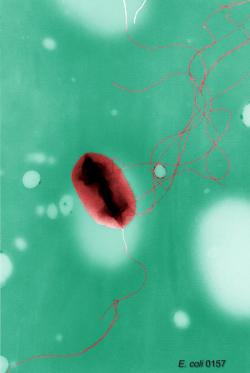
kswfoodworld E.coli O157

Image CDC

Research – Genetic diversity and pathogenic potential of Shiga toxin-producing Escherichia coli (STEC) derived from German flour

Science Direct

Abstract

Shiga toxin-producing Escherichia coli (STEC) can cause severe human illness, which are frequently linked to the consumption of contaminated beef or dairy products. However, recent outbreaks associated with contaminated flour and undercooked dough in the United States and Canada, highlight the potential of plant based food as transmission routes for STEC. In Germany STEC has been isolated from flour, but no cases of illness have been linked to flour.

In this study, we characterized 123 STEC strains isolated from flour and flour products collected between 2015 and 2019 across Germany. In addition to determination of serotype and Shiga toxin subtype, whole genome sequencing (WGS) was used for isolates collected in 2018 to determine phylogenetic relationships, sequence type (ST), and virulence-associated genes (VAGs).

We found a high diversity of serotypes including those frequently associated with human illness and outbreaks, such as O157:H7 (stx2c/d, eae), O145:H28 (stx2a, eae), O146:H28 (stx2b), and O103:H2 (stx1a, eae). Serotypes O187:H28 (ST200, stx2g) and O154:H31 (ST1892, stx1d) were most prevalent, but are rarely linked to human cases. However, WGS analysis revealed that these strains, as well as, O156:H25 (ST300, stx1a) harbour high numbers of VAGs, including eae, nleB and est1a/sta1.

Although STEC-contaminated flour products have yet not been epidemiologically linked to human clinical cases in Germany, this study revealed that flour can serve as a vector for STEC strains with a high pathogenic potential. Further investigation is needed to determine the sources of STEC contamination in flour and flour products particularly in regards to these rare serotypes.

Research – A Microbiological Survey of Minced Beef at Retail in Scotland

FSS

Click to access FSS_Report_Retail_Mince_FINAL.pdf

Research – Shiga Toxin–Associated Hemolytic Uremic Syndrome in Adults, France, 2009–2017

CDC

We conducted a retrospective study on hemolytic uremic syndrome caused by Shiga toxin–producing Escherichia coli (STEC) in 96 adults enrolled in the cohort of the National Reference Center for Thrombotic Microangiopathies network in France during 2009–2017. Most infections were caused by STEC strains not belonging to the O157 or O104 serogroups. Thirty (31.3%) patients had multiple risk factors for thrombotic microangiopathy. In total, 61 (63.5%) patients required dialysis, 50 (52.1%) had a serious neurologic complication, 34 (35.4%) required mechanical ventilation, and 19 (19.8%) died during hospitalization. We used multivariate analysis to determine that the greatest risk factors for death were underlying immunodeficiency (hazard ratio 3.54) and severe neurologic events (hazard ratio 3.40). According to multivariate analysis and propensity score-matching, eculizumab treatment was not associated with survival. We found that underlying conditions, especially immunodeficiency, are strongly associated with decreased survival in adults who have hemolytic uremic syndrome caused by STEC.