Packagingplastic tray or bare product in traditional network
Marketing start/end date From 09/12/2022 to 09/20/2022
Storage temperature Product to be stored in the refrigerator
Health mark FR-71-235-001-CE
Further information Dry goat cheese
Geographic area of sale Whole France
Distributors CARREFOUR France GRAND FRAIS France INTERMARCHE Bourgogne Franche Comté METRO Chalon sur Saône METRO Dijon HYPER U, SUPER U Burgundy Rhône Alpes Alsace
Practical information regarding the recall
Reason for recall Recall information for health reasons
Risks incurred by the consumer Toxigenic Shiga Escherichia coli (STEC)
WASHINGTON, October 13, 2022 – The U.S. Department of Agriculture’s Food Safety and Inspection Service (FSIS) is issuing a public health alert due to concerns that a specific ground beef product may be contaminated with E. coli O103. A recall was not requested because the products are no longer available for purchase.
The raw ground beef items were produced on October 4, 2022. The following product is subject to the public health alert view labels:
1-lb. plastic vacuum-packed packages containing “FRANK’S BUTCHER SHOP GROUND BEEF” with “PACKED ON” dates of 10-07-2022 and 10-09-2022 on the label.
The establishment’s retail store location in Hudson, Wyoming sold the affected product directly to consumers. FBS Hudson is actively attempting to contact consumers who may have purchased 14 packages of ground beef product subject to the public health alert.
The problem was discovered when FBS Hudson alerted FSIS that its routine microbial testing results found Shiga toxin-producingE. coli (STEC) O103 in a sample of the ground beef. There have been no confirmed reports of illness due to consumption of these products.
Many clinical laboratories do not test for non-O157 STEC, such as O103 because it is harder to identify than STEC O157:H7. People can become ill from STECs 2-8 days (average of 3-4 days) after consuming the organism.
Most people infected with STEC O103 develop diarrhea (often bloody) and vomiting. Some illnesses last longer and can be more severe. Infection is usually diagnosed by testing of a stool sample. Vigorous rehydration and other supportive care is the usual treatment; antibiotic treatment is generally not recommended. Most people recover within a week, but, rarely, some develop a more severe infection. Hemolytic uremic syndrome (HUS), a type of kidney failure, is uncommon with STEC O103 infection. HUS can occur in people of any age but is most common in children under 5 years old, older adults and persons with weakened immune systems. It is marked by easy bruising, pallor and decreased urine output. Persons who experience these symptoms should seek emergency medical care immediately.
Marketing start/end date From 05/10/2022 to 10/10/2022
Storage temperature Product to be stored in the refrigerator
Health mark EN 35.078.037 EC
Further information. In the event of consumption of the product and as soon as any symptoms appear (digestive disorders, fever, nausea and vomiting, etc.), consult your attending physician and inform him of this consumption. Particular attention should be paid to pregnant women and immunocompromised people, as well as the elderly, who are more fragile.
Geographic area of sale Whole France
Distributors Fishmongers, restaurants
Practical information regarding the recall
Reason for recall High levels of E. coli and presence of Salmonella
Risks incurred by the consumer Toxigenic Escherichia coli shiga (STEC) Salmonella spp (causative agent of salmonellosis)
The FDA, along with CDC and state and local partners, are investigating a multistate outbreak of E. coli O121:H19 infections linked to Earth Grown frozen falafel.
Based on epidemiologic information provided by CDC and interviews conducted by state and local public health officials, of 18 people interviewed, 15 reported shopping at ALDI stores. Among these 15 people who reported shopping at ALDI stores, 6 reported eating Earth Grown brand frozen falafel purchased from ALDI in the week before getting sick.
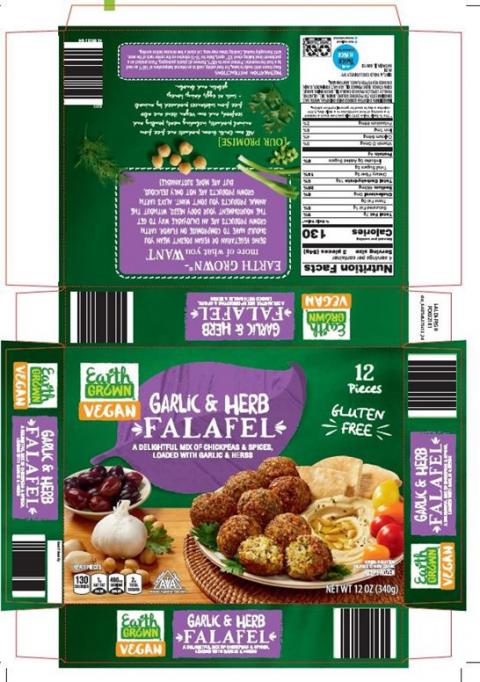
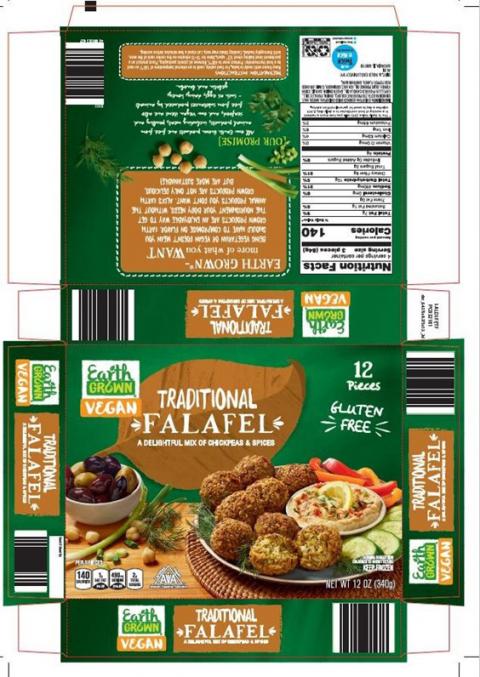
On October 6, 2022, the manufacturer of Earth Grown frozen falafel, Cuisine Innovations, initiated a voluntary recall. Recalled products include Earth Grown vegan traditional falafel and garlic & herb falafel distributed and sold exclusively by ALDI. Additional information on recalled products is available in the firm’s recall notice.
On October 6, 2022, ALDI removed any remaining Earth Grown frozen falafel from stores.
FDA’s investigation is ongoing. Updates to this advisory will be provided as they become available.
Recommendation
Consumers, restaurants, and retailers should not eat, sell, or serve recalled Earth Grown Traditional Falafel or Garlic & Herb Falafel sold exclusively by ALDI after June 24, 2021.
These items are no longer available for sale but were sold frozen and have a long shelf-life of 18 months, so consumers should check their freezers for these products. If you have recalled frozen falafel in your freezer, do not eat or serve them.
Potential contamination with shiga toxin-producing E. Coli
Company Name:
Cuisine Innovations Unlimited LLC
Brand Name:
Earth Grown Vegan
Product Description:
Earth Grown Vegan Traditional Falafel and Garlic & Herb Falafel
Company Announcement
Cuisine Innovations Unlimited, LLC of 180 Lehigh Avenue, Lakewood, NJ, is voluntarily recalling its Earth Grown Vegan Traditional Falafel and Garlic & Herb Falafel Distributed & Sold Exclusively by Aldi, Batavia, IL due to the possible presence of Shiga toxin-producing E. coli.
Shiga-toxin-producing E. coli is an organism that can cause foodborne illness in a person who eats a food item contaminated with it. Symptoms of infection may include stomach cramps, diarrhea, and vomiting. The illness primarily impacts elderly individuals, children, and people with weakened immune systems. Most healthy adults and children rarely become seriously ill.
The voluntarily recalled Earth Grown Vegan Traditional Falafel And Garlic & Herb Falafel Distributed & Sold Exclusively by Aldi, Batavia, IL were distributed in ALDI retail stores in the following states: Alabama, Arizona, Arkansas, California, Connecticut, Delaware, District of Columbia, Florida, Georgia, Illinois, Indiana, Iowa, Kansas, Kentucky, Louisiana, Maryland, Massachusetts, Michigan, Minnesota, Mississippi, Missouri, Nebraska, New Hampshire, New Jersey, New York, North Carolina, North Dakota, Ohio, Oklahoma, Pennsylvania, Rhode Island, South Carolina, South Dakota, Tennessee, Texas, Virginia, West Virginia, and Wisconsin.
The product comes in a bag in a box marked with any of the following Lot numbers: 1472, 1481, 1531, 1532, 1541, 1552, 1561, 1581, 1601, 1611, 1612, 1661, 1682, 1732, 1752, 1762, 1782, 1802, and 1812, and would have been shipped to stores after June 24, 2021. The lot number can be found in the “Best if used by” area on the outside flap of the box. There has been no further production of this product.
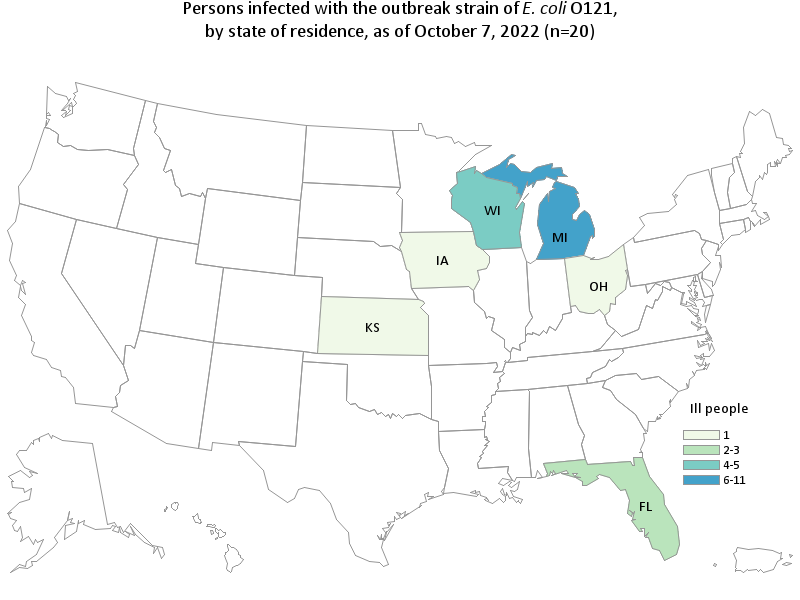
There have been 20 reported cases in six (6) states (FL, IA, KS, MI, OH and WI) with onset dates reported between July 24, 2022 and September 19, 2022 with 5 hospitalization and no deaths.
Consumers who have purchased Earth Grown Vegan Traditional Falafel and Garlic & Herb Falafel Distributed & Sold Exclusively by Aldi, Batavia, IL with any of the above lot numbers after June 24, 2021, are urged to return them to the place of purchase for a full refund. Consumers with questions may contact the company Monday through Friday, 8:00 a.m. to 4:00 p.m. Eastern Time at 1-201-439-1036, Ext. 26.
Foodborne illness causes a significant health burden in Australia. Estimates of both the extent of foodborne illness and the costs arising from illness are essential for measuring the impact on the population.
In 2010 it was estimated that Australians experience almost 16million episodes of gastroenteritis each year, with about one quarter of these due to contaminated food. This report updates these numbers to circa 2019 and estimates the associated costs to individuals and the health system. As foodborne disease interventions are often targeted at specific causes of illness, costs are also provided for ten high-priority pathogens.
We estimate that foodborne illness and its sequelae costs Australia AUD 2.44billion each year. The largest component of this cost is lost productivity due to non-fatal illness, followed by premature mortality and direct costs (including hospitalisations and other health care use).
While costs due to lost productivity are lower under the more conservative friction cost model, it remains the largest component cost for foodborne illness due to all causes. The pathogen with the highest individual cost is Campylobacter (AUD 365millionper year), while norovirus, other pathogenic E. coli, and Salmonella are all estimated to cost Australians over AUD 100 million each year. Lost productivity is the largest component cost for most pathogens, although premature mortality is the largest cost for pathogens that typically cause more severe illness, such as Listeria monocytogenes, Shiga toxin-producing Escherichia Coli, and Salmonella.
Significant advances in this report include the incorporation of estimated willingness to pay to avoid pain and suffering based on a discrete choice experiment from another FSANZ commissioned study, and the use of a simulation approach to estimating costs which provides uncertainty intervals on all estimates. A costing tool is provided with this report to allow estimates to be updated in the future.
Costs associated with surveillance for foodborne pathogens and related to outbreak investigations are considered separately to the model. Likewise, industry costs due to outbreaks such as lost sales, disposal of products, recall costs, enforcement related costs and potential business costs are not included in the costing model. Key limitations in this work include the lack of data on the long-term burden and health care usage associated with sequelae or ongoing illness due to toxoplasmosis and listeriosis. These costs are not included in this report due to unavailability of data. Costs of pain and suffering, which we approximate using willingness to pay to avoid pain and suffering, are relatively low compared to those estimated for other countries, which may represent differences in underlying preferences across countries and could suggest that greater international standardisation of methods and data collection may be required.
This report demonstrates that foodborne illness results in a substantial cost to Australia and that interventions to improve food safety across industry, retail, and consumers are needed to improve public health. Pathogen-specific costing estimates allow policy makers to target such interventions at individual pathogens, with the end goal of reducing the burden due to foodborne illness.