Category Archives: STEC

USA -How disease detectives’ quick work traced deadly E. coli outbreak to McDonald’s Quarter Pounders

6ABC

Scientists at the US Centers for Disease Control and Prevention who worked with the Colorado Department of Public Health and Environment to investigate the latest E. coli outbreak and nail down its cause say the fact that these cases were linked and solved so quickly makes it a noteworthy win.

As part of an outbreak investigation announced by the CDC and the US Food and Drug Administration on October 22, 90 cases of STEC infection from 13 states have been linked to McDonald’s Quarter Pounders. More than two dozen people have been hospitalized, and one has died.

Read More at the Link Above

Research -Authorities find source of STEC – E. coli outbreak in Iceland

Food Safety News

Health officials in Iceland have found the source of a Shiga toxin-producing E. coli (STEC) outbreak that sickened more than 20 children.

Officials found the handling of ground meat during cooking at a kindergarten was insufficient.

Affected children are from the Mánagarði kindergarten in the Vesturbær district of Reykjavík. More than 100 children attend the center. Landlaeknir (The Directorate of Health) reported that 23 pupils have fallen ill and two are in the intensive care unit.

Quebec – Warning not to consume lean ground beef and pork sold by the company Au Saucisson Vaudois – STEC E.coli

Quebec

QUEBEC CITY , Nov. , 2024 /CNW/ – The Ministry of Agriculture, Fisheries and Food (MAPAQ), in collaboration with the company Au Saucisson Vaudois, located at 368, rue Principale, in Sainte-Brigide-d’Iberville, is advising the public not to consume the products listed in the table below, as these foods may contain the E. coli bacteria that produces Shiga toxins.

Product name

Format

Target lot

“LEAN GROUND BEEF”

Variable weight

Lot: 264594

Packaging date: 20.09.24

Best before date: 19.09.25

“LEAN GROUND PORK”

Lot: 264595

Packaging date: 20.09.24

Best before date: 19.09.25

The products that are the subject of this warning were offered for sale until November 1, 2024. They were packaged in a plastic pouch with the words “Au Saucisson Vaudois” written on one side. They were sold frozen.

The operator is voluntarily recalling the products in question. It has agreed with MAPAQ to issue this warning as a precautionary measure. People who have one of these products in their possession are advised not to consume it. They must return it to the establishment where they purchased it or throw it away.

However, properly cooking meat destroys  E. coli bacteria . Preparing ready-made meals, such as spaghetti sauce, shepherd’s pie, or meat pie, requires a long enough cooking time and a high enough temperature to destroy the bacteria.

It should be noted that no cases of illness associated with the consumption of these foods have been reported to MAPAQ to date.

Iceland – E. coli O145 confirmed in children and mixed mince

MAST

Foodborne infection has been confirmed at the Mánagardı nursery school in Reykjavík. The causative agent is E. coli bacteria of a type known as STEC and of serotype O145. Analysis of samples at Matís confirmed that the same serotype, i.e. E. coli O145 was found both in faecal samples from children from the kindergarten and in a sample of minced meat used in cooking at the kindergarten. Their sequencing of the bacteria’s genetic material showed that the origin is the same.

After detailed interviews with the parents of the children, who fell ill, attention soon turned to Thursday, October 17 last. The Reykjavík Health Authority went to the site and took numerous samples for analysis of the food used in the cooking that day, such as minced meat, vegetables, lentils, melons, oatmeal and more. All food samples were negative for E. coli except for the mince. A few children who normally do not eat meat also fell ill, but it is not possible to confirm the route of infection for them. They may have been infected by other children who attended the kindergarten after they got sick but before the kindergarten was closed.

The mince turned out to be mixed beef and sheep mince from Kjarnaföð. It did not go on general sale, but only sold to larger kitchens, such as restaurants, canteens and kindergartens. Matvælastofnun contacted the representatives of the company when suspicion was directed at the mince, and the same day the company contacted all parties who received mince from the same production batch that was used in the Mánagard nursery school. During the recall, it was found that buyers had already used it in their operations. There have been no reports of infection or sickness among consumers at other kitchens.

E. coli bacteria are part of the natural intestinal flora of humans and animals and can be introduced into water, meat, vegetables and other foods during their production. Different types of E. coli exist. Most types of E. coli are harmless, but Shigatoxin-producing E. coli (STEC) carry genes that encode toxins that can cause illness (virulence genes). However, their strains can be highly pathogenic.

According to legislation on meat production, producers are not required to ensure that all meat is free of E. coli before it goes to market. However, meat producers should do everything in their power to reduce the chance of contamination of carcasses and meat products in the process. It is primarily done with clean grips, proper hand techniques and clean equipment. Sampling in the process is therefore aimed at checking whether working methods are adequate. The Food Agency reported on a screening of the presence of pathogenic bacteria in Icelandic meat on the Icelandic market in 2018. It stated that STEC virulence genes were found in almost 30% of lamb samples and 11.5% of beef samples.

Cleanliness and proper handling of meat and adequate cooking by users/consumers is therefore key to preventing infection caused by E. coli , including STEC from meat. The steering group’s research has revealed that the handling of the minced meat in this respect during cooking in the kindergarten was insufficient.

It is common practice that beef, lamb and horse steaks are served without being deep-fried. Raw cuts of meat have bacteria on the surface of the meat but not inside the muscle. They are therefore killed when the meat is fried or grilled at high temperatures. Hamburgers and other dishes made from minced meat are different, because during the mincing process, microorganisms spread throughout the mince. Insufficient heating/frying does not kill bacteria present deep inside the mince. In order to kill E. coli and other disease-causing microorganisms, hamburgers and other mincemeat dishes must be fried through or so that the core temperature is at least 75°C.

RASFF Alerts – STEC E.coli – French Cheese – Lamb Meat

RASFF

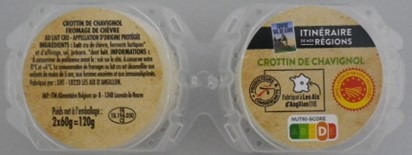
STEC in cheese “crottin de chavignol” in France in Netherlands

RASFF

E. Coli STEC in lamb meat from Ireland in Italy


USA – FDA – Core Investigation Table

FDA

What’s New

  • A new outbreak E. coli O26:H11 (ref #1272) linked to a not yet identified product has been added to the table.
  • For the outbreak of E. coli O157:H7 (ref #1270) the advisory has been updated to provide investigational updates and include more cases. A specific ingredient has not yet been confirmed as the source of the outbreak, but most sick people report eating McDonald’s Quarter Pounder burgers. Taylor Farms has initiated a voluntary recall of some onions sent to food service customers. FDA is working to determine if the slivered onions on Quarter Pounder burgers are the likely source of contamination. FDA has initiated an onsite inspection and sample collection.
  • For the outbreak of Listeria monocytogenes (ref #1268) linked to a not yet identified product, the case count has increased from three to four cases.
  • For the outbreak of Salmonella Thompson (ref #1262) linked to a not yet identified product, the case count has increased from 25 to 27 cases.

Iceland – The status of a food investigation for E. coli group infection in children

https://www.mast.is/is/um-mast/frettir/frettir/stadan-a-matvaelarannsokn-vegna-e-coli-hopsykingar-hja-bornum

Last week there was a group infection in children at the Mánagardí kindergarten in Reykjavík caused by E. coli bacteria of a type called STEC. An investigation into the cause and origin of the infection began on the same day as the diagnosis. The kindergarten was closed the next day. It is most likely a foodborne infection. Numerous food samples are being investigated at Matís, but the analysis of STEC in food is difficult and time-consuming. Results will be published with a press release on the websites of the Epidemiologist, the National Food Agency and the Reykjavík Health Authority when they are available.

Research on foodborne group infections is in the hands of a steering group, which in this case is appointed by an epidemiologist, Matvælastofnun, Reykjavík Health Authority, Department of Epidemiology and Virology of Landspítal, Matís, Health Care of the capital region and Children’s Hospital of the Circle.

After detailed information gathering by representatives of the epidemiologist and the capital region’s health care from the children’s parents, attention is focused on Thursday, October 17, on which day all the children who fell ill in the first few days were in the kindergarten. It is most likely a food-borne infection, as the children’s illness started at a similar time and spread across all the school’s departments. For the same reason, it is less likely that the infection is originally from the environment or between children. However, it is not possible to exclude those routes of transmission after the illness started and before a group infection was suspected and the kindergarten was closed.

On October 17, porridge was available in the morning, mince sauce or lentil dish (vegetable dish) and spaghetti for lunch and melons for fruit time. The Reykjavík Health Authority is conducting an on-site investigation and has taken numerous food samples for investigation, from the food that was offered that day. At the same time, health representatives have visited the kindergarten, reviewed procedures, assessed the situation and requested improvements as necessary. After the outbreak of the group infection, the kindergarten has been cleaned high and low, as well as toys and other equipment have been disinfected. The kindergarten is still closed and the decision on opening will be made by the operator in consultation with the steering committee. The Epidemiologist will issue instructions regarding when the children can return to school.

E. coli bacteria are part of the natural intestinal flora of humans and animals and can be introduced into water, meat, vegetables and other foods during their production. Different types of E. coli exist. Shigatoxin-producing E. coli (STEC) carry genes that produce toxins that cause the disease (virulence genes). However, their strains can be highly pathogenic.

Finding and culturing STEC strains in food can be difficult. First, virulence genes are screened and, if detected, E. coli strains are grown . Since a number of different E. coli strains are often found in each sample, it can be difficult to find the strain that carries the virulence genes, and the studies often have to be repeated. Sometimes the cause cannot be found.

The Food Agency reported on a screening of the presence of pathogenic bacteria in Icelandic meat on the Icelandic market in 2018. It stated that STEC virulence genes were found in almost 30% of lamb samples and 11.5% of beef samples. Comparable studies have not been carried out on vegetables, fruits or other foodstuffs in this country.


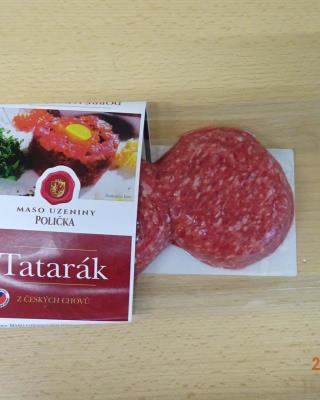
Czech Republic – MEAT SAUSAGE SHELF Tartar from CZECH BREEDING STEAK TATAR 250 g – STEC E.coli

Potravinynapranyri

Illustrative photo #1

Place of inspection:
Lidl Czech Republic Ltd
Jindřichův Hradec ( U Knihovny 1174, 377 01 Jindřichův Hradec – Jindřichův Hradec II )
ID: 26178541
Food group: Meat and meat products / Non-heat-treated non-perishable products
MEAT SAUSAGE SHELF Tartar from CZECH BREEDING STEAK TATAR 250 g
Category: Dangerous foods
Invalid parameter:
Shiga-toxin-producing Escherichia coli (STEC)
The presence of the pathogenic bacteria Escherichia coli producing shigatoxin was detected in the product .

Shiga toxins cause, among other things, diarrhea and can damage the kidneys.

The food was evaluated as harmful to health.

Batch: L: 96983
Expiration date: 06/05/2024
Packaging: PA-PE
Quantity of the product in the package: 250 g
Manufacturer: MASO UZENINY POLIČKA, as, no. 300, 572 01 Kamenec u Polička, Czech Republic
Country of origin: Czechia
Date of sample collection: 29/05/2024
Reference number: 24-000507-SZPI-CZ

The sample was detected by the official control of the State Agricultural and Food Inspection.

Research – E. coli in Food

MAST

In light of the news of the last few days, the Swedish Food Agency considers it appropriate to emphasize several points regarding the handling of food, especially with E. coli in mind.

What is E. coli ?

There are many types of coliform bacteria. They are found in the intestines of humans and animals. Some species can produce toxins and thus cause serious diseases in people, especially children, the elderly and other vulnerable individuals. These toxin-producing E. coli bacteria are called STEC (Shiga Toxin-producing Escherichia Coli ) and can cause serious illness in some cases.

Foodborne infections due to E. coli

The bacteria can get into meat during slaughter, if the contents of the animal’s intestines come into contact with the meat. Preventive measures that reduce the chance of meat becoming contaminated are therefore important, such as clean tools and hygiene during slaughter. The bacteria can also get into vegetables, fruits and other things that are grown in close contact with soil, organic waste or water that is contaminated with feces.

People can become infected with E. coli , through contaminated food (tdhakki and vegetables) or water, through direct contact with animals or environments contaminated with their feces. The bacterium thus gets through the mouth and down into the digestive tract.

It is common practice that beef, lamb and horse steaks are served without being deep-fried. On raw pieces of meat, bacteria are on the outer layer of the meat and not inside the muscle. They are therefore killed when the meat is fried or grilled at high temperatures. Everything else applies to hamburgers and other dishes made from minced meat. When meat is minced, microorganisms spread throughout the meat. Light frying therefore does not kill bacteria present in the meat. In order to kill E. coli and other disease-causing microorganisms, the hamburgers and other mincemeat dishes must be fried through or so that the core temperature is at least 75°C.

What can consumers do to avoid infection?

  • Fully fry round hamburgers and other minced meat
  • Maintain kitchen hygiene when handling raw and minced meat
  • Avoid cross contamination by keeping meat separate from other foods, especially from those that should not be cooked such as salad
  • Rinse all vegetables in clean water
  • Wash cutting boards, utensils, knives and the surrounding area after handling raw meat to prevent the transfer of bacteria to foods that are not to be heated
  • Do not wipe up blood with a cloth used on other surfaces, use paper towels instead
  • Good hand washing with soap and water after using the toilet, before handling food and after handling raw meat is an important rule to prevent infection
  • Prevent blood from leaking from meat in the fridge
  • Avoid consumption of unpasteurized dairy products

France – Chavignol goat cheese AOP 2x60G – STEC E.coli

Gov France

Product Category
Food
Product subcategory
Milk and dairy products
Product brand name
Itinerary of our Regions
Model names or references
CHAVIGNOL AOP ITM X2 – 2x60g =120G
Product identification
GTIN Batch Date
3250390155478 L262 07 All time codes Expiry date 11/18/2024
Packaging
Cellar by 2
Start/End of marketing date
From 10/07/2024 to 10/18/2024
Storage temperature
Product to be kept in the refrigerator
Health mark
FR 18.194.050 CE
Additional information
Manufacturer: LHT
Geographic area of ​​sale
Whole France
Distributors
Intermarche