Category Archives: Staphylococcus aureus

Research -An in situ-Synthesized Gene Chip for the Detection of Food-Borne Pathogens on Fresh-Cut Cantaloupe and Lettuce

Frontiers

Fresh foods are vulnerable to foodborne pathogens which cause foodborne illness and endanger people’s life and safety. The rapid detection of foodborne pathogens is crucial for food safety surveillance. An in situ-synthesized gene chip for the detection of foodborne pathogens on fresh-cut fruits and vegetables was developed. The target genes were identified and screened by comparing the specific sequences of Salmonella Typhimurium, Vibrio parahemolyticusStaphylococcus aureusListeria monocytogenes, and Escherichia coli O157:H7 from the National Center for Biotechnology Information database. Tiling array probes were designed to target selected genes in an optimized hybridization system. A total of 141 specific probes were selected from 3,227 hybridization probes, comprising 26 L. monocytogenes, 24 S. aureus, 25 E. coli O157:H7, 20 Salmonella Typhimurium, and 46 V. parahemolyticus probes that are unique to this study. The optimized assay had strong amplification signals and high accuracy. The detection limit for the five target pathogens on fresh-cut cantaloupe and lettuce was approximately 3 log cfu/g without culturing and with a detection time of 24 h. The detection technology established in this study can rapidly detect and monitor the foodborne pathogens on fresh-cut fruits and vegetables throughout the logistical distribution chain, i.e., processing, cleaning, fresh-cutting, packaging, storage, transport, and sale, and represents a valuable technology that support the safety of fresh agricultural products.
Research – VA/starch/propolis/anthocyanins rosemary extract composite films as active and intelligent food packaging materials

Wiley Online

Active and intelligent food packaging films has taken more importance over conventional packaging. The aim of this study was to develop active and intelligent food packaging films based on bio‐degradable polymers like polyvinyl alcohol and starch, incorporated with natural additives, that is, propolis extract (PE) and Anthocyanin. Boric acid was used as a cross‐linker. The results proved the compatibility of films mixture. The mechanical strength was also measured and highest value was achieved 6.1 MPa for films containing 20% PE. Moreover, the maximum zone of inhabitation, that is, 21 and 15 mm, was also achieved at same composition against Escherichia coli and methicillin‐resistant Staphylococcus aureus, respectively. Furthermore, all films had shown great color response against different pH ranging from 2 to 14. Finally, food spoilage test was performed using pasteurized milk. Films responded visibly by changing color and protected milk from spoilage. Hence, formulated bio‐degradable active and intelligent films can be used as food packaging material.

Research – Predicting the antimicrobial effect of probiotic lactic acid bacteria against Staphylococcus aureus in white cheeses, using Fourier series modeling method

Wiley Online

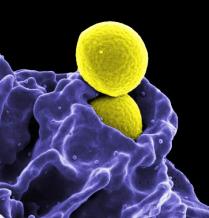
MRSA Staphylococcus KSW Food World

Image CDC

In this study, it was aimed to design the time‐predicted inactivation model for various growth curves and the growth parameters representing the changes in the inactivation of Staphylococcus aureus in probiotic white cheese. For this purpose, S. aureus were inoculated in the pasteurized milk and the production of probiotic white cheese was performed in five different groups, and then samples were matured for 60 days at 4°C. S. aureusLactobacillus rhamnosusLactobacillus casei Shirota, and mesophilic starter culture levels of the samples were analyzed on the 1st, 4th, 7th, 10th, 15th, 30th, and 60th days of maturation. The inactivation model evaluation was performed by using the number of microorganisms counted with Fourier modeling method. In determining the model to be applied, the coefficient of determination (R2) and the sum of squared errors (SSE) for the mean number of microorganisms detected via modeling method were used. As conclusions, the number of S. aureus has decreased by approximately 5 logarithmic units at the end of the storage period by using probiotics together with the starter culture. It was determined that the Fourier modeling method is a suitable inactivation model with R2 values of 0.9847–0.9986 and SSE values of 0.094–0.510.

Research – Indoor Particulate Matter From Smoker Homes Induces Bacterial Growth, Biofilm Formation, and Impairs Airway Antimicrobial Activity. A Pilot Study

Frontiers

Background: Particulate matter (PM) air pollution causes deleterious health effects; however, less is known about health effects of indoor air particulate matter (IAP).

Objective: To understand whether IAP influences distinct mechanisms in the development of respiratory tract infections, including bacterial growth, biofilm formation, and innate immunity. Additionally, we tested whether IAP from Iowa houses of subjects with and without recent respiratory exacerbations recapitulated the National Institute of Standards and Technology (NIST) IAP findings.

Methods: To test the effect of NIST and Iowa IAP on bacterial growth and biofilm formation, we assessed Staphylococcus aureus growth and Pseudomonas aeruginosa biofilm formation with and without the presence of IAP. To assess the effect of IAP on innate immunity, we exposed primary human airway surface liquid (ASL) to NIST, and Iowa IAP. Lastly, we tested whether specific metals may be responsible for effects on airway innate immunity.

Results: NIST and Iowa IAP significantly enhanced bacterial growth and biofilm formation. NIST IAP (whole particle and the soluble portion) impaired ASL antimicrobial activity. IAP from one Iowa home significantly impaired ASL antimicrobial activity (p < 0.05), and five other homes demonstrated a trend (p ≤ 0.18) of impaired ASL antimicrobial activity. IAP from homes of subjects with a recent history of respiratory exacerbation tended (p = 0.09) to impair ASL antimicrobial activity more than IAP from homes of those without a history respiratory exacerbation. Aluminum and Magnesium impaired ASL antimicrobial activity, while copper was bactericidal. Combining metals varied their effect on ASL antimicrobial activity.

Conclusions: NIST IAP and Iowa IAP enhanced bacterial growth and biofilm formation. ASL antimicrobial activity was impaired by NIST IAP, and Iowa house IAP from subjects with recent respiratory exacerbation tended to impair ASL antimicrobial activity. Individual metals may explain impaired ASL antimicrobial activity; however, antimicrobial activity in the presence of multiple metals warrants further study.

Research – Scientists Find Harmful Bacteria on 90% of Make-Up

Labmate

In a finding that could have millions of people around the world rethinking their makeup regimes, a team of researchers from Aston University have found potentially harmful bacteria in around 90% of cosmetics products. Bacterium detected include dangerous strains such as E. coli and Staphylococci, with the highest traces found on mascara, lip gloss and applicators.

Research – Microbial contamination of grocery shopping trolleys and baskets in west Texas, 2020

Barf Blog

Indicator microorganisms evaluated were those detected by aerobic plate count (APC), yeast and molds (YM), Enterobacteriaceae (EB). Environmental listeria (EL), coliforms (CF), and E. coli (EC).  In addition, listeria monocytogenes, staphylococcus aureus, Escherichia coli O157 and salmonella sp. Were tested for.  Trolley grills (n=36) had 2.7 x 10CFU/cm2.  Trolley handles (n=36) had 2.7 x 10of CF and 5.2 CFU/cm2 of YM.  The bottom of handheld baskets (n=25) had 3.5 x 10⁵ CFU/cm2 of CF and 5.07 CFU/cmof EC.  S. aureus was found on 96% of the baskets, 50% of the trolley handles (18 out of 36 samples), and 42% of the trolleys’ grills.  E. coli O157 was identified on 17% of baskets, 3% on trolley grills, and 3% on handles.  Salmonella sp. was detected on 16% of baskets and 8% of trolley grills.  L. monocytogenes was detected on 17% of the bottoms of handheld baskets but on none of the other samples. 

Research – Effect of Eryngium caeruleum essential oil on microbial and sensory quality of minced fish and fate of Listeria monocytogenes during the storage at 4°C

Wiley Online

The present study investigated in vitro antimicrobial activity of Eryngium caeruleum essential oil (EEO) against five foodborne pathogenic bacteria based on microdilution and disk diffusion methods. Moreover, its effects on specific spoilage microorganisms, inoculated Listeria monocytogenes, and its sensory changes in minced fish were evaluated during 12 days of storage at refrigeration temperature. The results showed that Staphylococcus aureus and Escherichia coli were the most sensitive and the most resistant bacteria with a minimum inhibitory concentration of 0.125 and 1 mg/ml, as well as inhibition zones of 15.66 and 11.66 mm, respectively. Regarding the antimicrobial effect of EEO on the microbial profile and inoculated L. monocytogenes, treating with 0.4% EEO caused a significant decrease in the studied microorganisms when compared to the control group (p < 0.05). In addition, considering the sensory evaluation, the best scores were observed for the samples treated with 0.2% and 0.4% EEO. However, none of the groups obtained acceptable scores until the final day of storage except for the color attribute. In general, sensory evaluation and its correlation with microbial counting indicated that the treatment with 0.4% EEO was able to preserve the microbial quality of the minced fish at refrigeration temperature without any undesirable sensory effects.

Information USA – What Are the Symptoms of Common Foodborne Pathogens?

CDC

Burden of Foodborne Illness: Findings

CDC estimates that each year roughly 1 in 6 Americans (or 48 million people) gets sick, 128,000 are hospitalized, and 3,000 die of foodborne diseases.


These estimates provide the most accurate estimates yet of which known foodborne pathogens (bacteria, viruses, and parasites) are causing the most illnesses in the United States, and how many foodborne illnesses are caused by unspecified agents. The estimates also show that much work remains to be done—specifically in focusing efforts on the top known pathogens and identifying the additional causes of foodborne illness and death.

CDC provides estimates for two major groups of foodborne illnesses

Known foodborne pathogens — 31 pathogens known to cause foodborne illness. Many of these pathogens are tracked by public health systems that track diseases and outbreaks. Read the report >

Unspecified agents — Agents with insufficient data to estimate agent-specific burden; known agents not yet identified as causing foodborne illness; microbes, chemicals, or other substances known to be in food whose ability to cause illness is unproven; and agents not yet identified. Because you can’t “track” what isn’t yet identified, estimates for this group of agents started with the health effects or symptoms that they are most likely to cause, such as acute gastroenteritis. Read the report >


Total number of foodborne illnesses each year

CDC estimated the number of illnesses, hospitalizations, and deaths caused by both known and unspecified agents. CDC then estimated what proportion of each were foodborne. The first table below provides estimates for domestically acquired foodborne illnesses, and the second table provides estimates for domestically acquired illnesses caused by all transmission routes (foodborne, waterborne, person-to-person contact, animal contact, environmental contamination, and others).

Estimated annual number of domestically acquired, foodborne illnesses, hospitalizations, and deaths due to 31 pathogens and the unspecified agents transmitted through food, United States
Foodborne agents Estimated annual number of illnesses Estimated annual number of hospitalizations Estimated annual number of deaths
Number (90% credible interval) % Number (90% credible interval) % Number (90% credible interval) %
31 known pathogens 9.4 million
(6.6–12.7 million)
20 55,961
(39,534–75,741)
44 1,351
(712–2,268)
44
Unspecified agents 38.4 million
(19.8–61.2 million)
80 71,878
(9,924–157,340)
56 1,686
(369–3,338)
56
Total 47.8 million
(28.7–71.1 million)
100 127,839
(62,529–215,562)
100 3,037
(1,492–4,983)
100
Estimated annual number of illnesses, hospitalizations, and deaths due to 31 pathogens and the unspecified agents, United States
Foodborne agents Estimated annual number of illnesses Estimated annual number of hospitalizations Estimated annual number of deaths
Number (90% credible interval) % Number (90% credible interval) % Number (90% credible interval) %
31 known pathogens 37.2 million
(28.4–47.6 million)
21 228,744
(188,326–275,601)
47 2,612
(1,723–3,819)
42
Unspecified agents 141.8 million 79 258,033 53 3,574 58
Total 179 million 100 486,777 100 6,186 100


Pathogens causing the most foodborne illnesses, hospitalizations, and deaths each year

Top five pathogens contributing to domestically acquired foodborne illnesses
Pathogen Estimated number of illnesses 90% credible interval %
Norovirus 5,461,731 3,227,078–8,309,480 58
Salmonella, nontyphoidal 1,027,561 644,786–1,679,667 11
Clostridium perfringens 965,958 192,316–2,483,309 10
Campylobacter spp. 845,024 337,031–1,611,083 9
Staphylococcus aureus 241,148 72,341–529,417 3
Subtotal 91

 Top of Page

Top five pathogens contributing to domestically acquired foodborne illnesses resulting in hospitalization
Pathogen Estimated number of hospitalizations 90% credible interval %
Salmonella, nontyphoidal 19,336 8,545–37,490 35
Norovirus 14,663 8,097–23,323 26
Campylobacter spp. 8,463 4,300–15,227 15
Toxoplasma gondii 4,428 2,634–6,674 8
E. coli (STEC) O157 2,138 549–4,614 4
Subtotal 88
Top five pathogens contributing to domestically acquired foodborne illnesses resulting in death
Pathogen Estimated number of deaths 90% credible interval %
Salmonella, nontyphoidal 378 0–1,011 28
Toxoplasma gondii 327 200–482 24
Listeria monocytogenes 255 0–733 19
Norovirus 149 84–237 11
Campylobacter spp. 76 0–332 6
Subtotal 88

Viet Nam – Kindergarten fined for feeding Staph bacteria contaminated food to students

Vn Express

A Thanh Hoa Province kindergarten where 143 kids had to be hospitalized with food poisoning a fortnight ago has been fined VND43 million ($1,860).

Results of tests done on the steamed rice rolls (banh cuon) served to the children of the Vuon Mat Troi Kindergarten last December 23 was announced Friday by the Central Food Quality Control Institute under the Ministry of Health,

The school in Thanh Hoa Town, capital of central province Thanh Hoa, had bought the rice rolls from a local shop.

Thanh Hoa’s Department of Food Safety and Hygiene fined the school for serving unhygienic food of unclear origin. The department also proposed authorities to punish the food provider.

Research – Antibacterial mechanism of Tetrapleura tetraptera extract against Escherichia coli and Staphylococcus aureus and its application in pork

Wiley Online

Abstract

The antibacterial activity and the mechanism of Tetrapleura tetraptera root extract against Escherichia coli and Staphylococcus aureus were investigated. The mechanism of action of T. tetraptera on tested bacterial species was predominantly characterized by the study of transmission electron microscopy, which revealed severe damage on the primary target which affected the cell integrity and cell membrane permeability. The loss of soluble proteins studied by bacterial protein sodium dodecyl sulfate–polyacrylamide gel electrophoresis analysis and the decreased adenosine triphosphate and DNA contents confirmed the leakage of cell wall. In addition, the studies revealed that the root extract of T. tetraptera could also disrupt the respiratory metabolism by inhibiting the bacteria through the Embden–Meyerhof–Parnas and the hexose monophosphate pathways. T. tetraptera extract possessed a high level of antimicrobial activity in pork, which significantly reduced total viable bacterial population. This study clearly indicates that the T. tetraptera could be a potential source of new antimicrobial agent which has proven effective activity against antibiotic‐resistant strains of pathogens.

Practical Applications

Tetrapleura tetraptera is a flowering plant native to Africa with a wide range of applicability in local cuisines and traditional medicine. The T. tetraptera root extract possesses high antimicrobial activity against both gram‐positive and gram‐negative bacteria. This study could contribute to the better understanding of antibacterial mechanism of T. tetraptera. As a natural food preservative, it has broad prospect to be utilized in the meat industry.