Category Archives: Research

USA – FDA issues warning to New Mexico onion importer linked to Salmonella outbreak

Food Safety News

An import company in New Mexico is on notice from the FDA for not having food safety documents for a number of imported foods. The inspection was initiated because of an investigation of a multistate foodborne outbreak of Salmonella Oranienburg illnesses linked to whole, fresh onions imported from the state of Chihuahua, Mexico.

The outbreak has sickened more than 800 people in the United States and remains under investigation. The Centers for Disease and Prevention has not yet declared the outbreak over.

In its warning letter the Food and Drug Administration  acknowledged that the company initiated a voluntary recall on Oct. 22, 2021, of red, yellow, and white onions imported from its “suppliers (redacted)” in Chihuahua, Mexico, from July 1, 2021, through Aug. 25, 2021.

In the March 2, 2022, warning letter just made public by the FDA, the agency described a Nov. 16, 2021, Foreign Supplier Verification Program (FSVP) inspection of Keeler Family Farms in DemingNM.

USA – Welcome to the Agricultural Water Assessment Builder!

FDA

Thank you for choosing to use the Agricultural Water Assessment Builder. The Agricultural Water Assessment Builder v. 1.0 is a user-friendly tool designed to help farms understand the proposed requirements for an agricultural water assessment in the “Standards for the Growing, Harvesting, Packing, and Holding of Produce for Human Consumption Relating to Agricultural Water” proposed rule (agricultural water proposed rule). If finalized, the rule would replace the microbial criteria and testing requirements for pre-harvest agricultural water for covered produce (other than sprouts) in the 2015 Produce Safety Final Rule with provisions for systems-based agricultural water assessments. Relevant definitions and resources can be viewed by clicking the icon next to the title of this page.
We welcome feedback on v1.0 of this optional tool, such as suggestions related to the tool’s functionality and useability. Feedback on the tool can be sent to agwaterbuilder@fda.hhs.gov.
Use of this tool is not required by law (see legal disclaimer) and would not be required. If the agricultural water proposed rule is finalized, FDA expects this tool to supplement and not replace other education, training, and experience that would be needed to understand and implement the requirements of the rule.
The information entered into this page will not be shared with FDA and will not be saved. If you need to pause while entering information, we recommend that you export a copy of your data and save it to your local machine. Once the document is saved, you may resume at a later time, and upload the file to begin from where you paused. Once you have reached the end of this tool, you will be given the opportunity to print out a summary of the information entered. Remember, the data that is entered here is not saved unless your export a file to save on your computer.
This tool is being provided for illustrative purposes only because the requirements for agricultural water assessments under proposed § 112.43 have not been finalized.
Legal disclaimer: Use of the Agricultural Water Assessment Builder v. 1.0 does not constitute FDA approval of an agricultural water assessment or guarantee compliance with FDA’s requirements, if finalized. FDA has taken all reasonable precautions in creating the Agricultural Water Assessment Builder v. 1.0. However, FDA is not responsible for errors, omissions or deficiencies regarding the tool. The Agricultural Water Assessment Builder v. 1.0 is available “as is” and without warranties of any kind, either expressed or implied, including, but not limited to, warranties of performance, merchantability, and fitness for a particular purpose. FDA is not making a commitment in any way to regularly update the tool. Responsibility for the interpretation and use of the Agricultural Water Assessment Builder v. 1.0 lies solely with the user. Third parties’ use of or acknowledgment of the tool does not in any way represent that FDA endorses such third parties or expresses any opinion with respect to their statements.

USA – Salmonella accounted for nearly 80 percent of pathogen violations in U.S. food imports from 2002 to 2019

USDA

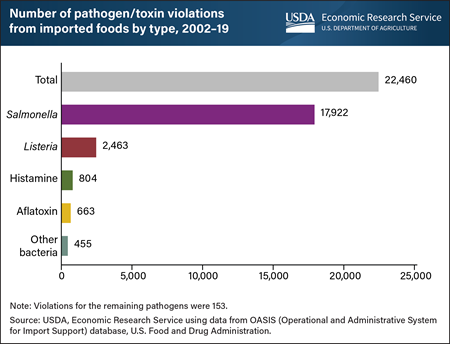
<i>Salmonella</i> accounted for nearly 80 percent of pathogen violations in U.S. food imports from 2002 to 2019

As the quantity of food imported into the United States continues to rise, it is increasingly important to minimize foodborne illness risks for U.S. consumers. Foods contaminated with pathogens or toxins can result in foodborne illnesses. A recent USDA, Economic Research Service (ERS) study examined the number of U.S. import refusals caused by pathogen/toxin contamination and which pathogens accounted for those safety violations. From 2002 to 2019, 22,460 pathogen/toxin violations were discovered among imported shipments. Salmonella was the most frequently identified agent among imported foods during the period with 80 percent, or 17,922 of total pathogen/toxin violations. Listeria recorded the second largest number of violations at 2,463, accounting for 11 percent of the total. It was followed by histamine with 804 violations (3.6 percent), aflatoxin with 663 violations (3 percent), and bacteria other than Salmonella or Listeria with 455 violations (2 percent). Those five most frequently detected pathogens and toxins accounted for 99.3 percent of the total pathogen/toxin violations from imported foods over the period. This chart was drawn from the ERS report Examining Pathogen-Based Import Refusals: Trends and Analysis From 2002 to 2019, published December 2021.

Research – Novel Salmonella Phage, vB_Sen_STGO-35-1, Characterization and Evaluation in Chicken Meat

MDPI

Salmonellosis is one of the most frequently reported zoonotic foodborne diseases worldwide, and poultry is the most important reservoir of Salmonella enterica serovar Enteritidis. The use of lytic bacteriophages (phages) to reduce foodborne pathogens has emerged as a promising biocontrol intervention for Salmonella spp. Here, we describe and evaluate the newly isolated Salmonella phage STGO-35-1, including: (i) genomic and phenotypic characterization, (ii) an analysis of the reduction of Salmonella in chicken meat, and (iii) genome plasticity testing. Phage STGO-35-1 represents an unclassified siphovirus, with a length of 47,483 bp, a G + C content of 46.5%, a headful strategy of packaging, and a virulent lifestyle. Phage STGO-35-1 reduced S. Enteritidis counts in chicken meat by 2.5 orders of magnitude at 4 °C. We identified two receptor-binding proteins with affinity to LPS, and their encoding genes showed plasticity during an exposure assay. Phenotypic, proteomic, and genomic characteristics of STGO-35-1, as well as the Salmonella reduction in chicken meat, support the potential use of STGO-35-1 as a targeted biocontrol agent against S. Enteritidis in chicken meat. Additionally, computational analysis and a short exposure time assay allowed us to predict the plasticity of genes encoding putative receptor-binding proteins.

Research – Campylobacter jejuni vaccine candidate set for human trials

Outbreak News Today

A potential vaccine developed by University of Guelph researchers to combat one of the main causes of bacterial diarrheal illness worldwide is set to be tested on people early this year.

Human clinical trials of a novel sugar-based vaccine will take place in 2022 at the Cincinnati Children’s Hospital Medical Center. The trials will be funded by the United States National Institutes of Health.

Dr. Mario Monteiro, a professor in the College of Engineering and Physical Sciences, hopes recent refinements to the vaccine in his lab following earlier phase one trials will improve its effectiveness against the Campylobacter jejuni bacterium.

Research – Report on the equivalence between the disinfection of tools in slaughterhouses and cutting rooms with hot water, at a temperature not lower than 82 °C, and various alternative disinfection systems.

AESAN

The different tools and utensils used in slaughterhouses and cutting rooms may lead to cross contamination if unsuitable cleaning and disinfecting procedures are used. In this regard, Regulation (EC) No. 853/2004 laying down specific hygiene rules for food of animal origin establishes that slaughterhouses and cutting rooms for ungulates as well as poultry and lagomorphs must have facilities for disinfecting

The Scientific Committee of the Spanish Agency for Food Safety and Nutrition (AESAN) has assessed several studies carried out in order to establish whether disinfection with four alternative systems may be considered equivalent to that conducted with water supplied at a temperature not less than 82 ºC.
After reviewing the studies, the AESAN Scientific Committee concludes that a notable effort has been made to demonstrate the equivalence of these systems. It is observed in these studies that the use of these compounds leads to reductions in the microorganisms studied which, under the testing conditions, appear to be similar to those obtained with the official method.
However, these studies have methodological limitations (number of repetitions, sampling plan, the microorganisms studied and method of analysis) which prevent establishing this equivalence.
Accordingly, the Committee makes a series of recommendations for conducting these studies: using swabs instead of contact slides; including the analysis of foodborne pathogenic microorganisms of interest in slaughterhouses; including detailed information on the disinfecting products used as well as the method of analysis; harmonising sampling and analysis procedures; guaranteeing the representativeness of the samples taken (it is suggested to take 5 samples per slaughterhouse per day-taken from at least 4 different locations-, using 4 different slaughterhouses in the study, during 5 non-consecutive days, uniformly distributed over a period of 3 months; that is to say, a total of 100 samples); ensuring that all samples analysed are acceptable based on the established criteria for mesophilic aerobes (0-10 cfu/cm2), enterobacteria (0-1 cfu/cm2), as well as the absence/cm2 for the pathogens Listeria monocytogenes and Salmonella.
Likewise, it is also recommended to draw up a sector-based Guide that, based on the recommendations made in this report, provides a detailed description of the protocol to be followed in order to demonstrate equivalence between the disinfection of tools in slaughterhouses and cutting rooms with hot water supplied at a temperature not less than 82 ºC and disinfection with alternative methods.

UK – Food Standards Agency launches new five-year strategy

FSA

The Food Standards Agency has today published its strategy for improving food over the next five years and recommitted to its mission of food you can trust.

The five-year strategy reflects the FSA’s greater responsibilities now that the UK is outside of the EU and takes into account growing public concern about health and climate change.

FSA Chair, Professor Susan Jebb, said:

“Two decades on from its inception, the FSA has developed a strong reputation for its work to ensure food is safe. This must continue. Now is also the right time for the FSA to contribute to wider government efforts to tackle diet-related disease and climate change, while keeping food affordable. Our five-year strategy signals our intention to work with partners and other stakeholders in the food system to achieve healthier and more sustainable food. Through all of this we will continue to uphold the interests of consumers so we can all enjoy food we can trust.”

FSA Chief Executive, Emily Miles, said:

“Leaving the EU has changed the FSA’s role. We have taken on new functions, like approving new types of food that come on sale here and setting rules for checks of imported food. Today the FSA therefore plays a more critical role than ever in supporting governments in England, Wales and Northern Ireland on matters relating to food. The strategy commits us to put consumer interests at the heart of our work so that food is safe and what it says it is as well as being healthier and more sustainable.”

The FSA’s new strategy sets out how, over the next five years, it will continue to lead the way on food safety and authenticity, so consumers can be confident that the food they buy is safe and what it says it is.

It also signals the FSA’s willingness to support governments to improve the health of the nation and to look after the planet.

Research – Biofilm through the Looking Glass: A Microbial Food Safety Perspective

MDPI

Food-processing facilities harbor a wide diversity of microorganisms that persist and interact in multispecies biofilms, which could provide an ecological niche for pathogens to better colonize and gain tolerance against sanitization. Biofilm formation by foodborne pathogens is a serious threat to food safety and public health. Biofilms are formed in an environment through synergistic interactions within the microbial community through mutual adaptive response to their long-term coexistence. Mixed-species biofilms are more tolerant to sanitizers than single-species biofilms or their planktonic equivalents. Hence, there is a need to explore how multispecies biofilms help in protecting the foodborne pathogen from common sanitizers and disseminate biofilm cells from hotspots and contaminate food products. This knowledge will help in designing microbial interventions to mitigate foodborne pathogens in the processing environment. As the global need for safe, high-quality, and nutritious food increases, it is vital to study foodborne pathogen behavior and engineer new interventions that safeguard food from contamination with pathogens. This review focuses on the potential food safety issues associated with biofilms in the food-processing environment. View Full-Text

USA – TechTalk Podcast Episode 3: Artificial Intelligence in the New Era of Smarter Food Safety

FDA

On March 21, 2022, the third installment of FDA’s new podcast series on technology and food safety will focus on artificial intelligence (AI) and its potential to advance food safety.

This quarterly podcast explores the potential for novel technological approaches and solutions in each of the core elements in the New Era of Smarter Food Safety Blueprint. The second Core Element, called Smarter Tools and Approaches for Prevention and Outbreak Response, includes goals to expand predictive analytics capabilities using AI and machine learning tools.

In this third podcast, Frank Yiannas, Deputy FDA Commissioner for Food Policy and Response, and Donald Prater, Associate Commissioner for Imported Food Safety, will lead a discussion with food industry experts on subjects that include the opportunities that AI offers to help protect consumers from food safety issues, potential uses of AI that food producers could consider, and what’s on the horizon for AI in FDA’s New Era of Smarter Food Safety.

The experts:

  • Maria Velissariou, Global Corporate Research & Development Vice President and Chief Science Officer for Mars Incorporated, a global, family-owned business with a portfolio of confectionary, food and pet-care products and services;
  • Nikos Manouselis, founder and CEO of Agroknow, a food safety intelligence company that predicts food safety risks to inform prevention; and
  • Cronan McNamara – founder and CEO of Creme Global, a company providing food safety data analytics and predictive modeling software and services.

To Listen

The link to listen will be posted on Monday, March 21, 2022 on this page and on the TechTalk Podcast main page on fda.gov.

Registration is not required but questions can be emailed in advance at SmarterFoodSafety@fda.hhs.gov. Questions submitted by March 14, 2022 may be considered by the panelists.

Related Podcasts

Slovakia – Safe defrosting of food – promotional leaflet in Slovakian

MPSR

The National Contact Point EFSA (Department of Food Safety and Nutrition MPRV SR ) in cooperation with the European Food Safety Authority has prepared a leaflet on safe defrosting of food in the Slovak language.

The leaflet presents basic information on defrosting food, usable in every household. By reducing the mistakes that consumers make when handling frozen food incorrectly, the formation of harmful bacteria is eliminated. Proper thawing procedures reduce the risk of foodborne illness and reduce food waste.