Category Archives: Research

Information – How to Report Seafood-Related Toxin and Scombrotoxin Fish Poisoning Illnesses

FDA

To help FDA effectively investigate, remove unsafe seafood products from the market, and develop new prevention strategies, the FDA relies on illness reporting from public health officials and healthcare providers. While most foodborne outbreaks are tracked through the FDA’s Coordinated Outbreak Response and Evaluation (CORE) network, seafood-related illnesses caused by natural toxins have a unique reporting mechanism. This web page provides information on commonly occurring seafood-related illnesses and how to report them to the FDA.  To report an illness from raw bivalve molluscan shellfish, email the FDA at shellfishepi@fda.hhs.gov.

The FDA receives reports of illnesses associated with the consumption of specific types of fish. These illnesses may originate from the activity of certain bacteria, toxins produced by marine algae, or hazards inherent in the fish.

Commonly occurring illness:

Illness and reporting information for the commonly occurring illnesses are provided in each section. Contact the FDA with any questions or need for clarification of the illness or reporting.

In addition to the illnesses listed above, reporting of other less frequently occurring illnesses from natural toxins may be accomplished by emailing the FDA at Seafood.Illness@fda.hhs.gov.  Refer to Chapter 6 of the “Fish and Fishery Products Hazards and Controls Guidance” for a comprehensive list of natural toxin illnesses. To report illnesses related to miscellaneous natural toxin illnesses, please email FDA at Seafood.Illness@fda.hhs.gov.

The FDA works with first responders, physicians, and state and local health departments to investigate illnesses and outbreaks, manage them, and learn how to lessen future occurrences.

USA – FSIS Retail Listeria monocytogenes (Lm) Pilot Project Update

FSIS USDA

Listeria kswfoodworld food safety food poisoning

Image CDC

In January 2016, FSIS launched a multi-year nationwide pilot project to assess whether retail delicatessens are using the recommendations in the Retail Lm Guidance. FSIS tracked progress for this pilot project in the fiscal year (FY) 2021 FSIS Annual Plan and the FY 2017-2021 FSIS Strategic Plan.

As of September 30, 2021, FSIS discontinued its retail Lm surveillance because data analysis has shown that retailers have consistently followed a high percentage of the recommendations. Moving forward, FSIS will continue steps to educate the industry on its Retail Lm Guidance and associated best practices. FSIS intends to broaden its reach by partnering with retail trade associations and state regulatory authorities to assist in the distribution of educational materials for this initiative.

Since the pilot project was launched, FSIS investigators completed a total of 7,114 questionnaires in retail delis to determine the adoption rate of the recommendations. In the fourth quarter of FY 2021, FSIS reviewed 155 questionnaires completed by investigators in retail delis. The agency exceeded its target with the retailers following 93% of the 33 recommendations over the previous 12 months (target 92%).

Additionally, under its strategic and annual plans, FSIS is tracking whether the retail delis assessed are following the top eight recommendations from the FSIS Retail Lm Guidance, which are listed on pages 1-2 of the FSIS Directive 10.310.1- Pilot Project: Control of Listeria monocytogenes in Retail Delicatessens.

In the fourth quarter of FY 2021, FSIS reviewed 151 questionnaires conducted by investigators in which all eight recommendations could be assessed. The agency exceeded its annual target with 75% retailers following all eight of the most important guidelines (target 64%). These results are similar to those of last fiscal year and quarter, with FSIS meeting or exceeding its targets for both measures.

Denmark – Danish pork main source of Salmonella infections

Food Safety News

Danish pork replaced travel abroad as the main source of Salmonella infections in 2020, according to figures from the Technical University of Denmark’s National Food Institute.

Danes travelled far less this past year because of COVID-19 restrictions, so going abroad was linked to just less than 20 percent of 614 Salmonella cases. Normally, about half of registered infections are travel related.

Danish pork was estimated to have caused 22 percent of illnesses followed by imported pork and duck meat with 9 percent and 6 percent of cases respectively.

A data management issue prevented the statistics being published earlier this year at the same time as the 2020 zoonoses report.

Research – Research Note: Contamination of eggs by Salmonella Enteritidis and Salmonella Typhimurium in experimentally infected laying hens in indoor cage-free housing

NCBI

hazegg.jpg

Contaminated eggs are a leading source of human Salmonella infections and this problem continues to challenge public health authorities and egg industries around the world. Salmonella invasion of the ovaries and oviducts of infected laying hens can result in bacterial deposition inside the edible portions of developing eggs. The introduction, persistence, and transmission of salmonellae in commercial egg-laying flocks are influenced by flock management practices, but the food safety ramifications of different types of laying hen housing remain unresolved. The present study assessed the frequency of internal contamination of eggs after experimental Salmonella Enteritidis and S. Typhimurium infection of laying hens in indoor cage-free housing. Groups of 72 hens were housed on wood shavings in isolation rooms simulating commercial cage-free barns with community kick-out nest boxes and perches and 1/3 of the hens in each room were orally inoculated with 8.0 × 107 cfu of 2-strain mixtures of either S. Enteritidis (2 rooms) or S. Typhimurium (2 rooms), and the entire internal contents of all eggs laid 5 to 30 d postinoculation in nest boxes or on the flooring substrate were cultured to detect Salmonella. Contaminated eggs were laid between 8 and 28 d postinoculation. The overall incidence of S. Enteritidis isolation from eggs (3.41%) was significantly (P = 0.0005) greater than S. Typhimurium (1.19%). The contamination frequencies associated with the 2 egg collection locations were not significantly different (P > 0.05). These results demonstrate that oral infection of a relatively small proportion of laying hens in indoor cage-free housing with invasive Salmonella serovars can result in the production of internally contaminated eggs at low frequencies over a period of nearly a month postinoculation.

Research – Your poultry doesn’t need a bath plus other food safety tips for Christmas and Summer entertaining

Food Safety Council

Campylobacter kswfoodworld

The Food Safety Information Council and the Australian Chicken Meat Federation today released a consumer survey that found 49% of Australian cooks were still taking a food poisoning risk by washing raw whole chicken before cooking.

Cathy Moir, Council Chair, said washing any raw poultry is very risky as it can spread bacteria to your hands, surfaces and other foods that may not be cooked. Washing is also unnecessary as cooking poultry to 75°C in the centre of a fillet or the thickest part of the thigh will kill any bacteria.

‘We are pleased that rates of washing raw whole chicken has reduced from 60% to 49% since we last asked this question in 2011. Cooks who wash raw chicken pieces with skin on has also reduced from 52% to 43% and washing skinless pieces from 41% to 40%.

‘The survey found that chicken is a popular dish with 78% of respondents cooking whole chicken, 83% cooking chicken pieces with skin on and 88% cooking skinless pieces. But the message is that washing any raw poultry, whether it is chicken, duck, goose or the Christmas turkey, is both unsafe and unnecessary.

“As we gather this Summer with multi-generations of family and friends, here are some of our key Christmas and Summer entertaining food safety tips:

  1. Wash hands: Another recent survey has found the number of times people wash their hands each day dropped 15% since last year. Don’t forget to wash your hands with soap and water before preparing and cooking food, and after handling shell eggs, seafood, raw meat and poultry, burgers and sausages. Watch how to wash your hands correctly using the Glitterbug here
  2. Clean utensils: Ensure your tools, utensils and chopping-boards are cleaned and dried thoroughly before you start preparing your food and ensure you clean them with hot soapy water after use. Use separate chopping-boards such as red for raw meat/poultry and  green for vegetables.
  3. Don’t strain your fridge: Plan ahead and don’t buy more food than you need. It’s vital that you don’t overstock your fridge and freezer, as this won’t allow the cool air to circulate freely and perishable food cannot be adequately frozen or chilled. Less food will also help to reduce food waste.
  4. Make space: Prevent overstocking by making room in your fridge for perishable foods by removing alcohol and soft drinks and put them on ice in a container or laundry sink. This also stops guests opening the fridge so often and helps to maintain the temperature at 5°C or below. Use a fridge thermometer to check the fridge temperature.
  5. Bird or bits? Think about getting a turkey breast that is simpler to cook, rather than a whole turkey. If you do need a whole turkey ask your supermarket if they sell them fresh rather than frozen. Otherwise it must be covered and defrosted in your fridge which can take several days and also increase the risk of potentially contaminating ready to eat foods stored in the fridge.
  6. Cook poultry correctly: Cook the any poultry until a meat thermometer shows it has reached 75° C in the thickest part of the thigh and cook any stuffing separately as it will slow the cooking and the inside of the bird might not be fully cooked. Probe thermometers are readily available, easy to use and help you make sure that food has reached the right temperature.
  7. Don’t go raw. Cooked egg dishes are simple and nutritious but try to avoid raw or minimally cooked egg dishes, such as raw egg mayonnaise or aioli, eggnog or fancy desserts like tiramisu, which can be a particular risk for food poisoning. A safer alternative, if you want to serve raw egg dishes, is to use pasteurised egg products.
  8. Christmas ham won’t last forever– check the storage instructions and best before or use by date before removing the ham from its plastic wrap, cover it with clean cloth soaked in water and vinegar so it doesn’t dry out, and store it in the fridge at or below 5°C. Keep the cloth moist to stop the ham drying out too much. It is important to remember that the use by date on the original packaging won’t apply after the packaging has been removed, so check the fine print and see if the ham has a suggested shelf life after opening. Reduced salt hams are now becoming popular but will not last as long as conventional hams so think how much you are going to use in the next week or so and freeze the rest for later.
  9. Phased roll-out: Don’t leave perishable chilled foods out for more than two hours. These foods include cold meats, soft cheeses like Camembert and Brie, cold poultry, cooked seafood like prawns and smoked salmon, pâtés, sushi and salads. Put out small amounts and replace them (do not top them up) from the fridge.
  10. Get it cold, quick. Refrigerate leftovers as soon as possible. If perishable foods and leftovers have been left out of the fridge for less than two hours they should be okay to refrigerate or freeze to eat later, so long as they haven’t been sitting out on a hot day. Never eat perishable food that has been unrefrigerated for more than four hours as it may not be safe and should be thrown away. Food should not be refrigerated if it has been outside in the heat for more than an hour and discarded after it has sat outside for 2 hours.
  11. Get it right hot. Always reheat leftovers to 75°C the centre of the item or the thickest part to kill any food poisoning bugs. Use a probe thermometer or the auto reheat function of your microwave (following any prompts) to help you make sure that the leftovers have been reheated safely.

‘We would like to thank our partner Tonic Media Network who will be showing our handwashing and food safety community service announcements in GP, Pharmacy and hospital waiting rooms around Australia this Summer. Also, thanks to our member First for Training, the Australian Chicken Meat Federation and Accord for their charitable donations to fund our Summer campaign.\,” Ms Mir concluded.

Media contact: Lydia Buchtmann, Food Safety Information Council, 0407 626 688 or info@foodsafety.asn.au

Survey details:

The chicken washing survey was conducted nationally by Omnipoll amongst 1219 people aged 18+ over the period 7-12 October 2021. Respondents were drawn from the online consumer panel managed by Lightspeed Research, OmniPoll’s online partner and to help reflect the overall population distribution. Results were post-weighted to Australian Bureau of Statistics (2016 Census) data on education, age, sex and area.


Research – Characterization of bacteria and antibiotic resistance in commercially-produced cheeses sold in China

Journal of Food Protection

The consumption of cheese in China is increasing rapidly. Little is known about the microbiota, the presence of antibiotic-resistant bacteria, or the distribution of antibiotic resistance genes (ARGs) in commercially-produced cheeses sold in China. These are important criteria for evaluating quality and safety. Thus, this study assessed the metagenomics of fifteen types of cheese using 16S rRNA gene sequencing. Fourteen bacterial genera were detected. Lactococcus , Lactobacillus , and Streptococcus were dominant based on numbers of sequence reads. Multidrug-resistant lactic acid bacteria were isolated from most of the types of cheese. The isolates showed 100% and 91.7% resistance to streptomycin and sulfamethoxazole, respectively, and genes involved in acquired resistance to streptomycin ( strB) and sulfonamides ( sul2) were detected with high frequency. To analyze the distribution of ARGs in the cheeses in overall, 309 ARGs from eight categories of ARG and nine transposase genes were profiled. A total of 169 ARGs were detected in the 15 cheeses; their occurrence and abundance varied significantly between cheeses. Our study demonstrates that there is various diversity of the bacteria and ARGs in cheeses sold in China. The risks associated with multidrug resistance of dominant lactic acid bacteria are of great concern.

Research – Effect of Plasma-Activated Solution Treatment on Cell Biology of Staphylococcus aureus and Quality of Fresh Lettuces

MDPI

This study aimed to investigate effects of plasma-activated solution (PAS) on the cell biology of Staphylococcus aureus and qualities of fresh lettuce leaves. PAS was prepared by dielectric barrier discharge plasma and incubated with S. aureus for 10–30 min or with lettuces for 10 min. Effects on cell biology were evaluated with microscopic images, cell integrity, and chemical modification of cellular components. Effects on lettuce quality were estimated with the viable microbial counts, color, contents of vitamin C and chlorophyll, and surface integrity. PAS reduced S. aureus population by 4.95-log and resulted in increased cell membrane leakage. It also resulted in increased contents of reactive oxygen species in cells, C=O bonds in peptidoglycan, and 8-hydroxydeoxyguanosine content in cellular DNA, and reduced ratios of unsaturated/saturated fatty acids in the cell membrane. PAS treatment reduced bacterial load on fresh lettuce and had no negative effects on the quality. Data suggest that PAS can be used for the disinfection of ready-to-eat fresh vegetables. View Full-Text

Research – Differential Survival of Generic E. coli and Listeria spp. in Northeastern U.S. Soils Amended with Dairy Manure Compost, Poultry Litter Compost, and Heat-Treated Poultry Pellets and Fate in Raw Edible Radish Crops

Journal of Food Protection

Composted or heat-treated Biological Soil Amendments of Animal Origin (BSAAO) can be added to soils to provide nutrients for fresh produce. These products lower the risk of pathogen contamination of fresh produce when compared with use of untreated BSAAO; however, meteorological conditions, geographic location, and soil properties can influence the presence of pathogenic bacteria, or their indicators (e.g., generic E. coli) and allow potential for produce contamination. Replicated field plots of loamy or sandy soils were tilled and amended with dairy manure compost (DMC), poultry litter compost (PLC), or no compost (NoC) over two different field seasons, and non-composted heat-treated poultry pellets (HTPP) during the second field season. Plots were inoculated with a three-strain cocktail of rifampicin-resistant E. coli (rE.coli) at levels of 8.7 log CFU/m2. Direct plating and most probable number (MPN) methods measured the persistence of rE.coli and Listeria spp. in plots through 104 days post-inoculation. Greater survival of rE. coli was observed in PLC plots in comparison to DMC plots and NoC plots during year 1 (P < 0.05). Similar trends were observed for year 2, where rE. coli survival was also greater in HTPP amended plots (P < 0.05). Survival of rE. coli was dependent on soil type, where water potential and temperature were significant covariables. Listeria spp. were found in NoC plots, but not in plots amended with HTPP, PLC or DMC. Radish data demonstrate that PLC treatment promoted the greatest level of rE.coli translocation when compared to DMC and NoC treatments (P  < 0.05). These results are consistent with findings from studies conducted in other regions of the US and informs Northeast produce growers that composted and non-composted poultry-based BSAAO supports greater survival of rE. coli in field soils. This result has the potential to impact the food safety risk of edible produce grown in BSAAO amended soils as a result of pathogen contamination.

Research – Desiccation survival in Salmonella enterica, Escherichia coli and Enterococcus faecium related to initial cell concentration and cellular components

Journal of Food Protection

Salmonella enterica is well-known for its ability to survive and persist in low-moisture environments.  Previous studies have indicated a link between the initial cell concentration and the population of Salmonella that survive upon desiccation and subsequent storage; however, how the initial cell concentration affects survival is unknown.  This study examined the basis of this phenomena and whether it occurred in other microorganisms, specifically Shiga toxigenic Escherichia coli (STEC), and Enterococcus faecium . Salmonella, STEC, and E. faecium were grown as lawns on TSAYE and harvested using buffered peptone water (BPW). To determine recovery at different initial cell levels, cultures were diluted to 9, 7, and 5 log CFU/mL and applied to filters.  Filters were dried for 24 h, then stored for 28 d at 25°C/33% RH. During storage, cells were recovered from filters using BPW and cultivated on TSAYE.  Both Salmonella and E. coli , but not E. faecium , showed non-proportional recovery. Less viability remained with lower initial starting population after 24 h desiccation such that ≥10 log CFU/mL were recovered when 11 log CFU/mL was desiccated, but ❤ log CFU/mL were recovered when 5 log CFU/mL was desiccated. Once dried, persistence did not appear affected by initial cell concentration. When dead cells (heat-treated) were added to the diluent, recovery of Salmonella was proportional with respect to the initial cell concentration. To further examine the response on desiccation, Salmonella was diluted in BPW containing one of 11 different test cell components related to quorum sensing or known to affect desiccation resistance to assess recovery and persistence. Of the 11 additions only cell debris fractions, cell-free extract, and peptidoglycan improved recovery of Salmonella . Desiccation survival appears related to cell wall components, however, the exact mechanism affecting survival remains unknown.

Research – Bioactivity of Essential Oils for Mitigation of Listeria monocytogenes Isolated from Fresh Retail Chicken Meat

MDPI

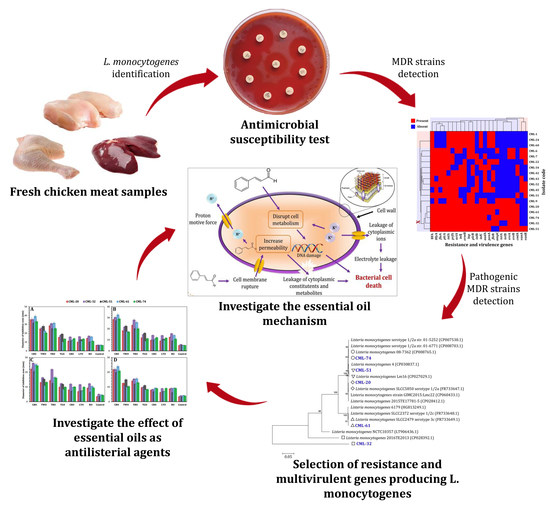
Listeria monocytogenes is one of the most severe foodborne pathogens found in several habitats. Therefore, this study aims to investigate the antilisterial activity of different essential oils (EOs) against multidrug-resistant (MDR) L. monocytogenes strains isolated from fresh chicken meat. Our results showed that the prevalence of L. monocytogenes in the examined samples was 48%. Seventy-eight isolates were identified as L. monocytogenes. Out of these, 64.1% were categorized as MDR and were categorized in 18 patterns with 50 MDR isolates. One isolate was selected randomly from each pattern to investigate their biofilm-forming ability, resistance, and virulence genes incidence. Out of 18 MDR isolates, 88.9% showed biofilm-forming ability. Moreover, the most prevalent resistance genes were ermB (72%), aadA (67%), penA (61%), and floR genes (61%). However, the most prevalent virulence genes were inlA (94.4%), prfA (88.9%), plcB (83.3%), and actaA (83.3%). The antilisterial activity of EOs showed that cinnamon bark oil (CBO) was the most effective antilisterial agent. CBO activity could be attributed to the bioactivity of cinnamaldehyde which effects cell viability by increasing the bacterial cell electrical conductivity, ion leakage, and salt tolerance capacity loss. Therefore, CBO could be an effective alternative natural agent for food safety applications. View Full-Text