Archives
-
Join 341 other subscribers
KSWFoodWorld
Blog Stats
- 425,819 Views

Cronobacter sakazakii is a foodborne pathogen predominately transmitted through contaminated dried foods and affects populations including neonates, infants, and the elderly. Following several recent outbreaks, it is now a notifiable infection in those under 12 months of age. Current control methods include strict manufacturing guidelines, with monitoring of this genus a legal requirement in powdered infant formula production. Fatty acids have long been known as antimicrobials, with long-chain fatty acids increasingly identified as agents that target virulence factors. This study gives insight into the changes promoted by three long-chain unsaturated fatty acids (oleic, linoleic, and α-linolenic) on C. sakazakii growth, morphology, and biofilm formation. Each fatty acid was individually introduced to C. sakazakii 29544 both as a sole carbon source and as an addition to complex media. Following comparison to the untreated control, bacterial cells treated with these fatty acids showed a significant and media-dependent impact on growth and biofilm inhibition. With further characterization, long-chain fatty acids, including α-linolenic acid, could be utilized as a control method with minimal safety constraints regarding their use in the food production environment.
A suspected food poisoning incident at a Hi-Lai Harbour restaurant at Kaohsiung Arena was not caused by norovirus or rotavirus, but might have been caused by pathogenic bacteria, the Centers for Disease Control (CDC) said yesterday.
Testing for viral pathogens was negative for the two common causes of diarrhea, CDC Deputy Director-General Tseng Shu-hui (曾淑慧) said.
As of 9am on Monday, the number of people who had sought medical attention after dining at the upscale buffet restaurant in Zuoying District (左營) on Friday and Saturday last week had increased to 52 since Saturday, when 11 diners were first reported to have fallen ill, the Kaohsiung Health Department said in a statement.
All of the 52 people reported diarrhea and abdominal pain, while a handful also reported nausea and vomiting, the department said.
It had previously collected specimens from seven people who fell ill after eating at the branch and from 48 employees who handle food at the restaurant, as well as food samples.
Testing on the customers and employees came back negative for viral pathogens, meaning it is likely that pathogenic bacteria were involved, Tseng said.
Common bacteria that cause foodborne illness include Vibrio parahaemolyticus, salmonella, enteropathogenic Escherichia coli, Staphylococcus aureus, Vibrio cholerae and Clostridium botulinum, she said, adding that testing was being conducted to clarify the situation.
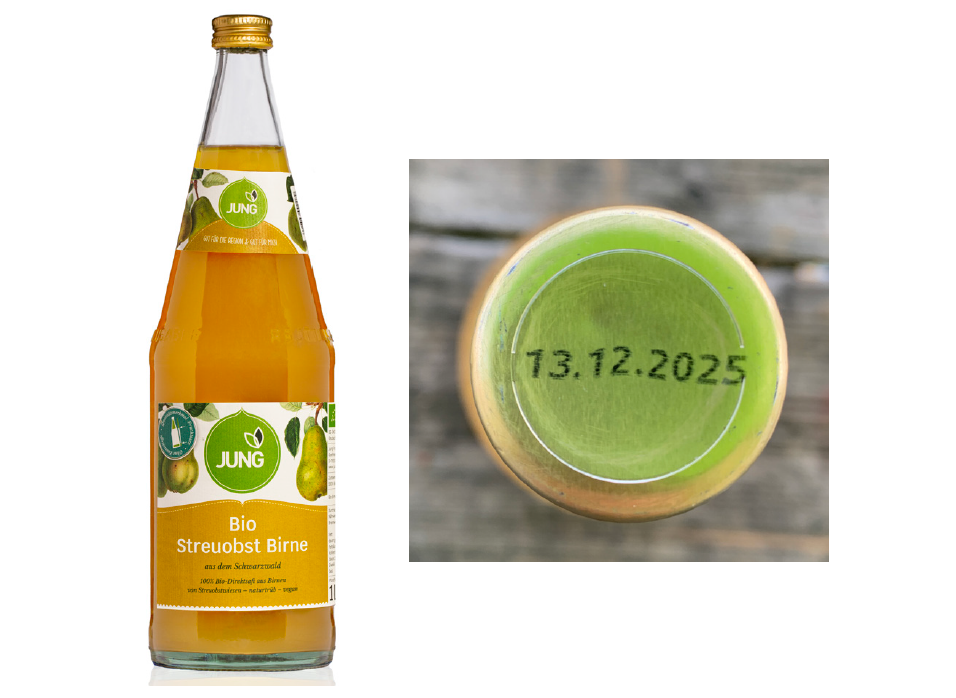
Organic orchard fruit pear juice 1 liter
customer information; Illustration of a glass bottle with a label and a bottle cap with a printed best-before date
Jung Fruit Juices GbR Goethestr. 18 79331 Teningen-Köntreiben Email: info@jung-saefte.de Telephone: 07641 96 22 02 2 Sales are limited to Baden-Württemberg.
An increased patulin content was found during an examination of an individual sample.
Excerpt from the attached customer information:
The company Jung Fruchtsäfte informs that an increased patulin content was found in the product. Organic Scattered Fruit Pear Juice 1l, EAN 4028748000089
as part of an investigation on a single sample.
Only bottles with a best-before date of December 13, 2025 are affected.
The best before date can be found on the lid of the bottle.
If you have already purchased bottles of this type of juice with the stated best-before date, please return them to the market.
You will then get them exchanged. Please do not consume this product!
The JUNG FRUCHTSÄFTE company sincerely apologizes for the inconvenience caused to you.
Posted in food contamination, food handler, Food Hazard, Food Hygiene, Food Inspections, Food Micro Blog, Food Microbiology, Food Microbiology Blog, Food Microbiology Testing, Food Pathogen, Food Quality, food recall, Food Safety, Food Safety Alert, Food Safety Management, Food Safety Regulations, Food Testing, Lebensmittelwarnung, Mold Toxin, Mould/Mold, Mycotoxin, Pathogen, Patulin
The extensive use of synthetic antibiotics and insecticides in controlling microbes and insect spreads led to a build-up of resistance strains and caused negative impacts on human health through bioaccumulation in food and the environment. The present study assessed the antimicrobial activity of Amphora coffeaeformis (A. coffeaeformis) ethanolic extract against foodborne pathogenic microbes as well as assessed its ability to control Culex pipiens L. (C. pipiens) larvae. The gas chromatography–mass spectrum (GC/MS) and high-performance liquid chromatography (HPLC) analysis showed that A. coffeaeformis extract was rich with phenolic compounds, organosulfur compounds, carboxylic acids, amino acids, organic quinoline, dipeptide and monosaccharide. The extract of A. coffeaeformis showed antibacterial capability against all tested bacteria, with minimal inhibition concentration (MIC) values ranging from 20.2 to 66.7 g/mL, as well as antifungal effects against all tested mycotoxigenic fungi, with MIC values ranging from 113.62, 68.95 and 49.37 μg/mL mg/mL. Furthermore, the extract showed high larvicidal activity against C. pipiens larvae at 24, 48, and 72 h, respectively. LC50 values decreased gradually with the treatment period. Likewise, the adult emergence and growth index were significantly negatively related to increasing extract concentrations. Moreover, the extract exhibited a noteworthy depletion in the reproductive potential and increased sterility index of C. pipiens females developed of treated larvae. Besides a reduction in egg hatching percent, increase pupal malformations, increase and adult abnormalities. C. pipiens biochemical markers; glutathione-S-transferase, carboxylesterase, acetylcholinesterase, α-esterase and cytochrome P-450 showed significant alteration after the extract exposure. Overall, these findings promise the application possibility of A. coffeaeformis extract as a biopreservator against foodborne pathogens and as bioinsecticides for mosquito control as well.
A recent review authored by researchers from Ohio State University has established pathogen-specific foodborne illness burden estimates for leafy greens in the U.S. by combining three outbreak-based attribution models with illness incidence and economic cost models.
This study was divided into two parts. The first part involved the isolation, and detection of the prevalence and antimicrobial resistance profile of Aeromonas hydrophila, Pseudomonas aeruginosa, and Vibrio species from Nile tilapia fish and marine aquatic water. One hundred freshly dead Nile tilapia fish were collected from freshwater aquaculture fish farms located in Al-Abbassah district, Sharkia Governorate, and 100 samples of marine aquatic water were collected from fish farms in Port Said. The second part of the study focused on determining the in vitro inhibitory effect of dual-combination of AgNPs-H2O2 on bacterial growth and its down regulatory effect on crucial virulence factors using RT-PCR. The highest levels of A. hydrophila and P. aeruginosa were detected in 43%, and 34% of Nile tilapia fish samples, respectively. Meanwhile, the highest level of Vibrio species was found in 37% of marine water samples. Additionally, most of the isolated A. hydrophila, P. aeruginosa and Vibrio species exhibited a multi-drug resistance profile. The MIC and MBC results indicated a bactericidal effect of AgNPs-H2O2. Furthermore, a transcriptional modulation effect of AgNPs-H2O2 on the virulence-associated genes resulted in a significant down-regulation of aerA, exoU, and trh genes in A. hydrophila, P. aeruginosa, and Vibrio spp., respectively. The findings of this study suggest the effectiveness of AgNPs-H2O2 against drug resistant pathogens related to aquaculture.