Category Archives: outbreak

Australia – Cause of illnesses from spinach in Australia identified; Costco among stores that received product

Food Safety News

Investigations into almost 200 foodborne illnesses in Australia after eating a brand of baby spinach have revealed what caused the illnesses.

Riviera Farms said the spinach was contaminated with a weed called thornapple. The scientific name is Datura stramonium and it is also known as jimsonweed. How the weed got into the food supply is still being investigated by Victorian authorities with site inspections underway.

Riviera Farms issued a recall of baby spinach after reports of customers falling ill. The company then contacted its 20 clients. Costco is the only direct major retail client, however, the product was also sold to stores such as Coles, Aldi, and Woolworths.

Spinach products were grown on a farm in Victoria and shipped to several stores across the country. More than 190 potential cases were reported in New South Wales, Australian Capital Territory, Victoria, and Queensland.

There have been several hospitalizations. Toxicological impacts are still to be confirmed but it is understood most people experienced symptoms for a short time and then recovered.

USA – CDC Update – Multistate Norovirus Outbreak Linked to Raw Oysters from Texas

CDC

Food Borne Illness - Norovirus -CDC Photo

The Centers for Disease Control and Prevention (CDC), the U.S. Food and Drug Administration (FDA), the Texas Department of State Health Services, and other public health partners, are investigating a multistate outbreak of norovirus illnesses linked to raw oysters from Texas.

FDA Advises Restaurants, Retailers and Consumers to Avoid Potentially Contaminated Oysters from Harvest Area TX 1, Texas | FDA

Fast Facts

Illnesses: 298 illnesses* have been reported as of December 20, 2022.

States affected: Alabama (AL), Florida (FL), Georgia (GA), Louisiana (LA), Mississippi (MS) North Carolina (NC), Tennessee (TN), Texas (TX)

Recall: Yes DSHS Recalls Oysters Harvested in Area of Southeastern Galveston Bay | Texas DSHS

Investigation Status: Active

*This number is an estimate based on the information we have at this time. CDC is working with state and local partners and will update this number as more information is gathered.

Raw Oysters and Norovirus

If eaten raw, oysters and other filter-feeding shellfish can contain viruses and bacteria that can cause illness or death. Anyone who consumes raw shellfish is at risk of contracting norovirus. Children younger than five years old, the elderly, and those people with weakened immune systems are more likely to have severe infections. Food contaminated with norovirus may look, smell, or taste normal. To avoid food poisoning from oysters, cook them well to a temperature of at least 145 degrees F.

USA -FDA Core Investigation Table -Investigations of Foodborne Illness Outbreaks

FDA

Active Investigations

Date
Posted
Ref Pathogen
or
Cause of
Illness
Product(s)
Linked to
Illnesses

(if any)
Total
Case
Count

Status
Outbreak/
Event
Status
11/16/22 1113 Salmonella

Typhimurium

Not Yet
Identified
274 Active Ended
See Advice
11/9/22 1127 Listeria
monocytogenes
Enoki Mushrooms See
CDC’s
Investigation
Notice
Active Ongoing
See
CDC’s
Investigation
Notice

Norway -Cucumber from Spain is a suspected source of infection in outbreaks of Salmonella

Matportalen

After an extensive outbreak investigation, cucumber from a Spanish supplier stands out as the likely source of infection in a salmonella outbreak that started in November. No new cases of illness have been reported in recent weeks, which may indicate that there are no longer any contaminated products on the market and that the outbreak is probably over.

There are now 72 people registered who have become ill from the gastrointestinal bacterium Salmonella Agona. The peak of infection in Norway was in mid-November, and the last reported case of the disease came on 2 December. Cases of the same outbreak strain have also been reported in Sweden and the Netherlands, in the same period.

– It is not always possible to find the source of infection in such outbreaks, but now some batches of cucumber from a Spanish supplier have been identified as the most likely, says Catherine Svindland, senior adviser at the Norwegian Food Safety Authority.

These batches of cucumber are no longer on the market. The Norwegian importers of cucumbers from the supplier have intensified the sampling of cucumbers as an additional safety measure. Salmonella was not found in these samples. The Norwegian Food Safety Authority has notified the Spanish authorities and other countries in the EU about the suspicion.

The contaminating cucumbers have probably not been on the market since November.

The outbreak investigation continues to, if possible, definitively establish that these cucumbers are the source of infection. This can be challenging, as the polluting products are likely to be out of the market and people’s fridges.

France – Nestlé allowed to restart pizza plant linked to deadly E. coli outbreak

Food Safety News

Nestlé has been given permission to partially reopen a plant in France where pizzas behind a serious E. coli outbreak were made.

French officials from the Nord area of the country in the Hauts-de-France region gave the green light this past week for operations to restart at the Buitoni factory in Caudry.

Approval only applies to production of pizzas with cooked dough. The line making pizzas with no re-baking of dough, such as the Fraîch’Up range, will not restart yet.

Fraîch’Up frozen pizzas were the source of the largest E. coli-HUS outbreak ever documented in France. 

One element of the plan to restart has included the dismantling and cleaning of 19,000 parts on the production line.

Denmark – Outbreak of invasive Listeria infection sequence type 7 in Denmark caused by fish meatballs

SSI

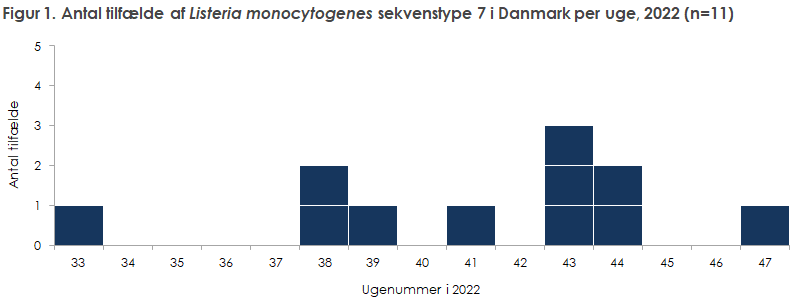
Between mid-August and December 2022, the Statens Serum Institut has registered 11 cases of Listeria monocytogenes . The Statens Serum Institut, the Danish Food Agency and the Danish Food Institute DTU have investigated the disease outbreak and identified fish cakes as the source.

About the disease outbreak

Between mid-August and December 2022, the Statens Serum Institut registered 11 people who are infected with the same type of Listeria monocytogenes (figure 1). Among the sick are 4 men and 7 women. In relation to age, there is one child and 10 adults (median age is 77). The patients are infected throughout the country (table 1). Interviews with six patients showed that all had eaten fish cakes.

Number of cases of Listeria monocytogenes sequence type 7 in Denmark per week, 2022 (n=11)

Table 1. Patients with the same type of Listeria monocytogenes in Denmark, August to December 2022, per region (n=11)

Region

Number of patients

The capital  4
Central Jutland 2
Northern Jutland 0
Zealand 2
Southern Denmark 3
Total 11

The investigation of the outbreak

The outbreak is handled by the Central Outbreak Group, which consists of SSI, the Danish Veterinary and Food Administration and the DTU Food Institute. SSI stands for whole-genome sequencing of listeria isolates from the patients and interviews with patients or relatives with a view to identifying a possible source of infection. The outbreak investigation showed that fish meatballs were the cause of the disease outbreak. The fish meatballs were recalled from stores on November 8, 2022.

The outbreak strain

The bacteria is of the type Listeria monocytogenes . By whole-genome sequencing of the Listeria monocytogenes bacteria isolated from the patients, it can be seen that they are very closely related and belong to sequence type 7.

USA – Multistate Norovirus Outbreak Linked to Raw Oysters from Texas

CDC

The Centers for Disease Control and Prevention (CDC), the U.S. Food and Drug Administration (FDA), the Texas Department of State Health Services, and other public health partners, are investigating a multistate outbreak of norovirus illnesses linked to raw oysters from Texas.

FDA Advises Restaurants, Retailers and Consumers to Avoid Potentially Contaminated Oysters from Harvest Area TX 1, Texas | FDA

Fast Facts

Illnesses: 211 illnesses* have been reported as of December 15, 2022.

States affected: Alabama (AL), Florida (FL), Georgia (GA), Louisiana (LA), Mississippi (MS) North Carolina (NC), Tennessee (TN), Texas (TX)

Recall: Yes DSHS Recalls Oysters Harvested in Area of Southeastern Galveston Bay | Texas DSHS

Investigation Status: Active

*This number is an estimate based on the information we have at this time. CDC is working with state and local partners and will update this number as more information is gathered.

Raw Oysters and Norovirus

If eaten raw, oysters and other filter-feeding shellfish can contain viruses and bacteria that can cause illness or death. Anyone who consumes raw shellfish is at risk of contracting norovirus. Children younger than five years old, the elderly, and those people with weakened immune systems are more likely to have severe infections. Food contaminated with norovirus may look, smell, or taste normal. To avoid food poisoning from oysters, cook them well to a temperature of at least 145 degrees F.

What Businesses Should Do

Do not serve or sell raw oysters harvested between 11/17/2022 and 12/7/2022 from harvest area TX 1, Galveston Bay, Texas:

  • Restaurants and food retailers should not serve raw oysters from harvest area TX 1, Galveston Bay, Texas, harvested between 11/17/2022 and 12/7/2022, which will be printed on product tags.
  • The FDA has confirmed that raw oysters harvested in area TX 1, Galveston Bay, Texas were potentially contaminated with norovirus and distributed to restaurants and retailers in Alabama (AL), Florida (FL), Georgia (GA), Louisiana (LA), Mississippi (MS) North Carolina (NC), Tennessee (TN) and Texas (TX). It is possible that additional states received these oysters through further distribution within the U.S.

Throw away any remaining oysters or return them to your distributor for destruction.

These oysters may be contaminated with norovirus. Follow these steps:

  • Wash and sanitize containers and surfaces that may have come into contact with these oysters.
  • Wash hands with warm water and soap following the cleaning and sanitation process.
What You Should Do

Do not eat any raw oysters from the areas listed above. If you have oysters at home from any of the areas listed above, throw them away. Clean any utensils or food preparation surfaces that may have touched the oysters.

If you think you might have gotten sick from eating possibly contaminated raw oysters, talk to your healthcare provider and report your illness to your local health department.


UK – Consumers warned about recalled smoked fish products linked to Listeria outbreak

FSA

Products produced by St James Smokehouse and sold under Lidl’s ‘Deluxe Oak Smoked Scottish Louch Trout’ and ‘Lighthouse Bay Smoked Trout Trimmings’ ranges are being recalled because they may contain Listeria monocytogenes.   

The products are:
 

Products  

Pack Size 

Use By Dates 

Lidl Deluxe Oak Smoked Scottish Louch Trout 

100g 

All use By Date between and including 20/12/2022 and 06/01/2023 

Lighthouse Bay Smoked Trout Trimmings 

120g 

All use By Date between and including 20/12/2022 and 06/01/2023 


Consumers should not eat the above products and return them to Lidl for a full refund.  

Junior Johnson, Director of Operations at the FSA, said: “Lidl has done the right thing in instigating this recall and their caution is to be commended. The ongoing investigation into a Listeria outbreak has identified the presence of a strain of Listeria monocytogenes which has caused serious illness. We are therefore warning consumers about these recalled products. 

“As we approach the peak of the festive season, we know consumers are more likely to eat smoked fish, such as smoked salmon and trout. While investigations into the outbreak continue, FSS and FSA are reminding vulnerable consumers of the advice more generally around consuming smoked fish – it must be heated until it is steaming hot, before they eat it. While the risk of listeria is low to the general consumer, all consumers should follow this advice if they are serving smoked fish to elderly and other vulnerable relatives and friends over the festive period.”  

To date, the investigation has identified 15 linked cases of listeriosis since 2020, with eight of these since January 2022. Cases have been identified in England, Scotland and Wales.  

Listeriosis is a form of food poisoning caused by the bacterium Listeria monocytogenes. Most people who are affected get mild gastroenteritis which subsides in a few days.  

However, certain individuals are particularly at risk of severe illness such as meningitis and life-threatening sepsis. These include those over the age of 65, those with certain underlying conditions such as cancer, liver and kidney failure or who are taking medications which can weaken the immune system. Listeriosis in pregnancy can cause miscarriages and severe sepsis or meningitis in new-born babies. 

You can find out more about the risks of listeria on the FSA website

Research – An outbreak of Cryptosporidium parvum linked to pasteurised milk from a vending machine in England: a descriptive study, March 2021

Cambridge Org

We describe the investigations and management of a Cryptosporidium parvum outbreak of linked to consumption of pasteurised milk from a vending machine. Multiple locus variable number of tandem repeats analysis was newly used, confirming that C. parvum detected in human cases was indistinguishable from that in a calf on the farm. This strengthened the evidence for milk from an on-farm vending machine as the source of the outbreak because of post-pasteurisation contamination. Bacteriological indicators of post-pasteurisation contamination persisted after the initial hygiene improvement notice. We propose that on-farm milk vending machines may represent an emerging public health risk.

RASFF Alerts – Foodborne Outbreak -Listeria monocytogenes – Chilled Smoked Mackerel

RASFF

Foodborne outbreak suspected to be caused by Listeria monocytogenes in chilled smoked mackerel from the Czech Republic in Austria