Brand : Cooperativa Pescatori Arborea
Name : Heart clams (Cerastoderma spp)
Reason for reporting : Recall due to chemical risk
Publication date : 8 June 2024


Brand : Cooperativa Pescatori Arborea
Name : Heart clams (Cerastoderma spp)
Reason for reporting : Recall due to chemical risk
Publication date : 8 June 2024
Posted in Diarrhoeic Shellfish Poisoning, DSP, food contamination, food handler, Food Hazard, Food Hygiene, Food Inspections, Food Micro Blog, Food Microbiology, Food Microbiology Blog, Food Microbiology Testing, Food Poisoning, Food Quality, food recall, Food Safety, Food Safety Alert, Food Safety Management, Food Safety Regulations, Food Testing, Food Toxin, Lipophilic Marine Biotoxin, Marine Biotoxin, okadaic acid, Shellfish, shellfish toxin
Brand : Cooperativa Pescatori Arborea)
Name : Local clams (Ruditapes decussatus)
Reason for reporting : Recall due to chemical risk
Publication date : 8 June 2024
Posted in Algal Toxin, Diarrhoeic Shellfish Poisoning, DSP, food contamination, food handler, Food Hazard, Food Hygiene, Food Inspections, Food Micro Blog, Food Microbiology, Food Microbiology Blog, Food Microbiology Testing, Food Poisoning, Food Quality, food recall, Food Safety, Food Safety Alert, Food Safety Management, Food Safety Regulations, Food Toxin, Food Virus, Lipophilic Marine Biotoxin, Marine Biotoxin, okadaic acid
The Centre for Food Safety (CFS) received in April 2023 a referral from the Centre for Health Protection of a suspected case of diarrhoetic shellfish poisoning in which the affected persons developed diarrhoea, nausea, vomiting and abdominal pain within an hour after consuming venus clams at a restaurant. This article gives a brief introduction on shellfish poisoning.
Shellfish poisoning is caused by shellfish toxins produced by certain species of algae. When shellfish eat toxin-producing algae, the toxins can accumulate in their tissue. Consumption of shellfish containing shellfish toxins by humans can cause a variety of gastrointestinal and neurological illnesses, known as shellfish poisoning. Examples of shellfish that have been involved in shellfish poisoning include mussels, clams, oysters, scallops and geoducks.
Numerous shellfish toxins have been discovered around the world; they could cause different types of shellfish poisoning. Five major types of shellfish poisoning are discussed below:
(i) Paralytic shellfish poisoning (PSP) — caused by paralytic shellfish toxins (PSTs), which are a group of water-soluble alkaloid neurotoxins, including saxitoxins (STXs).
(ii) Diarrhoetic shellfish poisoning (DSP) — caused by diarrhoetic shellfish toxins (DSTs), which are a group of lipid-soluble polyether toxins, including okadaic acid (OA).
(iii) Neurotoxic shellfish poisoning (NSP) — caused by neurotoxic shellfish toxins (NSTs), which are a group of lipid-soluble polyether toxins, including brevetoxins (BTXs).
(iv) Amnesic shellfish poisoning (ASP) — caused by amnesic shellfish toxins (ASTs), including the water-soluble amino acid domoic acid (DA).
(v) Azaspiracid shellfish poisoning (AZP) — caused by azaspiracid shellfish toxins (AZTs), including the lipid-soluble toxin azaspiracid (AZA).
Characteristics of Shellfish Toxins
Different groups of shellfish toxins display multifarious chemical structures, which can be broadly classified into amino acids (DA), alkaloids (STXs) and polyketides (OA, BTXs and AZA).
The reasons why some algae produce shellfish toxins remain unknown. These toxins are secondary metabolites with no explicit function for the algae. They are probably used by the algae to compete for space, defence against predators or prevent the overgrowth of other organisms.
In general, shellfish toxins are heat stable, odourless, tasteless and not destroyed by cooking, freezing or other food preparation procedures. It is hard to distinguish between toxic and non-toxic shellfish visually.
Bioaccumulation of Shellfish Toxins in Bivalve Molluscs
Algae are part of the natural diet of bivalve molluscs. After shellfish has ingested shellfish toxin-producing algae, shellfish toxins will accumulate and concentrate in their internal organs, such as hepatopancreas of bivalves (Figure 1). Generally speaking, the adductor muscle contains only a low level of shellfish toxins.
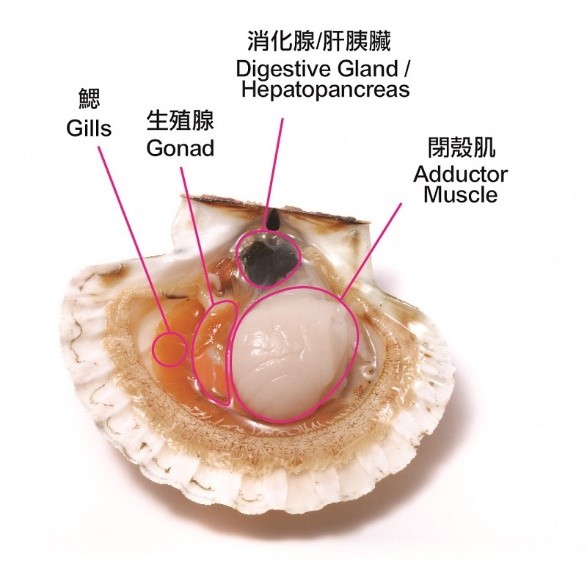
Figure 1: Internal parts of a scallop
Symptoms of Shellfish Poisoning
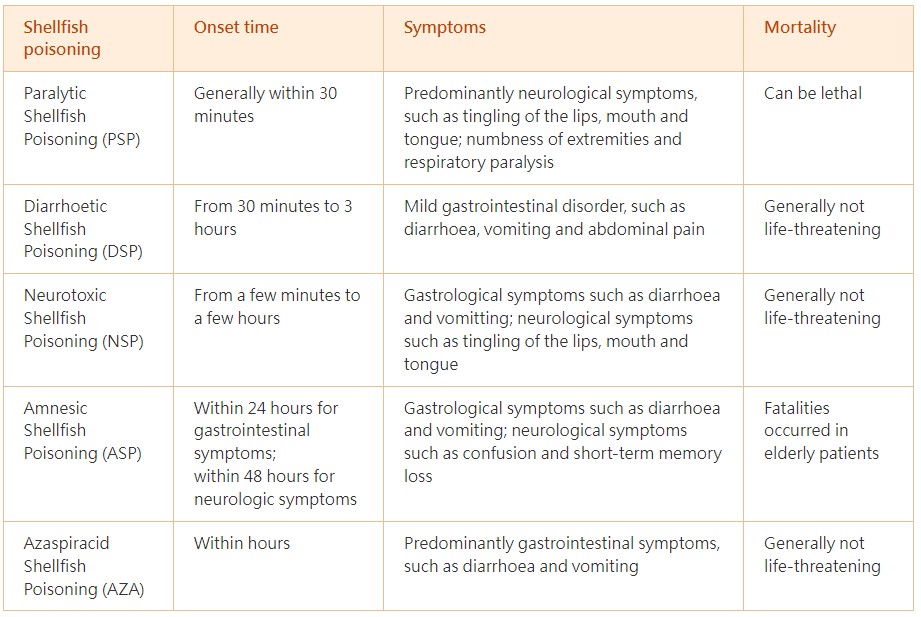
Shellfish toxins can cause a wide variety of symptoms in humans, depending on the type and amount of toxins ingested. Symptoms of different types of shellfish poisoning are summarised below:
Safety Levels of Shellfish Toxins
The toxicity of various shellfish toxins was evaluated by a joint expert working group of the Food and Agriculture Organization of the United Nations (FAO), the World Health Organization (WHO) and the Intergovernmental Oceanographic Commission of UNESCO in 2004. Acute reference doses (ARfDs) (i.e. the amount of toxins that can be ingested in a period of 24 hours or less without appreciable health risk) have been established for these shellfish toxins. In addition, the Codex Alimentarius Commission (Codex) has established the maximum levels (MLs) for shellfish toxins in edible parts (the whole or any part intended to be eaten separately) of live bivalve molluscs. While the ARfDs are critical in assessing the safety of food in terms of the level of shellfish toxins contained, Codex MLs are the levels recommended by Codex to be permitted in shellfish.
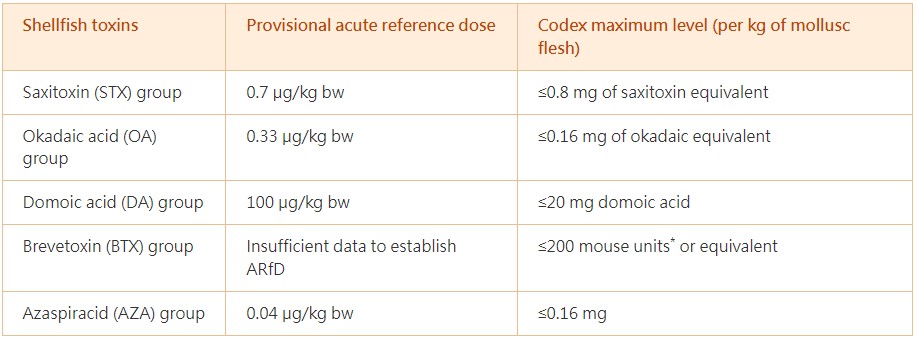
*An estimate of toxicity of the toxin made by mouse bioassay.
Key Points to Note
Advice to Consumers
Elevated levels of okadaic acid and dinophysis toxin in coquinas from Portugal in Spain
Posted in Diarrhoeic Shellfish Poisoning, DSP, food contamination, food handler, Food Hazard, Food Hygiene, Food Inspections, Food Micro Blog, Food Microbiology, Food Microbiology Blog, Food Microbiology Testing, Food Poisoning, Food Quality, food recall, Food Safety, Food Safety Alert, Food Safety Management, Food Safety Regulations, Food Testing, Food Toxin, okadaic acid, RASFF, Shellfish, shellfish toxin
Okadaic acid in Diarrhoetic Shellfish Poisoning from Portugal in Spain
Posted in Algal Toxin, Diarrhoeic Shellfish Poisoning, Dinoflagellates, DSP, food contamination, food handler, Food Hazard, Food Hygiene, Food Inspections, Food Micro Blog, Food Microbiology, Food Microbiology Blog, Food Microbiology Testing, Food Poisoning, food recall, Food Safety, Food Safety Alert, Food Testing, Food Toxin, okadaic acid, RASFF
Okadaic acid in mussels (Mytilus galloprovincialis) from Spain
Posted in food contamination, Food Hazard, Food Hygiene, Food Inspections, Food Micro Blog, Food Microbiology, Food Microbiology Blog, Food Microbiology Testing, Food Poisoning, food recall, Food Safety, Food Safety Alert, Food Testing, Food Toxin, mold, Mold Toxin, Mould Toxin, Moulds, Mycotoxin, okadaic acid, RASFF
The Centre for Food Safety (CFS) of the Food and Environmental Hygiene Department today (October 4) urged the public not to consume a kind of chilled razor clams imported from Scotland due to possible contamination with lipophilic marine biotoxins. The trade should stop using or selling the product concerned if they possess it.
Details of the product are as follows:
Product name: Razor Clams
Brand: Lochleven Shellfish
Place of origin: Scotland
Importer: Longfine Seafood Trading Company Limited
A spokesman for the CFS said, “The CFS received a notification from the authorities concerned in Scotland through the International Food Safety Authorities Network (INFOSAN) that the above-mentioned product might have been contaminated with lipophilic marine biotoxins. According to the information provided by INFOSAN, the affected product has been imported into Hong Kong. Upon learning of the incident, the CFS immediately contacted the local importer concerned for follow-up.”
A preliminary investigation found that the above-mentioned importer had imported some of the affected product into Hong Kong. For the sake of prudence, the CFS has instructed the importer to stop sale and remove from shelves the affected batch of product and initiate a recall. Enquiries about the recall can be made to the importer’s hotline at 2387 2388 during office hours.
“Lipophilic marine biotoxins are a group of fat-soluble shellfish poisoning toxins which may cause symptoms such as diarrhoea, nausea and vomiting. In general, they are heat-stable and cannot be destroyed by cooking.” the spokesman said.
The spokesman urged consumers not to consume the affected product if they have bought any. The trade should also stop using or selling the product concerned immediately if they possess it.
The CFS will alert the trade to the incident, continue to follow up and take appropriate action. An investigation is ongoing.
Posted in Algal Toxin, Azaspiracid Toxin, food contamination, Food Hazard, Food Hygiene, Food Inspections, Food Micro Blog, Food Microbiology, Food Microbiology Blog, Food Microbiology Testing, Food Poisoning, food recall, Food Safety, Food Safety Alert, Food Testing, Food Toxin, Lipophilic Marine Biotoxin, Marine Biotoxin, okadaic acid, Pectenotoxin, Yessotoxin
HIGH LEVELS OF LIPOPHILIC BIOTOXINS IN LIVE SLIPPER CLAM (VENERUPIS CORRUGATA) FROM PORTUGAL in Spain
Posted in Algal Toxin, Biotoxin, food contamination, Food Hazard, Food Hygiene, Food Inspections, Food Micro Blog, Food Microbiology, Food Microbiology Blog, Food Microbiology Testing, Food Poisoning, food recall, Food Safety, Food Safety Alert, Food Testing, Food Toxin, Marine Biotoxin, okadaic acid, RASFF, Toxin, Yessotoxin
HIGH LEVELS OF LIPOPHILIC BIOTOXINS IN LIVE SLIPPER CLAM (VENERUPIS CORRUGATA) FROM PORTUGAL in Spain
Lipophilic marine biotoxins include okadaic acid, pectenotoxin, yessotoxin and azaspiracid groups.
Posted in Algal Toxin, Biotoxin, food contamination, Food Hazard, Food Hygiene, Food Inspections, Food Micro Blog, Food Microbiology, Food Microbiology Blog, Food Microbiology Testing, Food Poisoning, food recall, Food Safety, Food Safety Alert, Food Toxin, Marine Biotoxin, okadaic acid, Poisoning, RASFF, Shellfish, shellfish toxin, Toxin, Yessotoxin
Diarrhetic Shellfish Poisoning (DSP) toxins (okadaic acid : 293,6 μg/kg) in frozen stuffed mussels(Mytilus galloprovincialis) from Turkey in Greece
Posted in Diarrhoeic Shellfish Poisoning, DSP, food contamination, Food Hazard, Food Hygiene, Food Inspections, Food Micro Blog, Food Microbiology, Food Microbiology Blog, Food Microbiology Testing, Food Poisoning, food recall, Food Safety, Food Safety Alert, Food Testing, Food Toxin, okadaic acid, RASFF

 FoodWorld