Category Archives: Microbiology Investigations

USA – FDA issues warning to New Mexico onion importer linked to Salmonella outbreak

Food Safety News

An import company in New Mexico is on notice from the FDA for not having food safety documents for a number of imported foods. The inspection was initiated because of an investigation of a multistate foodborne outbreak of Salmonella Oranienburg illnesses linked to whole, fresh onions imported from the state of Chihuahua, Mexico.

The outbreak has sickened more than 800 people in the United States and remains under investigation. The Centers for Disease and Prevention has not yet declared the outbreak over.

In its warning letter the Food and Drug Administration  acknowledged that the company initiated a voluntary recall on Oct. 22, 2021, of red, yellow, and white onions imported from its “suppliers (redacted)” in Chihuahua, Mexico, from July 1, 2021, through Aug. 25, 2021.

In the March 2, 2022, warning letter just made public by the FDA, the agency described a Nov. 16, 2021, Foreign Supplier Verification Program (FSVP) inspection of Keeler Family Farms in DemingNM.

USA – Welcome to the Agricultural Water Assessment Builder!

FDA

Thank you for choosing to use the Agricultural Water Assessment Builder. The Agricultural Water Assessment Builder v. 1.0 is a user-friendly tool designed to help farms understand the proposed requirements for an agricultural water assessment in the “Standards for the Growing, Harvesting, Packing, and Holding of Produce for Human Consumption Relating to Agricultural Water” proposed rule (agricultural water proposed rule). If finalized, the rule would replace the microbial criteria and testing requirements for pre-harvest agricultural water for covered produce (other than sprouts) in the 2015 Produce Safety Final Rule with provisions for systems-based agricultural water assessments. Relevant definitions and resources can be viewed by clicking the icon next to the title of this page.
We welcome feedback on v1.0 of this optional tool, such as suggestions related to the tool’s functionality and useability. Feedback on the tool can be sent to agwaterbuilder@fda.hhs.gov.
Use of this tool is not required by law (see legal disclaimer) and would not be required. If the agricultural water proposed rule is finalized, FDA expects this tool to supplement and not replace other education, training, and experience that would be needed to understand and implement the requirements of the rule.
The information entered into this page will not be shared with FDA and will not be saved. If you need to pause while entering information, we recommend that you export a copy of your data and save it to your local machine. Once the document is saved, you may resume at a later time, and upload the file to begin from where you paused. Once you have reached the end of this tool, you will be given the opportunity to print out a summary of the information entered. Remember, the data that is entered here is not saved unless your export a file to save on your computer.
This tool is being provided for illustrative purposes only because the requirements for agricultural water assessments under proposed § 112.43 have not been finalized.
Legal disclaimer: Use of the Agricultural Water Assessment Builder v. 1.0 does not constitute FDA approval of an agricultural water assessment or guarantee compliance with FDA’s requirements, if finalized. FDA has taken all reasonable precautions in creating the Agricultural Water Assessment Builder v. 1.0. However, FDA is not responsible for errors, omissions or deficiencies regarding the tool. The Agricultural Water Assessment Builder v. 1.0 is available “as is” and without warranties of any kind, either expressed or implied, including, but not limited to, warranties of performance, merchantability, and fitness for a particular purpose. FDA is not making a commitment in any way to regularly update the tool. Responsibility for the interpretation and use of the Agricultural Water Assessment Builder v. 1.0 lies solely with the user. Third parties’ use of or acknowledgment of the tool does not in any way represent that FDA endorses such third parties or expresses any opinion with respect to their statements.

Netherlands – Safety warning Conimex Ready-to-cook Nasi 230 grams – Micro Spoilage

NVWA

Safety warning Conimex Ready-to-cook Nasi 230 grams

Unilever recalls Conimex Ready-made Nasi as a precaution. There may be micro-holes in the packaging. This can spoil the product and is therefore not suitable for consumption.

Which product is it?

  • Conimex Ready-to-cook Nasi 230 grams
  • Consumer unit barcode 8720182086419
  • Trade unit bar code 8720182086426
  • Expiration dates 13/07/2022, 17/08/2022 and 18/08/2022

read more

Yours sincerely

The Dutch Food and Consumer Product Safety Authority

USA – Salmonella accounted for nearly 80 percent of pathogen violations in U.S. food imports from 2002 to 2019

USDA

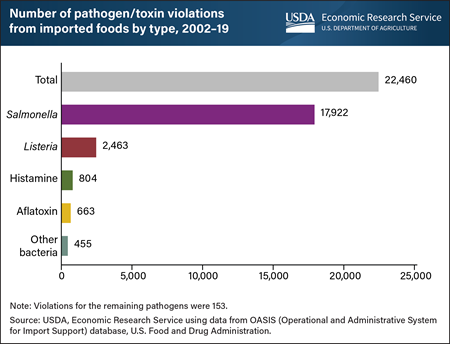
<i>Salmonella</i> accounted for nearly 80 percent of pathogen violations in U.S. food imports from 2002 to 2019

As the quantity of food imported into the United States continues to rise, it is increasingly important to minimize foodborne illness risks for U.S. consumers. Foods contaminated with pathogens or toxins can result in foodborne illnesses. A recent USDA, Economic Research Service (ERS) study examined the number of U.S. import refusals caused by pathogen/toxin contamination and which pathogens accounted for those safety violations. From 2002 to 2019, 22,460 pathogen/toxin violations were discovered among imported shipments. Salmonella was the most frequently identified agent among imported foods during the period with 80 percent, or 17,922 of total pathogen/toxin violations. Listeria recorded the second largest number of violations at 2,463, accounting for 11 percent of the total. It was followed by histamine with 804 violations (3.6 percent), aflatoxin with 663 violations (3 percent), and bacteria other than Salmonella or Listeria with 455 violations (2 percent). Those five most frequently detected pathogens and toxins accounted for 99.3 percent of the total pathogen/toxin violations from imported foods over the period. This chart was drawn from the ERS report Examining Pathogen-Based Import Refusals: Trends and Analysis From 2002 to 2019, published December 2021.

Quebec – Incorrect information necessary for the safe consumption of homemade salmon gravlax sold by Épicerie Le Butterblume

Quebec

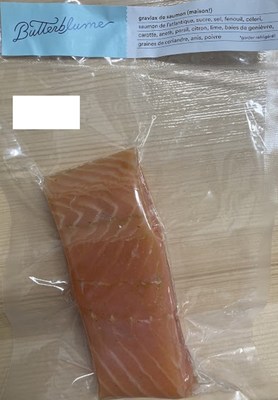
QUEBEC CITY, March 17, 2022 /CNW Telbec/ – The Ministry of Agriculture, Fisheries and Food (MAPAQ), in collaboration with the Food Inspection Division of the City of Montreal and the company Épicerie Le Butterblume, located at 5830, boulevard Saint-Laurent , in Montreal, advises the public not to consume the product indicated in the table below beyond 14 days following the date of packaging.

Product name

Format

Affected lot

“HOUSE-MADE SALMON GRAVLAX”

Variable

Units sold until
March 16, 2022

The product that is the subject of this warning was offered for sale until March 16, 2022, and only at the establishment mentioned above. The product was packaged in a transparent plastic bag and was offered refrigerated. The product label included the words “Butterblume”.

The operator is voluntarily recalling the product in question. It has agreed with MAPAQ and the Food Inspection Division of the City of Montreal to distribute this warning as a precautionary measure. In addition, people who have this product in their possession are advised not to consume it if its packaging date (PACKED ON:) is older than 14 days. They must return it to the establishment where they bought it or throw it away. Even if the affected product shows no signs of tampering or suspicious odors, its consumption may represent a health risk. It should be noted that no case of illness associated with the consumption of this food has been reported to MAPAQ to date.

Additional information

The Ministry publishes various information documents concerning food safety. Interested persons can consult them in the “Food Consumption” section of the MAPAQ website: www.mapaq.gouv.qc.ca/consommation . They also have the possibility of registering online, by visiting www.mapaq.gouv.qc.ca/rappelsfoods , to receive, by e-mail, the food recall press releases published by the Ministry. Finally, it is possible to follow “MAPAQfoods” on Twitter at the following address: www.twitter.com/MAPAQfoods .

Salmon gravlax (CNW Group/Ministry of Agriculture, Fisheries and Food) 

Hazard Classification:  Class 1

Reference Number:  4516

Source:
Media relations
Direction des communications
Ministry of Agriculture, Fisheries and Food
Tel. : 418 380-2100, extension 3512
www.mapaq.gouv.qc.ca

Research – Novel Salmonella Phage, vB_Sen_STGO-35-1, Characterization and Evaluation in Chicken Meat

MDPI

Salmonellosis is one of the most frequently reported zoonotic foodborne diseases worldwide, and poultry is the most important reservoir of Salmonella enterica serovar Enteritidis. The use of lytic bacteriophages (phages) to reduce foodborne pathogens has emerged as a promising biocontrol intervention for Salmonella spp. Here, we describe and evaluate the newly isolated Salmonella phage STGO-35-1, including: (i) genomic and phenotypic characterization, (ii) an analysis of the reduction of Salmonella in chicken meat, and (iii) genome plasticity testing. Phage STGO-35-1 represents an unclassified siphovirus, with a length of 47,483 bp, a G + C content of 46.5%, a headful strategy of packaging, and a virulent lifestyle. Phage STGO-35-1 reduced S. Enteritidis counts in chicken meat by 2.5 orders of magnitude at 4 °C. We identified two receptor-binding proteins with affinity to LPS, and their encoding genes showed plasticity during an exposure assay. Phenotypic, proteomic, and genomic characteristics of STGO-35-1, as well as the Salmonella reduction in chicken meat, support the potential use of STGO-35-1 as a targeted biocontrol agent against S. Enteritidis in chicken meat. Additionally, computational analysis and a short exposure time assay allowed us to predict the plasticity of genes encoding putative receptor-binding proteins.

Research – Co-Occurrence of L. monocytogenes with Other Bacterial Genera and Bacterial Diversity on Cleaned Conveyor Surfaces in a Swine Slaughterhouse

MDPI

Bacterial pathogens, such as Listeria monocytogenes, can show resistance to disinfection and persistence on working surfaces, permitting them to survive and contaminate food products. Persistence—a complex phenomenon involving interactions between many bacteria within a biofilm—is modulated by in situ characteristics. This study aimed to describe, in silico, the microbiota identified in a swine slaughterhouse after sanitation procedures to better understand the presence of L. monocytogenes on these surfaces. Molecular tools for characterization of microbial communities were used to assess the relative contribution of different bacteria resulting from this phenomenon, and the 16S rRNA sequencing method was used on samples from meat conveyor belt surfaces collected on four sampling visits to study the co-occurrence between L. monocytogenes and other bacteria. From the background microbiota, a total of six genera were found to be negatively correlated with Listeria spp., suggesting Listeria growth inhibition, competition, or at least an absence of shared habitats. Based on these results, a complete scenario of interactions of Listeria with components of background microbiota was established. This work contributes to identifying avenues that could prevent the growth and persistence of L. monocytogenes on food-processing surfaces. View Full-Text

Research – Campylobacter jejuni vaccine candidate set for human trials

Outbreak News Today

A potential vaccine developed by University of Guelph researchers to combat one of the main causes of bacterial diarrheal illness worldwide is set to be tested on people early this year.

Human clinical trials of a novel sugar-based vaccine will take place in 2022 at the Cincinnati Children’s Hospital Medical Center. The trials will be funded by the United States National Institutes of Health.

Dr. Mario Monteiro, a professor in the College of Engineering and Physical Sciences, hopes recent refinements to the vaccine in his lab following earlier phase one trials will improve its effectiveness against the Campylobacter jejuni bacterium.

Research – Report on the equivalence between the disinfection of tools in slaughterhouses and cutting rooms with hot water, at a temperature not lower than 82 °C, and various alternative disinfection systems.

AESAN

The different tools and utensils used in slaughterhouses and cutting rooms may lead to cross contamination if unsuitable cleaning and disinfecting procedures are used. In this regard, Regulation (EC) No. 853/2004 laying down specific hygiene rules for food of animal origin establishes that slaughterhouses and cutting rooms for ungulates as well as poultry and lagomorphs must have facilities for disinfecting

The Scientific Committee of the Spanish Agency for Food Safety and Nutrition (AESAN) has assessed several studies carried out in order to establish whether disinfection with four alternative systems may be considered equivalent to that conducted with water supplied at a temperature not less than 82 ºC.
After reviewing the studies, the AESAN Scientific Committee concludes that a notable effort has been made to demonstrate the equivalence of these systems. It is observed in these studies that the use of these compounds leads to reductions in the microorganisms studied which, under the testing conditions, appear to be similar to those obtained with the official method.
However, these studies have methodological limitations (number of repetitions, sampling plan, the microorganisms studied and method of analysis) which prevent establishing this equivalence.
Accordingly, the Committee makes a series of recommendations for conducting these studies: using swabs instead of contact slides; including the analysis of foodborne pathogenic microorganisms of interest in slaughterhouses; including detailed information on the disinfecting products used as well as the method of analysis; harmonising sampling and analysis procedures; guaranteeing the representativeness of the samples taken (it is suggested to take 5 samples per slaughterhouse per day-taken from at least 4 different locations-, using 4 different slaughterhouses in the study, during 5 non-consecutive days, uniformly distributed over a period of 3 months; that is to say, a total of 100 samples); ensuring that all samples analysed are acceptable based on the established criteria for mesophilic aerobes (0-10 cfu/cm2), enterobacteria (0-1 cfu/cm2), as well as the absence/cm2 for the pathogens Listeria monocytogenes and Salmonella.
Likewise, it is also recommended to draw up a sector-based Guide that, based on the recommendations made in this report, provides a detailed description of the protocol to be followed in order to demonstrate equivalence between the disinfection of tools in slaughterhouses and cutting rooms with hot water supplied at a temperature not less than 82 ºC and disinfection with alternative methods.

USA – Mystery Salmonella and Listeria Outbreaks sicken 75 in United States while infant formula kills 2

Food Poison Journal

The Food and Drug Administration has posted an increase in the number of patients in an outbreak of Listeria monocytogenes infections as it continues investigations into three other outbreaks.

The new patient count in the Listeria outbreak is 16, up from 14 reported a week ago. As of March 16 the FDA had not determined the cause of the outbreak. The agency has initiated traceback efforts, but has not revealed what food or foods are involved in those activities.

The FDA has not revealed any demographic information on the Listeria patients and has not reported where they live.

In other outbreak news the FDA is investigating a new outbreak of Salmonella SaintPaul infections that has sickened 59 people. The agency announced the outbreak on March 16. As with the Listeria outbreak investigation, the FDA has not released any patient information for the Salmonella outbreak and has not reported where the patients live. Traceback efforts have begun, according to the FDA, but the agency did not report what food or foods are involved.