Category Archives: Microbiological Risk Assessment

USA – 29 sick, 6 hospitalized in outbreak at Washington care facility

Food Safety News

Public health officials in Seattle are investigating a Salmonella outbreak that has sickened more than two dozen residents of a long-term care facility.

“Based on the investigation, this outbreak was likely due to contaminated food served at the facility,” according to an outbreak announcement this afternoon from Public Health Seattle & King County. The department did not report what food was involved.

The public health department has identified 29 people as outbreak patients. Six of them have had to be admitted to hospitals, but no one has died. The outbreak has concluded, according to the health department

Illness onsets appear to have been July 1 through July 5. No ill food workers were identified as patients as of today. The public health department said the facility is not typically open to the public.
USA – FDA – Investigations of Foodborne Illness Outbreaks

FDA

What’s New

  • For the outbreak of Cyclospora cayetanensis (ref #1171), the case count has increased from 39 to 47 cases.
  • For the outbreak of Cyclospora cayetanensis (ref #1163), the case count has increased from 121 to 140 cases.
  • For the outbreak of Salmonella Paratyphi B var. L(+) tartrate+ (ref #1157), the case count has increased from 35 to 36 cases.
  • For the outbreak of Cyclospora cayetanensis (ref #1159), the case count has increased from 68 to 69 cases.

Research – Outbreaks and illnesses rose in Belgium in 2022

Food Safety News

The number of outbreaks and people sick in them was higher in 2022 than the year before, according to the Belgian food agency.

Belgium recorded 830 outbreaks in 2022 compared to 547 in 2021, with 4,247 people affected compared to 2,070 in 2021. In 2022, 125 people were hospitalized, and two died.

The rise may partly be because of increased activity in the hospitality, restaurant, and catering sector after large closures because of COVID-19. The various incidents, such as Salmonella contamination at Ferrero, may also have raised consumer awareness and encouraged them to report illnesses, said the Federal Agency for the Safety of the Food Chain (FASFC).

UK – Rare E. coli type behind deadly UK outbreak; 2 dozen sick – E.coli O183

Food Safety News

One person has died in an E. coli outbreak being investigated by health authorities in the United Kingdom.

The Food Standards Agency (FSA) and UK Health Security Agency (UKHSA) are trying to find the source of the ongoing Shiga toxin-producing E. coli (STEC) O183 outbreak with the help of other public health agencies.

There are 24 cases in the UK, with 19 in England, two each in Northern Ireland and Scotland, and one in Wales since May. For patients with available information, onset dates range from May 23 to July 2.

France – Salmon with candied lemon and vegetable couscous – risk of bacterial development

Gov france

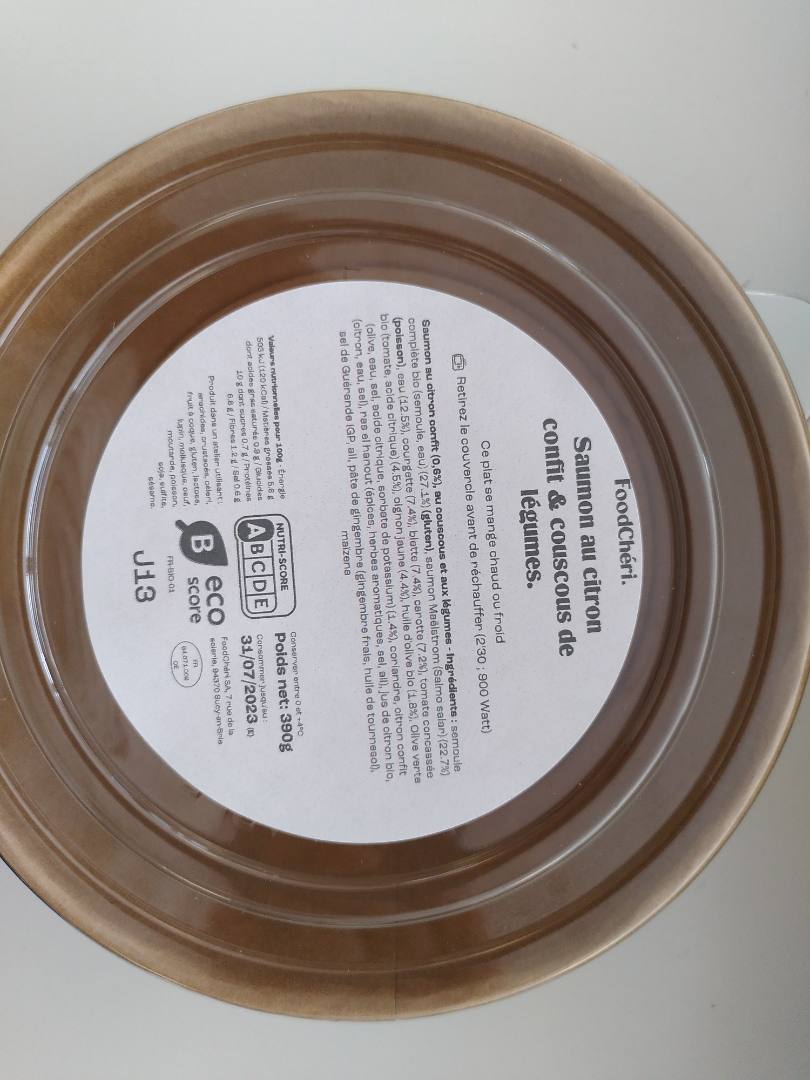
Identification information of the recalled product

  • Product category Feed
  • Product subcategory Prepared meals and snacks
  • Product brand name food cheri
  • Model names or references Salmon with candied lemon (0.6%) with couscous and vegetables
  • Identification of products
    Batch Date
    07/31/2023 (E) Use-by date 07/31/2023
  • Packaging Cardboard tray 390g
  • Marketing start/end date From 07/31/2023 to 07/31/2023
  • Storage temperature Product to be stored in the refrigerator
  • Health mark FR94.071.002CE
  • Geographic area of ​​sale Whole France
  • Distributors food cheri

Canadian Food Safety Agency implements temporary measures to address U.S. romaine lettuce – E.coli O157

Food Safety News

To mitigate the risk associated with E. coli O157:H7 in romaine lettuce from the United States, the Canadian Food Inspection Agency (CFIA) has announced the implementation of temporary Safe Food for Canadians (SFC) license conditions.

The measures will be in effect from Sept. 28 to Dec. 20.

According to the CFIA, this action was taken to address the recurring outbreaks of foodborne illnesses related to E. coli O157:H7 in romaine lettuce imported from the United States. Investigations by U.S. authorities have traced the source of the outbreaks to the California Salinas Valley counties of Santa Cruz, Santa Clara, San Benito, and Monterey.

During the designated period, importers of romaine lettuce and salad mixes containing romaine lettuce from the U.S. must adhere to one of the following requirements:

  • Declare that the product does not originate from the Salinas Valley counties of California mentioned above, or
  • Submit an attestation form and Certificates of Analysis for each shipment, confirming that the romaine lettuce is free from detectable levels of E. coli O157:H7.

Research – Salmonella spp., Escherichia coli and Enterobacteriaceae Control at a Pig Abattoir: Are We Missing Lairage Time Effect, Pig Skin, and Internal Carcass Surface Contamination?

MDPI

Abstract

To provide meat safety and consumer protection, appropriate hygiene control measures at an abattoir are required. This study aimed to evaluate the influence of visual fecal contamination level (VFCL) and lairage time (LT) on pig skin (PS) and external (ECS) and internal (ICS) carcass surfaces. The presence of EnterobacteriaceaeEscherichia coli (E. coli) and Salmonella in PS, ECS, and ICS were evaluated. A total of 300 paired samples were collected from 100 pigs. Results underlined the importance of the skin (Enterobacteriaceae: 3.27 ± 0.68 log CFU/cm2E. coli: 3.15 ± 0.63 log CFU/cm2Salmonella: 21% of samples) as a direct or indirect source of carcass contamination. Although VFCL revealed no significant effect (p > 0.05), the increase of LT had a significant impact (p < 0.001) on Enterobacteriaceae and E. coli levels across all analysed surfaces, and Salmonella presence on ICS (p < 0.01), demanding attention to LT. Also, the ICS showed a higher level of these bacteria compared to ECS. These results highlight the need of food business operators to consider ICS as an alternative area to sample for Salmonella, as a criterion for process hygiene based on EC Regulation No. 2073/2005, and as a potential contamination source to be integrated in the hazard analysis critical control point (HACCP) plans.

Malta – Authorities probe reports of food poisoning following Kalkara wedding

Times of Malta

The health authorities are investigating reports of people suffering from gastroenteritis following a wedding reception in Kalkara on Thursday, with at least one person hospitalised.

The Infectious Disease Prevention and Control Unit has asked attendees at the wedding reception at Villa Bighi to fill in an online form indicating whether they had fallen ill, what kind of symptoms they had, and when.

Attendees were also asked whether they had any complaints about the food served at the event because it may have tasted bad or was not warm enough, among other reasons.

USA – DPH warns residents about severe Vibrio infections caused by consumption of raw shellfish or exposure to salt or brackish water

CT Portal

The Connecticut Department of Public Health (DPH) is warning residents about the potential dangers of consuming raw shellfish and exposure to salt or brackish water along Long Island Sound, due to severe Vibrio vulnificus infections.

 Since July 1, three cases of V. vulnificus infections have been reported to DPH. The three patients are between 60-80 years of age. All three patients were hospitalized and one died.  One patient reported consuming raw oysters from an out-of-state establishment. Two patients reported exposure to salt or brackish water in Long Island Sound. Both patients had pre-existing open cuts or wounds or sustained new wounds during these activities which likely led to the infections. 

 “The identification of these severe cases, including one fatality, due to V. vulnificus is concerning,” said DPH Commissioner Manisha Juthani, MD. “People should consider the potential risk of consuming raw oysters and exposure to salt or brackish water and take appropriate precautions. Particularly during the hottest months of the summer, bacteria are more likely to overgrow and contaminate raw shellfish. Given our current heat wave, this may be a time to exercise particular caution in what you consume.”

Ireland – Boil notice an ongoing risk for the immunocompromised in West Limerick -Cryptosporidium

Limerick Post

LIMERICK residents who are at risk by being immunocompromised may be waiting months before they can shower in their own homes.

“Months” is how long Uisce Éireann says it may be until it can put a new treatment system in place to deal with cryptosporidium (a parasite found in human and animal faeces) found in the water supply at the Shannon Estuary Water Treatment Plant, which has seen a boil notice enforced in the area since May.

Affected households have been told that the water is safe to drink and to use to brush teeth if boiled, but medical experts warn that while infection can cause healthy people to become mildly ill, it can lead to a life-threatening illness for people with weak immune systems.