Category Archives: foodbourne outbreak

Indonesia – Palu earthquake victims suffer food poisoning at shelter

The Jakarta Post

Dozens of people from Kabonena and Tipo subdistricts in Palu, Central Sulawesi, who were displaced by a recent earthquake, have been hospitalized for reported food poisoning after consuming donated food on Saturday.

Badrun, one of the food poisoning victims, said the food was distributed to the shelter at around 11 a.m. local time. The displaced people did not feel anything strange as they ate the food but an hour later they started to feel dizzy and nauseous, he said.

The victims – mostly children – were rushed to Anutapura Palu Hospital.

Anutapura Palu Hospital deputy director for medical services Herry Mulyadi said his office had recorded that at least 38 people had been admitted to the hospital, while others were taken to other hospitals.

RASFF Alerts – Foodborne Outbreak – Listeria monocytogenes – Chilled Fermented Trout Fillets

RASFF-Logo

RASFF – foodborne outbreak caused by Listeria monocytogenes in chilled fermented salted trout fillets processed in Sweden, packaged in Norway in Norway

USA – Duncan Hines cake mix Salmonella Outbreak is over.

CDC

Final Outbreak Information

Illustration of a megaphone.

At A Glance

  • As of January 14, 2019, this outbreak appears to be over.
  • On November 5, 2018, ConAgra Brands recalled four varieties of Duncan Hines cake mix after officials in Oregon identified Salmonella Agbeni in a box of Duncan Hines Classic White Cake Mix.
  • CDC reviewed the PulseNet database and identified seven recent infections from five states with the same strain of Salmonella Agbeni as the Salmonella strain identified in the cake mix.
  • There was not enough epidemiologic and traceback information available to determine if ill people in this outbreak were linked to contaminated cake mix produced by Duncan Hines.

Advice to Consumers and Retailers

Illustration of a clipboard with check marks on it.
  • Do not bake with or eat recalled Duncan Hines cake mix, or eat cake prepared with recalled mix. Throw the mix away or return it to the store for a refund.
    • Recalled products include 15.25 oz. boxes of Duncan Hines cake mix in Classic White, Classic Yellow Cake, Classic Butter Golden Cake, and Confetti Cake flavors, with various “best if used by” dates ranging from March 7 to 13, 2019.
    • Check the FDA website for information to identify recalled mixes, including a list of “best if used by” dates for each flavor of recalled mix, and product photos.
  • Contact a healthcare provider if you think you got sick from eating recalled cake mix.
  • Retailers should not sell or serve recalled Duncan Hines cake mixes.

In general, CDC advises against eating any raw dough or batter, whether homemade or from a mix. Raw batter can contain germs that could make you sick.

UK and Ireland -Norovirus oyster outbreak

Food Safety News


Authorities in the United Kingdom and Ireland are investigating a foodborne outbreak suspected to be caused by norovirus in live oysters.

The oysters are thought to have come from Ireland and been purified in the UK and it is believed they are no longer on the market.

Harvesting records and purification operations at the unnamed implicated business in Ireland have been checked with nothing proving that oysters harvested at the time were contaminated.

A number of people fell ill in England and the investigation has pointed towards a potential norovirus outbreak linked to one restaurant.

The Food Safety Authority of Ireland (FSAI) told Food Safety News that it has sought detailed clarification on traceability and delivery channels.

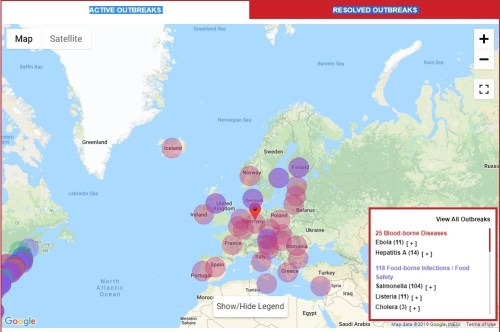
Information – The Contagion® Outbreak Monitor

Contagion Live

I came across this which is quite an interesting tool for looking at outbreaks.

cm


The Contagion® Outbreak Monitor provides details on the number of confirmed cases, deaths, and recent website articles on infectious disease outbreaks.
Use the Contagion® Outbreak Monitor to learn about infectious disease outbreaks in your geographical region and manipulate the map to find out the latest information on global outbreaks. Click on “Trends” to learn more about trends in the number of cases and deaths.

RASFF Alert -Foodborne Outbreak – Norovirus in live oysters

RASFF-Logo

RASFF-foodborne outbreak suspected to be caused by norovirus in live oysters (Crassostrea gigas) from Ireland, purified in United Kingdom in the UK

USA – CDC Led 24 Multi-State Foodborne Outbreak Investigations in 2018

Quality Assurance Mag

When two or more people get the same illness from the same contaminated food or drink, the event is called a foodborne disease outbreak.

According to the Centers for Disease Control and Prevention (CDC), CDC was the lead public health agency on 24 multistate foodborne outbreak investigations in 2018.

Perhaps the most significant event CDC was involved in was the December romaine lettuce recall.  CDC, public health and regulatory officials in several states, Canada, and the U.S. Food and Drug Administration (FDA) investigated a multistate outbreak of Shiga toxin-producing Escherichia coli O157:H7 (E. coli O157:H7) infections linked to romaine lettuce from the Central Coastal growing regions in northern and central California.

USA – Notable Outbreaks and Recalls of 2018 – A Busy Year!

Food Safety Tech


As stated by CDC’s John Besser, Ph.D. last month at the Food Safety Consortium, “It’s been quite a year for outbreaks.” Here’s a not-so-fond look back at some of the noteworthy outbreaks and recalls of 2018.

Romaine Lettuce –E.coli O157:H7

Raw Beef Products – Salmonella

Shell Eggs – Salmonella

Pre-cut Melon – Salmonella

Vegetable Trays – Cyclospora

Salad Mix – Cyclospora

Raw Turkey – Salmonella

Honey Smacks Cereal – Salmonella

Duncan Hines Cake Mix – Salmonella

Johnston County Hams – Listeria monocytogenes

Research – Genomically Informed Strain-Specific Recovery of Shiga Toxin–Producing Escherichia coli during Foodborne Illness Outbreak Investigations

Journal of Food Protection

Next-generation sequencing plays an important role in the characterization of clinical bacterial isolates for source attribution purposes during investigations of foodborne illness outbreaks. Once an illness cluster and a suspect food vehicle have been identified, food testing is initiated for confirmation and to determine the scope of a contamination event so that the implicated lots may be removed from the marketplace. For biochemically diverse families of pathogens such as Shiga toxin–producing Escherichia coli (STEC), the ability to detect specific strains may be hampered by the lack of a universal selective enrichment approach for their recovery against high levels of background microbiota. The availability of whole genome sequence data for a given outbreak STEC strain prior to commencement of food testing may provide food microbiologists an opportunity to customize selective enrichment techniques favoring the recovery of the outbreak strain. Here we demonstrate the advantages of using the publicly available ResFinder tool in the analysis of STEC model strains belonging to serotypes O111 and O157 to determine antimicrobial resistance traits that can be used in formulating strain-specific enrichment media to enhance recovery of these strains from microbiologically complex food samples. The improved recovery from ground beef of model STEC strains with various antimicrobial resistance profiles was demonstrated using three classes of antibiotics as selective agents, suggesting the universal applicability of this new approach in supporting foodborne illness investigations.

USA – Raw Turkey Salmonella Reading Outbreak Grows to 216 Sick

Food Poisoning Bulletin

The raw turkey Salmonella Reading outbreak has grown to 216 sick, according to the Centers for Disease Control and Prevention (CDC). Eighty-four people are hospitalized and one person who lived in California has died. This outbreak has also sickened people in Canada.