Category Archives: foodbourne outbreak

USA – South Carolina: Hepatitis A outbreak declared in Aiken County

Outbreak News Today

South Carolina health officials report that an employee of City Billiards tested positive for hepatitis A. Customers who ate there between January 22 and February 5 could have been exposed to the virus.

This is the second case of hepatitis A diagnosed in an Aiken-area food handler in February. At this time, the Department of Health and Environmental Control (DHEC) is not aware of a known connection between the two cases.

In light of these findings, DHEC is declaring a hepatitis A outbreak in Aiken County. An outbreak is defined as an unexpected increase in the number of cases in a geographic area or time period.  There have been 10 hepatitis A cases diagnosed in Aiken County since December 1, 2018.

France – More babies infected with Salmonella in outbreak linked to rice milk formula

Food Safety News Salmonella kswfoodworld

French authorities are investigating more than a dozen cases of Salmonella infection in babies less than 19 months old. The illnesses are linked to a rice milk formula made in Spain.

Of the 14 babies involved in the investigation, the French National Public Health Agency (Santé publique France) reports five have been confirmed and nine are under investigation. Seven of the babies were hospitalized for salmonellosis but have since recovered.

Luxembourg and Belgium have reported one case each linked to the outbreak.

USA – FDA Investigating a Multistate Outbreak of Salmonella Concord Linked to Tahini Produced by Achdut Ltd.

FDA

Update: February 08, 2019

United States Food and Drug Administration, along with the Centers for Disease Control and Prevention (CDC), and state and local partners, is investigating a multistate outbreak of Salmonella Concord illnesses linked to tahini imported from an Israeli manufacturer, Achdut Ltd., located in Ari’el, Israel.

On November 28, 2018, in response to the on-going investigation, Soom Foods voluntarily recalled the following additional products:

  • 12 oz. Chocolate Sweet Tahini Halva Spread 071318CH. Packed from tahini lot 18-123.

And tahini in the following sizes and types:

  • 40 lb. Organic Tahini.
  • 40 lb. Premium Tahini.
  • 16 oz. Premium Tahini.
  • 16 oz. Organic Tahini.
  • 11 oz. Premium Tahini.

The tahini product lot codes range from 18-097 through 18-141.

Some of the above listed products were included in the original voluntary recall by Achdut Ltd. on November 27, 2018. The FDA is posting this information to ensure the widest possible dissemination to the public.

Recommendations

The FDA is advising consumers not to eat recalled Achva, Achdut, Soom, S&F, and Pepperwood brand tahini and Soom brand Chocolate Sweet Tahini Halva Spread (lot code 071318CH) with expiration dates ranging from April 7, 2020 to May 21, 2020 and Baron’s brand tahini with the expiration date of May 5, 2021. The product lot codes range from 18-097 to 18-141. Consumers should discard the product or return the product to the store for a refund.

Some brands of tahini manufactured by Achdut Ltd. may lack specific dates or may have labels that are written in Hebrew. Consumers who have purchased a tahini product and are uncertain of where the product was manufactured or cannot identify the brand by lot codes or expiration dates should discard the product or return the food to the store for a refund. More product information and pictures of the recalled product labels can be found in Achdut ‘s recall announcement. View Soom Foods’ recall announcement.

Retailers and restaurants should not use any of the recalled tahini manufactured by Achdut Ltd. at their establishments. Retailers and restaurants should throw the product out.

Firms that may have used the recalled tahini (either repacked or used as an ingredient in a food without a kill step) should consider recalling their products. Recalls should be reported to your local FDA office. View a list of FDA recall coordinators.

Research – Zoonotic Source Attribution of Salmonella enterica Serotype Typhimurium Using Genomic Surveillance Data, United States

CDC

Salmonellaa

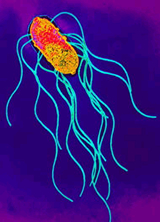
Image CDC

Increasingly, routine surveillance and monitoring of foodborne pathogens using whole-genome sequencing is creating opportunities to study foodborne illness epidemiology beyond routine outbreak investigations and case–control studies. Using a global phylogeny of Salmonella entericaserotype Typhimurium, we found that major livestock sources of the pathogen in the United States can be predicted through whole-genome sequencing data. Relatively steady rates of sequence divergence in livestock lineages enabled the inference of their recent origins. Elevated accumulation of lineage-specific pseudogenes after divergence from generalist populations and possible metabolic acclimation in a representative swine isolate indicates possible emergence of host adaptation. We developed and retrospectively applied a machine learning Random Forest classifier for genomic source prediction of Salmonella Typhimurium that correctly attributed 7 of 8 major zoonotic outbreaks in the United States during 1998–2013. We further identified 50 key genetic features that were sufficient for robust livestock source prediction.

USA – Norovirus confirmed as cause of outbreak on ‘Viking Sea’

Outbreak News Today

In a follow-up on a report approximately one week ago, Vessel Sanitation Program officials confirmed the etiology of the gastrointestinal outbreak on the Viking Ocean Cruises vessel, Viking Sea was Norovirus.

USA – Norovirus Outbreak Associated with La Fuente in Renton, WA

Food Poisoning Bulletin Eurofins

A possible norovirus outbreak has been associated with La Fuente restaurant, located at 14400 South East Petrovitsky Road in Renton, Washington, according to a press release by the King County Public Health Department. Twenty-eight people are sick after eating food and drinking beverages there on January 25, 2019. The 28 people were all from one party.

Canada – Raw Chicken Salmonella Outbreak in Canada Grows to 529 Sick

Food Poisoning Bulletin


A raw chicken Salmonella outbreak in Canada has grown to include 529 laboratory-confirmed illnesses. Ninety people have been hospitalized, and three people have died. However, Salmonella was not the case of death for two of those patients, and it was not determined whether this illness contributed to the death of the third person.

USA – Outbreak of Multidrug-Resistant Salmonella Infections Linked to Raw Turkey Products – Update

CDC

Latest Outbreak Information

Illustration of a megaphone.

At A Glance

  • Since the last update on November 8, 2018, 52 ill people from 26 states and the District of Columbia have been added to this investigation.
  • As of December 18, 2018, 216 people infected with the outbreak strain of SalmonellaReading have been reported from 38 states and the District of Columbia.
    • 84 people have been hospitalized, and one death has been reported from California.
  • Epidemiologic and laboratory evidence indicates that raw turkey products from a variety of sources are contaminated with Salmonella Reading and are making people sick.
  • In interviews, ill people report eating different types and brands of turkey products purchased from many different locations. Three ill people lived in households where raw turkey pet food was fed to pets.
  • The outbreak strain has been identified in samples taken from raw turkey pet food, raw turkey products, and live turkeys.
    • On November 15, 2018, Jennie-O Turkey Store Sales in Barron, Wisconsin recalled approximately 91,388 pounds of raw ground turkey products.
    • On December 21, 2018, Jennie-O Turkey Store Sales, LLC, in Faribault, Minnesota recalled approximately 164,210 pounds of raw ground turkey products.
    • On January 28, 2019, Woody’s Pet Food Deli in Minnesota recalled raw turkey pet food. The recalled product was sold in 5-pound plastic containers labeled “Woody’s Pet Food Deli Raw Free Range Turkey” and was sold in Minnesota.
    • A single, common supplier of raw turkey products or of live turkeys has not been identified that could account for the whole outbreak.
  • The Public Health Agency of Canada has identified ill people infected with the same DNA fingerprint of Salmonella Reading bacteria in Canada.
  • The outbreak strain of Salmonella Reading is present in live turkeys and in many types of raw turkey products, indicating it might be widespread in the turkey industry. CDC and USDA-FSIS have shared this information with representatives from the turkey industry and asked about steps that they may be taking to reduce Salmonella contamination.

USA – Outbreak of Listeria Infections Linked to Pork Products Final Update

CDC

This outbreak appears to be over. In general, people who are at higher risk for Listeria infection should avoid eating hot dogs, lunch meats, cold cuts, other deli meats (such as bologna), or fermented or dry sausages unless they are heated to an internal temperature of 165°F or until steaming hot just before serving. Learn more about how you can take steps to prevent Listeria infection.

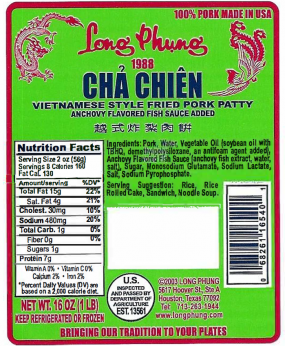
Label of packaging

CDC, public health and regulatory officials in several states, and the U.S. Department of Agriculture’s Food Safety and Inspection Service (USDA-FSIS) investigated a multistate outbreak of Listeria monocytogenes infections linked to pork products produced by Long Phung Food Products. As of January 29, 2019, this outbreak appears to be over.

Ireland -Salmonella infection in Ireland, 2017

HPSC

The 414 cases notified in 2017 were the highest number of salmonellosis cases reported
in Ireland since 2008
 International travel is a large contributor to the overall burden of salmonellosis in Ireland (40%), in particular in summer months
 The most common serotypes reported in Ireland and internationally are S. Enteritidis and S. Typhimurium, with S. Typhimurium the more prevalent among cases acquired in
Ireland
 The highest reported incidence was in children under five years, with this effect being
more pronounced among cases acquired in Ireland
 A large outbreak of S. Brandenburg in HSE-E resulted in this serotype being the third
most common serotype in Ireland this year. This highlights the continued potential for
foodborne outbreaks of salmonellosis
 The introduction of WGS at the NSSLRL has contributed to confirmation of suspected
outbreaks and to the identification of outbreaks which may not have been recognised on
epidemiological grounds alone
 WGS has also enabled a small cluster of cases in Ireland to be recognised as being part
of a much larger EU incident