Category Archives: foodborne outbreak

Australia – Investigations into Central Coast Salmonella outbreak continue

NSW GOV AU

NSW Health and the NSW Food Authority are continuing to investigate a significant foodborne outbreak following a conference on the Central Coast last week.

At least 69 people from across NSW, the Northern Territory and Queensland are known to have become unwell with symptoms of food poisoning, of which 27 people have confirmed Salmonella infections to date.

Dr Jeremy McAnulty, NSW Health Executive Director of Public Health, said public health officials from across NSW have been working to speak to all those who have become unwell after attending or working at the conference.

“Close to 230 people attended or worked at the two-day conference, and so far at least 31 of them are known to have attended Emergency Departments,” Dr McAnulty said.

“NSW Health is working closely with the NSW Food Authority to investigate the cause of the outbreak.

“Our public health experts continue to contact people associated with the event, including attendees from the Aboriginal Languages Trust and we thank all of those who have assisted us so far.

Australia – Donuts for weight loss? A norovirus outbreak associated with a bakery in the Australian Capital Territory

Gov Au

Three hundred and one people were surveyed, and 215 individuals (71.4%) reported vomiting and/or diarrhoea following consumption of a donut purchased from the business over a five-day period.
 
All ill respondents reported eating a donut. The medians of incubation period and illness duration were 34 hours (interquartile range, IQR: 29–42 hours) and 48 hours (IQR: 29–72 hours) respectively. Diarrhoea, vomiting and abdominal pain were the most commonly reported symptoms.
 
Eight out of 11 specimens collected from ill individuals were positive for norovirus. For the case-control study, data from 59 attendees were collected, with an attack rate of 46% (27/59). Eating any kind of filled donut was associated with a person becoming ill (odds ratio: 10.4; 95% confidence interval: 1.18–478.13).
 
No single flavour was identified as the likely source of infection.
 
Elevated levels of coliforms were present in two samples of donut filling obtained during the food safety inspection.
 
Conclusion
Donuts are a novel vehicle for norovirus infection. This implicated pathogen, plus evidence collected at the food premises suggestive of faecal contamination, indicates the source of this outbreak was likely an ill food handler. The findings of this outbreak highlight the importance of excluding food


More than 250 ill in UK E. coli outbreak linked to salad

Food Safety News

Vegetable Bacteria Danger

More than 250 people are sick in an E. coli O157 outbreak in the United Kingdom that may have been caused by salad.

There have been 259 confirmed cases in the UK with sample dates ranging from late August to the end of October, although most people fell ill in August and early September.

Shiga toxin-producing E. coli (STEC) O157 has affected people in England, Scotland, Northern Ireland, and Wales. The majority of those sick are adults.

Food Standards Scotland (FSS), the UK Health Security Agency (UKHSA) and Food Standards Agency (FSA) are investigating the outbreak.

It is the largest E. coli outbreak since Whole Genome Sequencing (WGS) started to be used in 2014, according to UKHSA.

Research – The European Scientific Conference on Applied Infectious Disease Epidemiology (ESCAIDE)

Escaide

Abstracts

Page 71 – An Easter Surprise: Salmonella Typhimurium outbreak linked to chocolate products in the United Kingdom, 2022; a case control study

Page 72  – International outbreak of Salmonella Typhimurium linked to a chocolate factory in 2022: Belgian findings

Page 73 – Whole Genome Sequencing identified a prolonged Salmonella Poona nursery outbreak (2016-2021) in North West England, UK

Page 74 – Climate Warming and increasing Vibrio vulnificus infections in North America

Page 106 – Timely and reliable outbreak investigation using a non-probabilistic online panel as a source of controls – two parallel case-control studies investigating a Salmonella Braenderup outbreak in Germany

Page 107 – An outbreak of Escherichia coli-associated haemolytic uremic syndrome linked to consumption of an unexpected food vehicle, France 2022

Page 108 – Outbreak investigation of cholera in a peri-urban village of Panchkula district, Haryana, India, 2021

Page 109 – Cholera Outbreak Investigation, Ballo Adda Mohalla, Lucknow District, Uttar Pradesh 2021

Page 110 – Norovirus GII.3[P12] outbreak associated with the drinking-water supply in a rural area in Galicia, Spain, 2021

Page 111 – Impact of COVID-19 restrictions on the epidemiology of Cryptosporidium spp. in England and Wales

Page 149 – Monophasic Salmonella Typhimurium outbreak linked to chocolate products, Ireland, 2022

Page 151 – Successful containment of a Listeria monocytogenes outbreak caused by shredded vegetables, Hesse/Germany, 2021-2022

Page 152 – Outbreak of monophasic Salmonella Typhimurium linked to fresh small tomatoes, Sweden, 2021

Page 194 – Cholera Outbreak Investigation, Kamarhati-Municipality, North-24-Parganas District, West Bengal, India 2021

Page 195 – Botulism outbreak and response in Dangara District Tajikistan, October 2020

Page 196 – Outbreak of suspected Clostridium perfringens associated with consumption of roast beef in a restaurant, January 2022 South West England

Page 198 – Doughnuts for weight loss? A norovirus outbreak in the Australian Capital Territory, November 2021

Page 212 – Outbreak of Legionnaires’ disease linked to unregistered cooling towers, West Midlands, England, July-September 2020



Research – Multi-country outbreak of Salmonella Mbandaka ST413, possibly linked to consumption of chicken meat in the EU/EEA, Israel and the UK

EFSA

A cross-border outbreak of Salmonella Mbandaka ST413 has been ongoing in the EU/EEA, Israel, and the UK since September 2021. By 8 November 2022, 196 cases had been reported in Czechia (n=5), Estonia (n=3), Finland (n=89), France (n=10), Germany (n=2), Ireland (n=1), the Netherlands (n=1), the United Kingdom (n=81), and Israel (n=4), according to the European case definition. Nineteen cases were hospitalised and five cases had septicaemia. One case in the UK died.

Based on case interviews from Finland and the UK, ready-to-eat (RTE) chicken products and/or fresh chicken meat are the likely vehicles of infection. Fifteen cases in Finland reported consumption of six RTE products from three brands. All 15 cases had consumed at least one RTE chicken product. Two products were marketed under the same brand name, which is adopted by the Estonian Company A and the Finnish Company B. Based on additional information, such as purchase data, and consultation of the grocery chains selling the products and of the Finnish Company B, the food authority in Finland linked the products to the Estonian Company A. However, this link could not be verified by the identification of the batches nor by microbiological evidence. The Estonian Company A received processed chicken meat from different suppliers, but there is no further information in RASFF. Therefore, the role of the Estonian Company A as a source of infection could not be established.

Epidemiological data and microbiological evidence from whole genome sequencing of human isolates indicate there are several active sources through different food distribution chains, with a likely common source higher up in the chicken supply chain. New cases are likely to occur in the EU/EEA until the source has been identified and controlled.

Further investigations are needed by public health and food safety authorities to identify the source(s)/origin of contamination.

Click to access roa-7707.pdf

Italy hit by new Listeria outbreak with one dead

Food Safety News

Italian authorities are investigating a Listeria outbreak that has sickened 22 people and killed one.

Mortadella sold by Veroni is being looked at as a potential source but an official link has not been confirmed by authorities.

In early November, a number of recalls were published for Veroni mortadella due to potential Listeria contamination.

A product recalled by Veroni in November

The Ministry of Health (Ministero della Salute) issued a warning covering a few batches of the Veroni Supergiant Mortadella packed in small portions due to the presence of Listeria monocytogenes.

Veroni said it immediately and voluntarily alerted the market, recalling all batches of Supergiant Mortadella with and without pistachios in portions that had expiry dates before Dec. 27, 2022.

USA – Outbreak Investigation of E. coli O121:H19 Frozen Falafel (October 2022)

FDA

The FDA, along with CDC and state and local partners, investigated a multistate outbreak of E. coli O121:H19 infections linked to Earth Grown frozen falafel.

As of December 1, 2022, CDC announced that the outbreak is over. There have been a total of 24 illnesses in six states. The last illness onset was October 24, 2022.

On October 7, 2022, the Michigan Department of Agriculture and Rural Development collected Earth Grown frozen falafel for testing from a sick person’s home. Whole Genome Sequencing done at the Michigan Department of Health & Human Services showed that the E. coli strain in the falafel sample was closely related to the strain causing illness in this outbreak.

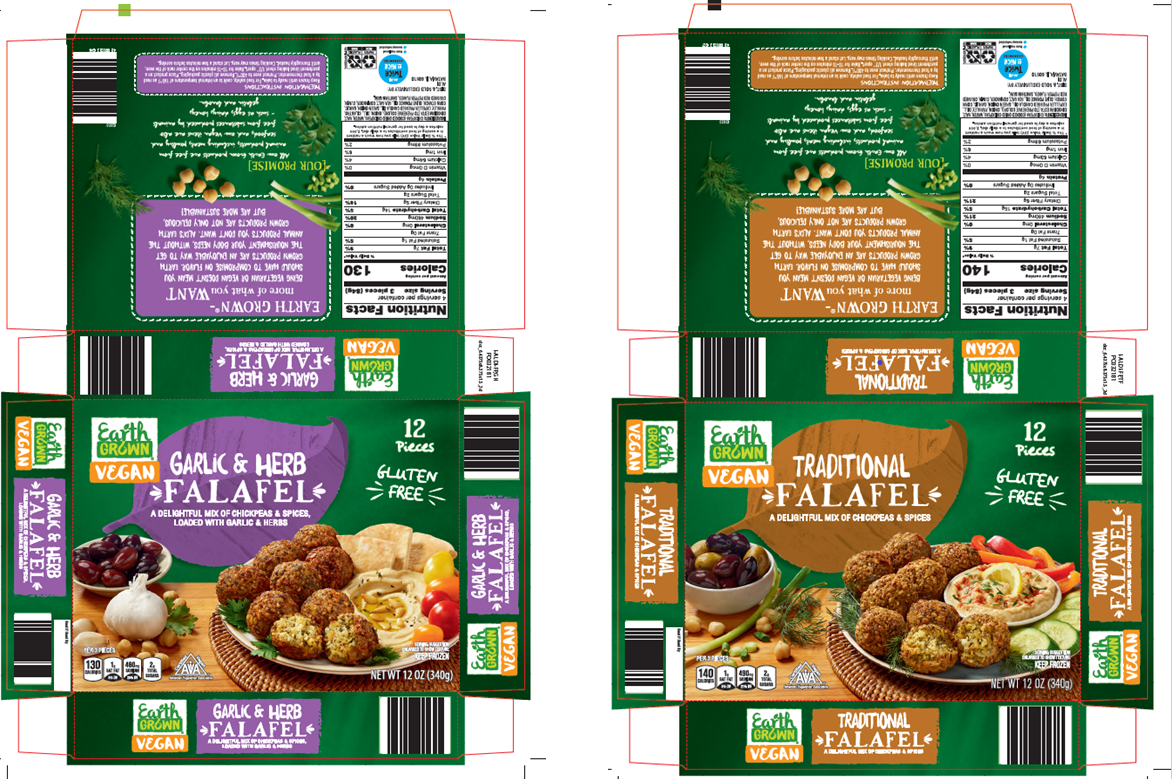
On October 6, 2022, the manufacturer of Earth Grown frozen falafel, Cuisine Innovations, initiated a voluntary recall. Recalled products include Earth Grown vegan traditional falafel and garlic & herb falafel distributed and sold exclusively by ALDI. Additional information on recalled products is available in the firm’s recall notice.

Recommendation

These items are no longer available for sale but were sold frozen and have a long shelf-life of 18 months, so consumers should check their freezers for any recalled Earth Grown vegan traditional falafel and garlic & herb falafel that was sold by ALDI. If you have recalled frozen falafel in your freezer, do not eat or serve them.


Product Images

Outbreak Investigation E.coli Frozen Falafel October 2022 - Sample Product Images

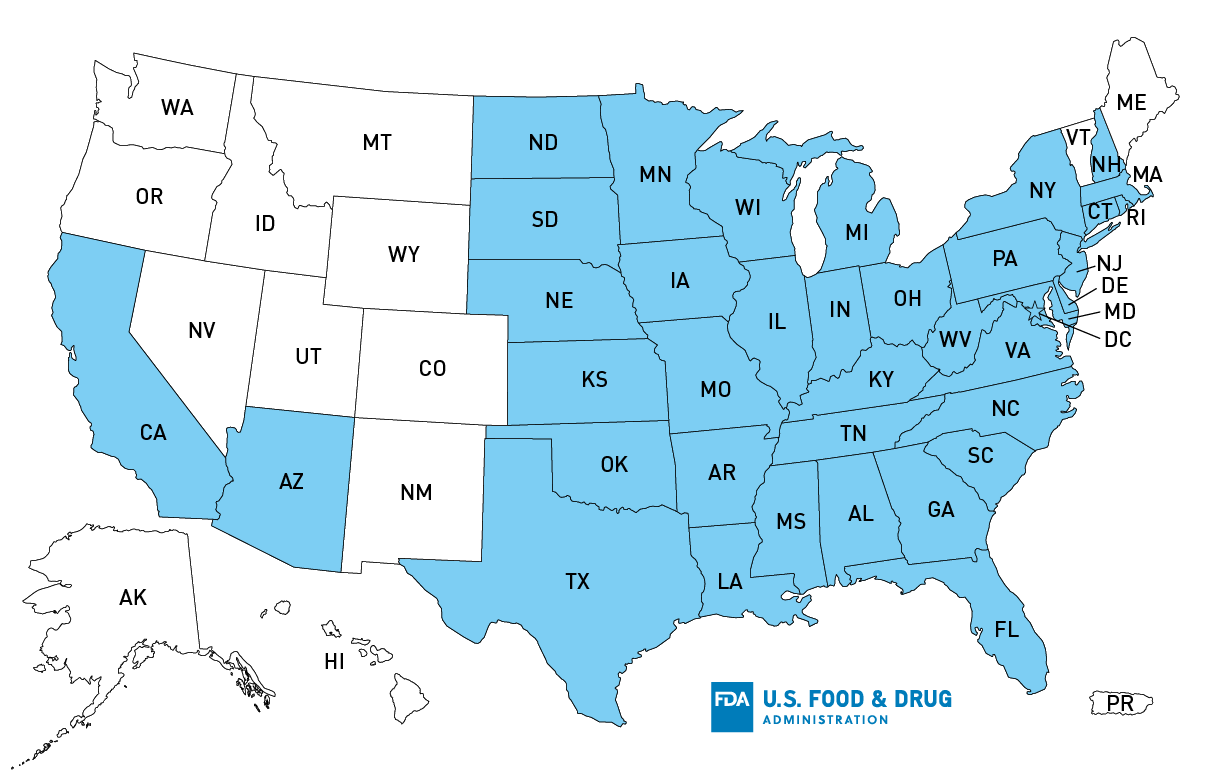
Map of U.S. Distribution

Outbreak Ecoli Falafel Distribution Map

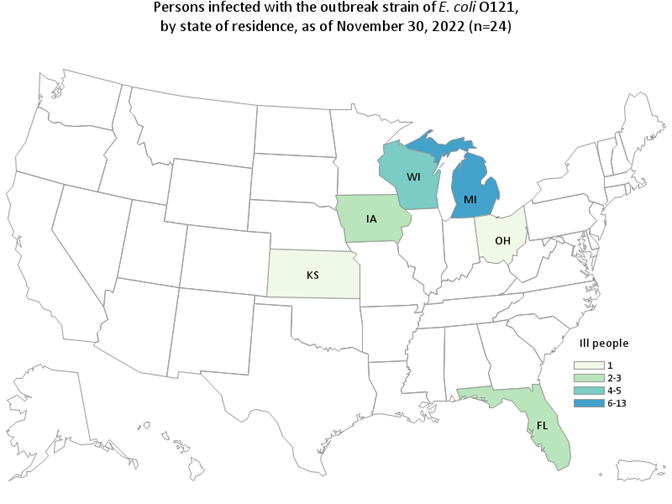
Case Count Map Provided by CDC

Outbreak Investigation of E. coli O121: Frozen Falafel (October 2022) - CDC Case Count Map as of December 1, 2022

Case Counts

Total Illnesses: 24
Hospitalizations: 5
Deaths: 1
Last illness onset: October 24, 2022
States with Cases: FL (2), IA (2), KS (1), MI (13), OH (1), WI (5)
Product Distribution: Nationwide

EU – Outbreak of Salmonella Mbandaka ST413 linked to chicken meat

ECDC

Foodborne Pathogen

As of 8 November 2022, 196 cases have been reported in Czechia, Estonia, Finland, France, Germany, Ireland, the Netherlands, the United Kingdom and Israel. Nineteen cases have been hospitalised and five cases have had septicaemia; there has been one fatal case in the UK. Cases have occurred across all age groups and there is no overall difference when gender is taken into account. 

Based on case interviews from Finland and the UK, ready-to-eat (RTE) chicken products and/or fresh chicken meat, such as those used in sandwiches and wraps, are the likely vehicles of infection. 

Following investigations, the food safety authority in Finland linked the suspected RTE products to an Estonian company, however, this link could not be verified by the identification of batches nor by microbiological evidence. The Estonian company received processed chicken meat from different suppliers, and its role as a source of infection could not be established. 

Epidemiological data and microbiological evidence from whole genome sequencing of human isolates indicate there are several active sources through different food distribution chains, with a likely common source further up the supply chain. New cases are likely to occur in the EU/EEA until the source has been identified and controlled. 

ECDC encourages Member States to sequence S. Mbandaka isolates from human cases and interview cases with S. Mbandaka ST413 infection focusing on the consumption of various poultry meat and related products. Further investigations are recommended in cooperation with food safety authorities. 

Hong Kong – CFS actively follows up on food poisoning clusters involving lava cake

CFS

kswfoodworld.com

The Centre for Food Safety (CFS) of the Food and Environmental Hygiene Department said today (November 29) that it is actively following up on four food poisoning clusters involving lava cake, including inspecting the restaurant concerned. A sample of lava cake collected from the restaurant was found to contain a pathogen, Group D Salmonella. The CFS is following up on the case.

“Upon notification by the Centre for Health Protection of the Department of Health earlier, the CFS immediately sent staff to the restaurant concerned in Tsim Sha Tsui to conduct investigation and take food and environmental samples for testing. The test result showed the presence of Salmonella in 25 grams of the lava cake sample, exceeding the criterion of the Microbiological Guidelines for Food which states that Salmonella should not be detected in 25g of a ready-to-eat food sample,” a CFS spokesman said.

The CFS has informed the restaurant concerned of the irregularity. The restaurant has already stopped selling and discarded the affected product according to the CFS’s advice. The CFS has also provided health education on food safety and hygiene to the person-in-charge and staff of the restaurant, and requested it to review and improve the food production process and carry out thorough cleaning and disinfection. Prosecution will be instituted should there be sufficient evidence.

According to section 54 of the Public Health and Municipal Services Ordinance (Cap.132), all food available for sale in Hong Kong, imported or locally produced, should be fit for human consumption. An offender is subject to a maximum fine of $50,000 and imprisonment for six months upon conviction.

“Salmonella infection may cause fever and gastrointestinal upset such as vomiting, abdominal pain and diarrhoea. The effects on infants, young children, the elderly and persons with a weak immune system could be more severe and may even lead to death,” the spokesman said.

The CFS will continue to follow up on the incident and take appropriate action to safeguard food safety and public health.

USA – FDA Core Outbreak Table – Investigations of Foodborne Illness Outbreaks

FDA

What’s New

  • For the outbreak of Listeria monocytogenes (reference #1127) linked to enoki mushrooms, FDA has initiated sample collection and analysis.
  • For the outbreak of Salmonella Typhimurium (reference #1113) in an unidentified product, one additional case has been added for a total case count of 270 cases and the outbreak has ended.

More information on the table at the link above.