Category Archives: Foodborne Illness

USA – Outbreak Investigation of Listeria: Ice Cream (August 2023)

FDA

Product 

  • The Ice Cream House has voluntarily recalled all dairy and non-dairy products with the Ice Cream House logo. Recalled products include dairy and non-dairy (parve):
    • ice creams
    • cakes
    • pies
    • ice cream logs
    • novelty items with the “Ice Cream House” logo
    • A full list of all recalled Ice Cream House Products is available on the firm’s recall notice.
  • Real Kosher Ice Cream has voluntarily recalled all flavors of Soft Serve On The Go 8-oz ice cream cups 
    • Soft Serve On The Go Vanilla Chocolate
    • Soft Serve On The Go Razzle
    • Soft Serve On The Go Caramel
    • Soft Serve On The Go Parve Vanilla Chocolate
    • Soft Serve On The Go Sorbet Strawberry Mango
    • Soft Serve On The Go Lite Peanut Butter

FDA’s investigation is ongoing. Products may be added to this advisory. Additional recall information is available below.

Stores Affected

  • Ice Cream House products: Recalled products with the Ice Cream House brand were sold at the Ice Cream House storefront in Brooklyn, NY and at retail supermarkets in NJ, NY, OH.
  • Real Kosher Ice Cream Soft Serve On The Go cups: Multiple retailers in CA, CO, CT, DC, DE, FL, IL, MA, MD, MI, MN, NC, NH, NJ, NY, OH, OR, PA, VA, WV.

Symptoms of Listeriosis (Listeria Infection)

Illness can occur within a few hours or as long as two to three days after eating contaminated food. More severe forms of listeriosis may take anywhere from three days to three months to develop. Mild symptoms may include a fever, muscle aches, nausea, vomiting, and diarrhea. If the more severe form of listeriosis develops, symptoms may include headache, stiff neck, confusion, loss of balance, and convulsions.

Status

Ongoing

Recommendation

  • Consumers, restaurants, and retailers should not eat, sell, or serve recalled ice cream and non-dairy [parve] frozen dessert products and should throw the recalled product away. Options to return recalled product can be found in the recall notice from Real Kosher Ice Cream and Ice Cream House.
  • Ice cream has a long shelf life and may still be in freezers. Consumers, restaurants, and retailers should check their freezers and throw away recalled ice cream products or follow the firms’ instructions for returning the recalled products.
  • Consumers, restaurants, and retailers who purchased or received any recalled ice cream products should follow FDA’s safe handling and cleaning advice  and use extra vigilance in cleaning and sanitizing any surfaces and containers that may have come in contact with these products to reduce the risk of cross-contamination. Listeria can survive temperatures at or below freezing and can easily spread to other foods and surfaces.

Recommendation for At-Risk Groups:

  • Listeria is most likely to sicken pregnant people and newborns, adults aged 65 or older, and people with weakened immune systems. Other people can be infected with Listeria, but they rarely become seriously ill.
  • Pregnant people typically experience only fever, fatigue, and muscle aches. However, Listeria infection during pregnancy can lead to miscarriage, stillbirth, premature delivery, or life-threatening infection of the newborn.
  • Call your healthcare provider right away if you have symptoms of a Listeria infection.
Wales – Wrexham pub linked to Salmonella outbreak that affected 33 people

ITV

A pub in Wrexham has been linked to a huge salmonella outbreak that affected 33 people.Public Health Wales said 33 confirmed cases and one of the probable cases were associated with The Nags Head pub on Mount Street.

Controls were put in place at the Marston’s owned pub following the outbreak at the end of July, to stop any further infections. This included a deep clean of the premises and testing of staff.

EU – Contaminated chicken suspected for Salmonella cases in 11 countries – Polish Chicken Suspected

Food Safety News

More than 130 people have fallen sick in 11 countries with contaminated chicken meat from Poland suspected as being the source of infection.

An analysis by the European Centre for Disease Prevention and Control (ECDC) focused on two sub-clusters of Salmonella Enteritidis sequence type (ST) 11 with 134 cases mostly reported between January and August 2023. This Salmonella Enteritidis sequence type is the most frequently detected in Europe.

In one cluster, 97 cases with recent or historical isolates, that were closely related genetically, were reported with 22 cases in Denmark, 19 in France and 12 each in Ireland and the Netherlands. Norway has nine patients, Austria and Belgium both have six, Finland has five, Slovenia has three, Sweden has two, and Germany has one.

USA – Five people hospitalized in E. coli O157 outbreak at the University of Arkansas

The Washington Post

Health officials are investigating an outbreak of E. coli food poisoning among students at the University of Arkansas, with dozens reporting symptoms and five people needing treatment in the hospital.

Among those affected are two 19-year-old sorority members who developed a serious complication that can lead to kidney failure after being infected with the E. coli strain O157:H7. That’s according to Bill Marler, a Seattle food safety lawyer who said he reviewed the patients’ medical records after being contacted by the families.

USA -FDA – Investigations of Foodborne Illness Outbreaks

FDA

What’s New

  • A new outbreak of Salmonella Newport (ref # 1179) linked to a not yet identified product has been added to the table. FDA has initiated traceback.
  • A new outbreak of Cryptosporidium (ref #1174) linked to a not yet identified product has been added to the table. To date, all 11 cases in this outbreak are in Minnesota (MN). FDA is assisting Minnesota Department of Health and Minnesota Department of Agriculture in this investigation and has initiated traceback. While the investigation is ongoing to determine what product made people sick, the outbreak appears to be over and there is likely no ongoing risk to consumers. Additional information will be provided as it becomes available.
Date
Posted
Ref Pathogen
or
Cause of
Illness
Product(s)
Linked to
Illnesses

(if any)
Total
Case
Count

Status
8/30/2023 1179 Salmonella
Newport
Not Yet
Identified
8 Active
8/30/2023 1174 Cryptosporidiums Not Yet
Identified
11 Active
8/9/2023 1172 Listeria
monocytogenes
Ice Cream See
Advisory
Active
7/6/2023 1163 Cyclospora
cayetanensis
Not Yet
Identified
140 Active
6/14/2023 1159 Cyclospora
cayetanensis
Not Yet
Identified
72 Active
3/1/2023 1143 Hepatitis
A Virus
Frozen
Strawberries
See
Advisory
Active

USA – Summary of Possible Multistate Enteric (Intestinal) Disease Outbreaks in 2021

CDC

Outbreak Investigations At A Glance

Possible Multistate Outbreaks

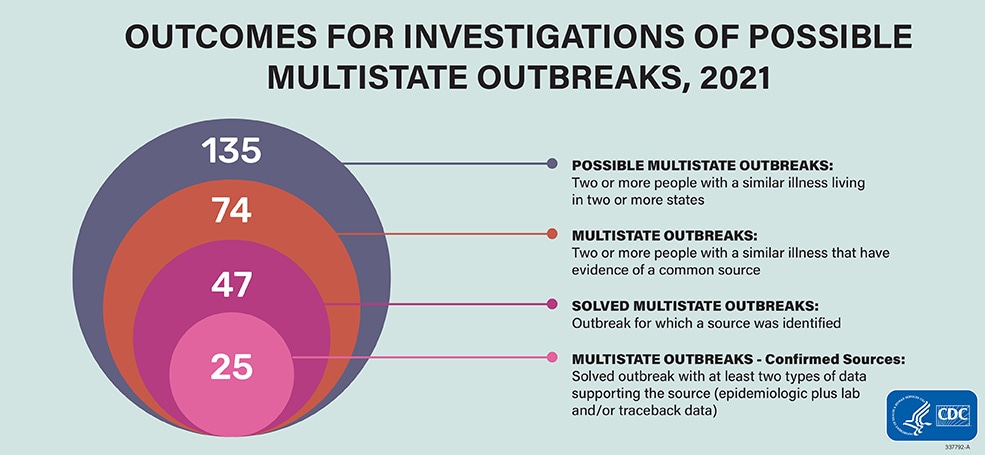
This analysis includes 135 possible multistate outbreak investigations during 2021.

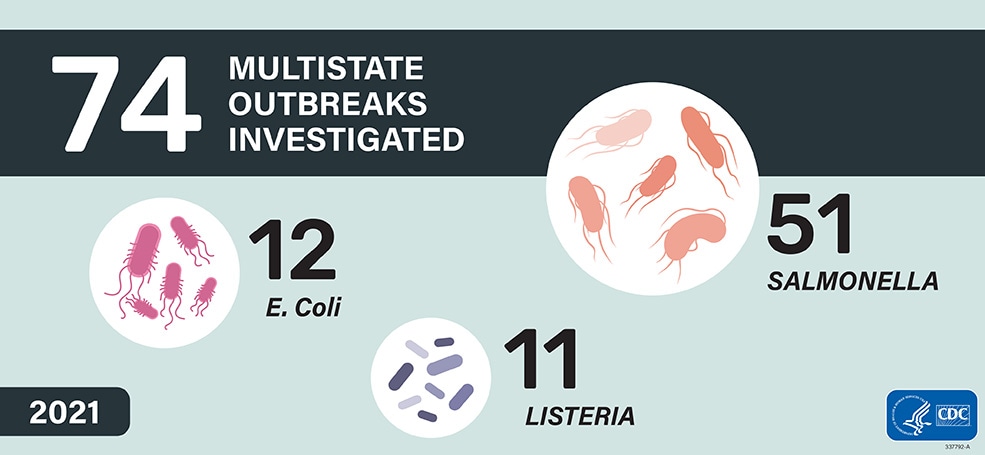
This analysis includes 135 investigations of possible multistate enteric (intestinal) outbreaks during 2021. Some possible outbreaks were excluded from this report because they were determined to be single state or because they were linked to international travel. After investigation, 74 (55%) of these were determined to be multistate outbreaks, and investigators solved 47 (64%) of these outbreaks.

Multistate Outbreaks

74 (55%) of the 135 investigations were determined to be multistate outbreaks.

The number of outbreaks increased from 2020 but was lower than the 82 investigated outbreaks in 2019. The number of outbreaks investigated in 2021 was likely lower than that in 2019 due in part to continued effects of the COVID-19 pandemic on enteric disease outbreak detection and investigation (e.g., decreased resources at local, state, and federal public health agencies, changes in healthcare-seeking behavior, and changed restaurant dining and grocery shopping patterns.) Additionally, changing diagnostic testing practices likely continued to affect enteric disease surveillance and the ability to identify possible outbreaks.

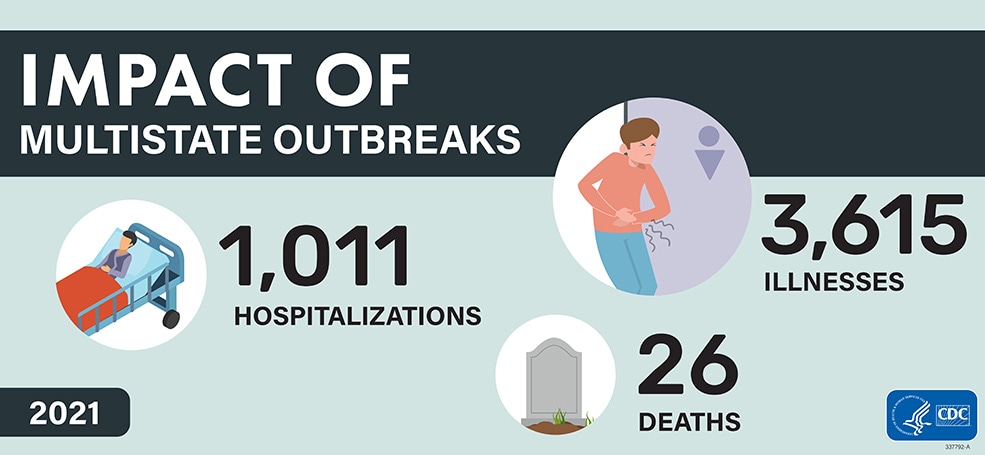
The 74 investigated multistate outbreaks resulted in 3,615 illnesses, 1,011 hospitalizations, and 26 deaths

Solved Multistate Outbreaks

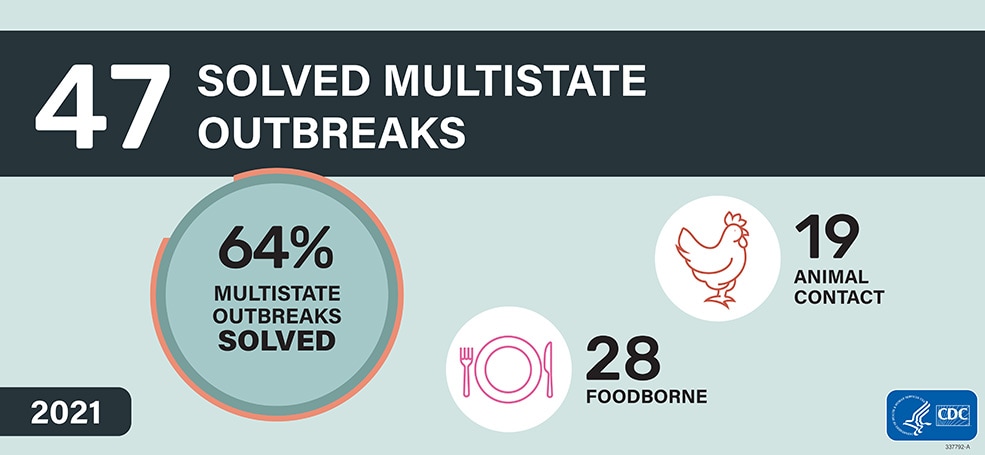
Among the 74 investigated multistate outbreaks, 47 (64%) were solved, including 25 outbreaks with confirmed sources and 22 with suspected sources.

Among the 74 multistate outbreaks, 47 (64%) were solved, meaning a confirmed or suspected source of the outbreak was identified, including 25 (53%) outbreaks with confirmed sources and 22 (47%) with suspected sources. Among the 47 solved outbreaks, 28 (60%) were linked to contaminated foods, and 19 (40%) were linked to animal contact.

Solved multistate outbreaks caused at least 2,047 illnesses. Solved multistate outbreaks linked to contaminated food caused 1,740 illnesses, 496 hospitalizations, and 15 deaths, while multistate outbreaks linked to animal contact caused 1,307 illnesses, 329 hospitalizations, and 3 deaths.

UK – Mogul Restaurant in Bagshot prosecuted for food safety failures.

Surrey Heath

Surrey Heath Borough Council has successfully prosecuted the previous operator of Mogul Restaurant for failing to comply with food safety regulations following a significant food poisoning outbreak amongst customers at the end of 2022.

The company has been ordered to pay a fine of £25,000, a victim surcharge of £2,000 and the Council’s costs of £14,116.

This prosecution is in addition to the restaurant being temporarily shut under Emergency Prohibition provisions to protect further risk of ill health to the public at the time of the outbreak whilst the necessary improvements were made.

Denmark – Polish chicken kebab is linked to Danish salmonella outbreak

SSI

Since May, 22 people have been registered in Denmark with the same salmonella type, which has also made people sick in other European countries. Now the investigation has shown that imported chicken kebab meat from Poland is also the source of infection for the Danish cases.

Last edited on August 29, 2023
Last week, the Danish Veterinary and Food Administration found salmonella in a batch of frozen chicken kebab meat from Poland, and the batch was withdrawn from the market. Further analyzes have shown that it is the same type of salmonella that made 22 people sick in Denmark in the period May to August 2023. It is estimated that more people may have been infected, as not all infected people go to the doctor and are tested for salmonella. The frozen chicken kebab products have mainly been sold to restaurants.

“The investigation into this salmonella outbreak has been extensive – partly there has been international collaboration to compare salmonella samples from humans and food, and partly we in the Danish food emergency department have interviewed patients and unraveled where the chicken kebab meat they had eaten came from. We have now found a clear connection between the salmonella type in the chicken kebab meat and the salmonella type in the Danish cases,” says epidemiologist at the Statens Serum Institut, Luise Müller.

“In general, it is the restaurant’s responsibility that consumers do not get sick from the food that is served. The Salmonella bacteria cannot survive heat treatment above 75 degrees,” says Senior researcher and research group leader at the DTU Food Institute Marianne Sandberg.

Head of unit Lene Mølsted Jensen from the Danish Food and Drug Administration states: “The chicken kebab meat from Poland was pre-fried and intended to be further heat-treated before eating. It is therefore an important lesson for restaurants and kebab places that in the future they pay attention to the handling and frying of chicken kebab meat to avoid this happening again.”

In the coming time, the Danish Food and Food Administration will keep an extra eye on whether other batches of chicken products from Poland may be contaminated with salmonella.

What should you do if you have eaten chicken kebab?

If you have not had symptoms of a salmonella infection, or if you have had symptoms that have resolved on their own, do not take any action. In case of persistent symptoms or questions, you can contact your own doctor.

The coordination of the investigation of the disease outbreak has taken place under the auspices of the Central Outbreak Group. It consists of representatives from SSI, the DTU Food Institute and the Danish Veterinary and Food Administration.

India – Maharashtra: 170 Students From Sangli Orphanage School Hospitalised; Food Poisoning Suspected

Free Press Journal

Maharashtra: Around 170 students at an orphanage school in Sangli were hospitalised on Monday following a suspected case of food poisoning. The students, aged 5 to 15, complained of nausea, vomiting, and diarrhoea shortly after consuming dinner served by the school staff.

Prompt action was taken, and the affected students were swiftly transported to the rural first aid centre at Madgyal. However, the situation worsened for some, leading to their admission to Sangli and Miraj government hospitals. Over 50 children were admitted to these hospitals as their symptoms aggravated.

USA – University of Arkansas officials report E. coli outbreak

Food Safety News

State and federal public health officials are working with the University of Arkansas on what appears to be an outbreak of E. Coli infections.

During a news conference this afternoon, a spokesman from the Arkansas Department of Health said four people were hospitalized. Also, about 100 students from the university responded to an email saying they currently have or have recently had symptoms.

The total number of confirmed outbreak patients has not been released.

The spokesman said the outbreak seems limited to the Northeast part of the state. He also said the state department and university officials are working with the U.S. Centers for Disease Control and Prevention to investigate the outbreak.

The spokesman said health officials believe the outbreak started about a week ago.