Category Archives: Food Testing

Canada – Updated Food Recall Warning – Certain pork products recalled due to E. coli O157:H7

CFIA

Recall details

Ottawa, April 27, 2018 – The food recall warning issued on April 26, 2018 has been updated to include additional product information. This additional information was identified during the Canadian Food Inspection Agency’s (CFIA) food safety investigation.

Industry is recalling certain pork products from the marketplace due to possible E. coli O157:H7 contamination. Consumers should not consume and distributors, retailers and food service establishments, such as hotels, restaurants and cafeterias, should not sell or use the recalled products described below.

Recalled products

Brand Name Common Name Size Code(s) on Product UPC
Rimbey Foods Ltd. Sliced Pork Belly Variable Sold from February 19 up to and including April 27, 2018 Starts with 0 200118
Fuge Fine Meat Salchicha de Huacho Sausage 630 g All Best Before dates from May 3, 2018 up to and including May 26, 2018 None
Fuge Fine Meat Maple Sage Bratwurst Sausage 630 g All Best Before dates from May 3, 2018 up to and including May 26, 2018 None
Fuge Fine Meat DD Bratwurst Sausage 630 g All Best Before dates from May 3, 2018 up to and including May 26, 2018 None

Research – Plant-Microbe and Abiotic Factors Influencing Salmonella Survival and Growth on Alfalfa Sprouts and Swiss Chard Microgreens

AEM kswfoodworld Salmonella

Microgreens, like sprouts, are relatively fast-growing products and are generally consumed raw. Moreover, as observed for sprouts, microbial contamination from preharvest sources may also be present in the production of microgreens. In this study, two Salmonella enterica serovars (Hartford and Cubana), applied at multiple inoculation levels, were evaluated for survival and growth on alfalfa sprouts and Swiss chard microgreens by using the most-probable-number (MPN) method. Various abiotic factors were also examined for their effects on Salmonella survival and growth on sprouts and microgreens. Community-level physiological profiles (CLPPs) of sprout/microgreen rhizospheres with different levels of S. enterica inoculation at different growth stages were characterized by use of Biolog EcoPlates. In the seed contamination group, the ability of S. enterica to grow on sprouting alfalfa seeds was affected by both seed storage time and inoculation level but not by serovar. However, the growth of S. enterica on Swiss chard microgreens was affected by serovar and inoculation level. Seed storage time had little effect on the average level of Salmonella populations in microgreens. In the irrigation water contamination group, the growth of Salmonella on both alfalfa sprouts and microgreens was largely affected by inoculation level. Surprisingly, the growth medium was found to play an important role in Salmonella survival and growth on microgreens. CLPP analysis showed significant changes in the microbial community metabolic diversity during sprouting for alfalfa sprouts, but few temporal changes were seen with microgreens. The data suggest that the change in rhizosphere bacterial functional diversity was dependent on the host but independent of Salmonella contamination.

Research – Listeriosis Outbreaks Associated with Soft Cheeses, United States, 1998–2014

CDC

Abstract

Since 2006, the number of reported US listeriosis outbreaks associated with cheese made under unsanitary conditions has increased. Two-thirds were linked to Latin-style soft cheese, often affecting pregnant Hispanic women and their newborns. Adherence to pasteurization protocols and sanitation measures to avoid contamination after pasteurization can reduce future outbreaks.

Listeria monocytogenes is a widely distributed environmental bacterium that can grow at refrigeration temperatures. Infection can cause severe illness and death. Persons at higher risk for infection include older adults, persons with weakened immune systems, and pregnant women and their newborns.

Listeriosis outbreaks have been associated with refrigerated ready-to-eat foods, including hot dogs, delicatessen meats, soft cheeses, milk, and other dairy products. For soft-ripened cheeses, the risk for listeriosis per serving is estimated to be 50- to 160-fold greater for cheese made from unpasteurized milk than pasteurized milk (1). Pasteurization kills L. monocytogenes; however, milk labeled as pasteurized and dairy products made from pasteurized milk can become contaminated due to inadequate hygiene practices after pasteurization. The earliest reported listeriosis outbreak in the United States in 1985, associated with Latin-style cheese (in particular, queso fresco and cotija), resulted in 142 illnesses, 28 deaths, and 20 fetal losses (2). Although the cheese was labeled as made from pasteurized milk, raw milk was inadvertently introduced into the pasteurized milk.

A US retail survey of several soft cheeses (Latin-style, blue-veined, mold-ripened) from 2000–2001 detected L. monocytogenes in 1.3% of cheeses made from unlabeled or unpasteurized milk and 0.5% of cheeses from pasteurized milk (3). However, pasteurized-milk cheese is much more commonly consumed than cheese made from unpasteurized milk. In a survey of food exposures conducted in 10 US states during 2006–2007, respondents reported eating types of soft cheeses (15.3% for blue-veined cheese, 6%–11% for other soft cheeses; pasteurization status unknown) more frequently than they reported eating cheeses made from unpasteurized milk in the previous 7 days (1.6%) (4). We describe outbreaks linked to soft cheese (both soft-ripened and acid-coagulated–ripened cheeses), demographic characteristics of the persons affected, and possible contributing factors to help inform prevention messaging for persons at higher risk.

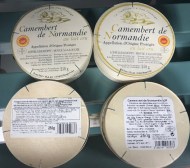
Ireland – Recall of Camembert de Normandie Cheese Sold at Avoca Stores Due to Possible Presence of E. coli O26

FSAI CamembertPhoto(1)

Summary
Category 2: For Information
Alert Notification: 2018.16
Product: Camembert de Normandie au lait cru, 250 g. Approval number FR 14 608 001 CE.
Batch Code: 260218DS0; use-by date: 02.05.18.
Country Of Origin: France

Canada – Updated Food Recall Warning – Certain pork products sold in Alberta recalled due to E. coli O157:H7

CFIA

Recall details

Ottawa, April 26, 2018 – The food recall warning issued on April 24, 2018 has been updated to include additional distribution information. This additional information was identified during the Canadian Food Inspection Agency’s (CFIA) food safety investigation.

The Meat Shop at Pine Haven is recalling certain pork products from the marketplace due to possible E. coli O157:H7 contamination. Consumers should not consume and distributors, retailers and food service establishments, such as hotels, restaurants and cafeterias, should not sell or use the recalled products.

The affected pork products, supplied by The Meat Shop at Pine Haven, may have been transformed into raw muscle meat cuts, ground pork, sausages, and raw ready-to-eat products. The products, which have been sold fresh or frozen, have only been distributed in Alberta.

The affected products are known to have been sold or distributed by the companies listed below from February 19, 2018 up to and including April 26, 2018. These products may have been sold pre-packaged or clerk-served, with or without a label. Consumers who are unsure if they have the affected products are advised to check with their retailer.

Company Name Address City
Acme Meat Market 9570 76 Avenue NW Edmonton
H & A Food Sales and Services 385059 Range Road 60 Alhambra

Canada – Updated Food Recall Warning – Certain Real Deal Meats brand pork products recalled due to E. coli O157:H7

CFIA

Recall details

Ottawa, April 26, 2018 – The food recall warning issued on April 25, 2018 has been updated to include additional product information. This additional information was identified during the Canadian Food Inspection Agency’s (CFIA) food safety investigation.

Real Deal Meats Ltd. is recalling certain pork products from the marketplace due to possible E. coli O157:H7 contamination. Consumers should not consume and distributors, retailers and food service establishments, such as hotels, restaurants and cafeterias, should not sell or use the recalled products described in the link above.

RASFF Alerts – Ochratoxin A – Sultana – Raisins

kswfoodworld food safety poisoning

RASFF-ochratoxin A (15.2 µg/kg – ppb) in raisins from Turkey in the UK

RASFF-ochratoxin A (13.6 mg/kg – ppm) in sultana raisins from Turkey in Bulgaria

RASFF-ochratoxin A (38.8 µg/kg – ppb) in raisins from Turkey, via Belgium in Germany

RASFF Alert – Mould – Parboiled Rice

kswfoodworld food safety poisoning

RASFF-abnormal smell of mould of parboiled rice from Myanmar in Poland

RASFF Alert – STEC E.coli – E.coli – Camembert Cheese

kswfoodworld food safety poisoning

RASFF-shigatoxin-producing Escherichia coli (stx1+, stx2+, eae+ /25g) and high count of Escherichia coli (140 CFU/g) in camembert cheese from France in Germany

RASFF Alert – Foodborne Outbreak – Salmonella – Fuet Sausage – France

kswfoodworld food safety poisoning

RASFF-foodborne outbreak caused by Salmonella (4, 5, 12:i:-) in fuet sausage from Spain in France