Category Archives: Food Microbiology Testing

Research – Local Salmonella Enteritidis restaurant outbreak investigation in England provides further evidence for eggs as source in widespread international cluster, March to April 2023

Eurosurveillance

An outbreak of food-borne infection linked to a restaurant was reported to the UK Health Security Agency (UKHSA) East of England Health Protection Team (HPT) in early April 2023. Whole genome sequencing (WGS) results indicated  Enteritidis infection, with all cases in a 5-single nucleotide polymorphism (SNP) cluster falling into a wider genomically diverse 10-SNP cluster investigated in several countries. We identified additional cases in the 5-SNP cluster with no known links to the restaurant, and historical cases reported since July 2022.

Our investigations aimed to define common exposures for cases in the 5-SNP cluster to determine the likely source of infection and implement control measures.

A confirmed case was defined as a person with laboratory-confirmed  Enteritidis infection belonging to the 5-SNP cluster 1.2.3.18.180.7268.% [1] in England since 1 March 2023. A probable case was defined as a person with gastroenteritis or confirmed  spp. infection in England who dined at the restaurant of interest from 1 March to 1 April 2023. Confirmed cases were further categorised as having known, unknown or no exposure to the restaurant.

In early April 2023, UKHSA was notified via Accident and Emergency doctors, general practitioners, and a local authority environmental health (EH) department of multiple cases of gastroenteritis following food consumption at a restaurant, with attendance or take-away dates in late March. We identified  Enteritidis as the causative organism.  isolates are routinely sent to the UKHSA Gastrointestinal Bacteria reference unit (GBRU) for sequencing [2]. The outbreak cases were confirmed to be within a 5-SNP cluster defined at UKHSA as 1.2.3.18.180.7268.% matching the Enterobase cgMLST hierarchical cluster HC2_316378 [3], falling into a wider genomically diverse cluster 1.2.3.18.180.%/HC5_2301 that is subject to several national and international investigations.

Cases identified through initial case notifications were interviewed using generic food history questionnaires; for cases notified since 2 May 2023, a bespoke menu-based questionnaire was used. Early cases were re-interviewed with the bespoke questionnaire completed by telephone or online. Additional cases identified through WGS were contacted to establish whether they were linked to the restaurant, and if so, asked to complete the bespoke questionnaire by telephone or online. Cases who did not reveal exposure to the restaurant completed a modified  trawling questionnaire focussed on poultry products.

Quebec- Notice not to consume the Pam Pi Gou brand 100% Haitian seasoning mix sold by the company Épicerie antillais et casse-croute Ében-Ézer – Clostridium botulinum

Quebec

QUEBEC CITY , July 6. 2, 2023 /CNW/ – The Ministère de l’Agriculture, des Pêcheries et de l’Alimentation (MAPAQ), in collaboration with Épicerie antillais et casse-croute Ében-Ézer, located at 125, rue Valmont, in Repentigny , advises the population not to consume the product indicated in the table below, because it has not been prepared and packaged in such a way as to ensure its harmlessness. Indeed, this product could promote the proliferation of the bacterium  Clostridium botulinum .

Product name

Format

Affected lot

“100% HAITIAN SEASONING”

500ml  _

Units sold until July 5, 2023

The product that is the subject of this warning was offered for sale until July 5, 2023, and only at the place designated above. The product was packaged in a Mason type glass jar and sold chilled. The product label includes, in addition to its name, the words “PAM PI GOU”.

The operator is voluntarily recalling the product in question. It has agreed with MAPAQ to issue this warning as a precautionary measure. In addition, people who have this product in their possession are advised not to consume it. They must return it to the establishment where they bought it or throw it away.

Even if the affected product shows no sign of tampering or suspicious odor, it could be contaminated with Clostridium botulinum bacteria . Foods contaminated with the toxin of this bacterium can cause, when ingested, the following symptoms: facial paralysis, non-reactive or fixed pupils, difficulty swallowing, droopy eyelids, vision and speech disorders. In severe cases, the disease can cause death.

It should be noted that no case of illness associated with the consumption of this food has been reported to MAPAQ to date.

Belgium – Poultry hamburger – Salmonella

AFSCA

Recall from Fiers NV
Product: Poultry hamburger
Nature of the problem: presence of Salmonella

In agreement with the FASFC, Fiers NV withdraws the Poultry Hamburger from sale and recalls it from consumers due to the presence of Salmonella.
Fiers NV asks its customers not to consume this product and to return it to the point of sale where it was purchased, where it will be refunded.

Product description

– Product name: Poultry hamburger
– Brand: Fiers
– Use-by dates (BBD) (“Use by”): 04-07-2023 / 05-07-2023 / 06-07-2023
– Batch number: 79393 – 79553 – 79691
– Sales period: from 06/27/2023 to 06/29/2023
– Type of packaging: transparent plastic dish
– Weight: 2 pieces per packaging

06/07/2023
Recall from Fiers NV
Product: Poultry hamburger
Nature of the problem: presence of Salmonella


In agreement with the FASFC, Fiers NV withdraws the Poultry Hamburger from sale and recalls it from consumers due to the presence of Salmonella.
Fiers NV asks its customers not to consume this product and to return it to the point of sale where it was purchased, where it will be refunded.Product description

– Product name: Poultry hamburger
– Brand: Fiers
– Use-by dates (BBD) (“Use by”): 04-07-2023 / 05-07-2023 / 06-07-2023
– Batch number: 79393 – 79553 – 79691
– Sales period: from 06/27/2023 to 06/29/2023
– Type of packaging: transparent plastic dish
– Weight: 2 pieces per packaging

The product was distributed by:

CARREFOUR EXPRESS NIEUWPOORT Albert I Laan 213, 8620 Nieuwpoort
GB ZWIJNAARDE ZWIJNAARDSESTEENWEG 736, 9000 GENT
GB MARKET AALST Hovenierstraat 20, 9300 Aalst
Proxy Denderleeuw A. DE COCKSTRAAT 13, 9470 Denderleeuw

For any additional information , contact Mrs. Vandenheede; kwaliteit@fiers.net or 04778/493117

New in August on Netflix – Poisoned: The Dirty Truth About Your Food

Food Poison Journal

The doc first premiered at the Tribeca Film Festival with multiple screenings taking place between June 9th and June 17th first premiering at the SVA Theatre on June 9th.  It also was shown in the author, Jeff Benedict’s, hometown, as well as Bill Marler’s, the main character of the film.

Here’s what you can expect from the documentary based on the book Poisoned by Jeff Benedict (which has an updated cover to reflect the Netflix adaptation).Netflix was first announced to be attached to develop the documentary on the 2011 book back in November 2022.  Here is the link and the cover:

France – Pâté and rillettes – Possible Poisoning

Gov france

Identification information of the recalled product

  • Product category Feed
  • Product subcategory Meats
  • Product brand name Western Whites
  • Model names or references Black pudding pâté Black pudding pâté with apples Angevin pâté Country pâté Plain rillettes
  • Identification of products
    Batch Date
    All lots Use-by date between 01/12/2021 and 05/07/2023
  • Packaging 200g glass jars
  • Marketing start/end date From 01/12/2021 to 05/07/2023
  • Storage temperature Product to be stored at room temperature
  • Further information Transparent jars with a black lid
  • Geographic area of ​​sale Departments: MAINE-ET-LOIRE (49)
  • Distributors grocery

Practical information regarding the recall

  • Reason for recall labeling error and lack of sterilization
  • Risks incurred by the consumer Poisoning

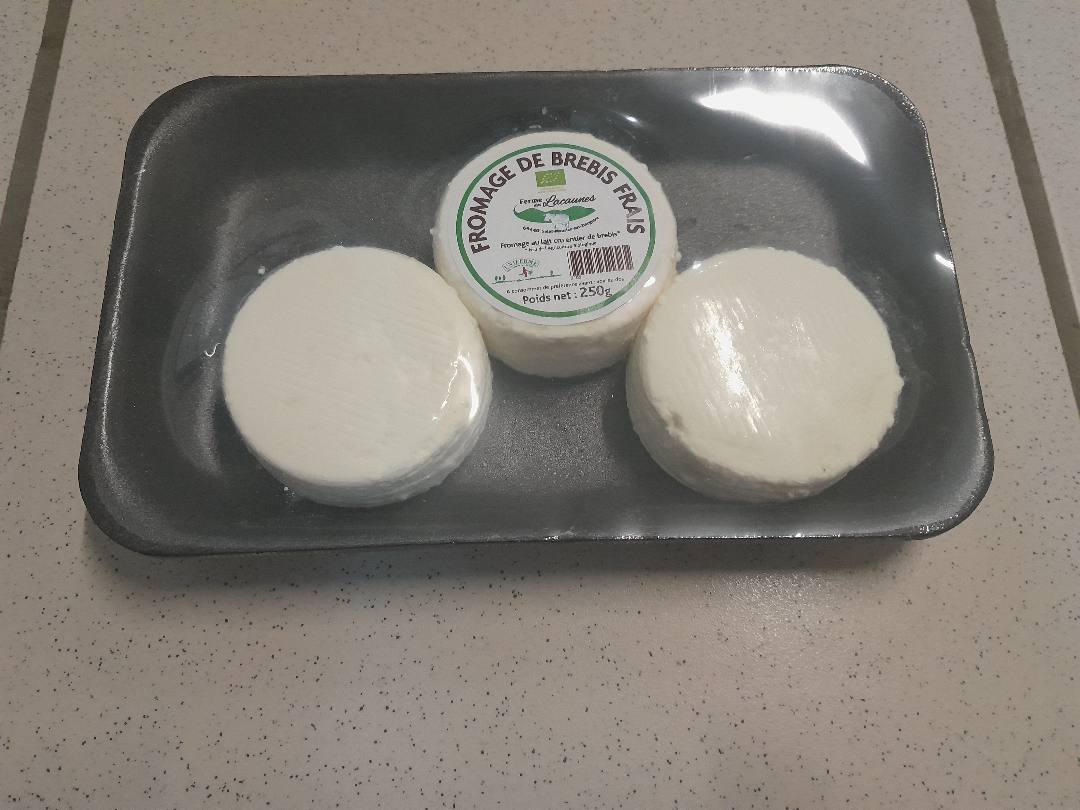
France – FRESH SHEEP CHEESE X3 – Salmonella

Gov france

Identification information of the recalled product

  • Product category Feed
  • Product subcategory Milk and dairy products
  • Product brand name THE LACAUNES FARM
  • Model names or references FRESH SHEEP CHEESE X3
  • Identification of products
    Batch Date
    2606F Use-by date 07/09/2023
  • Marketing start/end date From 06/27/2023 to 07/01/2023
  • Storage temperature Product to be stored in the refrigerator
  • Geographic area of ​​sale Departments: RHONE (69)
  • Distributors UNIFARM

France – SPICY SHEEP CHEESE X2 – Salmonella

Gov france

Identification information of the recalled product

  • Product category Feed
  • Product subcategory Milk and dairy products
  • Product brand name THE LACAUNES FARM
  • Model names or references SPICY SHEEP CHEESE X2
  • Identification of products
    Batch Date
    2606F Use-by date 07/09/2023
  • Marketing start/end date From 06/27/2023 to 07/01/2023
  • Storage temperature Product to be stored in the refrigerator
  • Geographic area of ​​sale Departments: RHONE (69)
  • Distributors UNIFARM

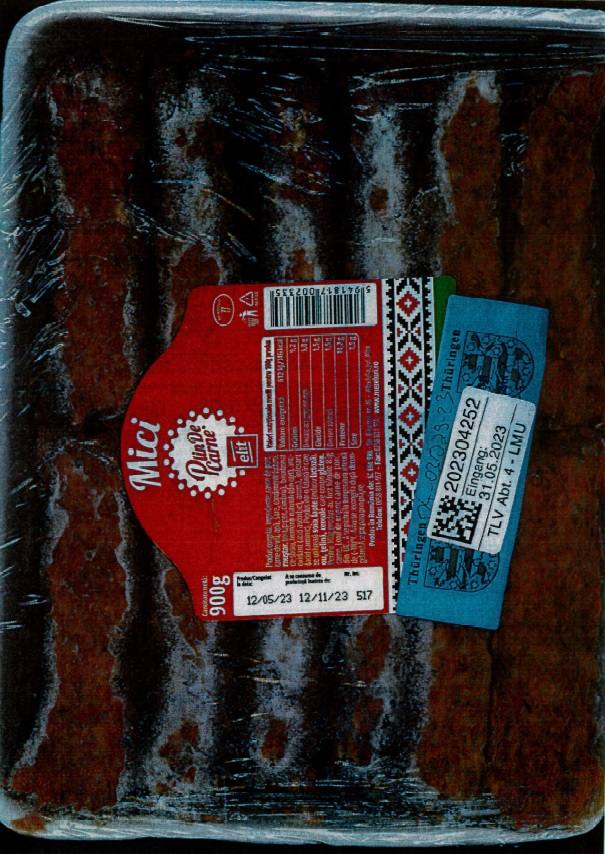
France – Mici – Carne Pine -Salmonella

Gov france

Identification information of the recalled product

  • Product category Feed
  • Product subcategory Meats
  • Product brand name elect
  • Model names or references Mici (Romanian sausages without skin)
  • Identification of products
    GTIN Batch Date
    3941817002335 517 Date of minimum durability 12/11/2023
  • Packaging 900g
  • Storage temperature Product to keep in the freezer
  • Geographic area of ​​sale Departments: SEINE-SAINT-DENIS (93)
  • Distributors Dana & Pop

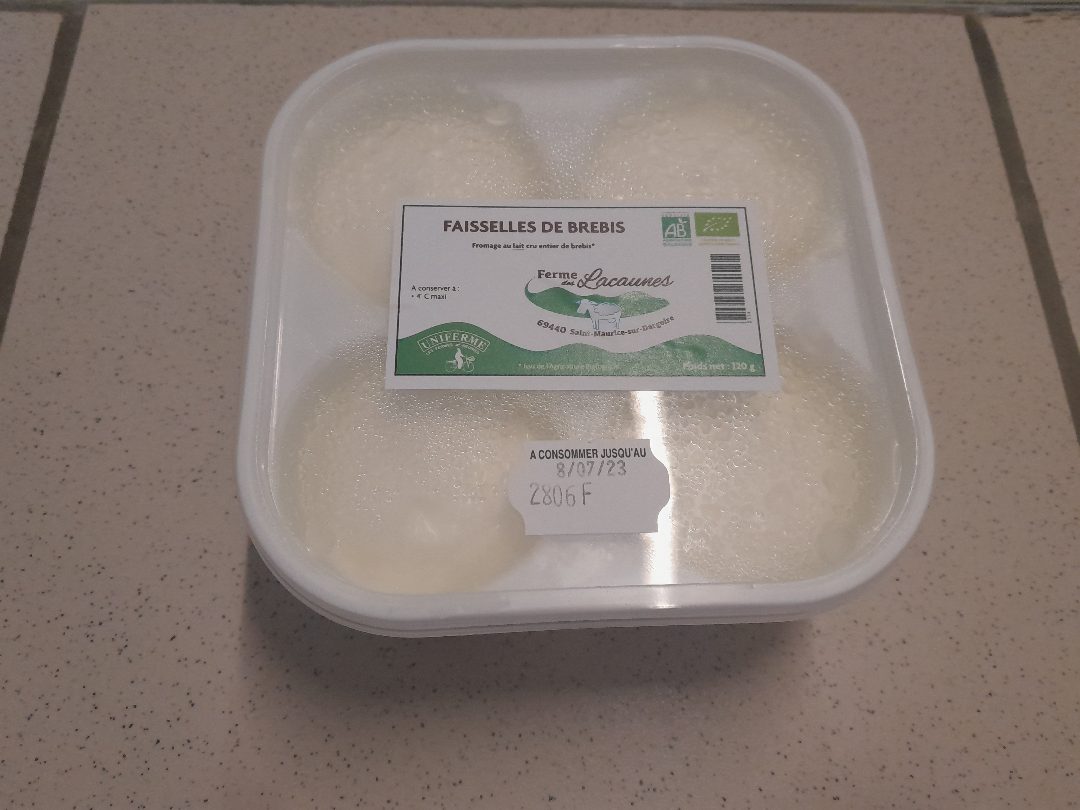
France – SHEEP CHEESE 4x 100g – Salmonella

Gov france

Identification information of the recalled product

  • Product category Feed
  • Product subcategory Milk and dairy products
  • Product brand name THE LACAUNES FARM
  • Model names or references SHEEP CHEESE 4X 100g
  • Identification of products
    Batch Date
    2606F Use-by date 07/09/2023
  • Marketing start/end date From 06/27/2023 to 07/01/2023
  • Storage temperature Product to be stored in the refrigerator
  • Geographic area of ​​sale Departments: RHONE (69)
  • Distributors UNIFARM

Sweden – Increase in cases of illness with Campylobacter infection

Folkhalsomyndigheten

Campylobacter kswfoodworld

In recent weeks, there has been an increase in the number of people who have contracted campylobacter infection. The rise in the number of cases is preceded by an increase in campylobacter in broiler flocks. Good hygiene when handling raw chicken reduces the risk of becoming infected.

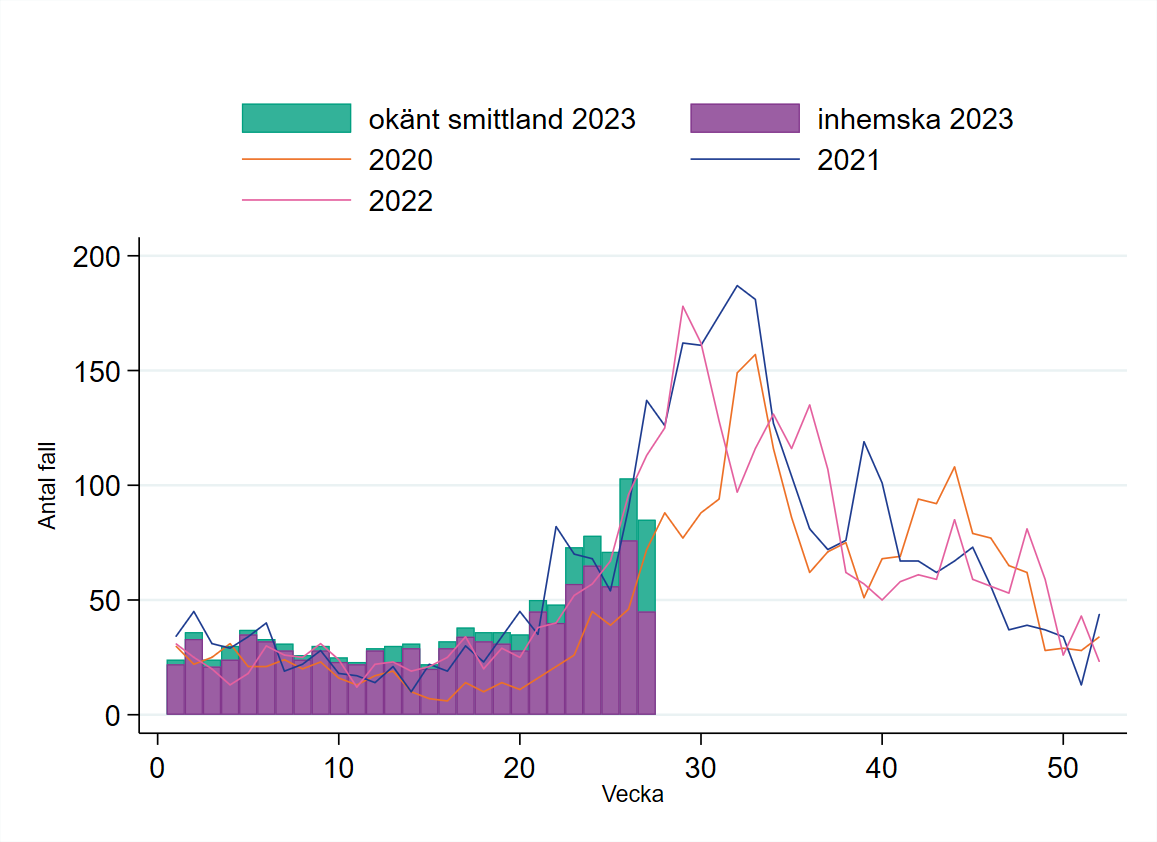
There has been an increase in the number of people who have been infected by the intestinal bacteria campylobacter in recent weeks. During week 26, the number of reported cases increased further compared to previous weeks and the increase looks set to continue.

Figure: The number of reported cases of campylobacter per week infected in Sweden or with an unknown country of infection (230706). Week 27 is not yet complete.

The number of sick people increased from week 21 to 60 cases per week from 30 cases.  In week 26, the cases increased further, a similar increase is seen in 2020-2022.

From mid-June, an increase in the occurrence of campylobacter in Swedish broiler flocks has also been observed. Previous studies have shown a connection between campylobacter infection and the consumption of fresh chicken, where around a third of those who have contracted the disease have been linked to fresh chicken. Campylobacter infection in humans is more common in summer as is the presence of campylobacter in broiler flocks.