Category Archives: Food Microbiology Research

Research – Tomato juice’s antimicrobial properties can kill Salmonella

Science Daily

Tomato juice can kill Salmonella Typhi and other bacteria that can harm people’s digestive and urinary tract health, according to research published this week in Microbiology Spectrum, a journal of the American Society for Microbiology. Salmonella Typhi is a deadly human-specific pathogen that causes typhoid fever.

“Our main goal in this study was to find out if tomato and tomato juice can kill enteric pathogens, including Salmonella Typhi, and if so, what qualities they have that make them work,” said principal study investigator Jeongmin Song, Ph.D., Associate Professor, Department of Microbiology & Immunology, Cornell University.

Research – Risks for animal health related to the presence of ergot alkaloids in feed

EFSA

The European Commission requested EFSA to provide an update of the 2012 Scientific Opinion of the Panel on Contaminants in the Food Chain (CONTAM) on the risks for animal health related to the presence of ergot alkaloids (EAs) in feed. EAs are produced by several fungi of the Claviceps and Epichloë genera. This Opinion focussed on the 14 EAs produced by C. purpurea (ergocristine, ergotamine, ergocornine, α‐ and β‐ergocryptine, ergometrine, ergosine and their corresponding ‘inine’ epimers). Effects observed with EAs from C. africana (mainly dihydroergosine) and Epichloë (ergovaline/−inine) were also evaluated. There is limited information on toxicokinetics in food and non‐food producing animals. However, transfer from feed to food of animal origin is negligible. The major effects of EAs are related to vasoconstriction and are exaggerated during extreme temperatures. In addition, EAs cause a decrease in prolactin, resulting in a reduced milk production. Based on the sum of the EAs, the Panel considered the following as Reference Points (RPs) in complete feed for adverse animal health effects: for pigs and piglets 0.6 mg/kg, for chickens for fattening and hens 2.1 and 3.7 mg/kg, respectively, for ducks 0.2 mg/kg, bovines 0.1 mg/kg and sheep 0.3 mg/kg. A total of 19,023 analytical results on EAs (only from C. purpurea) in feed materials and compound feeds were available for the exposure assessment (1580 samples). Dietary exposure was assessed using two feeding scenarios (model diets and compound feeds). Risk characterisation was done for the animals for which an RP could be identified. The CONTAM Panel considers that, based on exposure from model diets, the presence of EAs in feed raises a health concern in piglets, pigs for fattening, sows and bovines, while for chickens for fattening, laying hens, ducks, ovines and caprines, the health concern related to EAs in feed is low.

Research – The antimicrobial effect of eugenol against Campylobacter jejuni on experimental raw chicken breast meat model

Wiley Online

Campylobacter jejuni is the predominant bacterial cause of gastroenteritis, the main cause of foodborne deaths. Currently, Campylobacter is a common foodborne pathogen found in poultry; thus, there is a need for the development of novel intervention strategies. The aim of the study was to examine the effect of eugenol on C. jejuni load in an experimental chicken meat model. We observed that eugenol was effective in reducing C. jejuni load for 7 days of storage. Eugenol treatment at all concentrations (1.28, 5.12, and 10.24 mg mL−1) decreased Campylobacter load more significantly in the reference strain, and this decrease was dose-dependent throughout the storage period. Compared to the control group, eugenol reduced the counts of chicken isolate and the reference strain of C. jejuni by approximately 1.5 and 4.5 log/CFU, respectively, after 7 days of storage. Eugenol is a promising agent for improving the safety of poultry.

UK – Könecke Sp. Z.o.o recalls Yayla Sucuk (sausage) because of contamination with E. coli

FSA

Könecke Sp. Z.o.o is recalling Yayla Sucuk (sausage) because Shiga toxin-producing E. coli has been found in a batch of this product.

Product details

: Yayla Sucuk (sausage)
Pack size 200g
Batch code 10865984
Best before 14 January 2024, 26 January 2024, 23 February 2024 and 01 March 2024

Risk statement

Shiga toxin-producing E. coli has been found in a batch of the product listed above.

Symptoms caused by STEC organisms include severe diarrhoea (including bloody diarrhoea), abdominal pain, and sometimes haemolytic uremic syndrome, (HUS), a serious condition that can lead to kidney failure and can be fatal.

Action taken by the company

Könecke Sp. Z.o.o is recalling the above product. Point of sale notices will be displayed in stores where the product was sold. These notices explain to customers why the product is being recalled and tell them what to do if they have bought the product. Please see the attached photo of the product.

Our advice to consumers

If you have bought the above product do not eat it. Instead return it to the store from where it was bought for a full refund.

Research – A comparison of European surveillance programs for Campylobacter in broilers

Science Direct

Campylobacter kswfoodworld

Abstract

Campylobacter is an important foodborne pathogen as it is associated with significant disease burden across Europe. Among various sources, Campylobacter infections in humans are often related to the consumption of undercooked poultry meat or improper handling of poultry meat. Many European countries have implemented measures to reduce human exposure to Campylobacter from broiler meat. In this paper, surveillance programs implemented in some European countries is summarized. Our findings reveal that many European countries test neck skin samples for Campylobacter as per the Process Hygiene Criterion (PHC) set by the European Regulation. Variations to the legal plan are seen in some countries, as in Norway and Iceland, where weekly sampling is performed during infection peak periods only, or in Iceland, where the Campylobacter limit is set at 500 CFU/g instead of 1000 CFU/g. Furthermore, northern European countries have implemented national Campylobacter surveillance plans. Denmark tests cloaca and leg skin samples at the slaughterhouses and meat samples at the retail, while Finland, Norway, and Sweden test caeca at slaughterhouses. In contrast, Iceland tests feces on farms. Iceland and Norway test flocks close to the slaughter date and when a farm tests positive, competent authority implement measures such as logistic slaughter, heat treatment or freeze the meat from these flocks. In Iceland, frozen meat is further processed prior to being put on the market. While the incidence of campylobacteriosis has declined in all European countries except France since the introduction of PHC in 2018, it is uncertain whether this decrease is due to prevalence reduction or underreporting during the COVID-19 pandemic. Future investigations with more comprehensive data, devoid of potential confounding factors, are necessary to validate this potential trend. However, it is evident that the implementation of national action plans can be successful in reducing the incidence of human campylobacteriosis, as demonstrated by Iceland.

Research – Efficiency of Electronic Nose in Detecting the Microbial Spoilage of Fresh Sardines (Sardinella longiceps)

MDPI

Abstract

The assessment of microbial spoilage in fresh fish is a major concern for the fish industry. This study aimed to evaluate the efficiency and reliability of an electronic nose (E-nose) to detect microbial spoilage of fresh sardines (Sardinella longiceps) by comparing its measurements with Total Bacterial Count (TBC), Hydrogen Sulfide (H2S) producing bacterial count and Trimethylamine Oxide (TMAO) reducing bacterial count after variable storage conditions. The samples were stored at 0 °C (0, 2, 4, 6, and 8 days) and 25 °C (0, 3, 6, and 9 h), while day 0 was used as a control. The E-nose measurements were analyzed by Principal Component Analysis (PCA), Linear Discriminant Analysis (LDA) and Artificial Neural Network (ANN). Microbial counts increased significantly and simultaneously with the changes in E-nose measurements during storage. The LDA and ANN showed a good classification of E-nose data for different storage times at two storage temperatures (0 °C and 25 °C) compared to PCA. It is expected as PCA is based on linear relationships between the factors, while ANN is based on non-linear relationships. Correlation coefficients between E-nose and TBC, TMAO-reducing bacterial and H2S-producing bacterial counts at 0 °C were 0.919, 0.960 and 0.915, respectively, whereas at 25 °C, the correlation coefficients were 0.859, 0.945 and 0.849, respectively. These positive correlations qualify the E-nose as an efficient and reliable device for detecting microbial spoilage of fish during storage.

Research – The Survival of Salmonella enterica Strains in Ready-to-Eat Fruit Purees under Different Storage Temperatures

MDPI

Salmonella enterica, known for its resilience to acidic environments, has been linked to foodborne outbreaks of illness from fruit derivatives. This study aimed to assess the survival of five serovars of Salmonella enterica subsp. enterica in various fruit purees subjected to different storage temperatures. Among the studied serovars, S. enteritidis exhibited the most significant population decrease in all fruit purees. In contrast, S. Agona, S. Gaminara, S. Michigan, and S. Montevideo survived in peach puree at 4 °C for at least 3 days, and S. Agona, S. Gaminara, and S. Montevideo maintained their initial levels in pear puree under the same time/temperature conditions. However, none of the strains were detectable in plum and black currant purees after 2 days at 4, 15, or 25 °C. These findings highlight variations in the behaviour of S. enterica serovars within different fruit purees. Likewise, low-temperature conditions prolonged the survival of the tested strains in all fruit purees analysed.

USA – Nam & Son of MD Recalls Soybean Sprouts Because of Possible Health Risk – Listeria monocytogenes

FDA

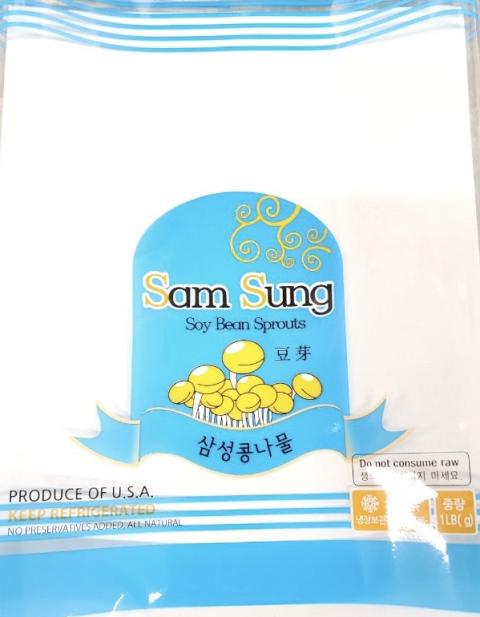
Sam Sung Soy Bean Sprouts in package

Company Announcement

Nam & Son of MD, Jessup, MD is recalling one-pound bags of soybean sprouts, with the sell-by date of December 21, 2023, because it has the potential to be contaminated with Listeria monocytogenes.

Listeria monocytogenes, an organism which can cause serious and sometimes fatal infections in young children, frail, or elderly people, and others with weakened immune systems. Although healthy individuals may suffer only short-term symptoms such as high fever, severe headaches, stiffness, nausea, abdominal pain and diarrhea, Listeria infections can cause miscarriages and stillbirths among pregnant women.

The product has been distributed to retail stores in MD ranging from December 14, 2023.

The affected product is packaged in a 1lb plastic bag (retail), labeled under the Nam & Son of MD DBA Sam Sung S & M Food and have a “Sell By” date of December 21, 2023.

NO illness has been reported to date.

The recall was initiated after a random sample was collected and analyzed by the state of Maryland, which resulted in confirmation of presence Listeria Monocytogenes in the product. The company has actively started investigating the root cause of the problem. All retail stores who have this “Sell By” date on the packaging should remove this product from their shelves. Consumers should not consume the products and should discard this product or return them to the place of purchase for a full refund.

Consumers should contact their health provider with any illness concerns. Consumers with questions about the warning may contact Nam & Son at 443-896-6738 which will be monitored 24 hours EST from Monday – Sunday.

Link to First Recall


Company Contact Information

Consumers:
Nam & Son
 443-896-6738

Research -EFSA – Persistence of microbiological hazards in food and feed production and processing environments

EFSA

Listeria monocytogenes (in the meat, fish and seafood, dairy and fruit and vegetable sectors), Salmonella enterica (in the feed, meat, egg and low moisture food sectors) and Cronobacter sakazakii (in the low moisture food sector) were identified as the bacterial food safety hazards most relevant to public health that are associated with persistence in the food and feed processing environment (FFPE). There is a wide range of subtypes of these hazards involved in persistence in the FFPE. While some specific subtypes are more commonly reported as persistent, it is currently not possible to identify universal markers (i.e. genetic determinants) for this trait. Common risk factors for persistence in the FFPE are inadequate zoning and hygiene barriers; lack of hygienic design of equipment and machines; and inadequate cleaning and disinfection. A well‐designed environmental sampling and testing programme is the most effective strategy to identify contamination sources and detect potentially persistent hazards. The establishment of hygienic barriers and measures within the food safety management system, during implementation of hazard analysis and critical control points, is key to prevent and/or control bacterial persistence in the FFPE. Once persistence is suspected in a plant, a ‘seek‐and‐destroy’ approach is frequently recommended, including intensified monitoring, the introduction of control measures and the continuation of the intensified monitoring. Successful actions triggered by persistence of L. monocytogenes are described, as well as interventions with direct bactericidal activity. These interventions could be efficient if properly validated, correctly applied and verified under industrial conditions. Perspectives are provided for performing a risk assessment for relevant combinations of hazard and food sector to assess the relative public health risk that can be associated with persistence, based on bottom‐up and top‐down approaches. Knowledge gaps related to bacterial food safety hazards associated with persistence in the FFPE and priorities for future research are provided.

UK – Research – Risk assessment for vulnerable consumers from Listeria monocytogenes in blue cheese

FSA

This risk assessment was commissioned to assess the risk to vulnerable groups in the UK from blue cheese contaminated with Listeria monocytogenes. Blue cheese is defined as cheese internally ripened with Penicillium mould.

Listeria monocytogenes are bacteria that cause listeriosis, a disease which is very severe in vulnerable people. Vulnerable people include pregnant women, people over 65 years of age, infants, and those with a weakened immune system. While most semi-soft cheeses do not let L. monocytogenes grow, blue cheeses may be an exception, and pose a risk to vulnerable groups.

L. monocytogenes is widespread in the environment and can grow at refrigeration temperatures. This makes it a particular problem in ready-to-eat foods such as cheese. It can also remain in the environment in food factories for several years as it can be difficult to remove.

Foodborne listeriosis is a relatively rare illness in comparison to other foodborne diseases. A search found two potential listeriosis outbreaks and one individual case may have been caused by blue cheese worldwide. No listeriosis illnesses due to blue cheese were identified in the UK.

Blue cheese is not frequently consumed by vulnerable consumers. When consumed, it is usually in low amounts.

Published data from Scottish local authorities and the Food Standards Agency suggest that overall percentage of blue cheeses contaminated with L. monocytogenes in the UK is low. A search of the scientific literature on contamination in blue cheese from European countries found that most of these studies examined Gorgonzola cheese. The rinds of Gorgonzola were much more likely to be contaminated than the centre of the cheese. Research also shows that the acidic levels and levels of moisture in blue cheese can support L. monocytogenes growth. Most of these studies showed only a small amount of bacterial growth in the centre of the cheese.

Outcome

The risk assessment concludes that the severity of Listeria monocytogenes infection in vulnerable people is high (severe illness: causing life-threatening or substantial chronic complications or illness of long duration), with a significant mortality rate. There is a low level of uncertainty due to the strong evidence.

The frequency of occurrence of listeriosis in vulnerable people from consumption of blue cheese is considered very low (very rare but cannot be excluded), based on the evidence gathered for blue cheese including outbreaks, typical L. monocytogenes contamination levels, typical consumption levels and typical L. monocytogenes growth. The uncertainty of occurrence is considered to be medium.