Category Archives: food bourne outbreak

USA – Outbreak Investigation of E. Coli O157:H7 – Spinach (November 2021)

FDA

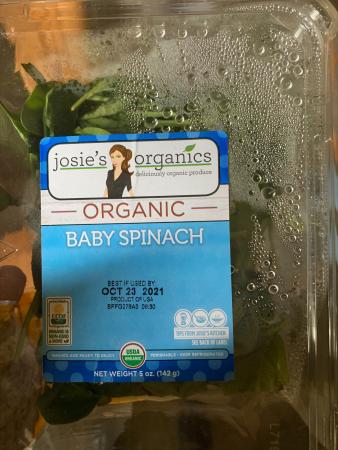
Outbreak Investigation of E. Coli O157:H7 in Spinach (November 2021): Sample Image of Josie's Organics Baby Spinach

The FDA and CDC, in collaboration with state and local partners, are investigating illnesses in a multistate outbreak of E. coli O157:H7. According to the CDC, as of November 15, 2021, 10 people infected with the outbreak strain of E. coli O157:H7 have been reported from 7 states. Illnesses started on dates ranging from October 15 to October 27, 2021. Five people in this outbreak report eating spinach in the week before becoming sick and one person reported Josie’s Organics brand.

On November 15, 2021, the Minnesota Department of Agriculture reported that, as part of this outbreak investigation, a sample of Josie’s Organics Baby Spinach collected from the home of an ill person tested positive for E. coli O157:H7. This sample had a “Best If Used By” date of October 23, 2021 and is undergoing Whole Genome Sequencing (WGS) analysis to determine if the strain of E. coli O157:H7 present in the product sample matches the outbreak strain.

As WGS analysis of the sample is underway, FDA is tracing back the supply of the baby spinach in the positive product sample. Thus far, FDA has traced supply chains for this product back to a small number of farms in two different geographic regions and is deploying investigators along the supply chains of interest.

FDA and state partners are working with the firm to determine if additional products could be affected. This is an ongoing investigation and additional information will be provided as it becomes available.

Recommendation

Consumers, restaurants, and retailers, should not eat, sell, or serve Josie’s Organics Baby Spinach with a “Best If Used By” date of October 23, 2021. Josie’s Organics Baby Spinach is sold in a clear plastic clamshell with the Best If Used By Date on the top label.

Although this product is past expiration and should no longer be available for purchase, consumers should check their homes for product and discard it. If consumers froze fresh Josie’s Organics Baby Spinach, they should discard it.


Case Count Map Provided by CDC
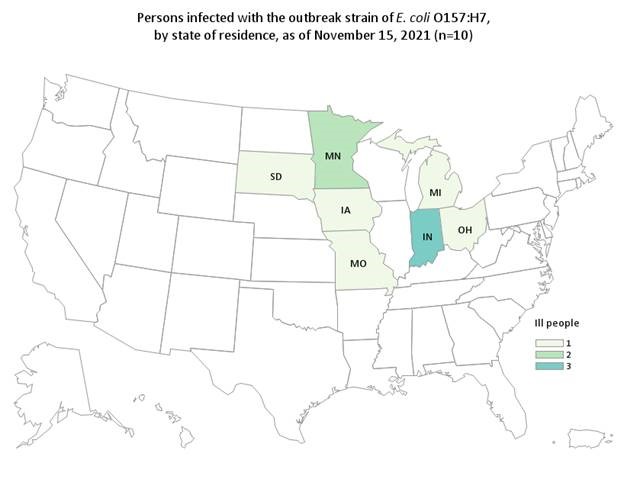
Outbreak Investigation of E. Coli O157:H7 in Spinach: Case Count Map Provided by CDC (November 15, 2021)

Case Counts

Total Illnesses: 10
Hospitalizations: 2
Deaths: 0
Last Illness Onset: October 27, 2021
States with Cases: IA (1), IN (3), MI (1), MN (2), MO (1), OH (1), SD (1)

USA – Alsum Farms Onions Are Recalled For Possible Salmonella Contamination

Food Poisoning Bulletin

Alsum Farms onions are recalled for possible Salmonella contamination, according to an FDA notice. The fresh yellow, white, and red onions were delivered to retailers in Wisconsin, Michigan, Illinois, and Pennsylvania between July 13, 2021 and August 18, 2021. The onions were imported from Chihuahua, Mexico by Keeler Family Farms. No illnesses have been reported to date in connection with onions marketed through Keeler Family Farms. Alsum Farms & Produce is located in Friesland, Wisconsin. You can see all of the secondary onion recalls in association with a multistate Salmonella outbreak here.

USA – Salmonella Outbreak linked to Onions hits nearly 900 in 38 States

Food Poison Journal

Since the last update on October 29, 2021, 84 more sick people were added to this outbreak. As of November 12, 2021, 892 people infected with the outbreak strain of Salmonella Oranienburg have been reported from 38 states and Puerto Rico (see map). Illnesses started on dates ranging from May 31, 2021, to October 25, 2021 (see timeline).
Sick people range in age from less than 1 year to 101 years, with a median age of 37, and 58% are female. Of 571 people with information available, 183 (32%) have been hospitalized.

The true number of sick people in an outbreak is likely much higher than the number reported, and the outbreak may not be limited to the states with known illnesses. This is because many people recover without medical care and are not tested for Salmonella. In addition, recent illnesses may not yet be reported as it usually takes 3 to 4 weeks to determine if a sick person is part of an outbreak.

USA – Salmonella Citterio Salame Sticks Outbreak Grows to 30

Food Poisoning Bulletin

kswfoodworld salmonella

The Salmonella Citterio Salame Sticks outbreak has grown to include 30 patients in 10 states, according to the Centers for Disease Control and Prevention (CDC), which is an increase of 10 patients since the last update on October 28, 2021. Six people are hospitalized because they are so ill. That is an increase of two more states in the case count. A recall was issued after the government discovered that the product was still being sold at one retail location, which was not named.

Canada – Salmonella outbreak: 46 cases in five provinces

Outbreak News Today

A collaboration of multiple health agencies to include The Public Health Agency of Canada (PHAC) report investigating a Salmonella outbreak involving five provinces: British Columbia, Alberta, Saskatchewan, Manitoba and Ontario.

As of November 10, there have been 46 laboratory-confirmed cases of Salmonella Enteritidis illness investigated in: British Columbia (18), Alberta (18), Saskatchewan (3), Manitoba (6) and Ontario (1). The illness reported in Ontario was related to travel to Alberta.

Three individuals have been hospitalized. No deaths have been reported.

Australia – Monitoring the incidence and causes of disease potentially transmitted by food in Australia: Annual report of the OzFoodNet network, 2016The OzFoodNet Working Group

AU 

In 2016, a total of 44,455 notifications of enteric diseases potentially related to food were received by state and territory health departments in Australia. Consistent with previous years, campylobacteri-osis (n = 24,171) and salmonellosis (n = 18,060) were the most frequently-notified infections. Notable increases in incidence were observed for shiga toxin-producing Escherichia coli (n = 343; 166% increase), shigellosis (n = 1,408; 93% increase), campylobacteriosis (33% increase) and salmonellosis (30% increase) when compared with the historical five-year mean. The extent to which the intro-duction of culture-independent testing as a method of diagnosis has contributed to these increases remains unclear. In total, 188 gastrointestinal outbreaks, including 177 foodborne outbreaks, were reported in 2016. The 11 non-foodborne outbreaks were due to environmental or probable environ-mental transmission (nine outbreaks) and animal-to-person or probable animal-to-person transmis-sion (two outbreaks). No outbreaks of waterborne or probable waterborne transmission were reported in 2016. Foodborne outbreaks affected 3,639 people, resulting in at least 348 hospital admissions and four deaths. Eggs continue to be a source of Salmonella Typhimurium infection across the country: 35 egg-related outbreaks, affecting approximately 510 people, were reported across six jurisdictions in 2016. Three large multi-jurisdictional Salmonella outbreaks associated with mung bean sprouts (n = 419 cases); bagged salad products (n = 311 cases); and rockmelons (n = 144 cases) were investigated in 2016. These outbreaks highlight the risks associated with fresh raw produce and the ongoing need for producers, retailers and consumers to implement strategies to reduce potential Salmonellacontamination.

USA – FDA Core Investigations Table Update

FDA

The FDA has closed an investigation of an outbreak of infections from Listeria monocytogenes without being able to identify a source.

Denmark – Salmonella outbreaks from Danish eggs stopped

SSI

The same type of salmonella has been found in both samples from a Danish egg producer and samples from patients in a current salmonella outbreak. The eggs, which have been sold through several retail stores, were recalled on October 30 and can therefore no longer be purchased.

Salmonella in Danish eggs has made a number of Danes sick. That is the conclusion, after the Statens Serum Institut (SSI) between 15 September and 29 October 2021 has registered 18 infected people with the same type of Salmonella Enteritidis. The 10 women and eight men aged 2-85 years live scattered across the country. In total, 9 (50%) of the patients have been hospitalized.

The DTU Food Institute and SSI have compared the bacteria from the herd and salmonella samples from the patients. The comparison showed that the 18 patients had an infection with exactly the same subtype of salmonella. Interviews with ten of the patients have further shown that they had all eaten eggs shortly before they became ill and before the infected eggs were withdrawn.

“It is highly unusual for us to have an outbreak of disease caused by Danish eggs. Fortunately, these outbreaks are very rare and the last time we had a similar outbreak was seven years ago “, says epidemiologist at SSI, Luise Müller.

Pulled eggs back

On Saturday, October 30, 2021, the egg packing plant recalled the specific eggs after salmonella was found in high levels in samples from the herd. The recall concerns scrap eggs, free-range eggs and cage eggs, where the egg has a stamp with “DK081131”. The eggs had a minimum shelf life to date 16 November 2021. Information on the recall of eggs can be found on the Danish Veterinary and Food Administration’s website .

“In Denmark, we have a fine-meshed system for testing eggs for salmonella and an emergency response across the human and food side that responds as soon as we see an outbreak with salmonella. That is why it is also a success that we have been able to clear up the source of the infection so quickly and call the eggs back, so that no more people get sick, ”says Nikolas Kühn Hove, Emergency Manager at the Danish Veterinary and Food Administration.

The system works

The Danish monitoring program for salmonella in eggs is very fine-grained and means, among other things, that samples for control of salmonella are taken every 14 days from egg producers. With this sampling frequency in Denmark, the risk of infected eggs entering the market is very small. The most recent disease outbreak, where Danish eggs were the source of infection, was in 2014, with 18 registered cases of the disease. Also there, the eruption was stopped before it became a major eruption.

There is no guarantee that eggs are free of salmonella, but the risk is generally small, especially in Danish eggs. To be on the safe side, and if, for example, you cook for the sick, the elderly and children, you can use pasteurized eggs for dishes that are not subsequently heat-treated. In addition, it is always important to follow the three tips on good kitchen hygiene: “Warm up properly – cool down quickly”, “Keep it separate” and “Rinse fruit and vegetables.”

The coordination of the efforts and the investigation of the disease outbreak has taken place under the auspices of the Central Outbreak Group. It consists of representatives from SSI, the DTU Food Institute and the Danish Veterinary and Food Administration.

USA – Chicken and Salmonella Infantis, the Neverending Outbreak?

Food Poisoning Bulletin

When the CDC ended its investigation of a deadly Salmonella Infantis outbreak linked to raw chicken products in February 2019, it added an unusual note at the top of the posting. “This investigation is over. Illnesses could continue because this Salmonella strain appears to be widespread in the chicken industry,” it read in part.

Two and a half years later, the impact of that statement came into focus when an investigative report from ProPublica revealed that the outbreak, linked to a multidrug-resistant strain of Salmonella Infantis, has never ended.

“Many people are still becoming ill, and some of them gravely ill,” Robert Tauxe told ProPublica. Tauxe, who is the director of the Center for Disease Control and Prevention’s (CDC’s) Division of Foodborne, Waterborne, and Environmental Diseases, said the agency receives dozens of reports of illness linked to this strain each month, according to the report.

For every culture-confirmed Salmonella illness, the CDC uses a multiplier of 29 to account for undiagnosed infections. One internal CDC document that the ProPublica Team found estimated that this single strain of Salmonella Infantis is responsible for 11,000-17,000 illnesses per year.

And the strain is still frequently turning up in chicken.

USA – Pier-C Produce Inc. Recalls 2 lb White Onions – Product of Mexico Because of Possible Health Risk -Salmonella

FDA

Pier-C Produce Inc. of Leamington, Ontario Canada is voluntarily recalling Mexican Origin, whole 2 lb White Onions supplied from Keeler Family Farms and sold as Pier-C 2lb white onions of Mexican origin. This recall does not affect any other items in the Pier-C Produce Inc. product catalogue.

The recalled product has the potential to be contaminated with SALMONELLA, an organism which can cause serious and sometimes fatal infections in young children, frail or elderly people, and others with weakened immune systems. Healthy persons infected with SALMONELLA often experience fever, diarrhea (which may be bloody), nausea, vomiting and abdominal pain. In rare circumstances, infection with SALMONELLA can result in the organism getting into the bloodstream and producing more severe illnesses such as arterial infections (i.e., infected aneurysms), endocarditis and arthritis.

The recalled product was delivered to a single retailer in the state of Florida between August 17th, 2021 and August 23rd, 2021.

Additionally, the recalled product was also delivered to a single wholesaler in Florida between August 9th, 2021 and August 24th, 2021.

The recalled product will contain the following four identifiers:

Product is packed in 2 lb mesh bags, labelled Product of Mexico and will bear the UPC code 0 33383 60051 2 bearing the brand Pier-C Produce.

To date, no illnesses have been reported. Pier-C Produce Inc. is conducting this recall voluntarily.

On October 22, 2021, Keeler Family farms of Deming, NM voluntarily recalled imported Onions from the state of Chihuahua, Mexico shipped from July 1, 2021 through August 25, 2021 for potential SALMONELLA contamination. In turn, Pier-C Produce Inc. identified white onions originating from the above recalled lots and proceeded to voluntarily recall the white onions as well.

Consumers should check to see if they have the recalled product in their homes or establishments. Recalled products should be thrown out or returned to the location where they were purchased. Consumers with questions identifying the affected product may contact Pier-C Produce Inc. at 888-783-8459, Monday to Friday, from 8:30 am to 4 pm Eastern Time.