Category Archives: E.coli O157:H7

USA – CDC Outbreaks Food Illness Outbreaks 2021

USA – New Ground Beef E. coli O157:H7 Outbreak on USDA Investigation Table

Food Poisoning Bulletin

A new ground beef E. coli O157:H7 outbreak on the USDA Investigation Table has been posted. Ground beef is suspected as being the source of thee pathogen. The USDA Outbreak Investigation Table has even less information that the FDA’s Table. There is no case count, and no information about whether or not traceback, sample collection, facility investigation, or lab analysis has been conducted.

Research – Desiccation survival in Salmonella enterica, Escherichia coli and Enterococcus faecium related to initial cell concentration and cellular components

Journal of Food Protection

Salmonella enterica is well-known for its ability to survive and persist in low-moisture environments.  Previous studies have indicated a link between the initial cell concentration and the population of Salmonella that survive upon desiccation and subsequent storage; however, how the initial cell concentration affects survival is unknown.  This study examined the basis of this phenomena and whether it occurred in other microorganisms, specifically Shiga toxigenic Escherichia coli (STEC), and Enterococcus faecium . Salmonella, STEC, and E. faecium were grown as lawns on TSAYE and harvested using buffered peptone water (BPW). To determine recovery at different initial cell levels, cultures were diluted to 9, 7, and 5 log CFU/mL and applied to filters.  Filters were dried for 24 h, then stored for 28 d at 25°C/33% RH. During storage, cells were recovered from filters using BPW and cultivated on TSAYE.  Both Salmonella and E. coli , but not E. faecium , showed non-proportional recovery. Less viability remained with lower initial starting population after 24 h desiccation such that ≥10 log CFU/mL were recovered when 11 log CFU/mL was desiccated, but ❤ log CFU/mL were recovered when 5 log CFU/mL was desiccated. Once dried, persistence did not appear affected by initial cell concentration. When dead cells (heat-treated) were added to the diluent, recovery of Salmonella was proportional with respect to the initial cell concentration. To further examine the response on desiccation, Salmonella was diluted in BPW containing one of 11 different test cell components related to quorum sensing or known to affect desiccation resistance to assess recovery and persistence. Of the 11 additions only cell debris fractions, cell-free extract, and peptidoglycan improved recovery of Salmonella . Desiccation survival appears related to cell wall components, however, the exact mechanism affecting survival remains unknown.

Research – Prevalence of E. coliO157:H7 in water sources: an overview on associated diseases, outbreaks and detection methods

Elsevier

Escherichia coli O157:H7 is a zoonotic pathogen with its ability to cause human illness ranging from diarrheal dis-ease to fatal hemolytic uremic syndrome. E. coli O157:H7 had been associated with waterborne outbreaks resulting in high morbidity and mortality worldwide. Therefore, it is important to investigate the prevalence of E. coli O157:H7 in water sources especially used for drinking and to develop the diagnostic methods for its early detection. The review describes traditional cultural methods, immunological techniques, and polymerase chain reaction (PCR)–based methods for detection of this bacterium in water sources. The current PCR-based techniques such as real-time PCR are more specific and sensitive and require less detection time (b3 hours).These methods can be applied for regular water monitoring and proper management of water sources to prevent waterborne diseases due to E. coli O157:H7.

USA – FDA Core Investigation Table Update

FDA

Increase in numbers of cases from Salmonella Javiana, source still not identified

Wales – Two E. coli O157 infections in children under investigation in Wales

Food Safety News

Public health officials in Wales are investigating two E. coli O157 infections at different primary schools in the country.

Public Health Wales, Conwy County Borough Council and Betsi Cadwaladr University Health Board are looking into a case of E. coli O157 at a primary school in Abergele.

The same three agencies are also investigating a probable case of E. coli O157 at a primary school in Conwy to try and find the source.

There is currently no evidence in either case to suggest the child acquired the infection at the school.

“Parents and guardians of pupils that attend the school and who may have had contact with this case have been contacted and advised on infection prevention and control measures, and what steps to take if their child develops symptoms. Contacts have been asked to submit samples for testing and to remain off school until negative results are received,” he said.

USA – Outbreak Investigation of E. Coli O157:H7 – Spinach (November 2021)

FDA

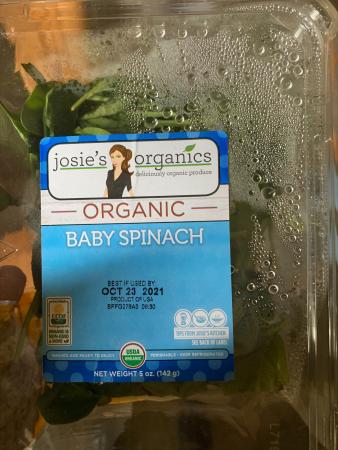
Outbreak Investigation of E. Coli O157:H7 in Spinach (November 2021): Sample Image of Josie's Organics Baby Spinach

The FDA and CDC, in collaboration with state and local partners, are investigating illnesses in a multistate outbreak of E. coli O157:H7. According to the CDC, as of November 15, 2021, 14 people infected with the outbreak strain of E. coli O157:H7 have been reported from nine states. Illnesses started on dates ranging from October 13 to October 27, 2021. 10 people in this outbreak report eating spinach in the week before becoming sick and six people reported Josie’s Organics brand.

On November 15, 2021, the Minnesota Department of Agriculture reported that, as part of this outbreak investigation, a sample of Josie’s Organics Baby Spinach collected from the home of an ill person tested positive for E. coli O157:H7. This sample had a “Best If Used By” date of October 23, 2021. Whole Genome Sequencing (WGS) analysis determined that the strain of E. coli O157:H7 present in the product sample matches the outbreak strain.

FDA traced the supply chain for this positive product sample back to a small number of farms in two different geographic regions and deployed Investigators along the supply chains of interest. FDA continues tracing back reported spinach exposures to identify if spinach from additional farms could have been implicated.

FDA and state partners are working with the firm to determine if additional products could be affected. This is an ongoing investigation and additional information will be provided as it becomes available.

Recommendation

Consumers, restaurants, and retailers, should not eat, sell, or serve Josie’s Organics Baby Spinach with a “Best If Used By” date of October 23, 2021. Josie’s Organics Baby Spinach is sold in a clear plastic clamshell with the Best If Used By Date on the top label.

Although this product is past expiration and should no longer be available for purchase, consumers should check their homes for product and discard it. If consumers froze fresh Josie’s Organics Baby Spinach, they should discard it.


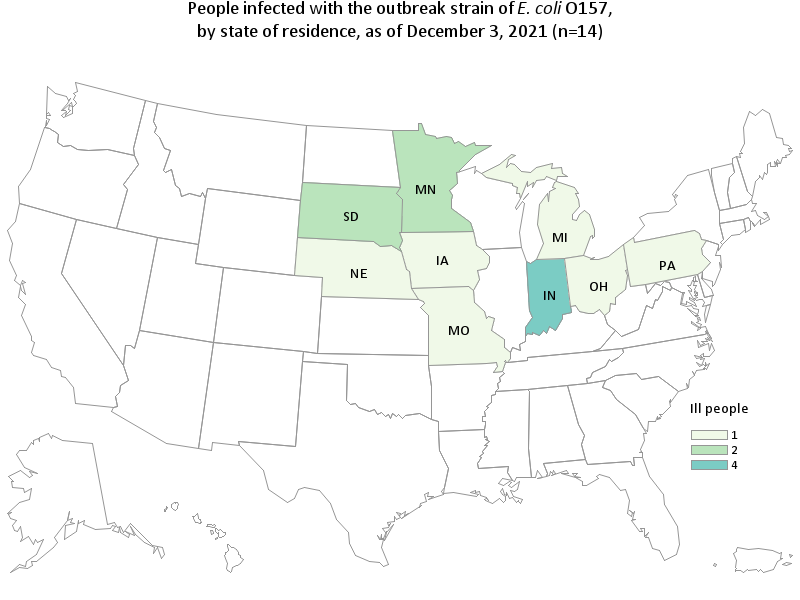
Case Count Map Provided by CDC

Outbreak Investigation of E. Coli O157:H7 in Spinach: Case Count Map Provided by CDC (December 3, 2021)

Case Counts

Total Illnesses: 14
Hospitalizations: 4
Deaths: 0
Last Illness Onset: October 27, 2021
States with Cases: IA (1), IN (4), MI (1), MN (2), MO (1), NE (1), OH (1), PA (1), SD (1)

Research – Inactivation of Salmonella spp., Escherichia coli O157:H7 and Listeria monocytogenes in Tahini by Microwave Heating

MDPI

Tahini (sesame paste) is a traditional food. Numerous foodborne outbreaks have been associated with it. This study aimed to (i) explore the efficiency of 2450 MHz microwave heating at 220, 330, 440, 550, and 660 W on the inactivation of Salmonella spp, Escherichia coli O157:H7, and Listeria monocytogenes in tahini; (ii) determine the impact of desiccation and starvation stresses on pathogen survival; (iii) assess the impact of microwave heating on the physicochemical characteristics of tahini. The inoculated microorganisms in tahini were reduced with higher microwave power levels (p < 0.05) and longer exposure times. The D-values of unstressed Salmonella spp., Escherichia coli O157:H7, and L. monocytogenes ranged from 6.18 to 0.50 min, 6.08 to 0.50 min, and 4.69 to 0.48 min, respectively, at power levels of 220 to 660 W, with z-values of 410, 440, and 460 W, respectively. Generally, desiccation and starvation stress levels prior to heating increased microbial resistance to heat treatment. Microwave heating did not affect acid, peroxide, p-anisidine, or color values of tahini up to 90 °C. These findings reveal microwave heating as a potential method for lowering the risk of Salmonella spp., E. coli O157:H7 and L. monocytogenes in tahini with no compromise on quality. View Full-Text

USA – Core Table Update

FDA

A new Salmonella Javiana outbreak has been listed on the FDA’s Core Outbreak Investigation Table.  The product linked to the illnesses has not been identified.

Research – Reduction of Escherichia coli O157:H7, Listeria monocytogenes, and Salmonella on Whole Yellow Onions (Allium cepa) Exposed to Hot Water

Journal of Food Protection

In-home or food service antimicrobial treatment options for fresh produce are limited. Hot water treatments for whole (unpeeled) produce have been proposed, but data to support this practice for onions are not available. Separate cocktails of rifampin-resistant Escherichia coli O157:H7, Listeria monocytogenes, and Salmonella were cultured on agar and suspended in sterile water. The outer papery skin at the equator or root or stem ends of the whole yellow onions was spot inoculated at 6 log CFU per onion. After drying for 30 min and, in some cases, storage at 4°C for 6 days, onions were immersed in water at ca. 100°C for 5 s or 85°C for 10 to 180 s. No significant difference (P > 0.05) in the mean decline of Salmonella was found on onions that were exposed to hot water after drying the inoculum for 30 min or after storage at 4°C for 6 days. Exposure of whole onions at 100°C for 5 s reduced E. coli O157:H7 and L. monocytogenes populations by >5 log CFU per onion at all inoculum sites and Salmonella populations by >5 log CFU per onion at the stem end and equator but not consistently at the root end. Mean root-end reductions of ≥5 log CFU per onion of E. coli O157:H7, L. monocytogenes, and Salmonella were achieved consistently when the root end was fully immersed in 85°C hot water for 45 or 60 s except in a small number of cases (4 of 57; 7%) when the root end was oriented upward and above the water line during treatment. When onions were held at 85°C for 180 s with the root end above the water line in an uncovered water bath, no significant declines in Salmonella populations were observed; significant mean declines in Salmonella were achieved (mean, 5 log CFU per onion; range, 3.49 to 6.25 log CFU per onion) when the water bath was covered. Short exposure to hot water can significantly reduce pathogens on the surface of whole onions. Reductions are more consistent when the root end is submerged and when the water bath is covered.

HIGHLIGHTS
  • Short hot-water exposure significantly reduces pathogen populations on whole onions.
  • Salmonella reductions were greater at the stem and equator than at the root end.
  • Pathogen reduction was greater for fully submerged root ends in covered water baths.