
RASFF – enteropathogenic Escherichia coli (O26:H11 O103:H2 eae+ stx- /25g) in frozen minced beef from the United Kingdom in France

RASFF – enteropathogenic Escherichia coli (O26:H11 O103:H2 eae+ stx- /25g) in frozen minced beef from the United Kingdom in France
Wheat flour has recently been described as a novel vehicle for transmission of Shiga toxin–producing Escherichia coli (STEC). Very recently, an outbreak of STEC O121 and STEC O26 infections was linked to flour in the United States. The aim of the present study was to generate baseline data for the occurrence of STEC in flour samples from different retailers in Switzerland. In total, 70 flour samples were analyzed. After enrichment, the samples were screened for stx1 and stx2 by the Assurance GDS MPX ID assay. STEC strains were isolated and serotyped by the E. coli SeroGenoTyping AS-1 kit. The determination of stx subtypes was performed with conventional PCR amplification. Screening for eae, aggR, elt, and estIa/Ib was performed by real-time PCR. Nine (12.9%) of the flour samples tested positive for stx by PCR. STEC was recovered from eight (88.9%) of the positive samples. Two isolates were STEC O11:H48 harboring stx1c/stx1d, two were O146:H28 containing stx2b, one was O103:H2 containing stx1a and eae, and three were O nontypeable: Ont:H12 (stx2a), Ont:H14 (stx2a/stx2g), and Ont:H31 (stx1c/stx1d). STEC O103 belongs to the “top five” serogroups of human pathogenic STEC in the European Union, and STEC O146 is frequently isolated from diseased humans in Switzerland. Our results show that flour may be contaminated with a variety of STEC serogroups. Consumption of raw or undercooked flour may constitute a risk for STEC infection.
Posted in E.coli, E.coli O103, E.coli O111, E.coli O121, eae, STEC, STX 1, STX 2, Uncategorized
Table 1. Raw Ground Beef Products (RGB) Analyzed for E. coli O157:H7, Current Calendar Year
| Sample Source1 | Collection Date | Where Collected | Product Status | Positives this Year | Samples Analyzed this Year | Total Positives2 | Total Samples Analyzed2 |
|---|---|---|---|---|---|---|---|
| Federal RGB Verification, Beef | Oct 15, 2018 | MN | Held | 4 | 9,541 | 540 | 238,301 |
| Federal RGB Verification, Beef | Oct 9, 2018 | NC | Held | 3 | 9,297 | 539 | 238,057 |
| Federal RGB Verification, Beef | Mar 26, 2018 | OR | Held | 2 | 3,085 | 538 | 231,845 |
| Federal RGB Verification, Beef | Feb 8, 2018 | CA | Held | 1 | 1,704 | 537 | 230,464 |
View by Year:
2018 Positive Results
2017 Positive Results
2016 Positive Results
2015 Positive Results
2014 Positive Results
2013 Positive Results
2012 Positive Results
2011 Positive Results
2010 Positive Results
2009 Positive Results
2008 Positive Results
2007 Positive Results
2006 Positive Results
2005 Positive Results
2004 Positive Results
2003 Positive Results
2002 Positive Results
2001 Positive Results
The table below includes all positive results as of November 4, 2018.
| Sample Source1 | Collection Date | Where Collected | Product Status | Positives this Year | Samples Analyzed this Year | Total Positives2 | Total Samples Analyzed2 |
|---|---|---|---|---|---|---|---|
| Federal RGB Verification, Beef | Oct 15, 2018 | MN | Held | 4 | 9,541 | 540 | 238,301 |
| Federal RGB Verification, Beef | Oct 9, 2018 | NC | Held | 3 | 9,297 | 539 | 238,057 |
| Federal RGB Verification, Beef | Mar 26, 2018 | OR | Held | 2 | 3,085 | 538 | 231,845 |
| Federal RGB Verification, Beef | Feb 8, 2018 | CA | Held | 1 | 1,704 | 537 | 230,464 |
1Sample Sources may include these types of establishments and samples:
–>
2Totals: “Total Positives” and “Total Samples Analyzed” are the totals since FSIS began its testing program to detect E. coli O157:H7 in raw ground beef on October 17, 1994.
The table below includes all positive results as of November 4, 2018.
| Sample Source4 | Collection Date | Target STECs | Where Collected | Product Status | Posi- tives this Year |
Samples Analyzed this Year5 | Total Posi- tives |
Total Samples Analyzed6 |
|---|---|---|---|---|---|---|---|---|
| Trim Verification, Beef | Oct 18, 2018 | O111 | PA | Held | 19 | 6,594 | 415 | 59,239 |
| Trim Verification, Beef | Oct 9, 2018 | O157:H7 | SD | Held | 18 | 6,262 | 414 | 58,907 |
| Trim Verification, Beef | Sep 5, 2018 | O157:H7 | PA | Held | 17 | 5,641 | 413 | 58,286 |
| Trim Verification, Beef | Aug 14, 2018 | O103 | PA | Held | 16 | 5,018 | 412 | 57,663 |
| Trim Verification, Beef | Jun 6, 2018 | O157:H7 | MO | Held | 15 | 3,583 | 411 | 56,228 |
| Trim Verification, Veal | Jun 6, 2018 | O26 | PA | Held | 14 | 3,428 | 410 | 56,073 |
| Follow-up to RGBC Positive, Beef | May 30, 2018 | O103 | PA | Held | 13 | 3,266 | 409 | 55,911 |
| Follow-up to RGBC Positive, Beef | May 29, 2018 | O103 | PA | Held | 12 | 3,266 | 408 | 55,911 |
| Trim Verification, Beef | May 21, 2018 | O157:H7 | TX | Held | 11 | 3,147 | 407 | 55,792 |
| Trim Verification, Beef | May 16, 2018 | O103 | PA | Held | 10 | 2,968 | 406 | 55,613 |
| Trim Verification, Beef | May 15, 2018 | O103 | NY | Held | 9 | 2,968 | 405 | 55,613 |
| Trim Verification, Beef | May 9, 2018 | O103 | PA | Held | 8 | 2,968 | 404 | 55,613 |
| Other RGBC Verification | May 9, 2018 | O157:H7 | NE | Held | 7 | 2,968 | 403 | 55,613 |
| Trim Verification, Beef | Mar 19, 2018 | O157:H7 | NM | Held | 6 | 1,814 | 402 | 54,455 |
| Trim Verification, Beef | Mar 1, 2018 | O121 | ID | Held | 5 | 1,507 | 401 | 54,148 |
| Trim Verification, Veal | Feb 27, 2018 | O103 | WA | Held | 4 | 1,347 | 400 | 53,988 |
| Follow-up to RGBC Positive, Beef | Jan 27, 2018 | O45 | WI | Held | 3 | 583 | 400 | 53,225 |
| Other RGBC Verification | Jan 4, 2018 | O157:H7 | SD | Held | 2 | 107 | 399 | 52,749 |
| Trim Verification, Beef | Dec 28, 2017 | O157:H7 | WI | Held | 1 | 107 | 398 | 52,749 |
Posted in E.coli, E.coli 045, E.coli O103, E.coli O104, E.coli O111, E.coli O121, E.coli O128, E.coli O145, E.coli O157, E.coli O157:H7, E.coli O26, food contamination, Food Hygiene, Food Inspections, Food Micro Blog, Food Microbiology, Food Microbiology Blog, Food Pathogen, Food Poisoning, Food Safety, Food Testing, Food Toxin, STEC, Uncategorized, VTEC
FSIS considers raw, non-intact beef products or the components of these products found to have six Shiga toxin-producing Escherichia coli (STEC) to be adulterated, in addition to E. coli O157:H7. (Refer to the Federal Register notice Shiga Toxin-Producing Escherichia coli in Certain Raw Beef Products | PDF). These six non-O157 STECs are O26, O45, O103, O111, O121, and O145.
On June 4, 2012, FSIS began verification testing for these non-O157 STEC in domestic and imported beef manufacturing trimmings from cattle slaughtered on or after June 4, 2012. Beef manufacturing trimmings collected from cattle slaughtered before June 4, 2012, or that contain other components such as cheek meat are analyzed for E. coli O157:H7 only.
Posted in E.coli, E.coli 045, E.coli O103, E.coli O111, E.coli O121, E.coli O145, E.coli O157:H7, E.coli O26, food contamination, Food Hygiene, Food Inspections, Food Micro Blog, Food Microbiology, Food Microbiology Blog, Food Pathogen, Food Poisoning, Food Safety, Food Testing, Food Toxin, Uncategorized
Texas Natural Meats, a Lott, Texas establishment, is recalling approximately 489 pounds of frozen raw, ground beef products that may be contaminated with Shiga toxin-producing E. coli (STEC) O103, the U.S. Department of Agriculture’s Food Safety and Inspection Service (FSIS) announced today.The frozen raw, ground beef items were produced on Aug. 8, 2017.


Research shows that a few pathogens occur often on dairy goat and dairy sheep farms. These bacteria reside in the intestines of the animals, and are excreted in manure. A small amount of manure is enough to contaminate raw milk or unpasteurised cheese. Visitors to these farms can also become infected if they come into contact with the animals or their environment. Contamination can be prevented by consuming or processing all milk pasteurized. Visitors can reduce the risk of disease by washing their hands if they have been in contact with the animals or their environment.
STEC and Campylobacter bacteria, in particular, were frequently found. STEC was detected at virtually all the farms that were investigated. Campylobacter was detected at 33 percent of the goat farms and 95.8 percent of the sheep farms. These bacteria were found much less often among the farmers and their family members. Listeria was detected less often: at 8.8 percent of the goat farms and 16.7 percent of the sheep farms, and not among people. However, it is a relevant pathogen since unpasteurised soft cheese is the most important source of Listeria infection in humans.
Salmonella was not found at dairy goat farms but was found at 12.5 percent of the dairy sheep farms. On most farms, only a type of Salmonella that is not transmitted to humans was found. ESBL-producing bacteria, which are insensitive to many antibiotics, were detected at 1.7 percent of the goat farms and 4.2 percent of the sheep farms. They were also found in 6.8 percent of the people. This percentage is not higher than for the general population.

RASFF-shigatoxin-producing Escherichia coli (O103, stx1, eae /25g) in chilled deboned beef meat from Uruguay in Spain
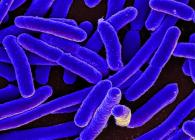
Image CDC
Escherichia Coli (known as E. coli) is a type of bacteria that can be found in the intestines of animals and humans. Many strains of E. coli are harmless to humans, but some can cause serious illness. Most cases of foodborne illness are caused by a strain known as E. coli O157.
Escherichia coli (E. coli) is a germ that occurs naturally in the gut of mammals and birds, as well as in the human intestinal flora. However, certain E. coli types can cause severe diarrhea in humans. These virulent E. coli types include Shiga toxin-producing E. coli (STEC), also known as Verotoxin-producing E. coli (VTEC).
Their damaging effect is due to the fact that STEC produce toxins known as Shiga toxins (Stx), which can cause disease in the human gut. As the best known STEC representative, an enterohaemorrhagic E. coli (EHEC) strain of the serotype O104:H4 was responsible for numerous severe cases of haemolyticuremic syndrome (HUS) and bloody diarrhea in Germany in 2011, as a result of which 53 people died.
PFP Enterprises, a Fort Worth, Texas, establishment, is recalling approximately 15,865 pounds of beef products because they may be contaminated with E. coli O103, E. coli O111, E. coli O121, E. coli O145, E. coli O26 and E. coliO45, the U.S. Department of Agriculture’s Food Safety and Inspection Service (FSIS) announced today.
FSIS personnel became aware of the problem during a Food Safety Assessment when they discovered that beef trim tested presumptive positive for multiple non-O157 Shiga toxin-producing E. coli (STEC) strains through the company’s testing program. The company inadvertently did not carry the test out to confirmation, and not all affected product was held.
Posted in Bacteria, E.coli, E.coli O103, E.coli O104, E.coli O121, E.coli O145, E.coli O157, E.coli O26, Food Hygiene, Food Inspections, Food Micro Blog, Food Microbiology, Food Safety, Food Safety Alert, Food Testing, FSIS, Hygiene, Microbiology, Pathogen, Recall, STEC, Toxin
Tagged beef products, E. coli, Food Safety Assessment, fsis, U.S. Department of Agriculture’s Food Safety and Inspection Service




 FoodWorld